

A 2025 systematic review reported mild redness after HIFU in 30% to 50% of cases, swelling in 10% to 20%, and tenderness in 15% to 25%. Nerve irritation and unintentional fat atrophy were each reported in less than 1% of cases, according to the review of HIFU facelift side effects and patient data. That distinction matters: most reactions are temporary, but a small group of complications needs prompt clinical attention.
HIFU, or high-intensity focused ultrasound, is often presented as a low-downtime alternative to surgery. It can be, but “non-surgical” doesn't mean risk-free. Your outcome depends on the device, energy settings, cartridge depth, treatment map, facial anatomy, and the clinician's ability to recognise when a planned area shouldn't be treated aggressively.
Table of Contents
- What HIFU Facelift Side Effects Really Mean in 2026
- How HIFU Works and Why Side Effects Happen
- Common Side Effects and Their Real Timelines
- Rare but Serious Risks Most Guides Overlook
- HIFU Facelift vs Surgical Facelift Risk Comparison
- Who Is More Likely to Get Side Effects
- Prevention Aftercare and Red Flags
- Choosing a Safety-Led Consultation at 3D Aesthetics Leamington Spa
What HIFU Facelift Side Effects Really Mean in 2026
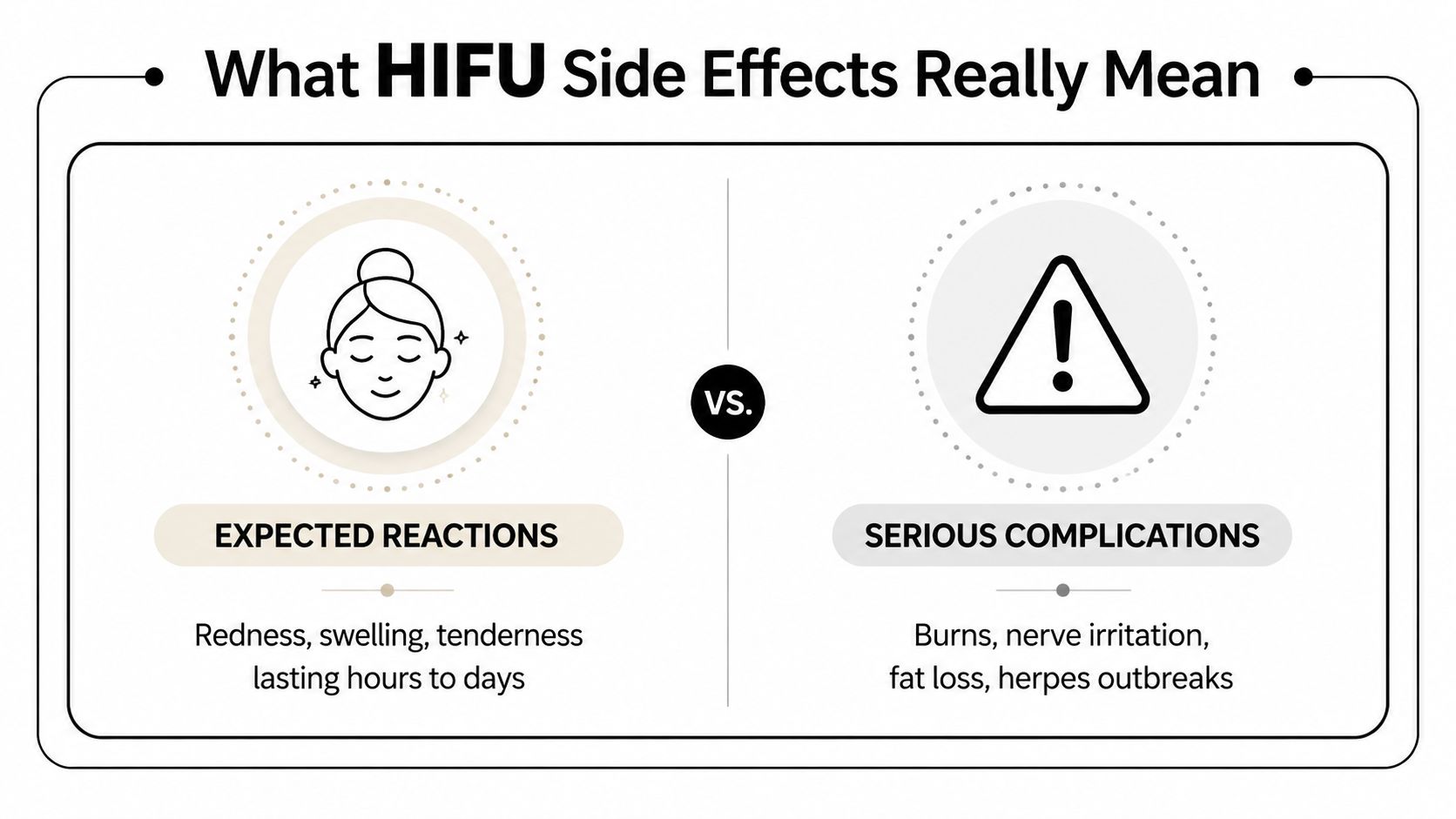
A reaction after HIFU does not automatically indicate a complication. Mild erythema, or redness, can appear soon after treatment as tissue responds to energy delivered beneath the skin. Swelling, tenderness, tingling, and temporary changes in sensation may also reflect normal healing.
The useful test is how severe the symptom is, how long it lasts, and whether it is improving. Redness that settles promptly differs from blistering. Tenderness that gradually eases differs from sharp, increasing pain. Slight asymmetry caused by temporary nerve irritation needs a different response from a clearly weak smile or new facial weakness.
The reactions most patients can expect
Common short-term effects include:
- Redness: Usually mild and temporary.
- Swelling: Often limited to treated areas.
- Tenderness: The skin may feel bruised or sensitive after treatment.
- Tingling or numbness: These sensations can result from temporary irritation near superficial nerves.
- Minor bruising: Thin skin and a tendency to bruise can make this more likely.
The 2025 systematic review in the Aesthetic Surgery Journal noted that erythema generally resolves within 24 to 48 hours, swelling within a few days, and tenderness within 1 to 2 weeks.
The symptoms that shouldn't be dismissed
Contact your clinic if pain remains strong or becomes worse after the early recovery period, especially if it continues beyond 72 hours. Skin that blisters, turns pale or charred, develops pronounced mottling, or forms grouped fluid-filled spots resembling a cold sore needs assessment. A new uneven smile, ongoing facial weakness, or difficulty moving a muscle also warrants prompt review.
A UK benchmark from NICE's focal HIFU safety summary found that, across a review of 20 studies, complications ranged from 13% to 41%, although most were minor. In a prospective registry of 1,379 people, 83 complications were recorded, equal to 6.0%, and 0.5% were above Clavien–Dindo grade 2. This evidence concerns focal HIFU rather than facial aesthetics, so it cannot predict an individual facelift outcome. It does support careful consent and early clinical review when symptoms change.
Practical rule: A reaction that steadily improves is usually less concerning than a milder symptom that persists, spreads, or develops a new character.
How HIFU Works and Why Side Effects Happen
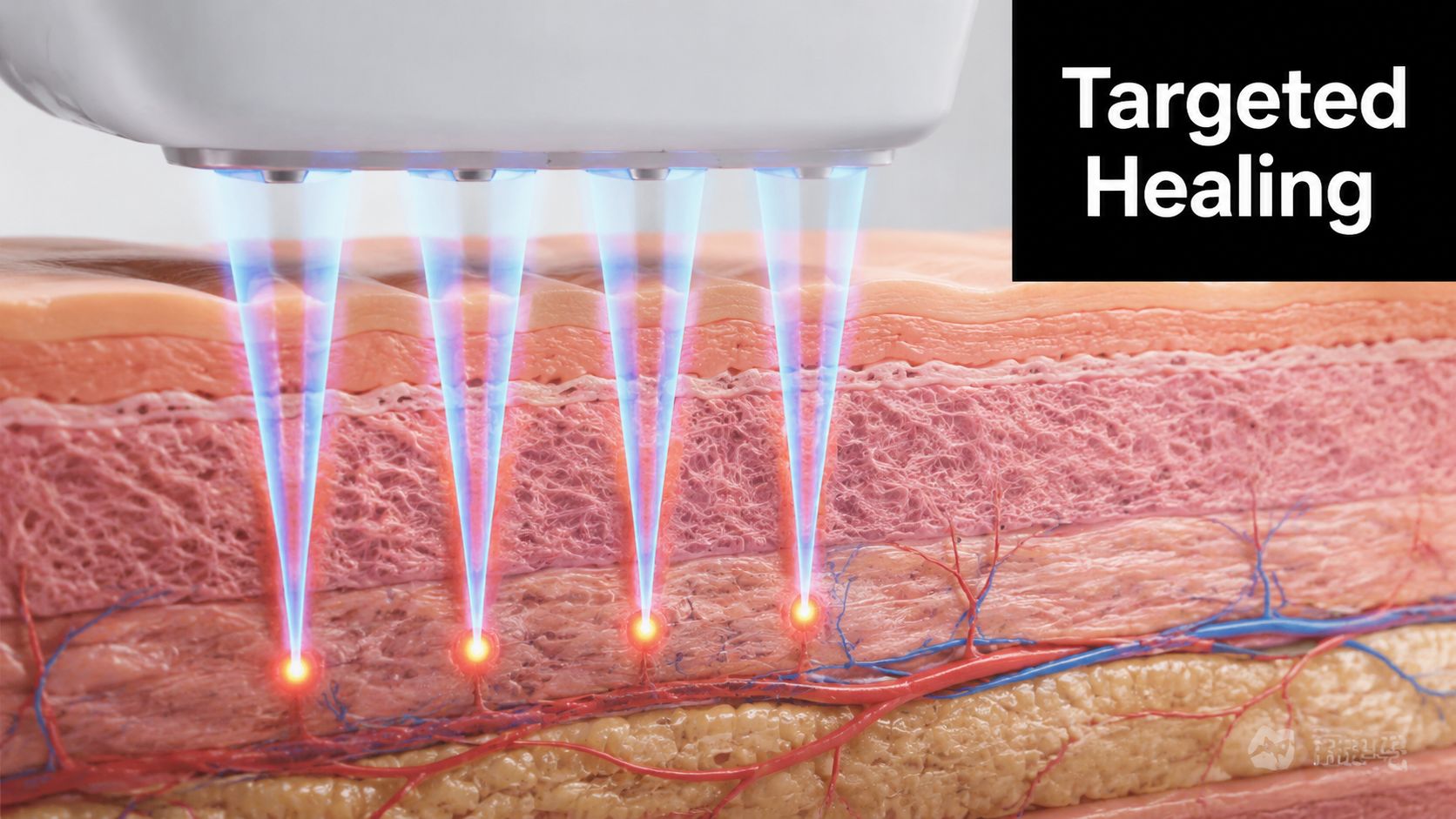
HIFU doesn't heat the whole face evenly. The handpiece sends ultrasound energy through the surface and concentrates it at a selected depth, creating small thermal treatment points beneath the epidermis. The skin surface may remain intact while deeper tissue responds to the controlled injury.
Think of the face like a layered dish. A 1.5 mm cartridge works closer to the dermis, while 3.0 mm and 4.5 mm cartridges reach progressively deeper tissue planes. The deeper cartridge may be selected for lifting structures, while a shallower one may be more appropriate for superficial tightening. The correct choice depends on local anatomy, not a standard setting used across every face.
The treatment depth changes the reaction
Energy placed near the dermis can produce redness and local inflammation. Energy delivered deeper into the SMAS or subcutaneous tissue can create a tender, bruised sensation. If the treatment reaches fat in an area where volume is already limited, unwanted fat reduction can contribute to a hollow appearance.
The clinician also controls the treatment dose through factors such as energy level, line count, pulse spacing, and whether passes overlap. Repeating energy over the same small zone can concentrate heat. This is why facial mapping, controlled spacing, and continuous reassessment matter as much as the machine itself.
A useful overview of the treatment concept is available in this guide to an ultrasound face lift. The important safety point is that focused energy is precise only when the operator understands the tissue beneath each treatment area.
Why anatomy matters
Bone prominence, thin skin, reduced facial fat, dental work, implants, and the position of superficial nerves can all influence treatment planning. The temple, forehead, area around the eyes, lips, and mandibular border require particular care because tissue can be thin and important nerves may lie relatively close to the treatment path.
That explains why two people can have different experiences with the same device. One person may notice only warmth and short-lived tenderness. Another may develop more swelling, bruising, or temporary sensory change because energy was delivered near a sensitive anatomical structure.
Common Side Effects and Their Real Timelines
A recovery timeline is often more useful than a side-effect label. A warm, pink face shortly after treatment belongs to a different pattern from a blister, worsening pain, or persistent facial weakness. The review evidence describes common reactions, while day-to-day change helps show whether healing is proceeding normally. The 2025 Aesthetic Surgery Journal systematic review summary provides the broader evidence context.
| Recovery stage | What may be noticed | What should happen next |
|---|---|---|
| Immediately after treatment | Warmth, pinkness, pressure sensitivity, or a deep bruised feeling | These sensations should remain manageable rather than become sharply painful |
| First day | Redness and tightness may still be visible, with puffiness developing in treated areas | Rest and gentle skin care are usually appropriate while the face begins to settle |
| Early recovery | Swelling may be most noticeable around the jawline or under the chin, and tenderness can remain with touch | Puffiness should level off, then gradually reduce |
| Following days | Redness should fade and swelling should become less prominent | Normal activities can resume as comfort allows, while strenuous activity should follow the clinician's advice |
| Around one to two weeks | Deeper tenderness or pressure sensitivity may still be present in some patients | Improvement should be clear, even if the area is not yet completely symptom-free |
| After the early recovery period | The treated area should feel progressively less intrusive | Persistent, worsening, or newly appearing symptoms need clinical review |
What each symptom feels like
Redness resembles a flush or mild sunburn. A normal pattern is gradual fading. Increasing heat, sharp pain, blistering, whitening, or darkening points to a different problem and should be assessed.
Swelling can make the face feel tight, particularly along the jawline or beneath the chin. The useful marker is direction: mild puffiness should stop increasing and then reduce. Pronounced swelling that persists beyond the expected recovery pattern deserves review.
Tenderness often feels like pressure sensitivity or a deep bruise. A facial rejuvenation study reported pain that resolved without intervention, and the Journal of Cosmetic Dermatology study also recorded transient erythema. Tenderness can remain compatible with recovery while it is steadily improving.
Tingling or numbness may reflect temporary irritation of a nearby nerve. It should be reported if it persists, spreads, or appears with a weak smile, forehead heaviness, facial asymmetry, or difficulty closing an eye. Those signs need assessment rather than reassurance alone.
The treatment area, energy settings, and individual anatomy can shift the timetable. A symptom diary makes that change easier to judge. Record the treatment date, affected area, photographs in consistent lighting, and whether each symptom is improving or worsening.
Rare but Serious Risks Most Guides Overlook
Rare complications deserve clear, practical explanations. They are not expected outcomes, but understanding their warning signs helps patients seek advice before a small problem becomes more difficult to manage. Burns can result from excessive energy, incorrect cartridge depth, overlapping pulses, or repeated passes over a small area. The pattern may resemble a heat injury rather than ordinary tenderness: intense focal pain, unusual whitening, darkening, blistering, or a crusted mark.
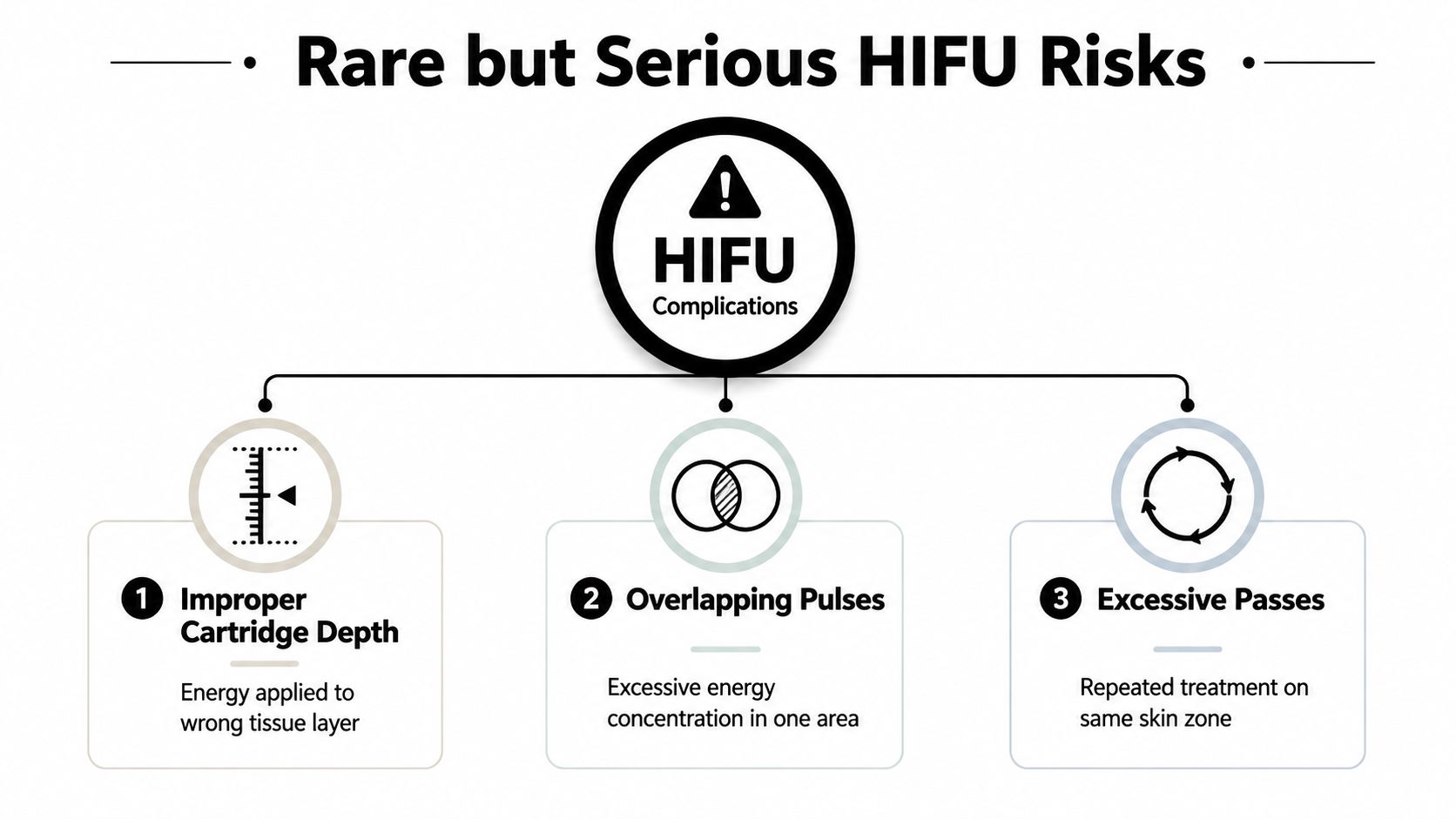
Nerve irritation depends on anatomy as well as device settings. Treatment close to the mandibular border, temple, brow, or another nerve pathway can cause altered sensation, a weak smile, forehead heaviness, or local muscle asymmetry. Temporary irritation may settle, but spreading symptoms, worsening weakness, facial asymmetry, or difficulty closing an eye needs prompt clinical assessment. The risk increases when treatment depth, energy, or placement does not match the patient's anatomy.
Paradoxical fat loss, also called fat atrophy, can produce hollowing in the cheek, temple, or under-chin area if energy reaches subcutaneous fat unintentionally. The risk is particularly relevant for people who already have low facial volume. A contour change may emerge gradually rather than immediately, so consistent follow-up photographs can reveal a developing hollow that is easy to miss day to day.
Facial procedures can reactivate cold sores in people with a previous herpes history. Tell the clinician about past outbreaks, even if none is visible on the treatment day. Active lesions may require postponement, and preventive medication may be considered.
Scarring, pigment change, and deeper tissue injury are uncommon, but risk deserves attention in skin prone to post-inflammatory pigmentation or abnormal scar formation. UK guidance on HIFU side effects distinguishes short-lived treatment reactions from symptoms that require review.
HIFU Facelift vs Surgical Facelift Risk Comparison
HIFU and a surgical facelift don't offer the same level of lifting, and they don't carry the same type of risk. HIFU avoids incisions and anaesthesia, while surgery changes tissue through dissection, repositioning, and removal. Comparing them as “safe” and “dangerous” gives patients the wrong decision framework.
| Risk Factor | HIFU Facelift | Surgical Facelift |
|---|---|---|
| Anaesthesia exposure | No general anaesthetic is required for the treatment itself | May involve local anaesthetic with sedation or general anaesthesia |
| Skin injury | Usually limited to temporary inflammation, with burns a recognised but uncommon risk | Incisions and surgical wound healing are expected |
| Infection | No surgical wound, so the risk profile differs | Surgical infection is a recognised complication |
| Scarring | Usually no incision scar, but abnormal scarring is possible after skin injury | Incision scars are unavoidable, although surgeons place and manage them carefully |
| Nerve effects | Temporary irritation or altered sensation can occur | Nerve injury can be temporary or permanent |
| Downtime | Usually limited, although swelling and tenderness can interfere with normal activities | Recovery is longer and more involved |
| Result profile | Gradual, generally more subtle tightening | More substantial structural lifting |
| Future treatment | Repeat non-surgical treatment may be considered | Revision surgery is more invasive |
The table intentionally avoids invented rate comparisons. The supplied evidence supports a low-grade, early pattern for many HIFU reactions, but it doesn't provide matching surgical facelift statistics. Surgical risk also varies with the procedure, anaesthetic plan, surgeon, health status, and extent of dissection.
A HIFU complication is often managed with observation and clinical support, but a burn, nerve problem, or unwanted volume change can still be distressing. A surgical complication may require a longer recovery or further intervention, while surgery can provide a greater lifting effect for suitable candidates.
For a broader non-surgical comparison, see this guide to HIFU versus radio frequency. The right option depends on your anatomy, expectations, tolerance for recovery, and desired degree of change.
Who Is More Likely to Get Side Effects
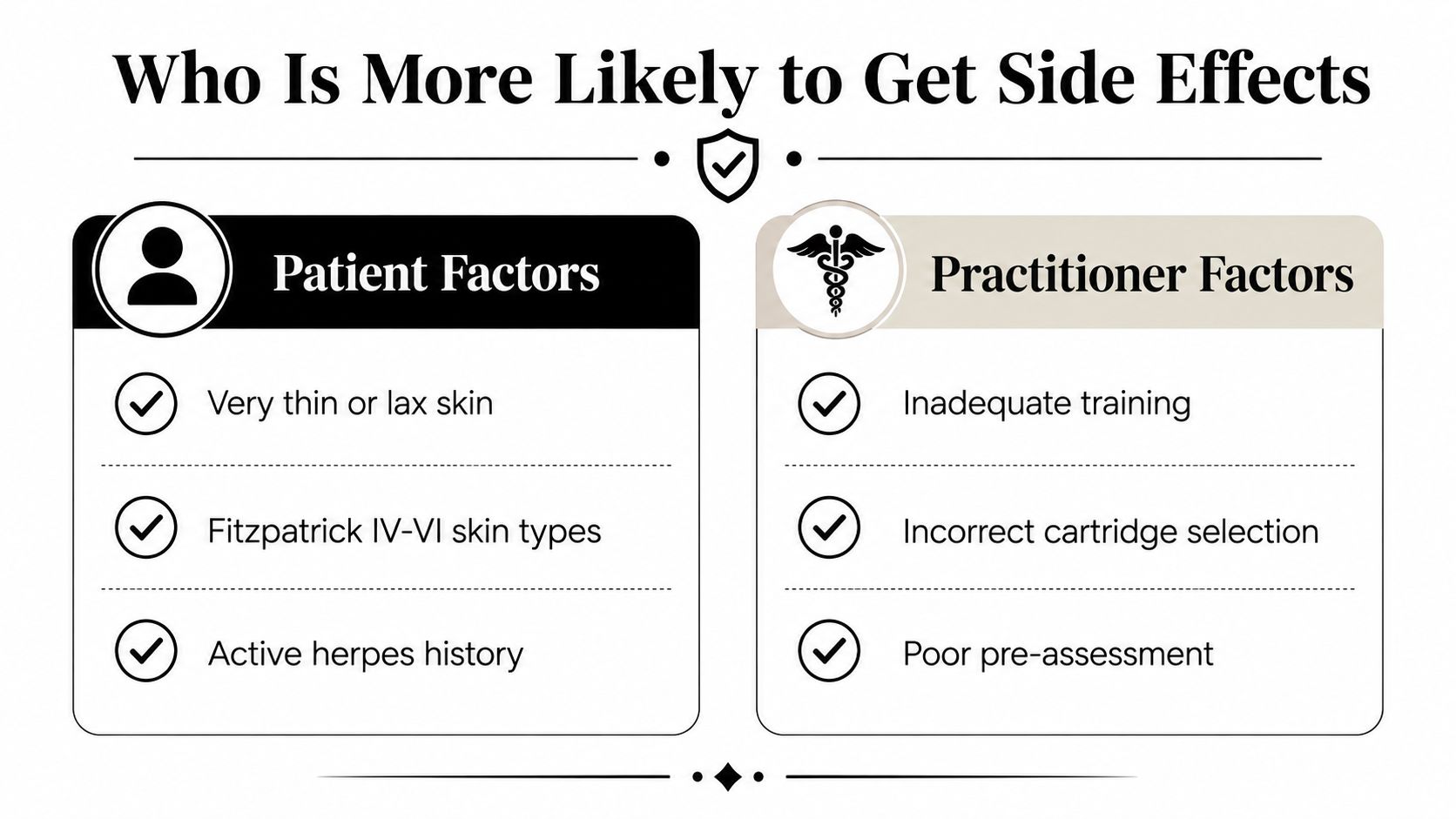
Risk isn't distributed evenly. A person with very thin facial tissue, limited fat, a history of cold sores, or a tendency to bruise may need a more conservative plan than someone with thicker, fuller tissue. Skin tone also matters because Fitzpatrick IV to VI skin types may be more vulnerable to pigment shifts after inflammation or thermal injury.
Patient factors that change planning
Tell the clinician about:
- Thin or lax skin: The target tissue may sit closer to bone or superficial nerves.
- Low facial volume: Deeper energy can create an unwanted hollowing effect if fat is affected.
- Cold-sore history: Facial treatment may be followed by herpes reactivation.
- Easy bruising or medication use: Anticoagulants and other medicines can affect bruising risk. Never stop prescribed medication without medical advice.
- Recent fillers, threads, dental work, or implants: The clinician needs to know where material or altered anatomy may sit.
- Active skin problems: Acne, rosacea, infection, eczema, or an autoimmune skin condition may require postponement or specialist advice.
- Pregnancy: Elective aesthetic treatment should be discussed with an appropriate healthcare professional and commonly deferred.
A consent form from Lumiere Medispa's HIFU guidance describes more extensive bruising in very thin skin and temporary nerve inflammation that can cause numbness, discomfort, or local muscle weakness.
Practitioner factors matter just as much
A 4.5 mm cartridge isn't automatically safer or more effective than a 3.0 mm cartridge. The clinician must match the transducer to tissue depth, avoid prominent bone and vulnerable nerve pathways, map each side of the face, and prevent excessive overlap.
Poor planning can amplify heat concentration, bruising, nerve irritation, or fat loss. A proper consultation should include examination rather than a quick tick-box conversation, and the operator should be willing to reduce energy, alter the treatment map, or decline treatment where the anatomy makes the risk unacceptable.
Prevention Aftercare and Red Flags
Good aftercare starts before the handpiece touches your skin. Ask the clinic which products and medicines you should pause, and disclose every relevant condition rather than assuming it's unrelated.
Before treatment
- Review skincare: Ask whether retinoids, exfoliating acids, or irritating products should be paused. The timing should come from your clinician, particularly if you use prescription products.
- Disclose cold sores: Tell the practitioner about previous outbreaks, active lesions, or tingling that suggests an outbreak is starting.
- Discuss medicines: Mention anticoagulants, antiplatelet medicines, supplements, and anything that affects bruising. Don't independently stop prescribed treatment.
- Report recent procedures: Fillers, threads, dental work, implants, or other facial treatments may change the treatment plan.
- Avoid treatment over active inflammation: Rosacea flares, acne lesions, infection, or broken skin need assessment first.
During the first days
Keep skincare gentle and fragrance-free. Avoid unnecessary heat exposure, strenuous exercise, saunas, and very hot showers during the period advised by your clinic. Protect treated skin from sunlight with broad-spectrum sunscreen, and don't massage a painful or swollen area unless your practitioner specifically instructs you to do so.
Mild redness, puffiness, tenderness, tingling, and small bruises can be compatible with recovery. The HIFU aftercare guidance from 3D Aesthetics is about microneedling rather than HIFU, so use it only as a general example of why treatment-specific aftercare instructions matter. Your HIFU provider should give you instructions designed for the device and area treated.
Normal or concerning
Contact the clinic promptly about worsening pain, swelling that isn't settling, persistent numbness, a new asymmetric smile, or unusual skin colour.
Request urgent medical assessment for blistering, charred or white skin, spreading redness with systemic illness, marked muscle weakness, or grouped vesicles suggesting herpes reactivation.
Attend A&E or seek emergency help for visual disturbance, severe facial weakness, difficulty swallowing, breathing problems, or rapidly worsening symptoms. Don't wait for a routine follow-up if a symptom affects vision, breathing, or major facial function.
Take photographs early: A clear record can help the treating clinician decide whether the pattern is expected inflammation, nerve irritation, a burn, infection, or another problem.
Choosing a Safety-Led Consultation at 3D Aesthetics Leamington Spa
A safe HIFU appointment begins with decisions made before treatment. The practitioner should review your medical history, medicines, skin conditions, previous aesthetic procedures, cold-sore history, bruising tendency, and any implants or recent dental work that could affect facial mapping.
The clinical examination should assess skin thickness, laxity, facial volume, bone prominence, and the position of important treatment zones. The clinician can then select suitable cartridges, commonly 1.5 mm, 3.0 mm, or 4.5 mm, according to tissue depth rather than applying one protocol to every face.
What a thorough plan should document
- Treatment mapping: Each side of the face should be planned with attention to anatomy and symmetry.
- Energy selection: Settings and line counts should reflect tissue thickness, treatment goals, and tolerance.
- Consent: You should receive clear information about expected redness, swelling, tenderness, numbness, bruising, and rare complications.
- Follow-up: The clinic should explain who to contact and what happens if a red-flag symptom develops.
- Expectations: A personalised plan should define the likely degree and pace of change without promising a surgical result.
3D Aesthetics Leamington Spa offers a complimentary 3D body scan and personalised treatment plan as part of its consultation process. The clinic's HIFU service can be considered alongside other non-surgical facial options, with treatment delivered after a two-week cooling-off period and adverse-event escalation pathways recorded in aftercare documentation. These details should be confirmed directly during your consultation because suitability and settings remain individual.
The best consultation is one where you're encouraged to ask what happens if the clinician finds thin tissue, low facial volume, active inflammation, or a nerve-sensitive area. You should leave knowing which symptoms are expected, how long they may last, and exactly when to call.
If you're considering HIFU in Leamington Spa, visit 3D Aesthetics Leamington Spa for a complimentary consultation, 3D body scan, personalised treatment planning, and clear aftercare guidance. Ask the team to assess your facial anatomy, discuss HIFU facelift side effects, and explain whether the treatment is appropriate for your skin and goals.
← Back to Home