
You might be reading this after doing all the “right” things. You eat fairly well, you move your body, you've probably tried cutting back, walking more, maybe even strength training, and yet one area still seems to ignore every bit of effort. It might be the lower tummy that sits over your jeans, the soft pocket at the flanks, or that small but persistent fullness on the thighs.
That's usually when people start asking a very specific question. How does fat freezing work, and can it actually help with fat that won't shift through diet and exercise alone? The short answer is yes, for the right person and the right kind of fat. But it helps to understand what the treatment is really doing, what it can't do, and what the journey feels like in a real clinic setting.
Table of Contents
- The Stubborn Fat That Diet and Exercise Can't Shift
- The Science of Cryolipolysis Explained
- Your Fat Freezing Journey at 3D Aesthetics
- Who Is a Good Candidate for Fat Freezing
- Results Timelines and Potential Side Effects
- Comparing Fat Freezing with Other Body Contouring
- Start Your Bespoke Body Contouring Plan in Leamington Spa
The Stubborn Fat That Diet and Exercise Can't Shift
A pattern I hear often goes like this. Someone has lost weight before. They know how to be disciplined. Their clothes fit better overall, but one area still feels unchanged. The body gets leaner in general, yet the lower abdomen, love handles, or inner thighs seem to hold on.
That's the exact gap fat freezing was designed to fill. It isn't a general slimming treatment and it isn't meant to replace healthy habits. It's a body contouring treatment for localised, pinchable fat pockets that sit under the skin and don't always respond evenly to lifestyle changes.
Fat freezing makes the most sense when your overall routine is already working, but one small area still isn't matching the rest of your progress.
That distinction matters. A lot of confusion comes from expecting cryolipolysis to act like weight loss. It doesn't. Weight loss shrinks fat cells across the body. Fat freezing targets a chosen area and reduces the fat layer there to improve shape and proportion.
If you're still building your wider routine, it can help to pair treatment decisions with practical lifestyle guidance. Resources on strategies for fat loss and muscle gain can be useful because they explain the bigger picture. Then fat freezing becomes what it should be: a finishing tool, not the whole plan.
Why people often choose it
- Lower belly softness: That small pouch that remains even when the waist has slimmed down.
- Flanks or love handles: The area that can show through fitted tops or sit above the waistband.
- Thigh pockets: Small deposits that affect the line of the legs more than the number on the scale.
For many people, the appeal is simple. There's no surgery, no anaesthetic, and no need to put life on hold while the body gradually clears the treated fat.
The Science of Cryolipolysis Explained
Cryolipolysis sounds technical, but the underlying concept is more straightforward than often perceived. Fat cells are more vulnerable to cold than the surrounding tissues. When a treatment device cools a selected area carefully and precisely, those fat cells react in a way that skin, nerves, and blood vessels are better able to tolerate.
Why cold affects fat cells first
If you leave different materials out in winter, they don't all respond the same way. Some stiffen quickly, others hardly change. Fat behaves a bit like the material that reacts first.
Fat freezing cools targeted subcutaneous fat to around -11°C to -5°C, which crystallises lipid droplets inside the fat cells while sparing surrounding skin, nerves, and vasculature because those tissues have a higher thermal tolerance, according to the Journal of Cosmetic Dermatology review on cryolipolysis.
That's the key mechanism. The treatment isn't “burning” fat or melting it away. It's using controlled cold to injure selected fat cells in a very specific way.
What your body does after treatment
A common misunderstanding arises. They expect the fat to vanish immediately after the session. It doesn't work that way.
Once those cooled fat cells have been damaged, the body starts a controlled inflammatory response. In plain language, your body recognises that some of those fat cells are no longer healthy and begins a tidy, gradual clean-up process. Special immune cells called macrophages break down the damaged material, and the lymphatic system helps carry it away over time.
Practical rule: If you want to understand how fat freezing works, think “freeze, signal, clear”, not “freeze and instantly disappear”.
The process is gradual by design. That's why results tend to look natural rather than abrupt. It also explains why people can feel disappointed if they judge the treatment too early.
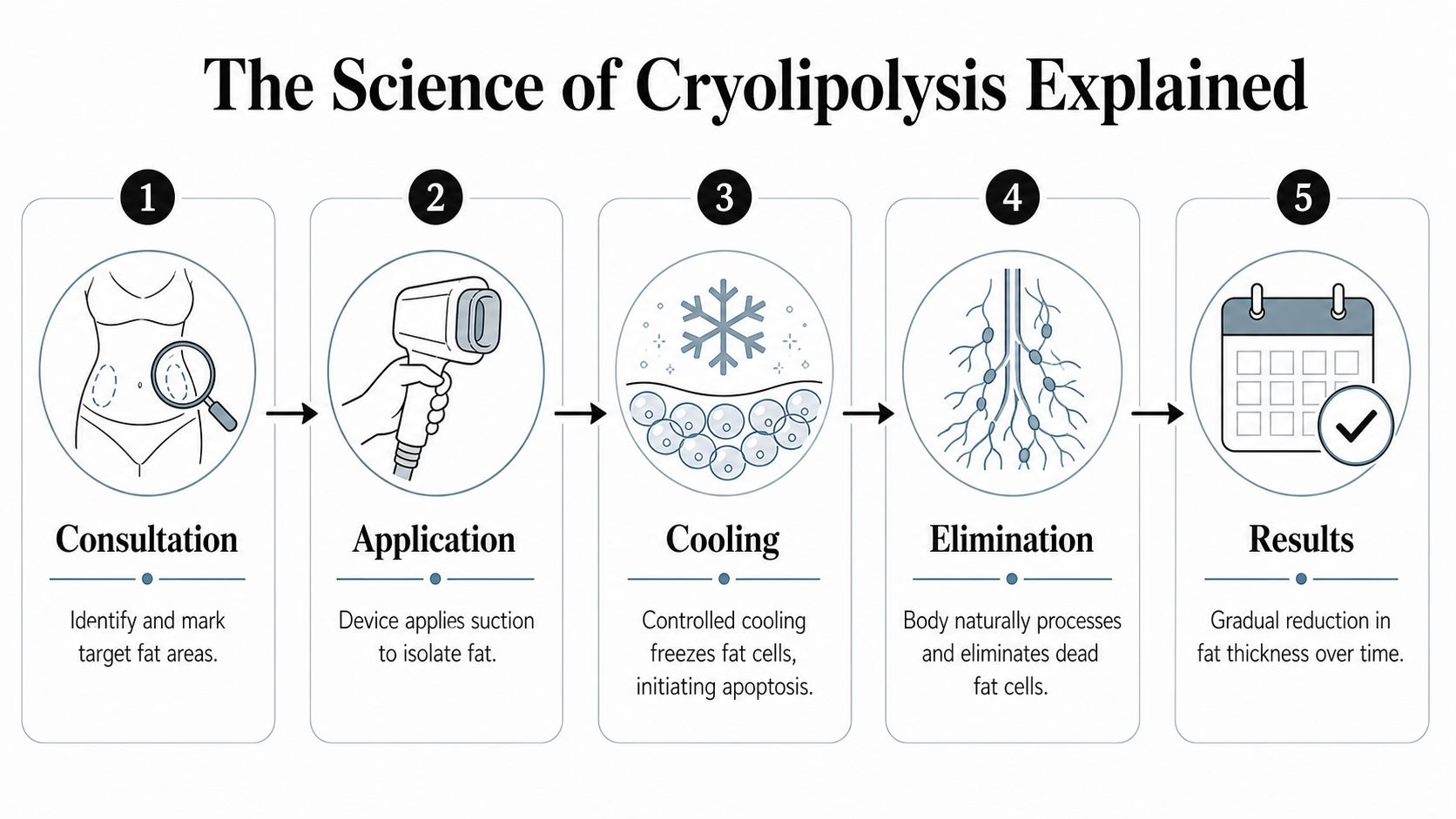
Here's the sequence in simple terms:
Area is selected
The therapist identifies a pocket of superficial fat that can be drawn into the applicator.Controlled cooling begins
The device applies suction and cold to the target tissue.Fat cells crystallise
The contents of those cells respond to cold more readily than the surrounding structures.The body starts clearing them
The treated cells go through apoptosis, which is a regulated form of cell death rather than a sudden traumatic event.The contour changes gradually
As the body clears those cells, the treated area looks slimmer and flatter.
Another point matters here. Destroyed fat cells in the treated area don't re-grow in the same way, and the body removes them naturally over time, with changes unfolding across roughly 2 to 4 months according to the ACE Group cryolipolysis clinical leaflet. That's why cryolipolysis is often described as giving a permanent reduction in the treated area.
It's also why fat freezing only works on the right kind of fat. It targets superficial, pinchable fat under the skin. It doesn't treat deeper visceral fat and it isn't a treatment for obesity.
Your Fat Freezing Journey at 3D Aesthetics
For most clients, the treatment starts feeling much less intimidating once they know what the appointment looks like from start to finish.
Your consultation and body scan
The first part is usually a conversation, not a machine. You talk through what bothers you, which areas you've noticed haven't changed, and what kind of result would feel worthwhile. That matters because two people can point to the same area, such as the abdomen, but need completely different advice.

At 3D Aesthetics, that consultation includes a 3D body scan, which gives a more structured view of shape, proportions, and the treatment area. Instead of relying only on a mirror or rough estimates, the scan helps map where the concern sits and gives a baseline for comparison later.
That's helpful for clients who say things like, “I know something has changed, but I can't tell how much,” or, “I always notice one side more than the other.” Seeing the body measured in a consistent way tends to make the process clearer.
If you want to see the specific treatment page for the clinic's cryolipolysis option, you can view 3D Cryofreeze treatment details.
What the session feels like
The actual appointment is far less dramatic than many people expect. Once the area is marked, a protective pad is placed on the skin and the applicator is positioned over the fat pocket. The device uses a gentle vacuum action to draw the tissue into the handpiece so the cooling plates can work on the selected area.
The first few minutes are often described as the strangest part. You feel pulling, firm pressure, and intense cold. After that, the area often becomes quite numb, so the treatment tends to feel easier than people feared.
A single treatment area generally takes 30 to 60 minutes, based on the ACE Group cryolipolysis leaflet. During that time, many clients rest, scroll on their phone, read, or chat.
This short video can help make the experience feel more familiar before you book.
After the applicator comes off, the treated area can look firm, cold, and slightly raised for a short while. That's normal immediately after treatment. You're not seeing the final result. You're seeing tissue that has just been through a controlled cooling cycle.
Who Is a Good Candidate for Fat Freezing
Fat freezing tends to work best when the goal is reshaping, not overall slimming. The people happiest with it are often already close to where they want to be in terms of weight, but one small area still feels out of proportion.
The profile that usually suits it best
A good candidate usually has:
- Pinchable fat under the skin: The treatment needs a localised area that can be drawn into the applicator.
- Stable expectations: You're looking for contour change, not a dramatic whole-body transformation.
- A healthy baseline routine: Food, movement, and weight are already reasonably settled.
The treatment is clinically recognised as most effective for people at or near their target body weight who have localised fat pockets resistant to diet and exercise, rather than for general weight loss or obesity management, as outlined in the UK clinical overview from Colaz.
The best question isn't “Will this make me lose weight?” It's “Will this improve the shape of this specific area?”
That's why a lower tummy pouch can be a good target, while a bloated-looking abdomen caused mainly by posture, deeper visceral fat, or digestive issues may not respond in the same way.
Why long-term habits still matter
One of the biggest myths is that once fat cells are treated, you can forget about maintenance. However, the situation is more nuanced.
The treated cells are reduced, but your remaining fat cells can still enlarge if your weight goes up later. A 2023 systematic review of cryolipolysis outcomes in UK clinics found that 22% of patients experienced partial loss of initial inch reduction after 18 months due to weight fluctuation, according to the BBC report discussing those findings.
That doesn't mean the treatment failed. It means body contouring still sits inside the wider reality of body weight and lifestyle.
A simple way to think about it is this. Fat freezing can help reduce the number of fat cells in a chosen area. It doesn't freeze your future habits in place. If you maintain your weight, the contour tends to hold far better. If your weight changes significantly, the result can soften.
Results Timelines and Potential Side Effects
Before deciding, people typically want two honest answers. When will I see something? And what might I feel afterwards?
When you may notice a change
Cryolipolysis rewards patience. A treated area doesn't look different overnight because your body needs time to process and remove the damaged fat cells.
In the UK, fat freezing typically reduces the treated fat layer by about 15% to 28% per cycle, with many clinical protocols reporting an average of 20% to 25%. Visible changes usually begin at 4 to 8 weeks, with the final result stabilising at around 12 weeks, according to the UK fat freezing results overview from Colaz.
That timeline helps explain why progress photos matter. Day to day, your eye often misses slow change. But when you compare before and after images taken under similar conditions, the reduction in thickness and contour is much easier to spot.
A realistic timeline often feels like this:
- Early phase: You may feel that the area is a little different before you can clearly see it.
- Middle phase: Clothes may sit more smoothly, especially around waistbands and fitted fabrics.
- Later phase: The shape usually looks more settled and proportionate.
Common effects and the rare risk to know about
Fat freezing has a strong safety profile when it's carried out properly, but transparency matters. Mild, temporary after-effects are common. These can include numbness, bruising, itching, stinging, tenderness, or redness as the body responds to the treatment and clears the affected cells.
A wider review also reported mild side effects such as transient numbness at 49.5% and redness at 44.5%, in an international meta-analysis discussed within the Journal of Cosmetic Dermatology article on cryolipolysis.
If you want a fuller overview of what these reactions can feel like in practice, the clinic's guide to fat freezing side effects and aftercare expectations is worth reading before treatment.
Most side effects are more inconvenient than alarming. The main pattern is temporary numbness or tenderness rather than downtime that stops normal daily life.
There is also a rare but documented side effect called paradoxical adipose hyperplasia. Instead of shrinking, the treated fat thickens and enlarges. It's uncommon, but it's one of the reasons proper assessment, informed consent, and professional treatment matter so much.
Comparing Fat Freezing with Other Body Contouring
Not every concern is best treated with cold. Some people need fat reduction. Others need skin tightening, cellulite work, or a combination approach. That's where comparison becomes useful.
When freezing fits and when another treatment may suit better
Fat freezing is usually chosen when there's a defined pocket of superficial fat that can be isolated. If the main issue is looser skin after weight loss, or texture and dimpling rather than volume, another technology may make more sense.
Here's a practical side-by-side view.
| Technology | Primary Target | Best For | Mechanism |
|---|---|---|---|
| Cryolipolysis | Localised subcutaneous fat | Pinchable fat pockets such as flanks, lower abdomen, or thighs | Controlled cooling targets fat cells so the body gradually clears them |
| Ultrasound cavitation | Fat layer and circumference change | Clients focused on inch loss across a broader area | Ultrasound energy disrupts fat cells in a non-surgical treatment setting |
| Radio frequency | Skin laxity and cellulite appearance | Areas that need tightening more than debulking | Heat-based energy stimulates tissue response and supports firmer-looking skin |
This is why one person may be advised to freeze the flanks but tighten the abdomen. Another may be better suited to a course of radio frequency because their main concern isn't the amount of fat. It's skin quality.
If you're weighing up the wider category rather than one device alone, this guide to non-surgical fat reduction treatment options gives context on how different approaches are used in clinic settings.
It also helps to keep expectations grounded in the bigger picture. If your goal includes overall leanness as well as contouring, information on sustainable body fat reduction can be useful alongside aesthetic treatment research. That way, you're not asking one treatment to do the job of an entire long-term plan.
Start Your Bespoke Body Contouring Plan in Leamington Spa
By the time most clients reach this stage, the question has shifted. It's no longer just “how does fat freezing work?” It becomes “is this the right way to treat my specific area?”
That's the right question to ask. Cryolipolysis works by exposing selected, superficial fat cells to controlled cold so the body can gradually clear them. It's non-surgical, it's targeted, and for the right candidate it can create a lasting improvement in contour. It isn't a shortcut around lifestyle, and it isn't designed for general weight loss.
What makes the biggest difference is good assessment. The treatment has to match the tissue in front of you. The area has to be suitable. The expected result has to be realistic. When those pieces line up, fat freezing can be a very sensible option for people who feel close to their goal but still bothered by one stubborn zone.
A consultation is where that clarity happens. You can assess the fat pocket properly, compare it with other body contouring options, and build a plan around what you actually want to improve rather than guessing from online before-and-after photos.
If you'd like specific advice on whether cryolipolysis suits your body shape and goals, book a consultation with 3D Aesthetics Leamington Spa to discuss your options and start a personalised treatment plan.