
You've booked the consultation, you've shaved once, and now you're wondering whether you've done enough, or whether one small mistake will mean a wasted appointment. That's the right mindset. How to prepare for laser hair removal is less about a beauty routine and more about a safety protocol, because the laser can only work properly when the follicle is intact, the skin tone is suitable on the day, and the treatment area is free from anything that could interfere with light delivery or irritate the skin.
Table of Contents
- Why Preparation Dictates Your Laser Results
- The Six Week Pre Treatment Timeline
- Mastering the Shaving Technique
- Navigating UK Clinic Safety and Patch Testing
- Adapting Preparation for Different Skin Tones
- Your Final 24 Hour Skin Checklist
Why Preparation Dictates Your Laser Results
A common first-timer mistake is assuming the clinic will “sort it out” on the day. In practice, the session goes best when you arrive with the right hair length, the right skin condition, and a clear record of anything that could affect the skin's response. Laser devices target pigment in the follicle, so if the follicle has been removed by waxing or plucking, or if the surface skin is too dark from tanning, the clinician is forced to work around a weaker target or postpone treatment.
That's why preparation changes both efficacy and comfort. If the visible hair is too long, it can waste laser energy at the surface and make treatment less efficient, while the actual target below the skin stays harder to reach. If the skin has been tanned, the skin itself holds more pigment, which raises the chance of adverse reaction and makes conservative settings more likely.
Practical rule: keep the follicle intact, keep the skin calm, and keep the surface clean.
There's also a simple efficiency issue. If you arrive with long regrowth, many practitioners will shave the area in clinic so they can treat safely, which eats into appointment time and makes the session feel more clinical than it needs to be. If you want a deeper sense of what a well-run course looks like in practice, this laser hair removal results guide is a useful companion read.
For UK clients, the logic is consistent across reputable hospital guidance, preserve the root, avoid surface interference, and arrive with skin that hasn't been recently provoked by sun, products, or hair removal trauma. That's the difference between a planned treatment and a compromised one.
The Six Week Pre Treatment Timeline
The cleanest way to think about preparation is in stages, not as a last-minute checklist. If you've been waxing, tweezing, threading, or epilating, stop now and switch to shaving or trimming only, because the laser needs the follicle root and pigment left in place to do its job. UK clinical guidance advises stopping waxing or plucking for at least 2 to 8 weeks before the treatment course starts, so the root can remain intact for targeting (Alder Hey NHS guidance).
What to stop first
The biggest mistake is “just this once” hair removal from the root. It resets the follicle target and can force you to wait longer before treatment becomes worthwhile again.
- Waxing and plucking: both remove the root, so they undermine the laser target.
- Threading and epilating: same problem, different method, the follicle is disturbed.
- Bleaching: the hair's natural colour matters for targeting, so bleaching makes treatment less effective and is specifically discouraged in UK hospital guidance.
- Sunbeds and fake tan: tanned skin is the wrong starting point for safe treatment.
What you can still do
Shaving is the method that preserves the root while clearing the surface. That matters because the laser doesn't need a long shaft above skin level, it needs the follicle beneath the surface. Keep the area neat, but don't chase smoothness by removing the hair from the root.
A useful mental rule is simple. If a method pulls the hair out, delays the treatment. If it only removes visible length, it usually fits the preparation plan.
For a clinic-side overview of the process itself, this laser hair removal process guide helps show how preparation sits inside the full treatment pathway.
Mastering the Shaving Technique
Shaving is the one pre-treatment method that should feel boring, not aggressive. UK hospital guidance advises shaving or trimming about 24 hours before treatment, with the hair kept as short as possible and the natural colour left intact so the laser can still target the follicle (Sandwell and West Birmingham NHS Trust). That timing gives the skin a little time to settle while keeping the surface hair short enough for comfort.
How to shave without creating a problem
Use a fresh, clean razor and light pressure. If you shave too early, stubble may grow back and the clinic may need to tidy the area again. If you shave too harshly, you can arrive with razor irritation, which can make the skin feel hotter once the laser is applied.
Don't aim for “baby smooth” at the expense of calm skin. Aim for short, intact, uninflamed skin.
The practical target is hair that sits below or just at the skin surface, not long enough to absorb energy above the skin. Surface hair can singe and waste laser energy, while intact follicle pigment below the skin is what the device is after. That's why a clean shave beats any other last-minute fix.
What not to do after shaving
Don't scrub the area raw, and don't add strong products to compensate for worry about bumps. If you're prone to ingrown hairs, it's worth reading browse ingrown hair oil picks alongside the clinic's own ingrown hair prevention advice, because shaving irritation and ingrowns are the main reasons clients feel tempted to overcorrect.
The useful standard is modest. Shave once, keep the skin calm, and let the practitioner handle the rest. If you arrive with long regrowth, the clinic may shave you, but that's not the ideal use of appointment time.
Navigating UK Clinic Safety and Patch Testing
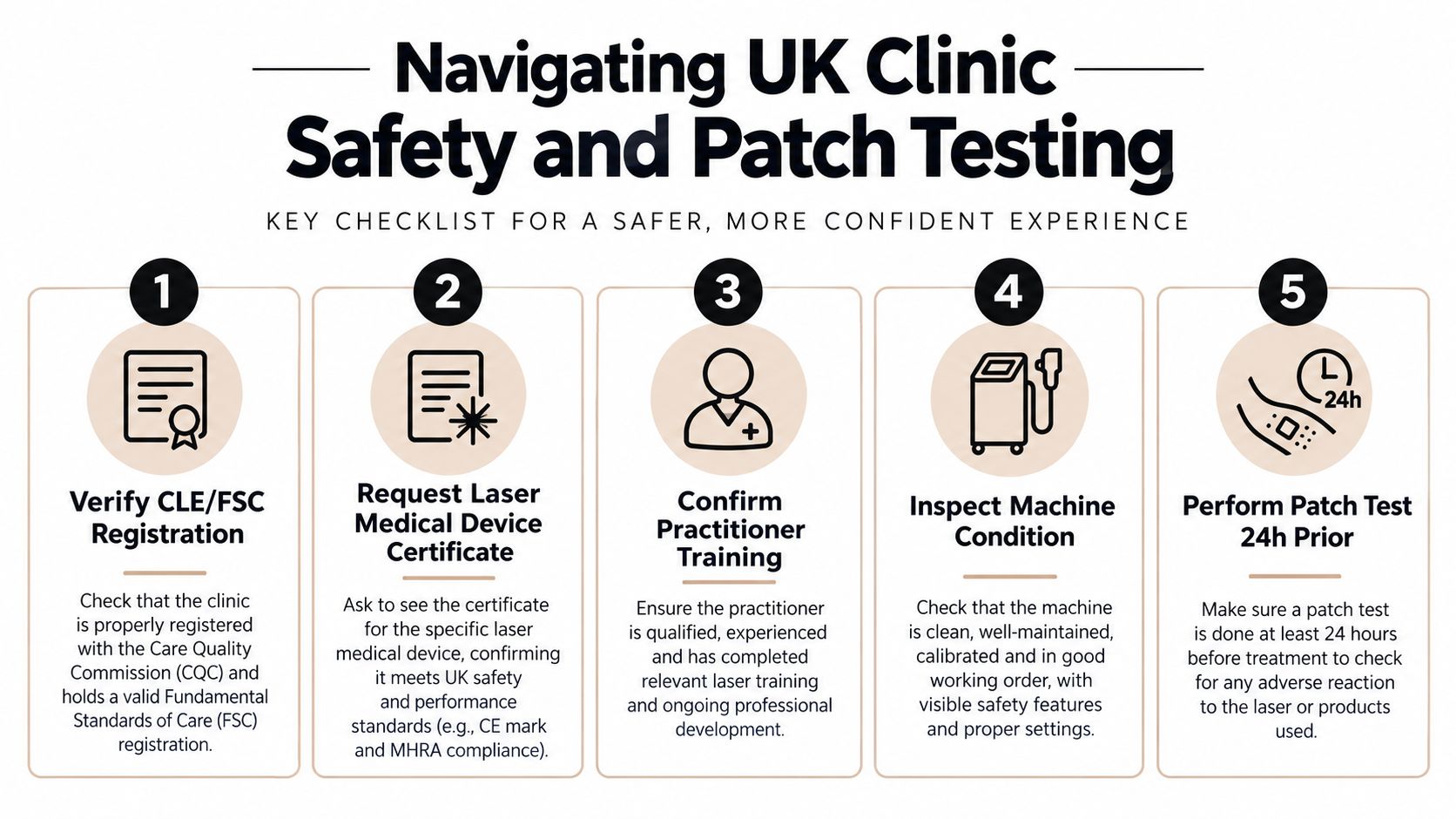
UK laser preparation isn't just about your skin, it's also about who is treating it. Following the deregulation of parts of the cosmetic sector, a 2019 review noted that non-healthcare providers were no longer required to register with the CQC for cosmetic laser hair removal, which makes your own screening process a genuine safety step rather than an optional extra (2019 review). In other words, the burden shifts onto the client to ask better questions.
What to verify before booking
A serious consultation should cover training, device type, patch-testing policy, skin tone, sun exposure, and medication history. If a clinic is vague about any of those points, that's a warning sign.
- Practitioner training: ask who performs the treatment and what laser-specific training they've had.
- Device suitability: ask which machine will be used and whether it matches your skin tone.
- Patch testing: confirm that a skin test is done before treatment starts.
- Contraindications: disclose recent sun exposure, fake tan, active skin irritation, and medicines that may affect the skin.
- Clinic hygiene and process: for a basic framework on standards and accountability, understanding health and safety basics is worth a look before you choose where to book.
Why the patch test matters
A patch test isn't a formality, it's a screening step for how your skin reacts to that specific device and setting. UK guidance from the British Medical Laser Association says patients must be given a skin patch test before laser or IPL treatment, with the result typically assessed after 24 to 72 hours, depending on the device guidance.
That waiting window matters because some reactions don't show immediately. If a clinic skips it or rushes it, they're asking your skin to do the testing for them. For a fuller idea of the treatment pathway, this process overview is a practical reference.
Adapting Preparation for Different Skin Tones
Generic prep advice often pretends everybody's skin behaves the same way. It doesn't. UK clinical sources stress that skin should be as pale as possible before treatment, yet clinics may use specific lasers like Nd:YAG for darker skin types, which means the consultation has to be more individual than a one-size-fits-all checklist (Health Centre guidance).
Why skin tone changes the plan
If your skin tans easily or is naturally more melanin-rich, the main issue is competition between skin pigment and follicle pigment. The treatment still has to target the follicle, but the clinic must protect the surrounding skin from excessive heat absorption. That's why the pre-treatment rules can feel stricter for some skin tones and more flexible for others only in the hands of an experienced practitioner using the right device.
A darker skin tone doesn't automatically rule out treatment. It does mean the clinic should explain why they've chosen a certain laser, how they'll test the skin, and how they'll adapt settings to reduce risk. That conversation should happen before any treatment starts, not after a reaction.
How to read the consultation properly
If you're tan-free, that helps. If you're not fully tan-free, you should expect the clinic to be cautious, not casual. The right response is not “we treat everyone the same”, it's “we'll assess your skin and choose the safest approach.”
That's where a good clinic proves its value. A well-run consultation should connect your skin tone, recent sun exposure, and hair characteristics to the device choice. For some clients, that means a different laser head, different settings, or a delayed session until the skin is in a better state.
Good sign: the practitioner explains the trade-off between being safe on the skin and being effective on the follicle.
Your Final 24 Hour Skin Checklist
The last day is about stripping the skin back to basics. UK hospital guidance requires the treatment area to be completely free from make-up, moisturiser, and sun cream on the day of the appointment so surface products don't interfere with the laser or irritate the skin during treatment (Sandwell and West Birmingham NHS Trust).
A practical routine works best here. Cleanse the area gently, avoid layering on anything that adds slip or residue, and wear loose clothing so the treated skin isn't rubbed on the way home. If you use any prescribed or potentially photosensitising product, tell the clinic in advance so they can decide whether to proceed.
A simple arrival routine
- Day before: shave the area if your clinic has told you to, then leave it alone.
- Day before: keep heat and friction low, so the skin isn't already irritated.
- Day of: arrive with bare skin, no residue, no body lotion, and no sun protection on the treatment area.
- Day of: bring up any changes in medication, skincare, or recent sun exposure before the session begins.
A strong appointment starts with a skin surface the clinician doesn't need to clean up first. That keeps the session efficient and lowers the chance of avoidable reactions.
If you want a clinic that treats laser hair removal as a proper consultation-led procedure, 3D Aesthetics Leamington Spa offers laser hair removal within a wider, medically informed treatment environment, with preparation and patch testing built into the booking process. Book a consultation there if you want a clear, skin-tone-aware plan before your first session, and arrive knowing exactly what to do, and what to avoid.
← Back to Home