
You're probably here because the usual routine has started to feel endless. Shave, get stubble. Wax, wait for regrowth. Use cream, hope your skin doesn't complain. Then do it all again. For many people, unwanted hair isn't just a beauty task. It becomes a repeating bit of admin that eats into mornings, holidays, gym plans, and confidence.
That's why the laser hair removal process appeals to so many clients. It isn't about chasing a quick fix. It's about moving from constant maintenance to a more organised, long-term plan. The treatment itself is only one part of that journey. The ultimate difference comes from careful assessment, safe settings, and realistic expectations from day one.
At a clinic like 3D Aesthetics Leamington Spa, that journey starts with detail. Not just where the hair is, but how your skin behaves, how your hair grows, what your goals are, and whether laser is the right option for you. That's especially important because laser doesn't suit every hair colour equally, and darker skin tones need the device and settings chosen with care.
Table of Contents
- Tired of Shaving and Waxing? Your Journey Starts Here
- Your Journey Begins The Consultation and Assessment
- How Different Lasers Target Unwanted Hair
- A Step-by-Step Guide to Your Treatment Session
- Why Multiple Sessions Are Essential for Success
- Your Pre-Treatment and Post-Treatment Care Plan
- Understanding Your Results and Long-Term Outlook
Tired of Shaving and Waxing? Your Journey Starts Here
A lot of clients arrive with the same story. They're not confused about how to remove hair. They're exhausted by how often they have to think about it. A rushed shave before work. Ingrown hairs after weekends away. Waxing appointments timed around holidays. It can feel never-ending.
Laser changes the conversation because it treats the follicle, not just the hair you can see. That's why people often see it as less of a one-off appointment and more of a structured course with a clear purpose. You're not just tidying up regrowth. You're trying to reduce how much comes back, how thick it feels, and how often you need to manage it.
The common reasons people start looking into laser
- Daily hassle: Shaving can become part of the morning you resent most.
- Skin irritation: Some people cope with razor burn, bumps, or sensitivity from repeated hair removal.
- Holiday panic: Hair removal often becomes urgent right before an event, break, or special occasion.
- Uneven regrowth: Waxing and shaving don't always leave the skin feeling smooth for long.
For many readers, the biggest shift is mental. You stop asking, “How do I get rid of this hair today?” and start asking, “What treatment plan makes sense for my skin, my hair, and my routine?”
Laser works best when it's treated as a process, not an impulse booking.
That's also why safety matters so much. The right clinic won't rush you onto a treatment bed because you've decided you want smoother skin. A good therapist slows things down first. They assess. They ask questions. They explain what's realistic. They check whether the treatment area, skin tone, and hair type are likely to respond well.
If you've been putting off laser because it sounds too technical or too intense, most of the confusion disappears once the process is broken down properly. The science is simpler than it sounds. The appointment is usually more manageable than expected. And the planning behind it is what makes the outcome safer and more customized.
Your Journey Begins The Consultation and Assessment
The consultation is where the laser hair removal process becomes personal. Before any treatment starts, a therapist needs to know what you want to treat, how your skin responds, whether your hair is suitable, and if there's anything in your medical history that changes the plan.

What happens in a proper consultation
A thorough consultation usually covers four areas.
Your goals
You might want to treat underarms, legs, bikini line, face, chest, or back. Some clients want lower-maintenance grooming. Others want help with irritation from shaving. The reason matters because it affects how the plan is shaped.Your medical background
Your therapist should ask about medications, skin sensitivity, recent sun exposure, previous reactions, and anything else that could affect safety. This isn't paperwork for the sake of it. It helps prevent avoidable complications.Skin and hair assessment
Laser targets pigment in the follicle, so the colour and texture of your hair matter. Skin tone matters too because the wrong approach can increase the risk of irritation or pigment change.Patch testing
A patch test helps your therapist see how your skin responds before a full session. It's a practical safety step, not a formality.
If you're comparing clinics, it's worth noticing whether the consultation feels generic or clinical. Some businesses treat it like a quick sales screen. Better-run services use it to make decisions carefully. That same attention to assessment is also reflected in wider Solutions for aesthetic clinics, where structured intake and clear treatment planning help clinics deliver safer, more personalised care.
Why a 3D body scan adds value
A full 3D body scan gives another layer of precision. Instead of relying only on visual inspection and rough notes, the therapist can assess the treatment area in more detail and build a plan that's specific to your body rather than a template.
That matters for three reasons:
- Better mapping: It helps define the treatment area clearly.
- Customized planning: Hair density and area size can be reviewed more carefully.
- Progress tracking: It gives a more consistent way to monitor changes across a course of treatment.
Practical rule: The more detailed the assessment, the easier it is to choose safe settings and set honest expectations.
At 3D Aesthetics Leamington Spa's laser hair removal service, the consultation includes this fuller assessment approach, including a 3D body scan, before treatment planning is finalised. For clients, that usually makes the whole process feel less mysterious. You're not guessing whether laser might work. You're making an informed decision based on your own skin and hair profile.
How Different Lasers Target Unwanted Hair
A lot of confusion starts with one question. How can light remove hair without harming the surrounding skin?
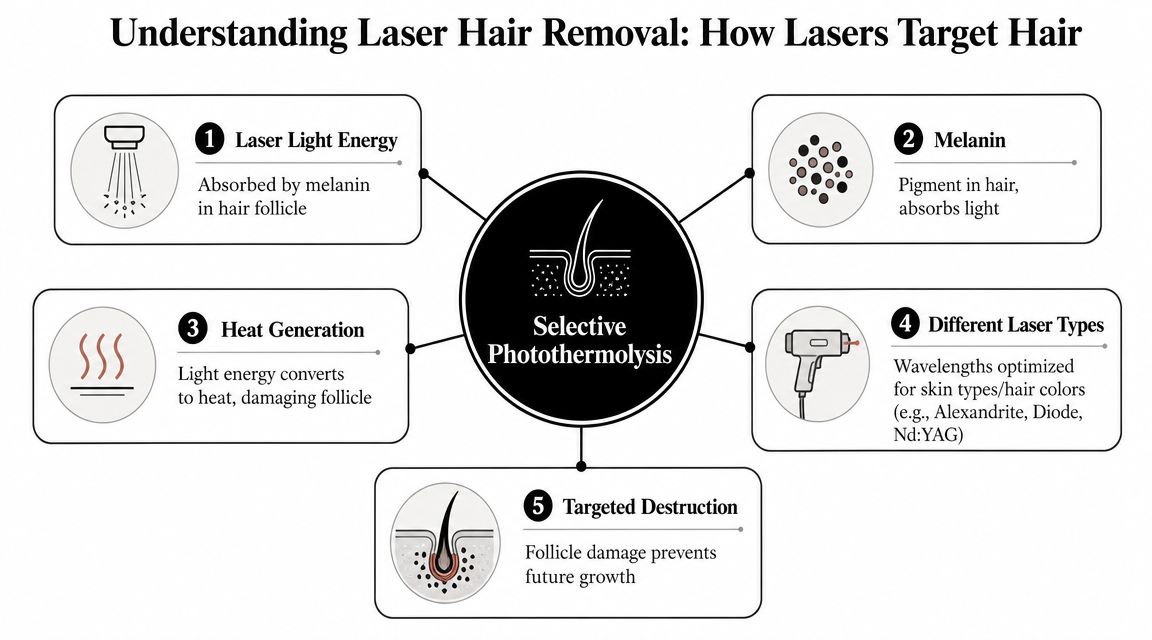
The answer is that the device is not using light at random. It uses a controlled wavelength chosen to be absorbed mainly by melanin, the pigment in the hair. Once that light is absorbed, it changes into heat inside the follicle. The goal is to injure the part of the follicle responsible for growing hair, while keeping the surrounding skin as protected as possible.
The simple science behind the beam
Clinicians call this selective photothermolysis. The name sounds technical, but the principle is straightforward. The laser is trying to heat the hair structure selectively, not the whole skin surface.
A useful way to picture it is a dark shirt warming up faster than a white one in sunlight. Darker hair absorbs laser energy more readily for the same basic reason. That is why coarse, dark hair usually responds better than blonde, grey, red, or very fine hair. Hair also responds best when it is in an active growing phase, because the follicle is more connected to the structures the laser needs to affect.
Here is the process in plain language:
| Part of the process | What it means in plain language |
|---|---|
| Light energy | The device sends a measured pulse into the skin |
| Melanin | Pigment in the hair absorbs that pulse |
| Heat | The absorbed light changes into heat inside the follicle |
| Follicle injury | The follicle becomes less able to produce strong regrowth |
That selective targeting is also why results vary from person to person. Hair colour, hair thickness, skin tone, recent tanning, and the body area all influence how well the energy can be directed where it needs to go.
Why laser choice matters for safety
Laser hair removal is not one single technology with one single setting. Different systems use different wavelengths, and each behaves a little differently in the skin. Alexandrite, Diode, and Nd:YAG devices are common examples. The wavelength affects the depth of energy penetration and how safely it can be used across different skin tones.
That choice matters because the therapist is balancing two things at once. The treatment needs enough energy to affect the follicle, but not so much that the surrounding skin absorbs too much heat. Darker skin contains more epidermal melanin, so device selection and settings need extra care to reduce the risk of burns or pigment changes.
This is one reason the earlier consultation matters so much at 3D Aesthetics. The assessment is not just about deciding whether you want treatment. It helps the therapist match the right device and settings to your skin and hair profile, and the 3D body scan adds a clearer map of the area being treated. That gives a more customized starting point than a quick visual guess.
A safe plan usually depends on questions like these:
- Is there enough pigment in the hair for the laser to target well?
- Which wavelength is the better fit for this skin tone?
- Is the hair coarse enough to respond predictably?
- Has the skin been tanned, irritated, or sensitised recently?
- Would a different hair removal method suit this person better?
If your hair is lighter, finer, or more scattered, another method may sometimes be discussed. Our guide to laser hair removal vs electrolysis explains the differences clearly and helps show why one option may suit your goals better than the other.
Safe treatment depends on matching the device, the settings, and the treatment area to the person in front of you.
A Step-by-Step Guide to Your Treatment Session
Most first-time clients feel calmer once they know what the appointment involves. The session itself is usually far less dramatic than people imagine. It's structured, controlled, and quite routine for your therapist.
From arrival to first pulse
When you arrive, the therapist checks the treatment area and confirms there haven't been any changes since your consultation. If you've had recent sun exposure, skin irritation, or started a new medication, they need to know before proceeding.
The area is then prepared. That usually means checking that it's shaved and clean, with no heavy creams, deodorant, or product sitting on the skin. You'll both wear protective eyewear, because eye protection is a standard safety step whenever the laser is in use.
Some systems use cooling built into the handpiece. Others may involve additional cooling support. This helps make treatment more comfortable and protects the skin surface while the laser energy targets the follicle beneath it.
What it feels like and what happens after
The sensation is often described as a quick flick against the skin, or a warm pinprick. Some areas are easier than others. Underarms may feel sharp but brief. The upper lip can feel more noticeable because the skin is delicate. Legs or backs may take longer because there's more area to cover.
A typical session moves in an organised pattern. The therapist places the handpiece, delivers pulses, checks skin response, and continues across the area methodically. You may notice a mild heat afterwards, a little redness, or a slightly flushed look. That's a common immediate response.
Here's what clients often notice during the appointment:
- The pace is controlled: The therapist doesn't rush through the area randomly.
- Comfort is monitored: If something feels too intense, settings can be reviewed.
- Smaller areas are quicker: Facial patches can be finished fast, while larger body areas naturally take longer.
- You can usually return to normal life straight after: There's little practical downtime, though the skin may feel warm.
For a fuller look at the sensation side of treatment, this page on whether laser hair removal hurts can help set expectations. Most clients find the anticipation is worse than the actual experience.
Why Multiple Sessions Are Essential for Success
A single appointment can only treat the hairs that are ready on that day. That is why laser hair removal is planned as a course, not a one-off fix.
The reason comes down to timing inside the follicle. Hair growth is staggered. Each follicle follows its own rhythm, so neighbouring hairs are often in different stages even within the same small patch of skin. Laser works best when the hair is actively growing and still firmly connected to the root.
Hair grows in cycles, not all at once
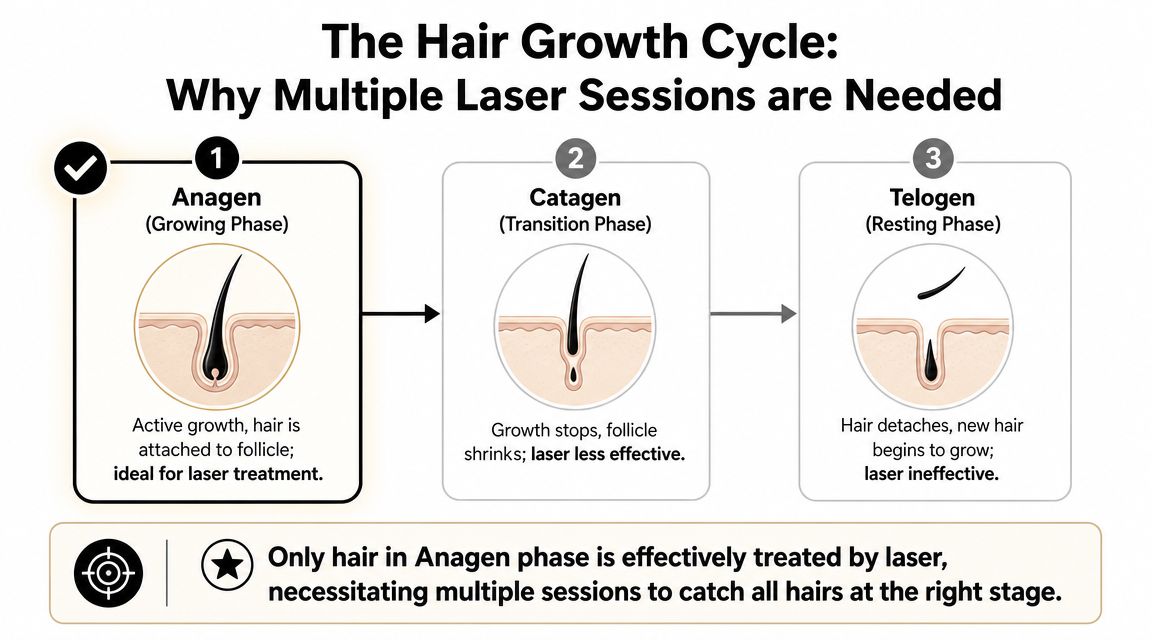
There are three main phases:
Anagen
The hair is actively growing. It is still attached deep in the follicle, so the laser can carry heat down to the part that needs to be treated.Catagen
The follicle is changing over. The hair is no longer in its strongest growing phase, so response is less predictable.Telogen
The hair is resting. It is not the ideal target because the connection the laser relies on is reduced.
A simple comparison helps here. Treating hair growth is a bit like catching buses that arrive on different timetables. If you stand at the stop once, you only catch the ones that happen to be there at that moment. Return at the right intervals, and you catch the next group.
That is why your therapist spaces appointments out rather than stacking them too close together. The gap gives more follicles time to enter the phase where treatment is most useful. At 3D Aesthetics, the schedule is also shaped by your consultation findings, including skin tone, hair type, treatment area, and the 3D body scanning assessment used to map the area accurately and support safe, optimized settings over the full course.
A course of sessions reflects how hair grows. It does not mean the first treatment failed.
What that means for your results
Early on, many clients notice patchy regrowth, slower growth, or hairs shedding from the treated area. All of those can be normal signs that treatment is doing its job. They can also be confusing if you were expecting every hair to disappear together.
What you usually see is a gradual reduction, not instant uniform smoothness. Some follicles were treated at the right moment. Others were inactive or between stages and need a later session.
Here is the practical picture:
| Stage | How well laser usually works |
|---|---|
| Anagen | Best response |
| Catagen | Reduced response |
| Telogen | Limited response |
This is also why two clients having the same area treated may not follow exactly the same timetable. Hormones, density of hair, skin response, and previous hair removal habits can all affect how the course is planned. The consultation process matters here because it helps the therapist set realistic expectations from the start, rather than giving a generic number of sessions to everyone.
Patience is part of the process. Each appointment builds on the last one, and the goal is steady long-term reduction with safe settings chosen for your skin and hair, not trying to force a quick result the biology will not support.
Your Pre-Treatment and Post-Treatment Care Plan
Results don't depend only on the machine. They depend on what happens between appointments as well. Good preparation makes treatment safer. Good aftercare helps the skin settle properly.
A simple checklist is often the easiest way to remember what matters.
What to do before each appointment
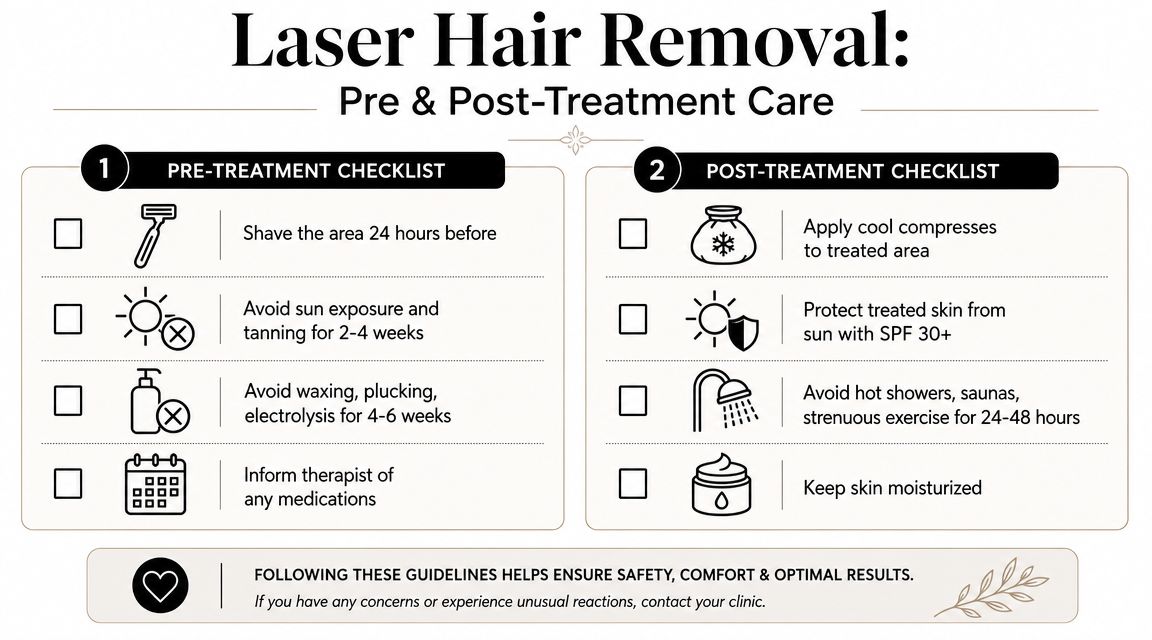
- Shave the area as advised: Shaving leaves the follicle in place under the skin, which gives the laser something to target.
- Avoid waxing or plucking beforehand: These methods remove the hair from the root, and that makes laser treatment less useful.
- Minimise sun exposure: Recently tanned or sun-sensitive skin can be more reactive.
- Tell your therapist about medication changes: Some medicines can affect skin sensitivity.
One of the easiest mistakes is assuming all hair removal methods are interchangeable before laser. They aren't. If you wax the area between sessions, you can interfere with the treatment plan because the target under the skin has been removed.
This short video gives a useful visual overview of sensible preparation and aftercare:
How to look after your skin afterwards
After treatment, the skin can feel warm and look pink for a while. That doesn't usually mean anything has gone wrong. It often means the skin has reacted in the expected short-term way.
These steps usually help:
- Keep the area cool: A cool compress can be soothing if the skin feels hot.
- Skip heat for a short period: Hot baths, saunas, and intense workouts can aggravate freshly treated skin.
- Use gentle skincare: Fragrance-free moisturisers or soothing products are often more comfortable than active exfoliants.
- Protect the area from sun exposure: Sunscreen matters, especially on exposed areas like the face or lower legs.
Aftercare advice: Treat the area like skin that's briefly sensitive, not like skin that needs scrubbing back to normal.
If anything feels unusually uncomfortable, or the skin reaction seems stronger than you expected, contact your clinic. Clients are sometimes tempted to self-diagnose online when a simple follow-up with the therapist would be more reassuring and more accurate.
Understanding Your Results and Long-Term Outlook
Results usually arrive gradually, not all at once. Hair often becomes patchier, slower to return, and softer in texture across the course of treatment. Some hairs may shed after sessions. Others may seem to reappear before later sessions reduce them further. That stop-start pattern can feel confusing if you were expecting a straight line from “hairy” to “hair-free”.
What results usually look like over time
Laser hair removal is one of the most popular non-surgical procedures in the UK. The Mayo Clinic notes that most patients require 4 to 8 treatments for optimal results, and that some hair may grow back over time, often finer and lighter in colour, with maintenance sometimes needed, according to the Mayo Clinic overview of laser hair removal.
That's a helpful expectation to hold onto. The aim is long-term reduction, not a promise that every single hair will disappear forever and never return under any circumstances.
What permanent reduction really means
In practice, “permanent hair reduction” means a lasting reduction in how much hair grows, how quickly it grows, and how noticeable it is. For many people, that means less shaving, fewer ingrown hairs, and smoother skin for longer stretches. It doesn't mean your body stops being a body.
Hormones, age, genetics, and individual response all shape the long-term picture. Some clients need occasional maintenance. Some areas respond faster than others. Some people discover that one area is an excellent candidate while another is less predictable.
A realistic outlook usually includes these points:
- Progress is cumulative: Each session contributes to the overall result.
- Some regrowth can happen: It may return finer and lighter.
- Maintenance can be normal: Especially if your hair growth is influenced by hormonal changes.
- Suitability still matters: Hair colour and skin type influence response.
Short-term side effects are usually straightforward. Mild redness or slight swelling around follicles can happen after treatment and often settles. The bigger priority is choosing a provider who assesses properly, matches the device carefully, and gives clear aftercare.
The most satisfied clients are often the ones who start with realistic expectations. They don't expect magic after one session. They expect a plan, steady progress, and a treatment course designed around how hair grows.
If you're considering laser and want a personalised assessment, you can book a consultation with 3D Aesthetics Leamington Spa. A proper consultation can help you understand whether your skin and hair are suitable, what kind of reduction is realistic, and how a customized treatment course would look for you.
← Back to Home