
You've probably done some version of this already. You stand near a window, tilt your face, and notice the same tiny deep marks catching the light. Makeup doesn't sit smoothly over them. Good skincare helps your skin feel healthier, but the dents stay put. That's usually the moment people start searching for ice pick scar removal and realise the advice online is all over the place.
The confusion makes sense. Ice pick scars don't behave like surface texture, and they usually don't respond well to one simple treatment. They need a more precise plan. In practice, the best results often come from matching the right tool to the right scar, then sequencing treatments so each one does a specific job.
Table of Contents
- What Are Ice Pick Scars and Why Are They So Stubborn
- A Guide to Professional Ice Pick Scar Removal Treatments
- Enhancing Results with Supporting Skin Treatments
- Why a Combined Treatment Approach Is Essential
- How We Create Your Scar Removal Plan at 3D Aesthetics
- Managing Downtime Risks and Results
- Ice Pick Scar Removal FAQs
What Are Ice Pick Scars and Why Are They So Stubborn
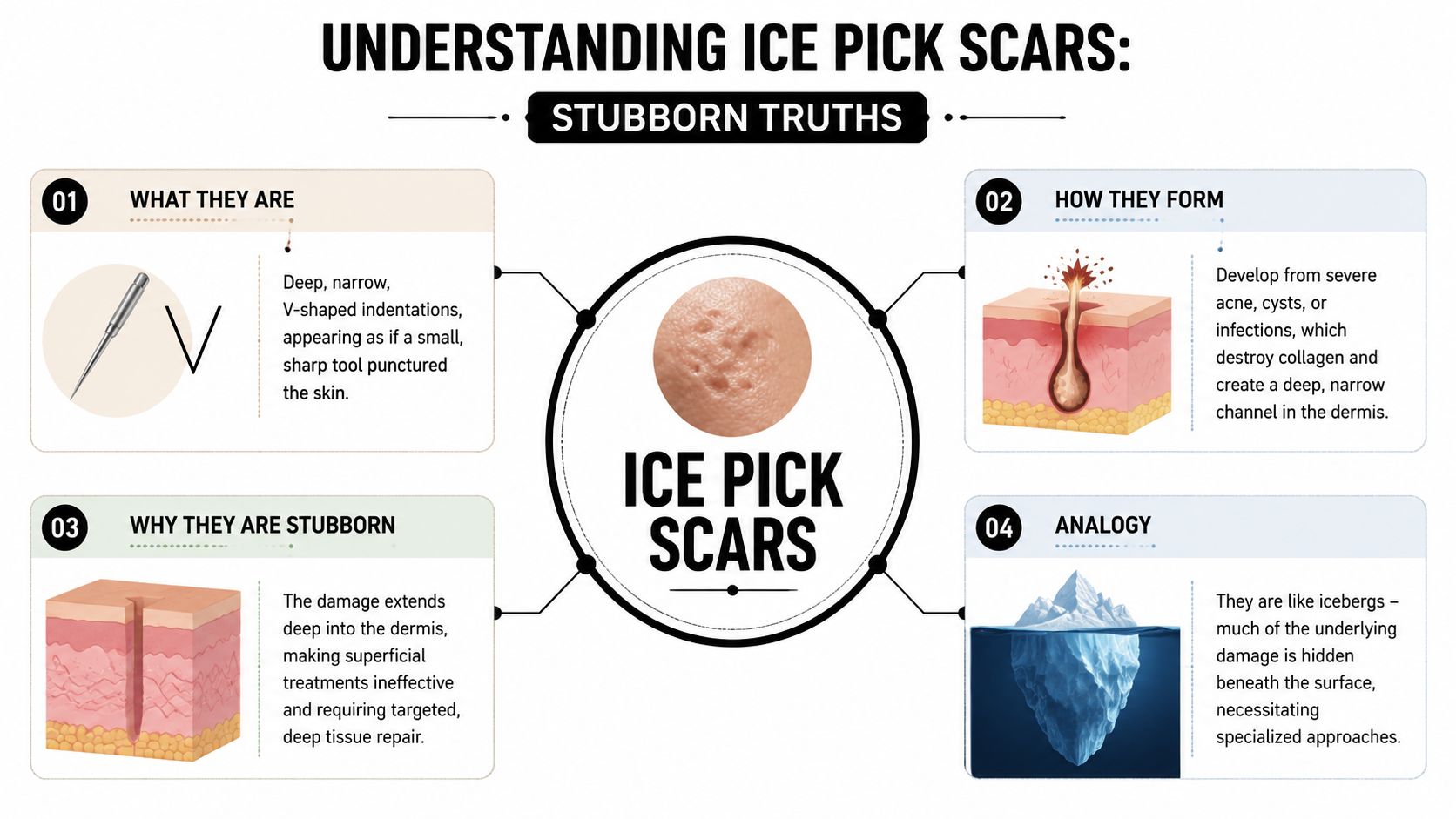
Ice pick scars are the scars people often describe as “tiny holes” or “little punctures” in the skin. That description is close to the truth. They're narrow at the surface and track down into the skin like a sharp point pressed into clay.
What ice pick scars actually look like
A simple way to picture them is to think of a pinprick in firm wax. The opening may look small, but the channel underneath can run much deeper than you'd expect. That's why they often look more obvious in side lighting than straight-on.
They're also very common. In UK clinical populations, ice pick scars account for approximately 60 to 70% of all atrophic acne scars according to epidemiological analyses of acne scar morphology. If you've felt like your skin concern is both common and oddly hard to explain, that's because it is common, but it needs more specific language than “acne scarring” on its own.
Ice pick scars aren't just rough texture. They're deep focal defects, and that changes everything about treatment.
Why creams and superficial treatments fall short
It's understandable that people become frustrated. If a problem is visible on the skin, it seems logical to treat the skin surface. But ice pick scars usually extend into deeper layers, so surface-only approaches often soften the surrounding skin without changing the actual depth of the scar very much.
That's why many at-home acids, scrubs, masks, and standard facials can improve glow yet leave the pit itself largely unchanged. They may help the “canvas” look healthier, but they don't remove the narrow tunnel-like structure.
A helpful distinction is this:
- Boxcar scars tend to look broader with more defined edges.
- Rolling scars create softer dips and uneven waves.
- Ice pick scars are narrow, deep, and more resistant to broad resurfacing alone.
When someone says, “I've tried everything and these marks won't budge,” they're often dealing with the wrong treatment depth, not a lack of effort.
A Guide to Professional Ice Pick Scar Removal Treatments
When clinics treat true ice pick scars, they usually rely on a short list of stronger, more targeted methods. These aren't interchangeable. Each one solves a different problem.
TCA CROSS for narrow deep pits
TCA CROSS stands for chemical reconstruction of skin scars. In practical terms, a practitioner places a high-strength trichloroacetic acid directly into the scar opening rather than sweeping acid across the whole face.
For ice pick scars, this technique uses TCA at 70 to 100%, applied into the scar, and it has been shown to produce visually significant improvement of more than 20% in scar depth in up to 60 to 70% of treated sites after three to four sessions in the evidence reviewed in this clinical paper on acne scar management. The same review notes sessions are typically spaced 4 to 6 weeks apart, with 3 to 7 days of erythema or peeling, and describes dermal remodelling over 3 to 6 months.
Why it works is easier to understand if you think of it as controlled rebuilding from inside the pit. The acid creates a precise injury within the scar wall. Your skin then responds by laying down new collagen as it heals, so the scar becomes shallower and less sharply defined over time.
TCA CROSS is often a strong choice when:
- The scars are very narrow and difficult to reach with broader treatments.
- You want focal treatment rather than full-face peeling.
- You can tolerate repeat sessions and gradual change.
Its limitation is equally important. It treats individual pits well, but it doesn't automatically solve broader redness, mixed scar types, or overall surface irregularity.
Punch excision for the deepest individual scars
Some ice pick scars are too deep and too sharply tethered for chemical remodelling alone. That's where punch excision comes in. It's considered the gold-standard surgical technique for deep, narrow ice pick scars under 3 mm in diameter in this surgical acne scar review.
The logic is surprisingly straightforward. Instead of trying to fill a narrow vertical shaft from above, the practitioner removes the scar and closes the skin so the defect becomes a finer linear mark. A vertical hole is converted into a flatter line that usually blends better as it matures.
The same review reports that punch excision can reduce the visual impact of individual lesions by 60 to 80% at 6 months, with revision rates under 5% when performed under the described conditions. It also notes that device-based treatments such as fractional CO2 or radiofrequency approaches often produce 30 to 50% improvement in comparable ice pick lesions, which is why they're often better used as adjuncts for the remaining textural work rather than as the only tool for the deepest pits.
Practical rule: The deepest, narrowest scars often need to be removed or structurally changed first. Refinement treatments make more sense after that.
Fractional CO2 laser for wider textural blending
Fractional CO2 laser isn't usually the first answer for the sharpest individual ice pick scars, but it can be very useful for the skin around them. It works by creating columns of thermal injury in the skin, which stimulates remodelling and helps smooth more diffuse textural unevenness.
That makes it valuable when the face has a mixed pattern. For example, someone may have a handful of true ice pick scars plus flatter areas of post-acne roughness. In that setting, laser can help blend transitions and improve the overall look of the treated area after focal work has been done.
If you want a patient-friendly overview of how clinics describe Skin Revision treatment options, that resource is useful because it presents the main routes side by side. If you're specifically exploring laser resurfacing, this page on CO2 laser scar removal gives a practical view of how that modality is positioned within scar care.
Ice Pick Scar Treatment Comparison
| Treatment | How It Works | Best For | Typical Downtime | Expected Improvement |
|---|---|---|---|---|
| TCA CROSS | High-strength TCA is applied directly into the scar to trigger collagen remodelling within the pit | Multiple narrow ice pick scars | Often a few days of visible redness or peeling | Up to 60 to 70% of treated sites show visually significant improvement of more than 20% after three to four sessions in the cited review |
| Punch excision | The scar is physically removed and the skin is closed so it heals as a finer line | Very deep, narrow, isolated scars | Depends on healing and suture care | Individual lesions may improve by 60 to 80% at 6 months in the cited review |
| Fractional CO2 laser | Fractionated thermal injury stimulates resurfacing and collagen remodelling | Broader texture issues and blending after focal treatment | Varies by intensity and area treated | Often best viewed qualitatively as a texture-refining treatment, especially when used with other methods |
Enhancing Results with Supporting Skin Treatments
Primary treatments do the heavy lifting. Supporting treatments improve the finish.

Why supporting treatments matter
A face with acne scarring rarely has one single issue. There may be deep pits, uneven tone, enlarged pores, rough texture, and areas where the skin looks slightly crêpey or lax. If you only treat the deepest scars and ignore the rest, the result can still feel incomplete.
That's where treatments like RF microneedling, conventional microneedling, LED support, and a sensible skincare plan can help. They don't replace the focal work used for true ice pick scars, but they can improve the surrounding skin so the final result looks more coherent.
Useful supporting roles often include:
- Texture refinement: Microneedling-based treatments can help the skin surface look smoother overall.
- Collagen support: Energy-based treatments can encourage remodelling in the wider treatment zone.
- Recovery support: Some clinics use light-based options to calm the skin after stronger procedures.
- Routine optimisation: Better barrier care can make healing more predictable and reduce irritation between sessions.
A home routine matters too, but it needs realistic expectations. Cleansers and exfoliants won't remove a deep ice pick scar, yet they can help maintain clarity and brightness. If you're comparing exfoliating cleansers, this guide to the benefits of AHA facial washes is a helpful primer on where that sort of product fits, and where it doesn't.
Skin quality changes the final result
Think of scar treatment like repairing dents in a wall before repainting a room. Fixing the dent matters most. But the paint finish still looks better when the whole surface is smoother.
That same principle explains why clinicians often pair focal scar work with broader skin-quality treatments. A person may need TCA CROSS or punch-based correction for the pits, then later use texture-improving options to soften the overall contrast between scarred and non-scarred skin.
For recovery-focused support, some patients also look into Dermalux LED therapy, which is often discussed as a calming adjunct within skin treatment plans.
This short video gives a useful visual sense of how professional scar-focused skin treatments fit into a broader plan:
Why a Combined Treatment Approach Is Essential
A common question is, “Which treatment is best?”
The better question is, “Which combination fits my scar pattern?”
One scar type rarely tells the whole story
Even if ice pick scars are your main concern, your skin probably doesn't present as a row of identical marks. One cheek may have three very deep pits. Another area may have shallow textural change. The chin may show old post-acne irregularity that catches light differently.
That's why a one-tool plan often disappoints. A treatment that's excellent for a single narrow pit may do very little for widespread roughness. A treatment that improves overall texture may not be strong enough for the deepest focal defects.
Recent UK health-economics work notes that fractional laser and microneedling protocols are often delivered in multiple sessions, while public information rarely breaks down cumulative burden clearly, leaving patients unsure whether to prioritise speed, cost, downtime, or maintenance according to this UK review on acne scarring care and outcomes. That uncertainty is exactly why personalised planning matters.
The best scar plan usually looks less like a single headline treatment and more like a toolkit used in the right order.
Sequencing matters as much as selection
A useful analogy is home renovation. You don't polish the walls before fixing the holes in them. Scar treatment works the same way.
A thoughtful sequence might look like this:
Structural correction first
Very deep individual scars may need punch excision or another focal method because they're the hardest defects to disguise.Targeted remodelling next
TCA CROSS may then be used for remaining narrow pits that still need depth reduction.Surface blending later
Broader textural treatments can help the area look more even once the worst focal defects have been addressed.Maintenance and refinement
Skin-quality treatments may support collagen and improve overall finish over time.
This is one reason people often explore technologies such as 3D microneedling as part of a wider plan rather than expecting one session to solve every layer of scarring.
How We Create Your Scar Removal Plan at 3D Aesthetics
Good scar planning starts by slowing the conversation down. Individuals often arrive with a treatment name in mind, but what they need is a proper match between scar type, skin behaviour, and tolerance for downtime.

What happens at the first consultation
At 3D Aesthetics, the process begins with a complimentary consultation and a detailed assessment rather than a quick recommendation. The aim is to work out whether the marks you dislike are true ice pick scars, mixed atrophic scarring, enlarged pores, post-inflammatory colour changes, or a combination of several things.
That distinction matters because many UK patients still aren't given clear personalised guidance on how treatment choice should be adapted to scar depth, skin type, and Fitzpatrick type, a gap noted in this publication on acne scarring education and variation in dermatology training.
A consultation should answer practical questions such as:
- Which scars are treatable with non-surgical options
- Which areas need focal correction and which need blending
- How much downtime feels realistic for you
- Whether active acne or skin sensitivity needs controlling first
How a bespoke plan is built
The clinic's broader assessment approach helps make treatment planning more objective. Instead of relying only on a mirror view, practitioners can use consultation findings and scan-based observations to judge pattern, depth, and progress over time.
A bespoke plan may include one flagship treatment or a staged combination depending on what the skin shows. One client may be steered toward resurfacing and collagen-focused work because their scarring is mixed and diffuse. Another may be told that a few deep pits are unlikely to respond well unless they're structurally addressed first.
A trustworthy consultation doesn't just tell you what can improve. It also tells you what probably won't change much with the wrong method.
That kind of transparency is especially important with ice pick scar removal, because the treatment name people ask for isn't always the treatment their skin most needs.
Managing Downtime Risks and Results
Scar treatment gets easier when you expect the healing process to look a bit untidy before it looks better. Many people worry that redness, tiny crusts, dryness, or temporary roughness mean something has gone wrong. In most cases, those short-term changes are part of the normal repair phase after professional treatment.
What healing usually looks like
Different treatments create different recovery patterns. TCA CROSS often causes small treated spots to darken or crust before they shed. Laser resurfacing can leave the skin feeling warm, pink, tight, and flaky for a period. Microneedling-based treatments may bring temporary redness and sensitivity.
The key point is that improvement usually doesn't appear all at once. The visible mark on the surface may settle first, but the more meaningful change happens underneath as collagen remodelling progresses.
Helpful mindset shifts include:
- Judge results late, not early: Freshly treated skin often looks worse before it looks smoother.
- Protect the skin barrier: Gentle cleansing, moisturising, and following aftercare advice matter more than adding lots of active products.
- Avoid picking or over-treating: Healing skin is easy to irritate, and impatience can create setbacks.
How to protect your result
Aftercare isn't a side note. It's part of the treatment outcome. Sun protection, friction avoidance, and restraint with acids or retinoids during recovery can influence how evenly the skin settles.
It also helps to think in seasons rather than days. Ice pick scar removal is usually a process of cumulative gains. You may notice one scar looks softer, another blends better in certain light, and the overall skin texture starts to look calmer over repeated healing cycles.
Healing collagen works on skin time, not on mirror-checking time.
Ice Pick Scar Removal FAQs
Can ice pick scars be completely removed?
Usually, the better aim is meaningful improvement, not a promise of perfection. Some scars can become much less visible. Very deep scars may still leave a trace even after good treatment.
Are at-home dermarollers enough?
For true ice pick scars, usually not. Home devices may have a role in general texture care, but they don't offer the precision or depth control needed for narrow, deep pits. Used aggressively, they can also irritate the skin.
How many sessions will I need?
It depends on the treatment and the scar pattern. Some approaches are done as a course, while others are used for selected scars and then followed with refinement treatment. A proper consultation is the only reliable way to judge that.
Is one treatment always enough?
Often, no. Mixed acne scarring usually responds best when the deepest pits are treated differently from the surrounding texture.
Are these treatments safe for darker skin tones?
They can be, but planning becomes more important. The practitioner needs to consider your skin type carefully, especially when choosing resurfacing intensity and aftercare.
When should I start treatment?
Once active acne is under control, scar treatment planning becomes much clearer. If breakouts are still ongoing, protecting the skin from new scars is usually part of the strategy.
If you're ready for clear, honest guidance on ice pick scar removal, book a consultation with 3D Aesthetics Leamington Spa. The team offers a detailed assessment, personalised treatment planning, and advanced non-surgical options designed around your scar pattern, skin type, and comfort with downtime.