
If you're comparing laser hair removal and IPL right now, you're probably tired of managing the same problem on repeat. Shaving lasts a day or two. Waxing means planning around regrowth. Tweezing turns a small irritation into an ongoing routine. At some point, most clients stop asking for a temporary fix and start asking for a treatment that reduces hair properly over time.
That's where the confusion usually starts. Both laser hair removal and IPL use light to target the follicle. Both are marketed as long-term solutions. Both can reduce hair growth. But they are not interchangeable, and the difference matters more than many comparison pages suggest.
In clinic, the better question isn't “Which one is better?” It's which one is better for your skin tone, hair colour, treatment area, budget, and comfort level. A method that makes sense for underarms on fair skin may be the wrong choice for facial hair, darker skin, or low-contrast hair. Cost also needs to be judged over a full treatment plan, not just by the cheapest session price.
This guide takes a practical UK view of laser hair removal vs IPL. It focuses on how the technologies work, where each performs well, where they fall short, and how to choose a provider safely.
Table of Contents
- Introduction The Quest for Smooth Skin
- How Light Based Hair Removal Actually Works
- A Detailed Comparison of Laser and IPL
- Which Treatment Is Right for Your Skin and Hair
- Understanding Safety Side Effects and Downtime
- Your Guide to Choosing a Quality Provider
- Frequently Asked Questions About Hair Removal
Introduction The Quest for Smooth Skin
Individuals don't typically start looking into advanced hair removal because they're curious about technology. They start because they're fed up. The constant cycle of shaving, waxing, ingrown hairs, missed patches, and regrowth becomes expensive in time, frustrating in practice, and tiring to maintain.
That's why long-term hair reduction appeals to so many clients. It offers a route away from high-maintenance grooming and towards a plan that works with the hair-growth cycle instead of fighting it every few days. In clinic, that shift is often what changes the conversation. Clients stop asking how to remove hair today and start asking how to reduce it properly over time.
Two names usually come up first. Laser hair removal and Intense Pulsed Light (IPL).
They sound similar, and on the surface they can look similar too. Both involve flashes of light. Both target pigment in the hair. Both are used for repeated treatments. But the technology, precision, treatment efficiency, and suitability across skin and hair types are different enough that a proper comparison matters.
Clinical perspective: The right treatment is usually the one that matches the person in front of you, not the one with the loudest marketing.
The most useful way to approach laser hair removal vs IPL is to treat it like a decision framework. Start with four questions:
- Your skin tone: Some devices are safer and more effective on certain skin types than others.
- Your hair colour and thickness: Dark, coarse hair behaves very differently from fine, light hair.
- Your treatment area: Facial hair often responds differently from underarms, legs, or bikini.
- Your priorities: Some clients want speed. Others want comfort. Others care most about value over a full course.
Once those factors are clear, the choice usually becomes much easier.
How Light Based Hair Removal Actually Works
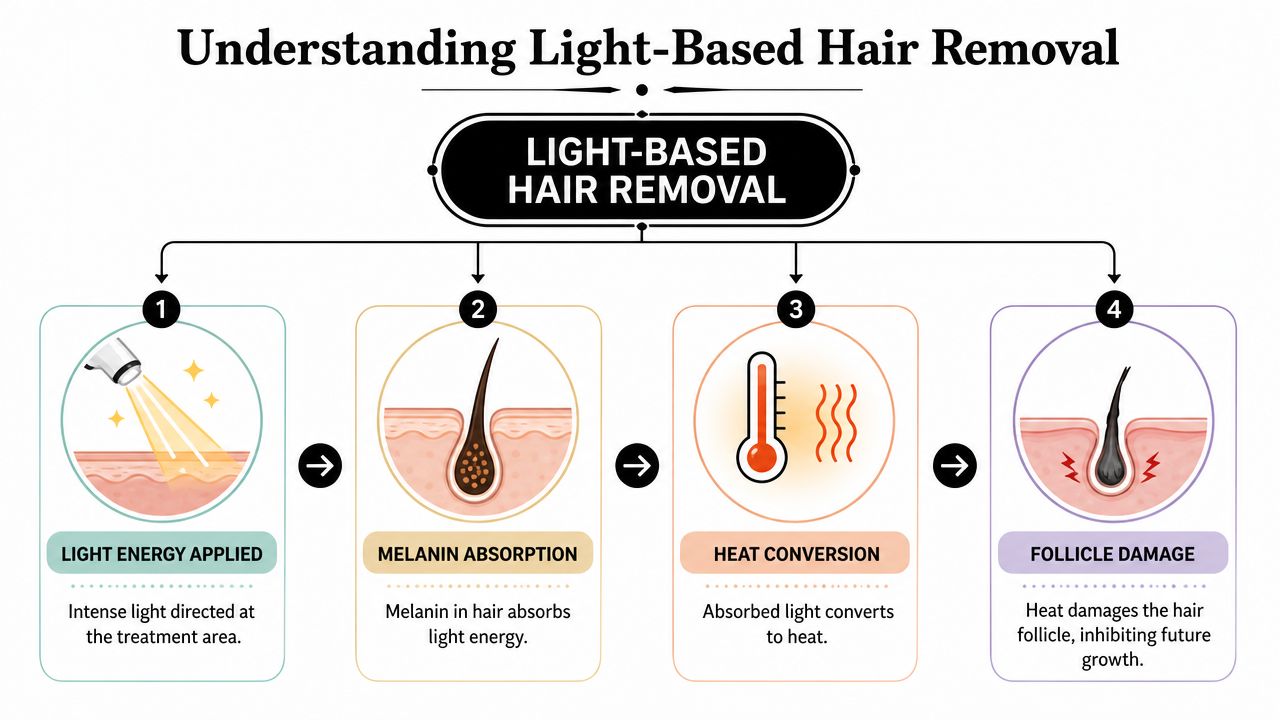
Both treatments rely on the same basic principle. Light is delivered into the skin and is absorbed by melanin, the pigment in the hair. That light energy converts into heat. The heat then damages the follicle so future growth is reduced.
That's the shared mechanism. The important difference lies in how the light is delivered.
Laser uses a focused wavelength
In UK practice, the key technical distinction is that laser hair removal uses a single, monochromatic wavelength, while IPL uses broad-spectrum pulsed light. Because laser energy is more selective and collimated, it generally reaches follicles more precisely and is reported to need fewer sessions for durable reduction. UK clinical commentary also notes that newer laser systems with integrated cooling can be more comfortable and can treat a wider range of skin and hair types than IPL devices, as outlined by Harley Street Skin Clinic's explanation of IPL versus laser hair removal.
A simple way to think about it is this:
- Laser is targeted: It sends one focused wavelength towards the follicle.
- IPL is broad: It sends out a wider spread of light, more like a flash.
That difference affects precision, efficiency, and skin suitability.
IPL uses a wider light range
IPL is not a laser. It uses multiple wavelengths of light rather than one concentrated beam. That broader delivery can still reduce hair, but it is less selective. In practical terms, more energy may spread into surrounding tissue rather than concentrating on the follicle alone.
This is one reason consultations matter. The treatment only works well when there is enough contrast between hair pigment and the surrounding skin for the light to target the follicle effectively. If that contrast is poor, results become less predictable and safety needs closer assessment.
IPL can work well in the right candidate. It just isn't as universally forgiving as many adverts imply.
Why multiple sessions are always needed
Neither laser nor IPL removes every hair in one appointment because hair grows in different phases. Light-based treatment is most effective when the follicle is in the active growth stage. Since not all follicles are in that phase at once, treatments are spaced over time.
That's why a professional plan isn't just about the device. It also depends on timing, body area, and consistent follow-up. Clients who understand this from the start tend to be much happier with the process and less vulnerable to unrealistic promises.
A Detailed Comparison of Laser and IPL
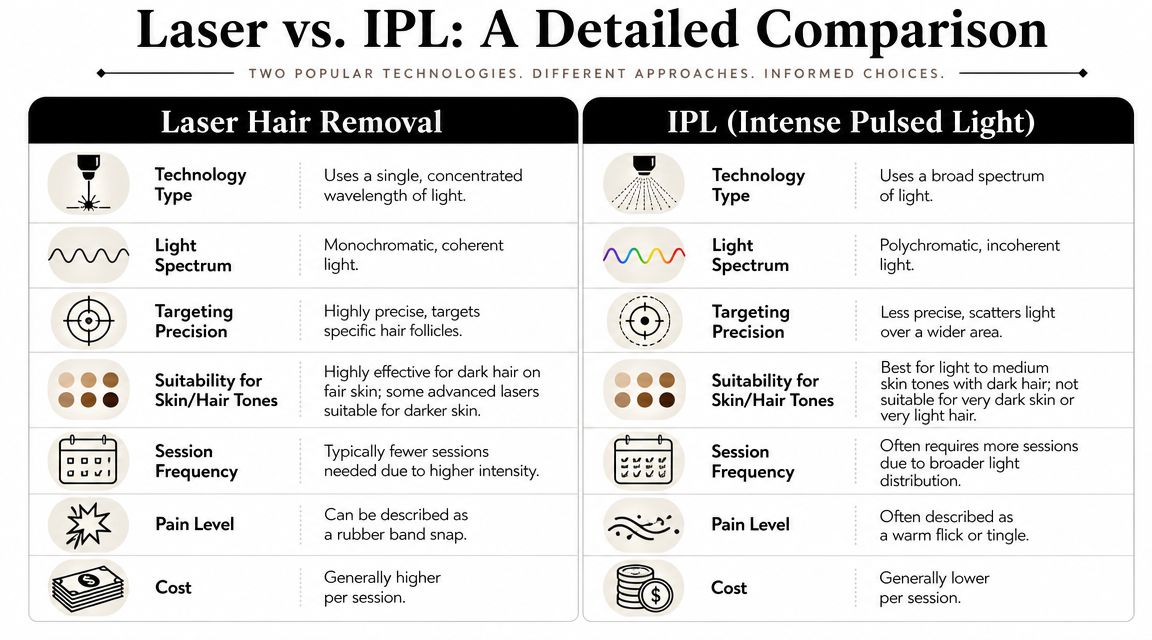
For most clients, the clearest starting point is a side-by-side view.
| Feature | Medical-Grade Laser | IPL (Intense Pulsed Light) |
|---|---|---|
| Technology | Single, focused wavelength | Broad-spectrum pulsed light |
| Precision | More targeted follicle delivery | Less selective light spread |
| Efficiency | Often better for durable reduction | Can work, but usually less consistent |
| Comfort | Can feel sharper, though cooling helps | Often feels gentler to some clients |
| Speed per treatment | Often efficient in experienced hands | Can also cover larger areas quickly |
| Skin and hair suitability | Broader range with the right system | More dependent on favourable contrast |
| Value question | Higher session price in many clinics | Lower session price in many clinics, but not always better value overall |
Effectiveness and precision
The biggest practical difference in laser hair removal vs IPL is precision. Laser devices concentrate energy more narrowly, so they generally target the follicle more efficiently. That matters most in clients who want stronger long-term reduction, are treating coarse hair, or have struggled with inconsistent results elsewhere.
A randomised trial found that diode laser achieved greater hair-count reduction than IPL at both 3 and 12 months, with results of 59.7% and 69.2% for diode laser versus 42.4% and 52.7% for IPL. The same trial also found that diode laser was more painful but faster to perform. You can review those figures in the PubMed record for the randomised trial comparing diode laser and IPL.
That's a useful finding because it reflects real clinic trade-offs. Better reduction doesn't always mean a gentler sensation. Faster treatment doesn't always mean the cheaper option per appointment. What matters is whether the overall plan gives you the best outcome for your profile.
Treatment plan and session expectations
Most clients focus on the per-session price first. That's understandable, but it can be misleading.
A lower-cost session only represents good value if the treatment is suitable for your skin and hair and produces a worthwhile reduction pattern over time. If a cheaper option needs more appointments, produces a weaker response, or leaves certain areas patchy, the headline price stops being the relevant figure.
Consider the treatment plan through these questions:
- How well does the device match my skin and hair? A good match usually matters more than the cheapest starting cost.
- How evenly does the area respond? Patchy reduction often creates frustration even if some hairs improve.
- Am I paying for speed, comfort, or stronger reduction? Different clients prioritise different outcomes.
Value rule: Judge the full course, not the sticker price of one session.
A well-run consultation should discuss all three. If a provider talks only about package pricing and not suitability, that's a warning sign.
To see the technologies discussed visually, this short overview is useful:
Pain and comfort
Pain tolerance is personal. Some clients describe laser as a quick snap. Others find IPL more comfortable. Area matters too. Underarms, bikini, upper lip, and jawline usually feel more intense than lower legs or arms.
Modern laser systems have improved the comfort side significantly through cooling features and better pulse control. That doesn't mean laser feels mild for everyone. It means the old assumption that laser is always harsh and IPL is always easy is too simplistic.
In practice:
- If you prioritise stronger reduction: Laser often makes more sense.
- If you're highly sensation-sensitive: Comfort features, treatment area, and device choice matter as much as the category itself.
- If you want a quick appointment: Faster delivery can be worth more than a gentler but longer session.
Cost versus result
Many online comparisons fall short. They stop at “laser is stronger” and “IPL is cheaper.” That isn't enough to guide a real decision.
A better question is: What gives the best cost-per-result for my skin, hair, and treatment area?
For some clients, IPL may still be a reasonable value choice. For others, especially where precision matters, laser can be the better investment even if the session price is higher. The right answer depends on how likely the device is to deliver consistent, durable reduction in your specific case.
Which Treatment Is Right for Your Skin and Hair
Personal suitability matters more than broad claims. Two people can book the same treatment area and get very different recommendations because their skin tone, hair pigment, hair thickness, and hormonal pattern are different.
For Fair Skin and Dark Hair
This is usually the most straightforward profile for light-based hair removal. The contrast between lighter skin and darker hair makes it easier for the device to target pigment in the follicle.
In this group, both laser and IPL may be considered, but laser often has the efficiency advantage. If the goal is stronger reduction with fewer compromises on precision, laser is usually the cleaner fit. IPL may still appeal to clients who are weighing budget carefully and have a treatment area that tends to respond well.
If you're comparing this with other permanent hair reduction routes, it can help to read a separate discussion of laser hair removal versus electrolysis before choosing.
For Darker Skin Tones
Consequently, device selection becomes much more important. The wrong technology or poor settings can increase the risk of irritation and make results less reliable.
Broad-spectrum IPL is more dependent on a clear pigment contrast. That's why it often becomes less suitable as skin tone deepens. In darker skin, practitioners generally look more carefully at laser platform, pulse settings, cooling, and test response rather than assuming any light-based treatment will do.
The main point is simple. You should never choose based on marketing language alone if you have a deeper skin tone. You need a clinician or trained therapist who understands the device properly and will patch test conservatively.
Darker skin can absolutely be treated. It just requires the right technology and the right operator.
For Lighter Hair Colours
Blonde, red, grey, and very fine hairs are more difficult because there is less pigment for the light to target. This is one of the most common sources of disappointment in hair removal consultations. Clients are often told what they want to hear instead of what the technology can realistically do.
If the hair has limited pigment, both laser and IPL become less reliable. In those situations, the safest consultation is an honest one. Sometimes the right answer is “results may be modest,” not “buy a package and hope.”
Treatment Area Matters More Than Most Clients Expect
The body area changes the conversation. A 2022 systematic review of randomised trials found that IPL delivered average long-term hair reduction of 52.7% to 27%, with the lowest reduction on the face and the highest on the axilla, across three IPL trials. The same review included 223 patients across five eligible randomised controlled trials, which is a relatively small but still useful evidence base for comparing light-based methods. The review supports a practical point clinicians already see often. IPL outcomes are less uniform than many marketing claims suggest, and response varies by body site and hair-growth cycle, as detailed in the systematic review of light-based hair removal trials.
That matters because clients often assume one good result on underarms will translate directly to chin, upper lip, or jawline. It often doesn't.
A sensible way to think about area-based choice is:
- Face: Be cautious about overpromised IPL results. Facial hair can be hormonally influenced and less predictable.
- Underarms and some body areas: These may respond more consistently.
- Areas with mixed hair texture: Precision becomes more valuable.
If your provider doesn't separate advice by treatment area, the recommendation is probably too generic.
Understanding Safety Side Effects and Downtime
Most clients don't need a dramatic downtime plan after laser or IPL. What they do need is realistic preparation and sensible aftercare. Mild redness, warmth, and a temporary feeling of sensitivity are common responses after treatment. Around follicles, you may also see slight swelling. In clinic, that is usually treated as a normal short-term reaction rather than a sign that something has gone wrong.
What's normal after treatment
The typical early response is similar to mild heat in the skin. Some areas settle quickly. More sensitive zones can take longer to calm down. The key difference between a normal response and a concerning one is whether symptoms are improving steadily rather than escalating.
Clients should also expect to follow aftercare properly. That includes avoiding friction, excess heat, and unnecessary irritation immediately after treatment. Sun behaviour matters as well. Tanned or recently sun-exposed skin changes how safely light energy can be used.
The biggest safety factor is the operator
In practice, the largest risk isn't the concept of laser or IPL itself. It's poor assessment, poor settings, or poor judgement.
A safe clinic should always check:
- Your skin history: Sensitivity, pigmentation issues, recent sun exposure, and any reactions to previous treatments.
- Your hair characteristics: Colour, density, and whether the area is hormonally driven.
- Your suitability on the day: Skin can look different from one appointment to the next.
If you're nervous about discomfort, it may help to read more about whether laser hair removal hurts and what the sensation usually feels like in real treatment settings.
Good hair removal treatment starts before the first pulse. It starts with deciding whether you should be treated at all that day.
Downtime is minimal, but caution isn't optional
Many clients return to normal routines quickly, but “minimal downtime” should never be interpreted as “no aftercare.” That's where people get careless. Heat exposure, active skincare, heavy gym sessions, and sun exposure can all aggravate freshly treated skin if introduced too quickly.
The safest mindset is to treat the skin as temporarily reactive. Choose a clinic that gives clear written aftercare rather than vague verbal reassurance.
Your Guide to Choosing a Quality Provider
The device matters, but the provider matters more. A strong machine in untrained hands is not a safer option than a well-run clinic using the right protocol conservatively.
What to look for before you book
A worthwhile provider should offer more than a treatment menu. You want a process that shows they assess suitability properly.
Look for these signs:
- A proper consultation: They should ask about skin type, hair colour, medications, sun exposure, previous treatments, and your expectations.
- Patch testing: This isn't a formality. It helps assess skin response and supports safer parameter selection.
- Clear treatment planning: You should understand why a device has been recommended for you, not just be told that it “works for everyone.”
- Straightforward pricing: Honest clinics explain the likely course and any limits of treatment instead of pushing package urgency.
- Experienced therapists: Training, confidence, and caution matter, especially on the face, bikini, and darker skin types.
Questions worth asking
Before committing, ask direct questions. A reputable provider should answer them comfortably.
For example:
- Which device are you using for my skin type and hair type?
- Why is this better suited to me than IPL or another laser platform?
- What response would count as normal after treatment?
- What would make you postpone a session?
Those answers tell you a great deal about standards.
One example of what a thorough clinic setup looks like
In Leamington Spa, one local option is 3D Aesthetics Leamington Spa's laser hair removal service, which offers laser hair removal using the 3D-Trilogyice device and states that clients receive a complimentary in-depth consultation. In practical terms, that kind of setup matters because it gives the provider a chance to assess skin, hair, and treatment goals before recommending a course.

A quality provider doesn't need to promise perfection. They need to demonstrate judgement, consistency, and honesty about what the technology can and cannot do.
Frequently Asked Questions About Hair Removal
Is professional IPL the same as at-home IPL
No. The biggest difference is control, assessment, and device capability. Home devices may look convenient, but they don't replace a trained consultation, patch test, or professional adjustment for skin and hair variables. They can suit some users for maintenance, but they are not the same as a clinic-led treatment plan.
Can I switch from IPL to laser if I'm not seeing the results I expected
Yes, but you should treat it as a fresh assessment rather than a simple continuation. A new provider should review your skin, hair, treatment history, and how the area responded. Poor response doesn't always mean the category failed. Sometimes the problem was candidate selection, device choice, settings, or treatment timing.
Does laser hair removal hurt more than IPL
Sometimes, yes. Many clients describe laser as sharper and IPL as gentler. But area, device, cooling method, and your own sensitivity all affect that experience. A well-managed laser treatment can still be very tolerable.
Is one treatment always better for everyone
No. That's the wrong framework. Some clients are strong laser candidates from the start. Others may weigh budget and comfort differently. Some hair types are difficult for both. A trustworthy recommendation should sound specific to you.
Why do some areas respond better than others
Hair density, growth cycle, hormone influence, and skin-to-hair contrast all affect response. That's why underarms, legs, face, and bikini don't always behave the same way, even in the same person.
If you want help deciding which option makes sense for your skin and hair, 3D Aesthetics Leamington Spa offers consultations that can assess suitability, explain treatment options clearly, and help you choose a safe plan based on your treatment area, skin type, and goals.
← Back to Home