

You've probably had the same thought after trying acids, prescription creams, and the odd facial, if none of it has fully settled your breakouts, what else is left? That's usually where LED light therapy acne enters the conversation. It sounds simple, almost too simple, but clinics keep offering it because different wavelengths can target different parts of the acne process, and that makes it worth understanding properly rather than treating it like another skincare trend.
A useful way to think about it is as light-based support for acne-prone skin, not a magic reset button. Blue light, red light, and near-infrared light each do different jobs, and the choice between an at-home device and a professional session changes how that light is delivered. If you're also trying to calm your routine down, it can help to pair treatment with a gentle moisturiser, and ALODERMA's fresh aloe moisturizer guide is a practical place to compare lightweight options that won't pile on more irritation.
In UK clinics, that distinction matters. People usually arrive with a real-world problem, not a theory. They want to know whether this could help stubborn inflamed spots, whether it's worth doing in a clinic, and whether they can safely use a home mask without wasting time or money.
Table of Contents
- Why LED Light Therapy Keeps Coming Up for Acne
- How LED Light Therapy Actually Works on Acne
- What the Evidence Says About Blue and Red Light
- At-Home Devices Versus Professional Dermalux Treatments
- What a Realistic Treatment Course Looks Like
- Safety, Side Effects and Who Should Get Medical Advice First
- Setting Realistic Expectations for Results
- Booking a Dermalux Consultation at 3D Aesthetics Leamington Spa
Why LED Light Therapy Keeps Coming Up for Acne
Mia has done the usual round of acne care. She's swapped cleansers, used exfoliating acids, tried prescription creams, and still gets the same cycle of red bumps along her jaw and cheeks. That's the point where many people start hearing about LED light therapy acne from a clinic, a friend, or a search result, because it sits in the space between skincare and more medical treatments.
At its simplest, LED therapy uses visible light at specific wavelengths to influence skin processes without needles or heat-based damage. In acne care, clinics talk about it because it can be used on its own or alongside other treatments, and it doesn't rely on medication in the same way prescription options do. That makes it appealing for people who want something structured, repeatable, and low-drama.
Why clinics keep putting it on the menu
Light-based acne treatment appears on many clinic menus because it fits a common pattern, the skin is inflamed, but the person doesn't want a harsh or highly invasive route. It's also easier to scale from mild breakouts to maintenance care than many people expect. Professional systems can be paired with facial treatments, while home devices let people keep going between appointments.
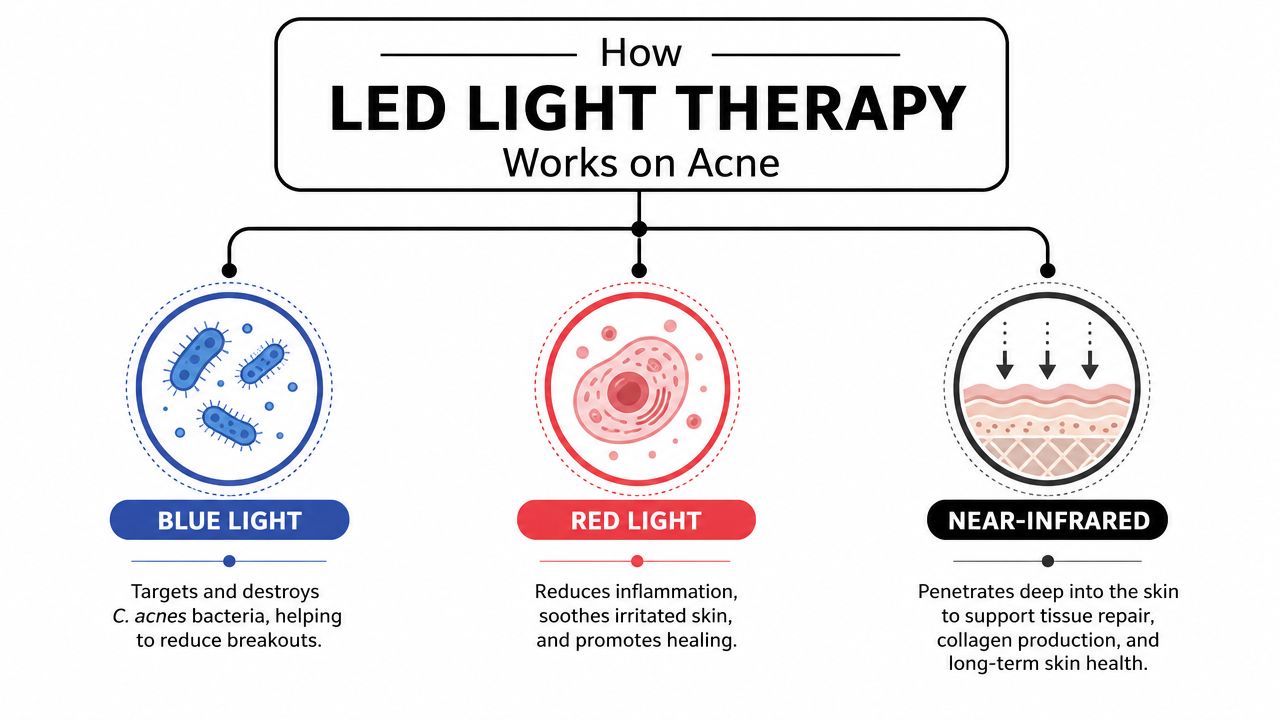
The useful mental model is this, blue light is usually discussed for bacteria, red light for calming inflammation, and near-infrared light for deeper recovery support. You don't need to memorise the physics on day one. You just need to know that clinics don't offer it because it sounds futuristic, they offer it because it fills a practical gap between over-the-counter skincare and stronger medical treatment.
Practical rule: if your acne is active, inflamed, and recurring, light therapy is usually being considered for control and support, not as a one-time cure.
That's why so many people end up searching for it after the basics stop being enough. They're not looking for hype. They're looking for a realistic next step, and in UK practice that means matching the light, the schedule, and the setting to the type of acne in front of you.
How LED Light Therapy Actually Works on Acne
The easiest way to understand acne light therapy is to think in three colours, three jobs. Blue light is aimed at bacteria, red light is aimed at inflammation and repair, and near-infrared light reaches a little deeper to support tissue recovery. Clinics often combine them because acne isn't caused by one thing, and the skin doesn't respond to one mechanism in isolation.
Blue light for bacteria
Blue light is the one people usually hear about first. The UK-based NHS systematic review found that high-intensity narrowband blue light, 405 to 420 nm, used for 8 to 20 minutes twice weekly for four weeks, was associated with a 60% to 70% reduction in inflammatory acne lesion counts on the studies reviewed, with the strongest effect in mild-to-moderate inflammatory acne (NHS systematic review). That matters because it's a realistic match for people whose acne is red, angry, and active.
The simple explanation is that acne bacteria make light-sensitive compounds, and blue light interacts with those compounds. The result is less bacterial pressure in the follicle, which can help reduce the cycle of fresh inflamed spots.
Red and near-infrared for calming and repair
Red light is usually used to settle skin that's irritated and to support a healthier healing response. Near-infrared goes deeper, so it's often discussed as a recovery support wavelength rather than a surface treatment. In real clinic settings, this is why a provider may choose a combined panel or a Dermalux-style session rather than a single-colour device.
That combination approach also helps explain why some people feel their skin looks less angry before they see major changes in spot count. The skin can start to look calmer first, then clearer later.
If you're comparing it with topical routines, a practical overview like comparing the ordinary for breakouts can help you see where actives stop and light-based support starts. The point isn't that one replaces the other, it's that they solve different parts of the same problem.
What the Evidence Says About Blue and Red Light
A practical reading of the evidence starts with a simple pattern. Blue light has the clearest fit for inflammatory acne, while mixed-light approaches are often more useful when redness, active spots, and day-to-day skin recovery all need attention. That is why a good clinic discussion begins with acne type, not with the device on the shelf.
What the clinical review suggests
The strongest review evidence is useful because it comes from clinicians looking at outcomes, not from a product page. The NHS systematic review reported that high-intensity narrowband blue light, 405 to 420 nm, used for 8 to 20 minutes twice weekly over four weeks, was associated with a 60% to 70% reduction in inflammatory lesions. It also found that non-inflammatory lesions responded less well, which matters for anyone whose main concern is clogged pores rather than red, swollen breakouts.
That difference explains why two people can have very different experiences with the same kind of LED routine. One person may see a clear drop in angry spots, while another sees only a modest change because their acne sits more in the comedone category.
Where combined light and PDT fit
Dermatology guidance from DermNet NZ says blue-red light therapy and photodynamic therapy can both reduce inflammatory and non-inflammatory acne lesions. It also notes that PDT is usually more effective yet has more short-term adverse effects. For anyone trying to understand why clinic plans can feel more intensive than a home mask, that trade-off is the key point.
The same guidance also notes that Nd:YAG laser protocols are commonly delivered at 2-week intervals and can reduce inflammatory lesion counts, sebum output, and inflammatory cytokines. In a real clinic setting, that makes light-based care sound less like a quick fix and more like a structured course, where the aim is steady control rather than an overnight change.
LED still sits in the support-and-control category. It can be a sensible part of acne care, especially for people comparing home routines with clinic sessions, and a guide to at-home LED devices for clearer skin can help set those expectations without the sales pitch.
Useful takeaway: LED can help calm active acne and support recovery, but it is not the same thing as scar treatment or a complete acne cure.
At-Home Devices Versus Professional Dermalux Treatments
The biggest decision for home versus clinic isn't blue versus red. That choice changes the dose you're likely to get, how carefully the device is calibrated, and how much support you have if your skin needs screening or a plan adjustment. A mask in your bathroom and a Dermalux session in clinic can both use LED, but they don't behave like the same treatment route.
What usually separates the two
At-home devices are built around convenience. You can use them regularly, fit them around work, and keep going once you've bought the unit. That makes them attractive for maintenance and for people who like routines they can control themselves.
Professional treatment usually wins on precision and oversight. A clinic can screen for suitability, choose the right wavelength mix, and adapt the plan if acne is mixed with sensitivity, pigmentation, or scarring. That's one reason many people look at a dedicated clinic page such as 3D Aesthetics Leamington Spa's Dermalux LED therapy when they want a fuller picture of in-clinic treatment.
| Criterion | At-home device | Professional Dermalux session |
|---|---|---|
| Treatment setting | Home, self-managed | Clinic, supervised |
| Convenience | High | Lower, because appointments are needed |
| Screening | Limited to your own judgement | A clinician can assess suitability |
| Wavelength control | Depends on device quality | Usually more tightly calibrated |
| Best use | Maintenance and consistency | Structured treatment, expert guidance |
| Hygiene | You clean the device yourself | Clinic handles device prep and workflow |
At-home devices shine when your skin is already stable enough that you want to maintain results. Professional sessions are stronger when acne is active, you're unsure whether light is appropriate, or you want the treatment integrated with other clinical options. That can matter in a place like Leamington Spa, where a broader skin plan may include acne facials, microneedling, or resurfacing rather than light alone.
What a Realistic Treatment Course Looks Like
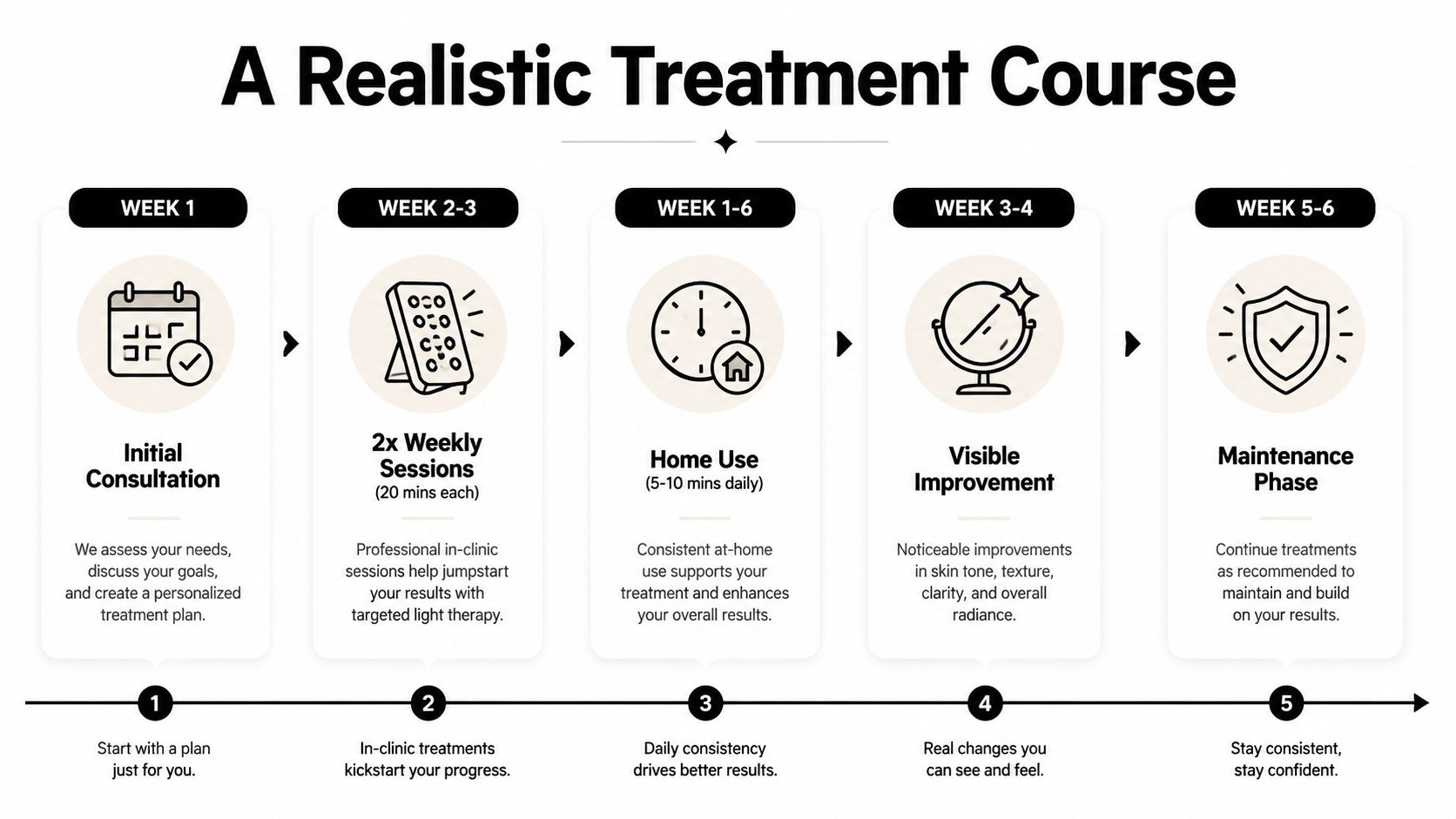
A sensible LED plan is usually measured in weeks, not days. People often expect to see a dramatic change after one visit, but acne light therapy tends to work best as a repeatable course that lets the skin settle gradually. The rhythm matters as much as the device.
What the first few weeks can feel like
A clinic course commonly starts with an assessment, then moves into repeated sessions. At home, people often use a device for short daily sessions, while clinic appointments are often scheduled more deliberately. In either case, the treatment should feel comfortable, not aggressive, and many people describe it as gentle warmth rather than pain.
In the early phase, the most obvious change is often that the skin looks a little less inflamed before it looks fully clear. Spots may still appear, but they can become less angry or heal more cleanly. That's a useful signal, because the goal is to interrupt the cycle rather than blast the skin into submission.
A simple course framework
- Week 1: Skin is assessed, settings are chosen, and the first sessions begin with a focus on tolerance and consistency.
- Week 2: Early calming may show up as reduced redness or a less irritated look after breakouts.
- Week 4: This is often the point when people notice a clearer pattern in lesion count or how quickly active spots settle.
- Week 6: Many plans are reviewed here, then adjusted or moved into maintenance if the skin is responding.
- Maintenance phase: Ongoing sessions are used to help keep acne under control rather than starting from scratch again.
A realistic skincare routine around treatment days usually gets simpler, not more complicated. Over-exfoliating can make acne-prone skin more reactive, so many clinics keep the focus on cleansing, moisturising, and avoiding too many active ingredients on the same day.
If you're pairing acne treatment with a professional facial, 3D Aesthetics' 3D Prescriptive Acne Facial is one example of how clinics often combine surface-level support with light therapy rather than relying on one tool alone.
Safety, Side Effects and Who Should Get Medical Advice First
A person can read that LED is safe and non-invasive and assume it suits everyone. That is too broad. Side effects are usually mild, but the first question is who should be screened before starting, especially with a home device where there is no clinician there to spot a problem early.
Typical side effects are usually minor
Recent reviews of at-home devices report side effects such as dryness, erythema, discomfort, or pain, and a systematic review of home devices found no severe adverse reactions in the studies it assessed (systematic review of at-home devices). That is reassuring. It still does not mean every user is a good fit, because long-term safety data remain limited and the same review also shows why simple screening still matters.
Practical rule: mild redness or dryness can happen for some users, but anything that stays, hurts, or looks unusual deserves a pause and a review.
Who should ask for medical advice first
People on photosensitising medicines should speak to a clinician before starting LED. That includes certain acne medications and some antibiotics, because the question is not just whether the device works, it is whether your skin is more reactive than usual. People with a history of light-sensitive conditions, recent sunburn, or active skin infection should also get checked first.
Eye protection matters too. Home masks and clinic panels should be used with proper shielding or closed eyes according to device guidance, because light therapy is meant for the skin, not the eyes. Pregnancy, epilepsy, and a history of pigment change after inflammation are all situations where individual advice is more sensible than guesswork.
A proper consultation matters because the same light can be useful, unhelpful, or poorly matched depending on the person. A clinic can decide whether LED alone makes sense or whether another route should be prioritised first.
Setting Realistic Expectations for Results
The fastest responders are usually people with mild-to-moderate inflammatory acne who can stick to the plan. That lines up with the evidence above, and it also matches what clinics see in practice, consistent attendance tends to matter more than enthusiasm in week one. If you miss sessions, the improvement curve usually flattens.
What improvement often looks like in practice
Early on, the skin may look less inflamed before it looks dramatically clearer. That means fewer angry red spots, less tenderness, and a faster settling time after a breakout. Later, you may notice that active lesions are showing up less often or that they resolve more cleanly.
Maintenance is common because acne control and acne cure are not the same thing. Once the initial improvement has been achieved, many people need periodic top-up sessions to keep the skin steady. That isn't failure, it's just the practical reality of a condition that can be driven by hormones, oil production, and inflammation.
When LED isn't the whole answer
Some acne patterns need more than light. Deep acne scarring often needs microneedling or CO2 resurfacing rather than LED, because light can't rebuild loss of tissue on its own. Persistent post-inflammatory hyperpigmentation is a different problem again, and a focused pathway such as post-inflammatory hyperpigmentation support may be more relevant than acne clearance alone.
Hormonal cystic acne and long-standing comedonal acne can also sit outside the sweet spot for LED. In those cases, light may still be part of the plan, but it's usually not the only part. A mature treatment plan is one that switches tools when the skin's needs change, instead of forcing one device to do every job.
Booking a Dermalux Consultation at 3D Aesthetics Leamington Spa
A good consultation turns a vague interest in light therapy into a skin plan. At 3D Aesthetics Leamington Spa, the process starts with a complimentary in-depth review, then a 3D skin scan is used to map concerns and track change over time. That matters because acne, scarring, and pigmentation often travel together, and a scan gives you a clearer before-and-after record than guesswork does.

The point of that assessment is to decide whether Dermalux LED should stand alone or sit inside a wider plan. In clinic, that may include Dermaforce microneedling, CO2 resurfacing, HydrO2 facials, chemical peels, or pigmentation-focused treatment, depending on what the skin needs rather than what's trending.
If you want a practical next step, book a consultation, bring your current skincare list, and be ready to talk about breakouts, sensitivity, and any medicines you're using. The clinic is based in Leamington Spa, and the team offers flexible opening times, so it's easier to fit an assessment around work and family life than many people expect. A clear, personalised plan beats trying to decode light wavelengths on your own.
A CTA for 3D Aesthetics Leamington Spa.