

You might be reading this after weeks or months of trying to “do everything right”. You're eating better, walking more, getting back to the gym, maybe even watching your portions carefully, and yet that small lower-belly pouch still seems to sit there unchanged. It can feel especially frustrating when the rest of your body responds, but the area below the navel doesn't.
That experience is common. Lower belly fat is often the area people notice last to change, and it isn't always about effort. Hormones, genetics, pregnancy history, age, and natural fat distribution all play a part. For some women, midlife changes add another layer, so practical nutrition support like this guide to an effective diet for perimenopause belly fat can help if hormones are part of the picture.
The important point is this. “Lower belly fat” isn't one single problem with one single fix. The type of fat matters, your skin quality matters, and the right treatment depends on both.
Table of Contents
- The Stubborn Fat That Diet and Exercise Can't Shift
- Subcutaneous vs Visceral Fat Why It Matters for Treatment
- Surgical vs Non-Surgical A Complete Comparison
- How Non-Surgical Technologies Work
- Your Treatment Journey What to Expect
- Start Your Personalised Plan at 3D Aesthetics
- Frequently Asked Questions
The Stubborn Fat That Diet and Exercise Can't Shift
A pattern I hear often goes like this. Someone starts eating more carefully, cuts back on snacks, gets consistent with movement, and notices changes in their face, waist, or clothes fit. Then they look in the mirror side-on and the lower tummy still pushes forward slightly.
That doesn't mean they've failed. It usually means the body is holding fat in a very normal, very stubborn place.
For many people, the lower abdomen is a “storage area”. The body doesn't always lose fat evenly, and it doesn't always choose the area you'd most like to shrink first. After pregnancy, after weight changes, or during hormonal shifts, the lower belly can become the one area that seems out of proportion to the rest of your progress.
Many clients don't need more discipline. They need a more accurate understanding of what kind of fat they're dealing with and whether skin laxity is part of the picture.
That's where lower belly fat removal becomes less about generic slimming advice and more about matching the right method to the right tissue.
Why this area often feels different
A lower belly bulge can be caused by several things at once:
- Stubborn surface fat: This is the soft layer just under the skin.
- Deeper internal fullness: This can create a rounded abdomen even when the surface doesn't feel very fatty.
- Loose skin or reduced firmness: This often shows up after pregnancy or weight loss.
- Posture and muscle tone: These can change how the area sits, even without a large amount of fat.
That mix is why two people can both say “I hate my lower belly” while needing completely different advice.
What realistic improvement looks like
Some people want a flatter outline in fitted clothes. Others want the pouch below the waistband reduced. Others mainly want the skin to look smoother. Those are different goals, and lower belly fat removal works best when the goal is specific.
If you only remember one thing from this guide, make it this. Before choosing any treatment, you need to know whether the problem is mostly fat, mostly skin, or a combination of both.
Subcutaneous vs Visceral Fat Why It Matters for Treatment
If I could clear up one source of confusion for every client, it would be this distinction. Not all belly fat is the same.
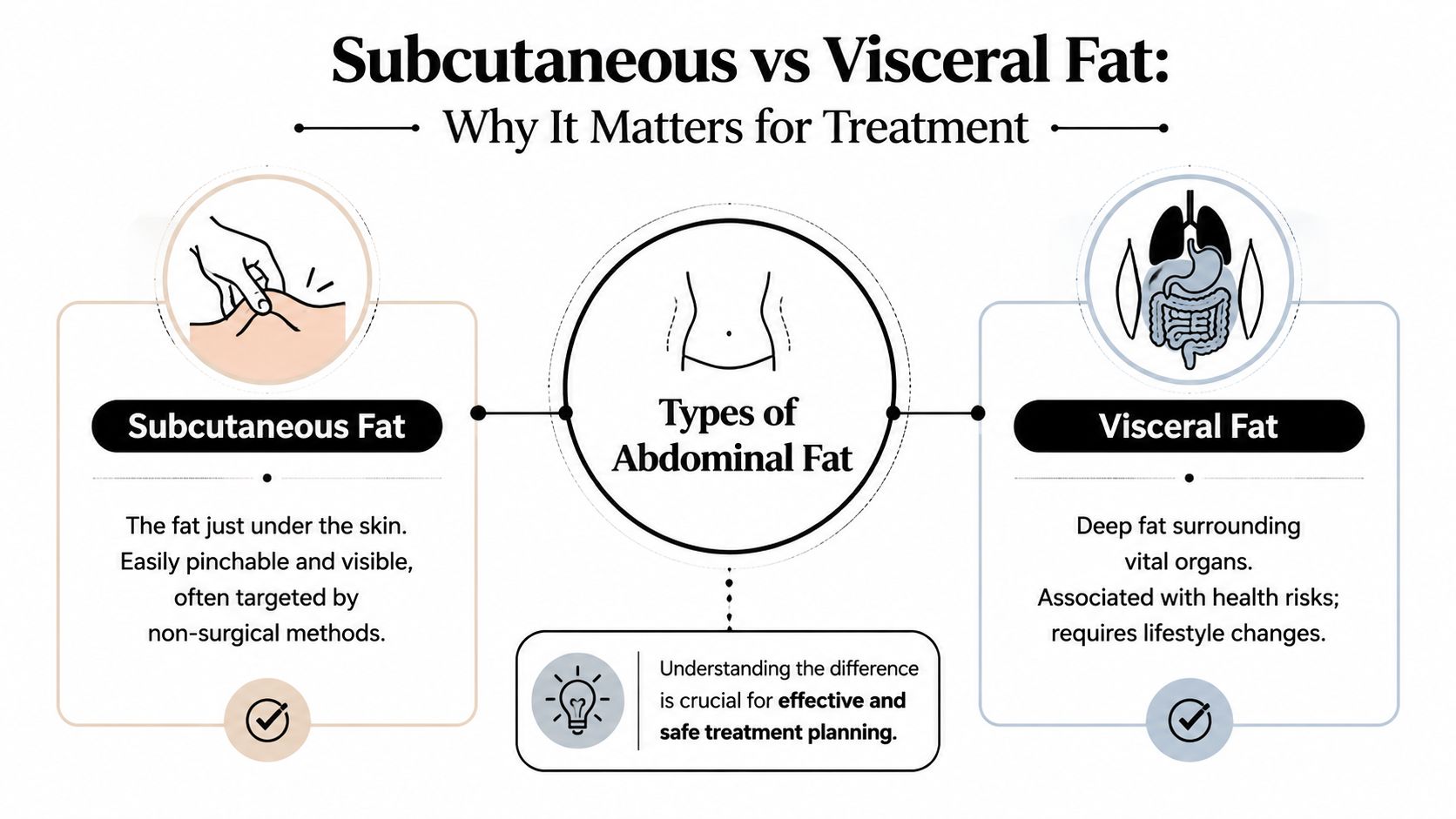
Think of abdominal fat like an iceberg. One part sits near the surface and is easy to grasp. The other sits deeper out of reach. Non-surgical treatments work on the part you can access, not the part hidden underneath.
The fat you can pinch
Subcutaneous fat is the layer just under the skin. This is the soft, pinchable fat many people feel in the lower tummy, flanks, thighs, or upper arms.
This is the tissue that body contouring treatments are designed to target. That's why cryolipolysis is usually discussed for people with a defined pocket they can hold between finger and thumb. As BBC reporting on fat freezing explains, non-invasive fat freezing only works on pinchable subcutaneous fat, not deep visceral fat. The same source notes that targeted subcutaneous areas can see up to 27% of fat cells removed.
A simple at-home clue is this:
- If you can pinch it easily, you may be looking at subcutaneous fat.
- If your tummy feels firm, pushed out, or difficult to grasp, deeper fat may be playing a bigger role.
- If the area wrinkles or folds more than it bulges, skin laxity may be part of the concern.
The fat you can't reach with body contouring
Visceral fat sits deeper inside the abdomen around the internal organs. You can't freeze it, cavitate it, or tighten it away from the outside with cosmetic body contouring.
That's why some people are disappointed by treatment when they were never ideal candidates in the first place. If the belly prominence comes mainly from internal abdominal fat, a non-surgical applicator on the skin surface won't address the true source of the shape.
For people who suspect deeper abdominal fullness, practical lifestyle guidance matters more than a contouring device. A useful starting point is this article on strategies for visceral fat reduction, which focuses on the sort of changes that affect deep abdominal fat rather than surface contour alone.
Practical rule: If a treatment sounds like it “removes belly fat” without first telling you which kind of fat it can reach, the explanation is incomplete.
Many consultations become much clearer once this distinction is made. It often answers the question clients have been carrying for months: “Why hasn't this area responded the way I expected?”
Surgical vs Non-Surgical A Complete Comparison
A common consultation starts like this. Someone can pinch a lower-belly roll, feels frustrated that it has stayed there for months, and assumes the only real option must be liposuction. Then we assess the area more closely and find a second issue sitting beside the fat. The skin has also lost some recoil. That changes the plan, because removing volume and improving the skin are not always the same job.
The choice is less about which option sounds stronger and more about matching the method to the tissue in front of you. Surgery removes more fat in one go. Non-surgical treatment aims for a smaller shape change with much less disruption. If skin laxity is part of the picture, either route may need a separate tightening strategy to avoid the loose skin paradox, where the area looks flatter but not necessarily firmer.
What surgical liposuction can do
Surgical liposuction is the higher-volume option for people who want a larger reduction in a single procedure. Earlier in the article, the BBC report noted rising UK demand, typical pricing, treatment time, and the fact that several litres of fat may be removed in one session.
That scale is the main advantage. The trade-off is that it is still surgery. Anaesthesia, swelling, bruising, compression garments, and recovery are part of the process, and the final shape takes time to settle. Liposuction also does not treat visceral fat, and it does not reliably fix stretch marks, cellulite, or loose skin.
Skin quality matters more than many clients expect.
If the lower abdomen already looks crepey, folded, or lax, removing fat can sometimes reveal that looseness more clearly. In some cases, surgery is paired with a skin procedure. In others, a non-surgical skin-tightening plan is discussed after healing.
Surgical liposuction usually suits people who:
- Want a more dramatic reduction in one procedure
- Accept anaesthesia, recovery, and the risks of an invasive treatment
- Have a clear pocket of subcutaneous fat rather than mainly deep abdominal fullness
- Understand that skin retraction is not guaranteed
Where non-surgical treatment fits
Non-surgical lower belly fat removal works best for smaller, localised pockets of pinchable fat. A useful comparison is sculpting rather than excavation. The goal is to improve the outline, not remove a large volume all at once.
Earlier in the article, the PMC review described the kind of change commonly seen with cryolipolysis over the following months, along with the usual pricing pattern per cycle. That gradual timeline is often a good fit for clients who want less downtime and are comfortable with more modest change.
For a broader look at clinic-based options for the abdomen, including ultrasound-based approaches, you can also see this overview of fat reduction treatment.
Some clients also ask whether exercise devices can replace contouring treatment. Muscle stimulation may support activity and muscle engagement, but it does not remove a localised fat pocket in the same way a targeted contouring treatment aims to. For background on that category, this guide to EMS cardio explains how EMS is used in a fitness context.
Treatment Comparison Lower Belly Fat Removal
| Treatment | Best For | Typical Results | Downtime | Average UK Cost |
|---|---|---|---|---|
| Surgical liposuction | Larger-volume fat removal in one procedure | Larger immediate fat reduction than non-surgical options, with final contour settling over time | Recovery needed after surgery | Earlier cited UK figures place this in the £3,000 to £8,500 range |
| Cryolipolysis | Pinchable lower-belly fat | Gradual reduction in the treated area over the following months | Usually little interruption to daily routine | Earlier cited pricing places this at £350 to £750 per cycle |
| HIFU | Smaller contour changes where heat-based fat reduction suits the tissue | Gradual contour improvement over a course of treatments | Minimal downtime in most clinic settings | Varies by clinic |
| Radiofrequency | Clients needing a mix of contouring and tightening support | Incremental contour change with skin-firming support over multiple sessions | Usually minimal downtime | Varies by clinic |
| Ultrasound cavitation | Localised subcutaneous fat and inch-loss plans | Gradual contour improvement over a treatment course | Usually minimal downtime | Varies by clinic |
How to choose between them
A simple test is to ask what outcome you want first.
If your priority is the biggest possible reduction in one sitting, surgery is usually the option people compare against. If your priority is a smaller change, no anaesthetic, and minimal recovery, non-surgical treatment is often the better fit.
Then add the second question. How is the skin likely to behave after the fat reduces?
That is where treatment plans become more realistic. A flatter lower abdomen does not always mean a tighter-looking one. If fat and loose skin are both involved, the strongest plan is often a combined one that addresses each problem with the right tool, rather than expecting a single treatment to do everything.
How Non-Surgical Technologies Work
A lot of people assume all lower belly fat treatments do the same job. They do not. Non-surgical devices work only on fat that sits close enough to the surface to be reached, which is why the pinchable layer matters so much.
They are designed to affect subcutaneous fat. They do not treat the deeper visceral fat that sits around the organs. That distinction shapes what kind of result is realistic before a single session begins.
Cryolipolysis and targeted cooling
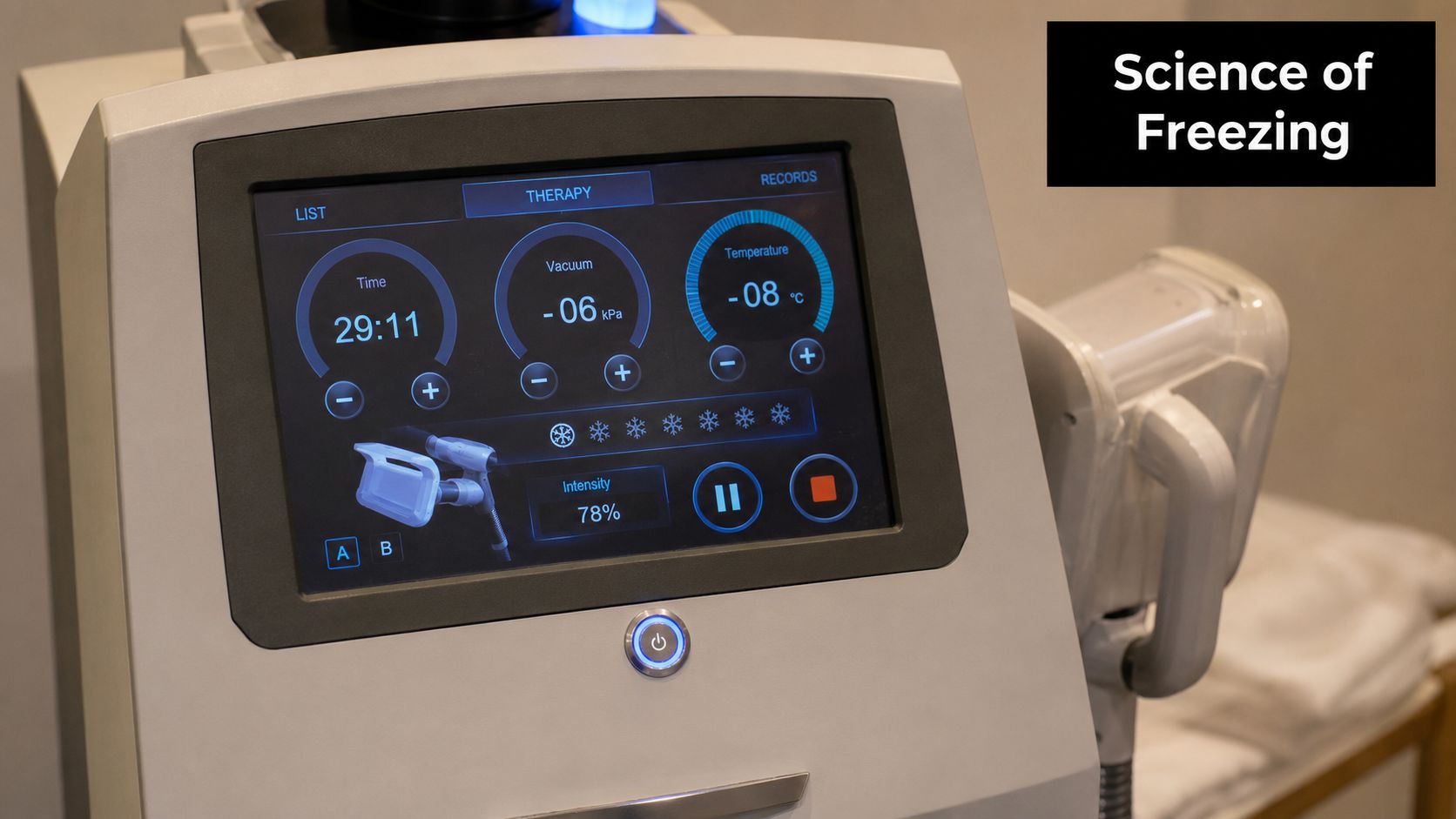
Cryolipolysis uses controlled cooling to stress fat cells without intentionally injuring the surrounding skin. Fat tissue is more sensitive to cold than skin and muscle, so the applicator can target the fatty layer with a level of precision that is useful for the lower abdomen.
According to Axiom Aesthetics' summary of non-invasive fat reduction technologies, cryolipolysis cools fat cells to −10°C to −13°C, triggering apoptosis. The same source reports a consistent 20% to 25% reduction in subcutaneous fat after one session, with 86% of patients seeing visible improvement within 3 months.
A simple way to understand apoptosis is to picture a cell reaching the end of its working life in a controlled, tidy way rather than bursting and causing widespread irritation. Your body then clears those affected fat cells gradually over the following weeks and months. That slow clearance is why the mirror usually changes little at first, then more steadily later.
During treatment, people often notice strong suction first, then cold, then numbness. Afterward, the area can feel firm, tender, or slightly tingly for a while as the tissue settles.
If you want a closer look at how this is used specifically on the abdomen, this page on fat freezing on the stomach gives a practical treatment overview.
Heat-based methods such as HIFU and RF
HIFU and RF aim for the same destination by a different route. Instead of cooling the fat, they heat targeted tissue enough to damage fat cells and encourage gradual contour change.
As noted in the same technology comparison, HIFU and RF can also reduce localised subcutaneous fat over a course of treatment. The practical difference for the client is usually the sensation and the treatment goal. Cryolipolysis is often chosen when there is a clear pinchable pocket of fat. RF is often used when that pocket comes with mild skin looseness, because heat-based treatments may support some tightening at the same time.
That leads to the part many people are not warned about early enough. If the lower belly already has stretched or weakened skin, reducing fat can sometimes make laxity more noticeable. It is a bit like taking filling out of a cushion. The cushion is smaller, but the cover does not always shrink to match. That is why clinics often combine fat reduction with skin-tightening technologies instead of expecting one device to solve both issues.
For clients who are also trying to improve activity levels or recovery habits around a body-shaping plan, tools outside the clinic can play a supporting role. For example, this guide to EMS cardio explains one at-home approach people explore alongside broader fitness routines.
A short visual walkthrough can make these differences easier to understand:
Your Treatment Journey What to Expect
Individuals feel calmer once they know what the process looks like. The mystery is often worse than the treatment.
From consultation to treatment day
A proper consultation should look at more than the size of the tummy. The therapist needs to assess whether the area is pinchable, whether there's visible skin laxity, and whether the goal is reduction, smoothing, or both.
On treatment day, non-surgical sessions are usually straightforward. With cryolipolysis, for example, clients often notice a pull from the applicator, then cold, then numbness. With RF or HIFU, the sensation is usually more about warmth moving through the area.
After treatment, the body needs time. Non-surgical lower belly fat removal doesn't give the instant “debulking” effect of surgery. It works more gradually, which can suit people who want a subtle transition and no obvious recovery period.
The loose skin paradox
This is the part many articles skip, and it matters. Removing fat does not automatically create a tight, smooth lower abdomen.
According to The Private Clinic's discussion of belly fat treatment options, after a 27% fat reduction from fat freezing, up to 40% of patients may experience worsened skin sag. The same source notes that surgical repair for appearance alone is rarely funded by the NHS, which leaves many people needing non-surgical tightening if skin laxity becomes more obvious.
That's why a combined plan is often the more honest answer for the lower belly, especially after pregnancy or weight loss.
- If fat is the main issue: Reduction may be enough.
- If the skin already looks thin or crepey: Tightening support may be needed from the start.
- If the area has both fullness and laxity: Treating fat alone can make the skin concern more noticeable.
Some lower bellies don't need more fat removed. They need a better balance between reduction and skin support.
This doesn't mean treatment goes wrong. It means the lower abdomen behaves differently from firmer areas of the body, and expectations need to match that reality.
Start Your Personalised Plan at 3D Aesthetics
The most useful next step usually isn't choosing a machine. It's getting a proper assessment.
Why assessment comes first
A consultation should answer a few practical questions before any plan is discussed:
- Is the area mainly subcutaneous fat or is deeper fullness dominating the shape?
- How well does the skin spring back?
- Is the goal reduction, tightening, or both?
- Would a course of treatment make more sense than a one-off session?
At 3D Aesthetics Leamington Spa, one option for that assessment is a consultation paired with body composition analysis, which includes a full 3D body scan. That kind of scan can help move the conversation away from guesswork and towards measurable planning.
That matters because lower belly fat removal is rarely just about “getting rid of fat”. For one person, the right plan may involve cryolipolysis. For another, ultrasound cavitation may fit better. For someone else, the deciding factor may be whether radiofrequency or another tightening treatment needs to sit alongside fat reduction from the start.
A personalised plan should leave you with a clear answer to three things. What can improve, what probably won't change with body contouring, and what kind of timeline is realistic for your body.
Frequently Asked Questions
How many sessions do people usually need
Session numbers vary because lower-belly concerns do not all behave the same way. A small, pinchable pocket of subcutaneous fat may respond on a different timeline from an area where loose skin is also part of the shape. As noted in the body contouring evidence review mentioned earlier, non-surgical treatment is usually approached as a course rather than a one-off appointment, with gradual change over time.
Is non-surgical lower belly fat removal a weight-loss treatment
Non-surgical lower belly fat removal is a body contouring option for a localised area. It works best when the concern sits in the layer you can pinch.
If the abdomen feels firm, rounded from deeper inside, or changes mainly with overall weight gain, that points more toward visceral fat or general fullness. In that situation, a surface treatment is unlikely to change the result in the way many people hope. That distinction matters because the right treatment depends on the type of fat involved, not just the location.
Will the fat come back
Treated fat cells do not behave exactly like untreated ones, but the body can still store fat in the area if weight increases over time. A useful way to picture it is this: reducing fat in one small zone changes the contour of that zone, but it does not switch off your body's ability to store energy.
Stable habits usually help maintain the new shape. Larger weight changes can soften the result.
Does treatment help with loose skin too
Sometimes, but the answer depends on what is creating the lower-belly bulge in the first place.
This is the loose skin paradox that catches many people out. If fat is reduced from an area where the skin already has limited recoil, the outline may become flatter but not tighter. In some cases, skin laxity becomes more noticeable after fat reduction because the volume that was filling the skin envelope has been reduced. That is why a combined plan often makes more sense than expecting one fat-removal treatment to do two different jobs.
How do I know if I'm a good candidate
A good candidate usually has a defined pocket of soft, pinchable lower-belly fat, a fairly stable weight, and a clear goal. The best results also depend on skin quality and on whether the concern is in the superficial layer.
If your stomach feels more firm than soft, or the main issue is crepey or loose skin, your treatment plan may need to be different from what you first had in mind. A proper assessment helps separate subcutaneous fat, deeper fullness, and skin laxity so the plan matches your body rather than a generic before-and-after promise.
If you want clarity on what's causing your lower-belly concern, a consultation with 3D Aesthetics Leamington Spa can help you separate subcutaneous fat, deeper fullness, and skin laxity so you can choose a treatment plan that fits your body rather than chasing a generic promise.