

You've probably had this moment already. You catch your reflection in a window, or your phone camera flips to the front lens, and the patches on your cheeks or upper lip seem darker than they did a few months ago. You try a brightening serum, then a peel, then a stronger cream, and nothing feels straightforward.
That confusion is normal. Melasma isn't like a single spot left behind after a breakout. It behaves more like a long-term pigment pattern that reacts to light, heat, hormones, irritation, and even the timing of treatment. That's why the most useful way to think about melasma treatment options is not “Which one cures it?” but “Which sequence gives me the safest, most realistic control?”
A good plan usually starts simple, builds in layers, and stays flexible. Some people do well with prescription creams and strict sun protection. Others need procedures added later. A smaller group, especially those with a vascular component, need more careful laser selection than most general advice ever explains.
Table of Contents
- Understanding melasma and its impact
- Causes triggers and factors influencing melasma
- Comparing topical melasma treatment options
- Evaluating procedural melasma therapies
- Oral therapies sunscreen and lifestyle strategies
- Sequencing maintenance realistic outcomes and downtime
- Specialist care and personalising treatment at 3D Aesthetics Leamington Spa
Understanding melasma and its impact
Melasma usually appears as symmetrical brown or grey-brown patches, most often on the cheeks, forehead, upper lip, or chin. Many people first assume it's ordinary sun damage or marks left after acne, but melasma behaves differently. It tends to return, deepen, and flare in patterns.
The simplest way to picture it is this. Your pigment cells act like tiny paint dispensers. In melasma, those cells become overactive and send out too many pigment packets into the skin. Instead of one isolated splash of colour, you get a more organised wash of pigment across certain facial zones.
Why it feels persistent
Melasma can affect confidence because it sits in the centre of the face and often resists quick fixes. That's one reason people jump from product to product. The problem is that melasma rarely rewards impatience.
UK guidance from the Primary Care Dermatology Society states that there is no cure for melasma, and treatment focuses on controlling the condition year-round with sun protection. The same guidance notes that topical therapies need to be applied twice daily for 8 to 12 weeks before results should be assessed in many routine treatment plans, which is a useful reality check if you're expecting change in a fortnight (PCDS patient guidance on melasma).
Practical rule: If a treatment hasn't had enough time, you can't judge it fairly. With melasma, consistency matters more than novelty.
How melasma differs from other pigmentation
A sun spot often behaves like a local stain. Melasma behaves more like a trigger-sensitive pattern. That distinction matters because treatment has to address not only existing pigment, but also the reasons the skin keeps making more.
Common clues that point towards melasma include:
- Symmetry: It often appears on both sides of the face.
- Recurrence: It may fade and return rather than disappear permanently.
- Sensitivity to triggers: Sun, heat, hormones, and irritation can all make it more obvious.
- Slow response: Improvement usually comes gradually, not overnight.
That's why realistic expectations matter so much. The goal isn't perfection. The goal is steadier pigment behaviour, fewer flares, and a plan you can maintain.
Causes triggers and factors influencing melasma
Melasma rarely has one single cause. Individuals commonly present with a mix of drivers, and these can change over time. One person's pigment may worsen after summer holidays. Another may notice it after pregnancy, a contraceptive change, or a run of irritating skincare.
Hormones often set the stage
Hormonal shifts are one of the most common reasons melasma appears or deepens. Pregnancy is a familiar example, but it's not the only one. Some people notice pigment changes during perimenopause, after starting hormonal contraception, or when other hormone-related symptoms begin to show up.
If your melasma seemed to arrive alongside irregular periods, sleep changes, hot flushes, or unexplained mood swings, it can help to look at the bigger picture. A useful starting point is understanding hormone imbalance signals, because melasma sometimes sits alongside wider hormonal changes rather than acting as an isolated skin issue.
Light and heat keep it active
Sunlight is a widely recognized trigger, but patients often underestimate heat and cumulative daily exposure. Walking the dog, driving, sitting near a sunny window, or eating lunch outside can all keep pigment cells switched on. That's why melasma often seems “stubborn” even when someone says they only go in the sun occasionally.
If you're not sure whether what you're seeing is melasma, general sun damage, or a mix of both, comparing the pattern with sun damage skin treatment information can help frame the conversation before a clinic assessment.
Melasma doesn't need a dramatic sunburn to worsen. Repeated small exposures can be enough to keep pigment production going.
Genetics and irritation also matter
Some people seem more pigment-prone from the start. They may have family members with similar facial pigmentation, or their skin may react strongly after inflammation. In practice, that means melasma is often easier to trigger and harder to calm once the cycle starts.
Common aggravating factors include:
- Genetic tendency: Some skin types produce pigment more readily.
- Irritating skincare: Overuse of acids, scrubs, or strong actives can inflame the skin.
- Inflammatory procedures: The wrong peel or laser setting can worsen pigment rather than improve it.
- Seasonal pattern: Brighter months often reveal flares that winter only partly hides.
A simple trigger diary can help. Note when the patches darken, what products you used, how much outdoor exposure you had, and whether hormonal changes were happening at the same time. That pattern often tells you more than a single mirror check.
Comparing topical melasma treatment options
Topical treatment is usually the first serious step because it targets pigment production at the source. Think of it as lowering the volume on overactive pigment cells before you ask procedures to do more visible clearing.
Some creams reduce melanin production. Some speed up the shedding of pigmented surface cells. Some do both. The best choice depends on skin sensitivity, previous treatment history, and how strong a plan your clinician thinks your skin can tolerate.
The main prescription and non-prescription routes
The strongest evidence in UK practice sits with the triple combination cream. According to the PCDS clinical guideline, the standard first-line formulation is fluocinolone acetonide 0.01%, hydroquinone 4%, and tretinoin 0.05%, applied once daily for 6 to 8 weeks. The guideline reports clinical improvement in 60 to 80% of patients, with complete clearance in about 30% (PCDS clinical guidance on melasma treatment).
That sounds impressive, but it's still not a forever cream. It's usually used in a controlled course because the ingredients are potent and need supervision.
Azelaic acid is often discussed when people want something gentler or more maintenance-friendly. UK patient guidance also notes that azelaic acid must be used twice daily for at least 8 to 12 weeks before results can be assessed, which helps explain why people often quit too early if they expect a fast fade.
Cysteamine has become more interesting as an alternative route for people who can't use hydroquinone-based treatment or want another option. There's also growing public interest in tranexamic-acid serums, and if you're comparing cosmetic options rather than prescriptions, Finding Favourites' serum recommendations can help you see what kinds of products people usually consider. They're not a substitute for diagnosis, but they can make ingredient shopping less random.
Comparison of Topical Treatments
| Treatment | Mechanism | Pros | Cons |
|---|---|---|---|
| Triple combination cream | Combines pigment suppression, faster skin turnover, and anti-inflammatory action | Strong first-line medical option, clear UK protocol, good documented response | Can irritate, needs supervision, not for indefinite unsupervised use |
| Hydroquinone-based treatment | Reduces melanin production | Well known in medical practice | May irritate, often not enough alone in stubborn cases |
| Azelaic acid | Helps reduce pigment activity and suits longer use in some patients | Often better tolerated, useful when skin is sensitive | Slower pace, requires patience and routine use |
| 5% cysteamine cream | Depigmenting option used as an alternative to hydroquinone-based regimens | Useful non-hydroquinone route | Can still irritate, needs proper instruction and consistency |
How to choose sensibly
The right topical isn't always the strongest one. It's the one your skin can tolerate long enough to work. If you're also trying to simplify your routine, why a skincare routine is so important is worth keeping in mind, because layering too many “brightening” products often backfires.
A practical way to think about selection is:
- If pigment is obvious and treatment-resistant: prescription therapy is usually the serious starting point.
- If skin is reactive: a gentler route may be safer, even if progress is slower.
- If you've relapsed before: maintenance planning matters as much as the initial fading phase.
- If you're self-treating with multiple actives: simplification may help more than adding another bottle.
The biggest mistake is treating irritation as proof that something is “working harder”. In melasma, inflamed skin can become darker skin.
Evaluating procedural melasma therapies
Procedures can help when topicals alone aren't doing enough, but they need careful timing and careful selection. Melasma doesn't respond well to the attitude of “let's blast the pigment and hope for the best”. In clinic practice, the skin usually does better when procedures are added after the pigment has already been stabilised.
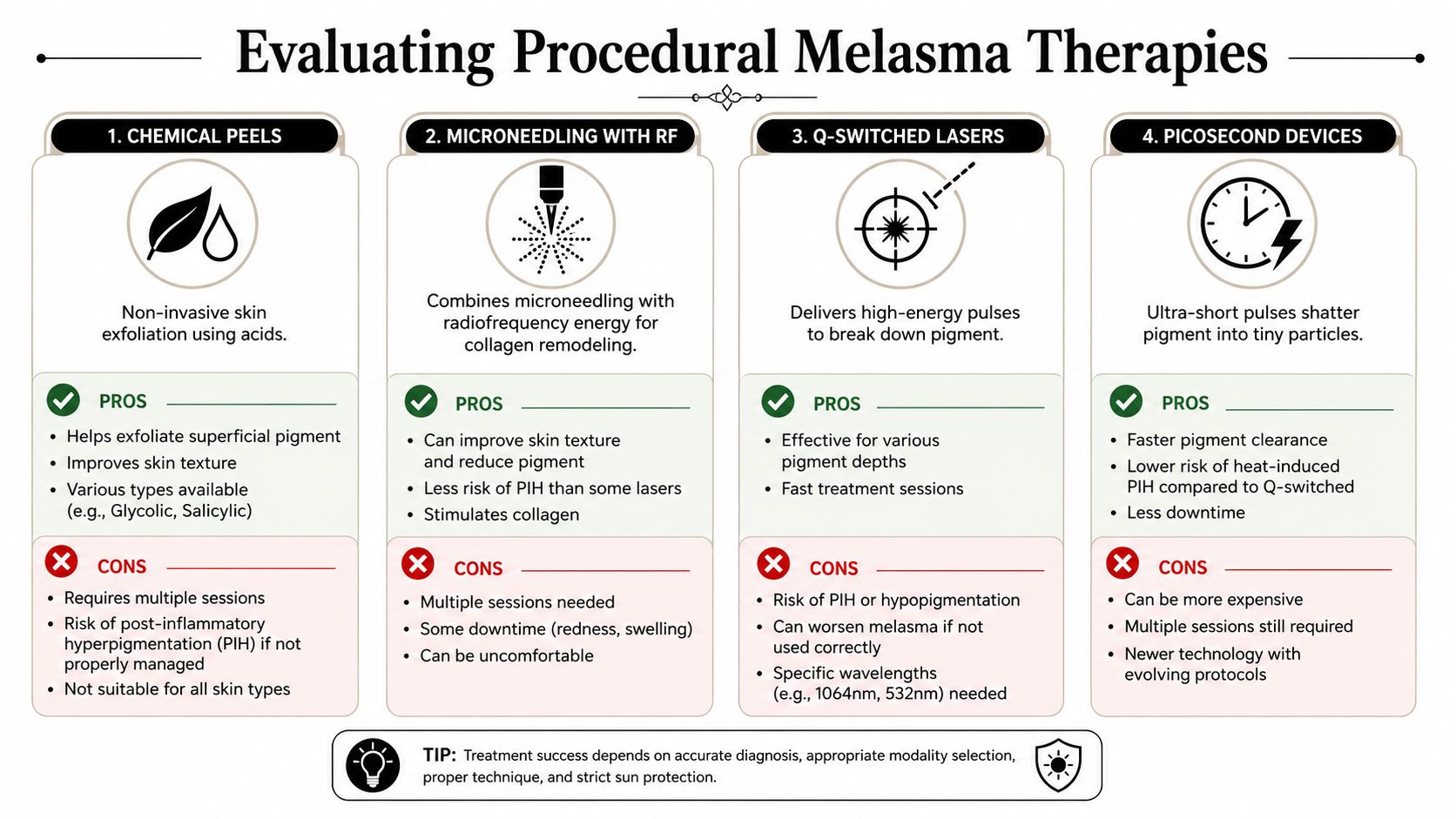
This visual summary helps compare the main non-surgical routes.
Peels microneedling and energy-based treatments
Chemical peels work at the surface. They can help lift superficial pigment and improve texture, but they need restraint. A peel that's too aggressive can create the inflammation that pushes melasma darker afterwards.
RF microneedling is drawing more attention because it doesn't just roughen the surface. UK-compatible treatment updates note that radiofrequency with microneedling is showing promising outcomes for improving melanin elimination, which is one reason clinicians consider it for stubborn cases that need a non-surgical step up (UK-compatible advances in melasma treatment options for 2026).
For readers who want to understand how clinics approach pigment-focused device work more broadly, laser pigmentation removal gives useful context on where these treatments fit.
Where lasers help and where they confuse people
Laser advice online is often too vague. “Laser can help” isn't enough, because the wavelength and the melasma subtype matter. The same treatment category can help one patient and aggravate another.
The same UK-compatible update notes that Q-switched laser therapy can be delivered at 694, 755, or 1064 nm across six to ten sessions at intervals of 2 to 4 weeks for suitable cases of stubborn pigmentation. That gives a much more usable framework than generic mentions of “a course of laser”.
A short explainer often helps here.
Use procedures to support a plan, not replace one. If the skin is still being triggered every day, even a well-performed laser course can disappoint.
A simple way to compare procedural choices
- Chemical peels: Better for surface pigment and texture. Higher caution if your skin gets inflamed easily.
- RF microneedling: Useful when you want a non-surgical treatment that addresses texture and pigment behaviour together.
- Q-switched lasers: More structured for resistant pigmentation, but they require proper patient selection.
- Picosecond and other emerging devices: Increasingly discussed where clinicians want more precise pigment disruption with careful heat control.
Downtime varies by device and by how strongly the skin reacts. In melasma care, the safest procedure is often the one that looks less dramatic on day one but causes less rebound later.
Oral therapies sunscreen and lifestyle strategies
Some patients need more than creams and procedures. That doesn't mean jumping straight to something stronger. It means looking at the full environment your skin lives in every day.
Where oral treatment fits
Oral tranexamic acid is considered in more severe or stubborn cases, usually under medical supervision. It isn't a casual add-on and it isn't right for everyone. The key point is that systemic treatment sits inside a broader plan. It works best when the skin is also protected from repeated triggers.
The daily basics often matter more than realized. A beautifully chosen prescription won't perform well if the skin is heated, irritated, or repeatedly exposed without protection.
The part people underestimate most
Sunscreen isn't the glamorous step, but it's the step that protects everything else you've spent time and money on. The mistake I see most often is “I wear it when it's sunny” or “I only use it on holiday”. Melasma doesn't care whether the weather feels bright enough to justify effort.
If you're reviewing options for daily use, hats, and practical sun-care accessories, it can help to explore Maximum Health Products' sun collection as a reference point for what a more complete protection setup can look like.
A simple day-to-day strategy looks like this:
- Choose consistency over perfection: A sunscreen you'll apply every day beats an ideal formula you dislike.
- Reapply when exposure continues: Morning-only protection often fades long before the day does.
- Reduce unnecessary heat: Long hot walks, direct sun through car windows, and heat-heavy routines can all keep pigment active.
- Keep skincare calm: Gentle cleansing and a boring moisturiser often support treatment better than a shelf full of actives.
Lifestyle choices that support treatment
You don't need a “melasma diet” or a punishing routine. You do need fewer triggers. If your skin stings after every exfoliant, that's useful information. If your pigment gets deeper after holidays, that's useful too.
Calm skin usually responds better than over-treated skin.
Stress management, sleep, and a steady skincare routine won't erase melasma on their own. But they reduce the noise around treatment, and that makes the medical parts of the plan easier to judge.
Sequencing maintenance realistic outcomes and downtime
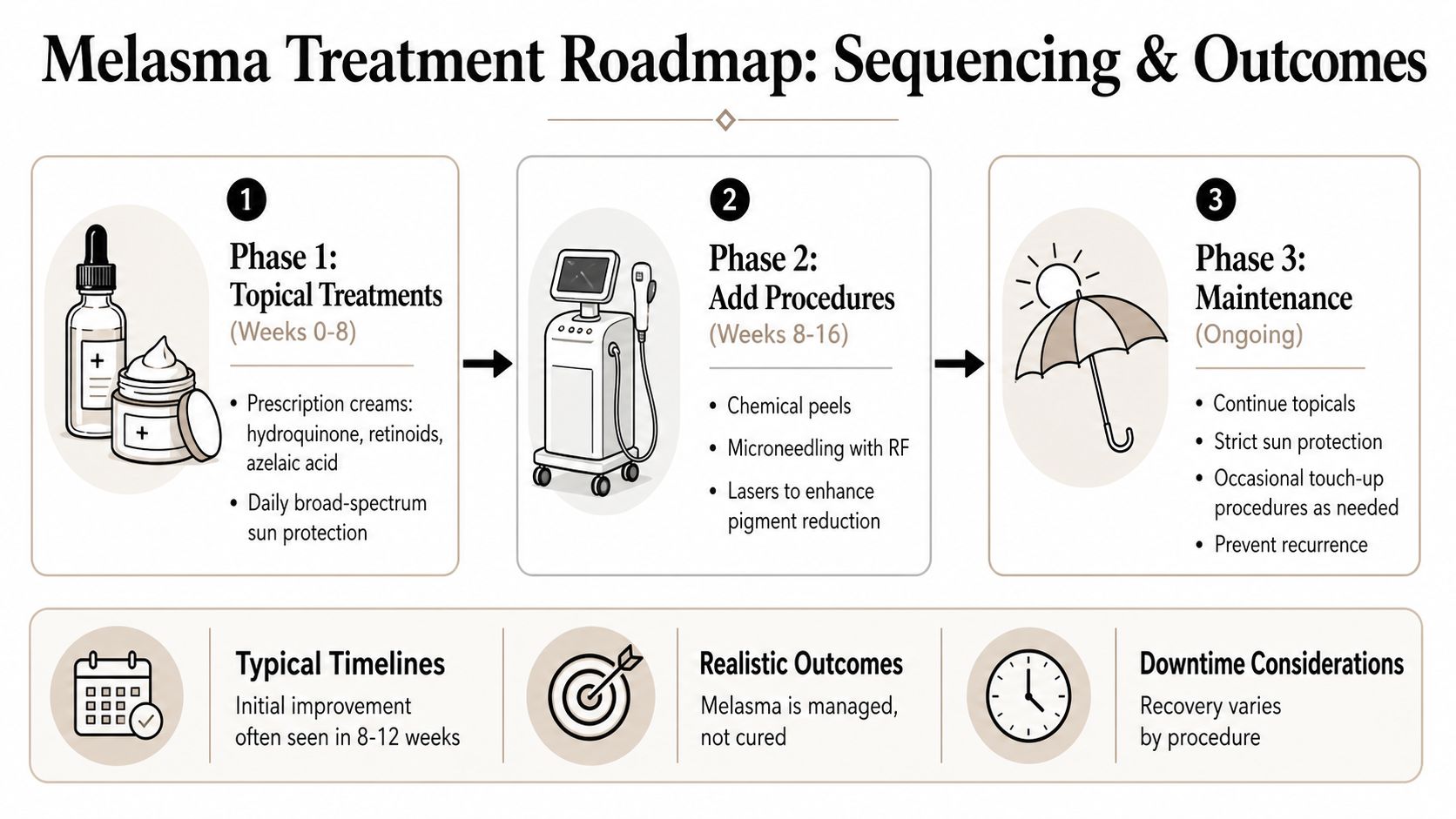
Most melasma treatment plans work better when they follow a sequence. Start by calming pigment activity. Then add procedures if needed. Then shift into maintenance before the skin slides back.
That may sound slower, but it's usually more efficient than doing three strong interventions at once and then trying to work out which one caused the flare.
Phase one starts with control
The first phase is usually topical treatment plus rigorous photoprotection. This is where patience matters most. If your plan includes azelaic acid, the earlier section already covered why clinicians often wait before judging it. If your plan uses prescription triple combination cream, it's usually used as a defined course rather than an endless routine.
The aim here is not dramatic overnight lightening. The aim is to make the skin less reactive and pigment production less active.
Phase two adds procedures selectively
Once the skin is more stable, procedures can make more sense. This is the stage where clinicians may consider peels, RF microneedling, or pigment-targeting laser work if the pattern and skin type are suitable.
For laser-based treatment, there is at least one clear timetable in the evidence we've covered earlier: Q-switched protocols may involve six to ten sessions at 2 to 4 week intervals in selected cases. That kind of spacing matters because melasma often rewards measured treatment, not back-to-back aggression.
A practical sequence often looks like this:
- Stabilise first: Use topicals and daily protection consistently.
- Review response: Check whether the pigment is fading, plateauing, or flaring.
- Add one procedural category: Avoid changing everything at once.
- Watch for rebound: Temporary brightening isn't the same as long-term control.
Maintenance is where results are kept
This is the stage many people neglect. They stop as soon as the patches look better, then act surprised when pigment returns with the next stretch of sun or hormonal change. Maintenance doesn't always mean heavy treatment. Often it means a lighter version of the same discipline.
Downtime also needs realistic framing:
- Topicals: Usually minimal visible downtime, but irritation can happen.
- Peels: Short recovery is common, though reactive skin needs caution.
- Microneedling with RF: Redness and sensitivity can follow for a period after treatment.
- Lasers: Downtime depends on device choice and settings, and the risk of rebound matters as much as visible recovery.
Reality check: The best outcome with melasma is usually better control, lighter patches, and fewer flare-ups. It isn't a promise that the condition will never return.
That's not pessimism. It's the kind of expectation that helps people choose plans they can maintain.
Specialist care and personalising treatment at 3D Aesthetics Leamington Spa
Melasma becomes a specialist problem when the pattern isn't clear, the skin keeps relapsing, or previous treatment has made things more reactive. This is especially true when someone may have mixed or vascular-type melasma, because generic advice often stops at “lasers are risky” without explaining which laser category might fit the subtype.

Why personalisation matters more than enthusiasm
A good clinic assessment should answer a few basic questions before anyone reaches for a machine. Is the pigment mostly epidermal, or does it look mixed? Is there visible redness or a vascular component? Has the skin already been irritated by strong products? Does the patient want the fastest possible change, or the lowest-risk plan?
Those questions matter because the wrong treatment can still be technically well performed and yet be wrong for that skin. Melasma is one of the clearest examples of why diagnosis drives treatment.
The overlooked issue in vascular-type melasma
One of the more confusing areas for patients is mixed melasma with a vascular element. Emerging data highlighted in a consensus paper indicate that vascular melasma (M+V) responds best to 585 to 595 nm pulsed dye laser or 532 nm Nd:YAG lasers with relapse prevention, and that mainstream resources rarely specify these wavelengths clearly for mixed-type cases (consensus details on laser selection for vascular-type melasma).
That matters because “laser” is not one treatment. It's a category. Telling a patient that laser is either good or bad without discussing subtype is a bit like saying all antibiotics are the same. They aren't.
What a non-surgical clinic should do well
In a non-surgical setting, the most useful pathway is usually a staged one. A proper consultation should identify whether your skin needs topical control first, whether a device-based approach is appropriate later, and whether signs of vascular involvement change the device choice.
For patients in Warwickshire, 3D Aesthetics Leamington Spa offers a complimentary in-depth consultation with a full 3D scan, which can help document skin concerns, personalise a treatment plan, and review change over time. In the context of pigmentation work, that kind of structured assessment is helpful because melasma often looks different under casual day-to-day lighting than it does when reviewed methodically in clinic.
A sensible personalised plan often includes:
- Pattern analysis: Looking at where the pigment sits and whether redness is part of the picture.
- Barrier assessment: Checking if the skin is strong enough for active treatment.
- Sequential treatment choice: Deciding whether to begin with topicals, devices, or both in stages.
- Relapse planning: Building in maintenance rather than treating the first fade as the finish line.
The most reassuring thing a clinic can say about melasma is not “we can cure it”. It's “we can assess your pattern properly, choose a realistic route, and monitor how your skin responds”.
If you'd like a personalised review of your pigmentation concerns, 3D Aesthetics Leamington Spa offers consultation-led, non-surgical treatment planning designed around skin type, trigger patterns, and realistic maintenance. That kind of step-by-step assessment is often the difference between trying random melasma treatment options and following a plan that makes sense.