

You're probably comparing microneedling with a chemical peel because your skin has more than one story to tell. Perhaps old acne has left indented scars and dark marks, your pores look more visible than they used to, or your complexion feels dull despite a carefully chosen skincare routine. The difficult part isn't finding treatments. It's understanding which one addresses the cause of your concern, and whether choosing just one is the right decision.
Microneedling and chemical peels are both established, non-surgical options in UK aesthetics. A 2020 survey found that 248 respondents performed microneedling at least weekly, compared with 238 who performed chemical peels weekly, making both mainstream treatments in professional practice (UK aesthetics survey). The more useful question, though, isn't “which is better?” It's which treatment, or sequence of treatments, suits your skin, goals, tone and recovery preferences?
Table of Contents
- Choosing Your Path to Renewed Skin
- How Each Treatment Rejuvenates Your Skin
- A Detailed Comparison of Your Treatment Experience
- Which Treatment Is Best for Your Skin Concern
- Beyond Versus Combining Treatments for Superior Results
- Your Personalised Treatment Plan at 3D Aesthetics
- Frequently Asked Questions
Choosing Your Path to Renewed Skin
A client may arrive wanting “smoother skin”, but that phrase can describe very different concerns. One person means shallow acne scars that catch the light. Another means brown post-acne marks, uneven tone around the cheeks, or fine lines that have become more noticeable. These concerns can appear together, yet they don't all respond to the same type of treatment.
Microneedling works primarily by encouraging structural change beneath the surface. Chemical peels work by controlled exfoliation at the skin's surface. That distinction makes the comparison practical rather than theoretical. If the problem is mainly a depression, loss of firmness or uneven texture, a collagen-inducing treatment may be more appropriate. If the problem is mainly superficial pigment, congestion or dullness, a carefully selected peel may offer a more direct route.
The right treatment should match the layer where the concern exists.
Both procedures are popular because they can improve the appearance of skin without surgical intervention, but popularity shouldn't replace assessment. Skin sensitivity, active acne, medication, previous pigmentation changes and your ability to follow aftercare all affect suitability. A superficial peel for one client may be inappropriate for another, even when the visible concern looks similar.
At 3D Aesthetics Leamington Spa, the useful conversation starts with your actual priority. Do you want to improve the feel of your skin, soften acne scarring, brighten uneven tone, or combine several goals into one carefully paced plan? Once that's clear, microneedling and peels stop looking like competing procedures and become tools with different jobs.
How Each Treatment Rejuvenates Your Skin
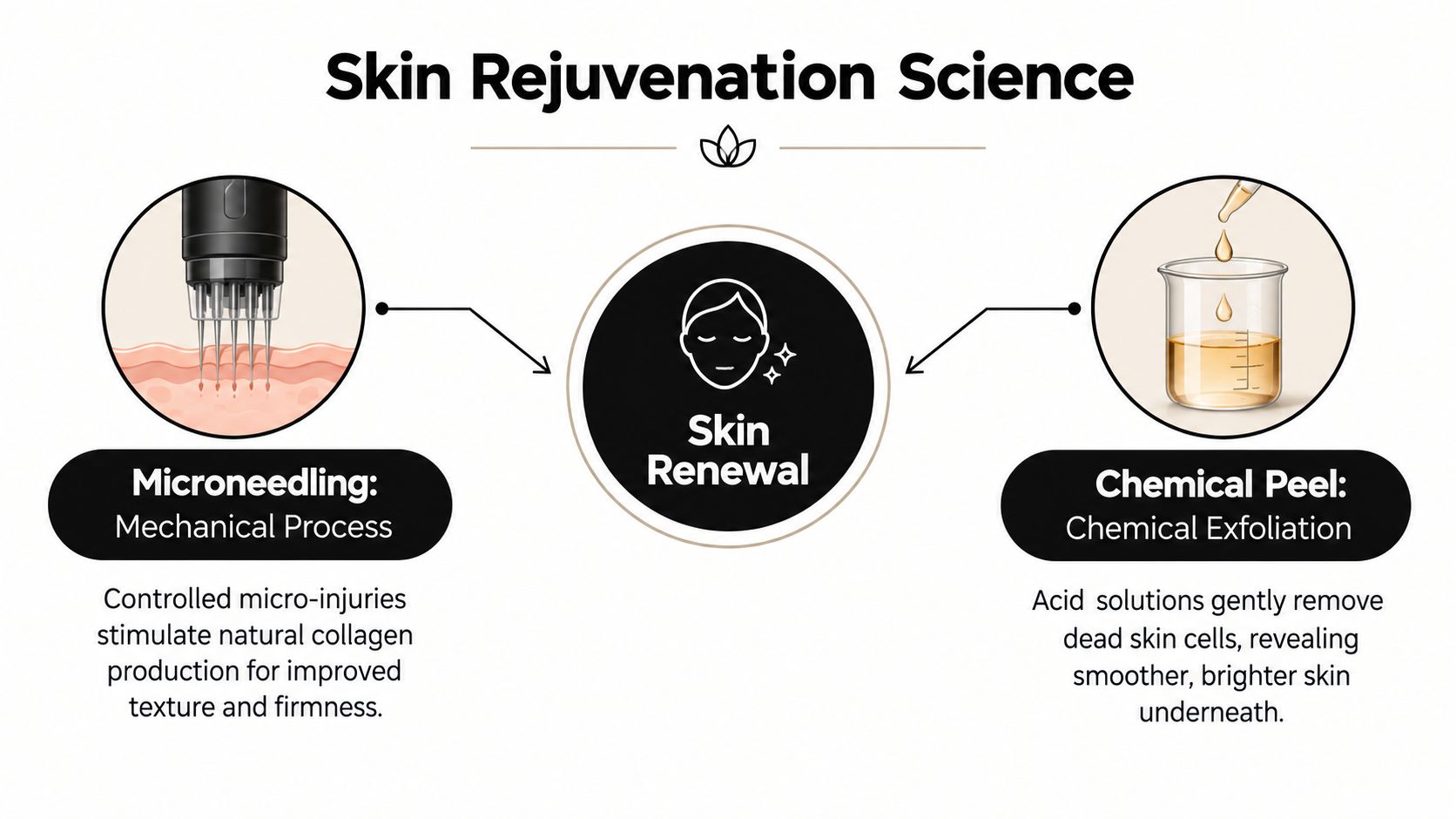
Microneedling is a mechanical treatment. A professional device uses fine needles to create controlled micro-injuries within the skin. These tiny channels activate the body's wound-healing response, which can encourage collagen and elastin production during the repair process. The aim isn't to damage the skin randomly. It's to create a measured stimulus that encourages gradual remodelling.
A useful analogy is aerating a compacted lawn. Creating small openings allows the ground to respond and support healthier growth. Microneedling applies a comparable principle to skin renewal, although the treatment depth and technique must be selected professionally for the area and concern.
UK regulatory discussions distinguish microneedling as a minimally invasive, tissue-penetrative procedure, while superficial chemical peels are grouped with skin-surface treatments (UK regulatory discussion). That difference matters because needling and exfoliation create different forms of stimulation and require different safety decisions.
Microneedling and collagen remodelling
Microneedling is generally chosen when the treatment goal involves texture, firmness, enlarged pores or atrophic scarring. The visible improvement develops progressively rather than appearing as soon as the appointment ends. Your skin needs time to repair and remodel, so a realistic plan focuses on a course of treatment and consistent aftercare rather than an instant transformation.
Advanced systems can add another form of energy. For example, radiofrequency microneedling combines needle-based stimulation with radiofrequency energy, allowing a practitioner to consider both collagen induction and skin tightening within one treatment strategy.
If you're researching device-based approaches, an overview of SkinPen microneedling can help you understand how a professional microneedling system differs from a consumer roller. You can also explore the microneedling facial treatment available through a clinic-based treatment pathway.
Chemical peels and controlled exfoliation
A chemical peel applies a selected solution to loosen the bonds between surface skin cells. As those cells shed, fresher skin becomes visible and the complexion may look brighter and feel smoother. Superficial peels primarily address the epidermis, while deeper formulations reach further into the skin and therefore carry a different recovery and governance burden.
Think of a peel as refining a rough painted surface. It removes unwanted surface build-up, but it doesn't rebuild a deep indentation in the same way that collagen stimulation can. Peel depth, formulation, application time and your skin's reactivity all matter, especially when pigmentation is a concern.
A Detailed Comparison of Your Treatment Experience
The choice between microneedling and a chemical peel often comes down to more than results. Sensation, visible recovery, skin tone, lifestyle and the type of improvement you want all deserve equal attention. The table gives a practical starting point, but your clinician should adjust the plan after assessing your skin.
Microneedling vs chemical peel at a glance
| Factor | Microneedling | Chemical Peel, Superficial or Medium |
|---|---|---|
| Primary action | Controlled needle-based stimulation beneath the surface | Controlled exfoliation of surface skin layers |
| Common treatment focus | Texture, collagen support, atrophic acne scarring and pores | Dullness, superficial uneven tone, congestion and selected pigmentation concerns |
| Sensation | Prickling, warmth or pressure, influenced by the device and topical preparation | Tingling, warmth or stinging, influenced by formulation and depth |
| Visible recovery | Redness and sensitivity can occur after treatment | Tightness, dryness, flaking or peeling can occur, particularly with a deeper peel |
| Result pattern | Gradual improvement as skin remodels | Surface refinement may become apparent as the skin sheds and settles |
| Skin of colour | Often considered a suitable option when performed conservatively and appropriately | Superficial peels may be suitable, while medium-depth peels require caution and deep peels should be avoided in darker skin |
| Main risk to discuss | Irritation, prolonged inflammation or pigmentation change if unsuitable or poorly performed | Irritation and post-inflammatory hyperpigmentation, with risk increasing as peel depth and skin reactivity increase |
Recovery and social downtime
Microneedling usually leaves the skin looking flushed and feeling sensitive for a period after treatment. You may prefer to avoid strenuous plans, heat and unnecessary touching while the barrier settles. A peel can produce visible dryness or shedding, which some clients find more noticeable socially even when the treatment itself felt straightforward.
Neither treatment should be judged by the first few hours alone. The skin's response depends on the intensity selected, your baseline sensitivity, sun exposure and whether you follow the prescribed aftercare. Avoiding active products until your clinician says they're appropriate is often more important than trying to accelerate the result.
Skin tone and suitability
Skin of colour needs a careful, individualised approach. A 2026 review reports that microneedling and superficial peels are generally safe and effective for Fitzpatrick types IV to VI, while medium-depth peels require caution and deep peels should be avoided to reduce the risk of post-inflammatory hyperpigmentation (review of hyperpigmentation treatment).
That doesn't make microneedling automatically suitable, or a superficial peel automatically risk-free. A history of pigmentation after spots, bites or previous treatments should influence the plan. Active infection, uncontrolled inflammatory skin conditions, poor wound healing and some medicines may also mean treatment needs to be delayed or modified.
Cost and treatment planning
There isn't a responsible universal price comparison. The cost depends on the device, peel formulation, practitioner, treatment area, consultation requirements and whether you need a single session or a planned course. A cheaper appointment may not represent better value if the treatment is poorly matched to your skin or lacks appropriate follow-up.
Ask what's included, who performs the procedure, how the treatment is adjusted for your skin tone and what happens if your skin reacts unexpectedly. Those questions reveal more about quality than the treatment name alone.
Which Treatment Is Best for Your Skin Concern
The most reliable way to choose is to identify whether your priority is structure, surface appearance or both. Microneedling is often favoured for concerns involving collagen and dermal support. Chemical peels are often useful when the main issue sits closer to the surface, such as dullness or uneven superficial tone.

Atrophic acne scarring
Indented acne scars are a structural concern. Microneedling can stimulate collagen remodelling beneath the surface, which is why it's commonly considered for rolling and selected boxcar scars. It won't erase every scar, and tethered or sharply defined scars may need a different intervention, but it directly addresses the type of tissue change involved.
The 2022 British Journal of Dermatology systematic review identified 8 studies on microneedling, compared with 5 studies on chemical-peel adjuncts, within its review of atrophic acne-scar resurfacing techniques (British Journal of Dermatology review). The review's evidence structure supports microneedling as a direct, evidence-backed option for scar remodelling, while peels were more often considered alongside another treatment.
If you're weighing options for indented scars and lingering brown marks together, the best acne scar removal treatment will depend on whether the dominant issue is indentation, pigment or a combination.
Pigmentation and post-acne marks
Chemical peels can be useful when pigment is superficial and the treatment has been selected conservatively. A peel may improve brightness and surface uniformity, but pigmentation can return if the underlying trigger, including inflammation or ultraviolet exposure, isn't managed.
Microneedling isn't automatically the right choice for pigment. Mechanical inflammation can be counterproductive for clients who develop post-inflammatory hyperpigmentation easily, so skin history and Fitzpatrick type need to guide the decision. In some cases, the safest plan prioritises barrier support, pigment control and staged treatment before any resurfacing procedure.
Fine lines, pores and uneven texture
Both treatments may have a role in fine lines, but they work differently. Microneedling is more relevant when laxity, crepey texture or reduced dermal support is part of the concern. A superficial peel may produce a fresher-looking surface and soften roughness, particularly when dull cell build-up is the main issue.
For enlarged pores, microneedling may be preferable when the surrounding skin lacks firmness. A peel can improve congestion and surface smoothness, but it won't create the same type of structural support. Many clients have both oiliness and reduced elasticity, which is where a staged plan becomes more logical than choosing a winner.
Beyond Versus Combining Treatments for Superior Results
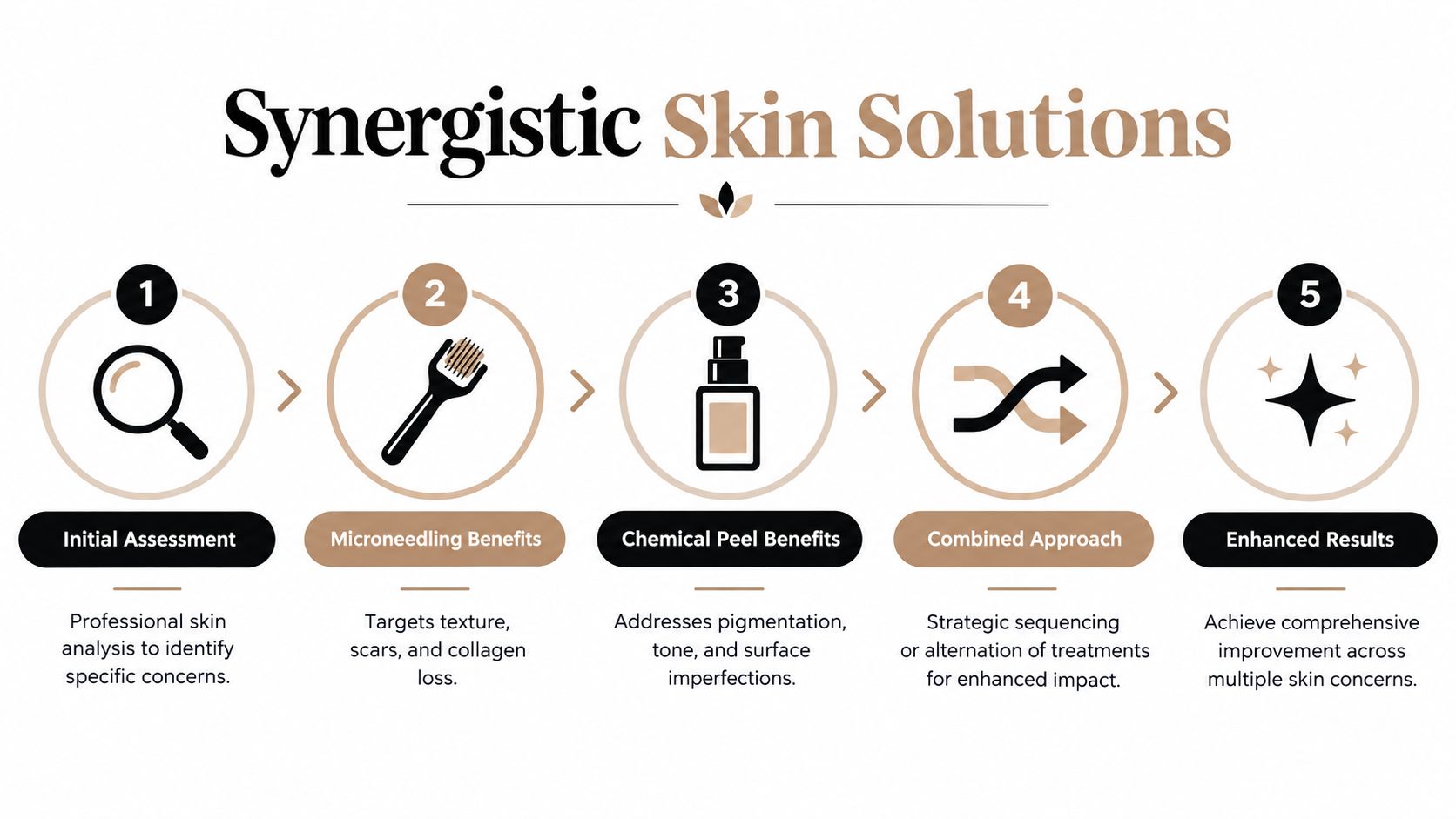
Some clients are asking the wrong question when they ask, “Should I have microneedling or a peel?” If acne scarring includes both depressions and post-inflammatory pigment, treating only one layer leaves part of the problem untouched. Microneedling can address texture, while a carefully chosen peel can address selected surface irregularities and tone.
Recent evidence supports this broader view. A 2025 systematic review and meta-analysis found that combined microneedling and chemical peeling outperformed either treatment alone for atrophic acne scars, with responder rates of 40 to 50% for the combined protocol, compared with no more than 13% for either monotherapy (2025 systematic review and meta-analysis). These figures apply to the reviewed clinical context, not to a guarantee for every individual.
Combination doesn't mean doing everything at once
Combining treatments should mean planned sequencing, not stacking aggressive procedures into one appointment. Your clinician may choose to focus first on the concern most likely to influence the outcome, then introduce the second modality once the skin has recovered and shown that it tolerates the approach.
A safe protocol considers treatment depth, intervals, sun exposure, pigment history and the products used before and after each appointment. The deeper the peel, the more cautious the planning needs to be, particularly for darker skin tones.
A combined plan is only superior when the skin can tolerate the sequence. More treatment isn't automatically better treatment.
Combination care may also include supportive modalities rather than another resurfacing procedure. For example, Dermalux LED therapy may be considered as part of a broader skin-support plan, depending on the treatment and your clinician's assessment.
The advanced insight is not that everyone needs both treatments. It's that a single treatment may be too narrow for a mixed concern. A client with shallow scars and uneven pigmentation may benefit from a customized combination, while someone with reactive skin may need a slower, simpler route.
Your Personalised Treatment Plan at 3D Aesthetics
A consultation should answer three questions before you book a procedure. What exactly are we treating? What level of inflammation can your skin safely tolerate? What result can this treatment realistically provide? Without those answers, comparing microneedling and peels becomes a product-shopping exercise rather than clinical planning.
At 3D Aesthetics Leamington Spa, the consultation process considers your skin concern, tone, history, sensitivity, current routine and practical recovery requirements. The clinic's facial treatment options include standard microneedling, 3D Dermaforce radiofrequency microneedling, fractional CO2 resurfacing, Dermalux LED light therapy and prescriptive facial peels. These treatments aren't interchangeable, so the choice should follow the assessment rather than lead it.

How the plan may be tailored
A texture-led plan may prioritise microneedling or radiofrequency microneedling, particularly where pores, laxity or atrophic scarring are involved. A tone-led plan may begin with a conservative peel selection and a supportive skincare routine. A mixed plan may alternate treatments, allowing the skin to settle between sessions and giving the practitioner an opportunity to review its response.
Fractional CO2 resurfacing may be discussed for concerns requiring a more intensive resurfacing approach, although treatment intensity and suitability must be assessed carefully. LED therapy may be incorporated to support comfort and recovery as part of a wider protocol, rather than used as a substitute for treating the underlying scar or pigment.
The purpose of a professional consultation isn't to persuade you into the most advanced option. It's to remove guesswork. You should leave knowing why a particular procedure has been recommended, what recovery involves, which results are realistic and when the plan should be reviewed.
Frequently Asked Questions
Is microneedling or a chemical peel more effective?
Neither is universally more effective. Microneedling generally fits structural concerns such as atrophic acne scarring and uneven texture, while a suitable chemical peel can be more relevant to superficial dullness and selected pigmentation concerns. For mixed acne scarring, recent evidence suggests that a planned combination can outperform either treatment used alone (systematic review of combined treatment).
Can sensitive skin have either treatment?
Sensitive skin doesn't automatically rule out both procedures, but it does demand conservative planning. Your practitioner may need to stabilise the barrier, review active skincare ingredients and select a lower-intensity treatment. A history of eczema, rosacea, frequent flushing or previous reactions should be discussed before booking.
Are at-home rollers equivalent to professional microneedling?
No. Professional microneedling uses a controlled device, clinical hygiene procedures and a treatment depth selected for your concern. At-home rollers can create irritation, uneven trauma or contamination risks, particularly when users apply too much pressure or repeat treatment before the skin has recovered.
When will I see results?
A peel can make the surface look fresher as exfoliation settles, although the timing depends on its formulation and depth. Microneedling results develop more gradually because collagen remodelling takes time. Your practitioner should explain whether your plan is intended to improve immediate radiance, progressive texture or both.
When can I wear makeup?
Follow the specific aftercare instructions you're given. Both treatments can leave the skin more reactive, and applying makeup too soon may increase irritation or interfere with barrier recovery. If you have an important event, tell the clinic before treatment so the appointment can be planned around the visible recovery period.
Is combining treatments safe for darker skin tones?
It can be appropriate, but combination treatment requires careful sequencing and conservative peel selection. For Fitzpatrick types IV to VI, superficial peels and microneedling are generally considered safe in the cited 2026 review, while medium-depth peels require caution and deep peels should be avoided (skin-of-colour safety review). Your pigmentation history matters as much as the treatment label.
For personalized advice on microneedling, prescriptive chemical peels, 3D Dermaforce radiofrequency microneedling and supportive facial treatments, book a consultation with 3D Aesthetics Leamington Spa. Bring your main concern, your preferred recovery window and any history of pigmentation or sensitivity, so the team can help you choose a safe treatment or combination plan.
← Back to Home