

You eat well, exercise consistently, and still notice a soft pocket around your abdomen, flanks, or thighs. The scales may reflect your effort, yet one area seems unwilling to change. That frustration is common, and it doesn't necessarily mean your routine has failed.
Non-surgical body sculpting is designed for this gap between general fat loss and localised contouring. It isn't a replacement for nutrition, exercise, or medical weight management. Instead, it uses targeted energy and carefully planned treatment zones to refine areas where diet and training haven't produced the shape you want.
Table of Contents
- Why Stubborn Fat Resists Diet and Exercise
- How Non Surgical Body Sculpting Technologies Work
- Expected Results and Realistic Timelines
- Choosing the Right Treatment for Your Concerns
- The Role of 3D Body Scanning in Personalised Plans
- Common Misconceptions About Body Contouring
- Your Next Steps at 3D Aesthetics Leamington Spa
Why Stubborn Fat Resists Diet and Exercise
Consider someone who has improved their meals, walks regularly, and follows a structured strength programme. Their overall body composition may change, but the lower abdomen remains fuller than they'd like, or the outer thighs still appear disproportionate. Fat storage doesn't occur evenly, so progress elsewhere doesn't guarantee identical change in every area.
Genetics strongly influence where the body stores and releases fat. Hormonal patterns, age, sex, and inherited fat distribution all affect whether someone tends to retain volume around the abdomen, hips, thighs, upper arms, or another region. Two people following similar routines can therefore experience different visible changes.
Subcutaneous fat is not visceral fat
The fat relevant to body contouring is usually subcutaneous fat, the soft layer beneath the skin. Visceral fat sits deeper around internal organs and has a different relationship with metabolic health. Treating a surface fat pocket won't remove visceral fat, alter overall obesity-related risk, or replace clinical weight-management care.
Calorie restriction and physical activity generally make fat cells smaller. They don't selectively remove every cell from a chosen pocket. When the body draws on stored energy, some areas respond readily while others remain comparatively resistant, which explains why a person can become fitter without achieving the exact contour they want.
Practical rule: Think of body sculpting as refinement after, or alongside, healthy habits, not as a shortcut to general weight loss.
A suitable client often has a stable weight and a mild-to-moderate localised concern, with enough tissue for an applicator or energy treatment to address safely. The intended outcome is a smoother transition, reduced fullness, or improved definition in the treated area. It isn't a dramatic whole-body transformation.
Hormonal conditions can also affect how someone experiences abdominal fat and bloating. If that concern relates to polycystic ovary syndrome, the PCOS belly reduction guide offers useful context on why abdominal changes may involve more than a simple surface fat pocket.
How Non Surgical Body Sculpting Technologies Work
Different devices act on different tissues. A consultation should identify whether the main issue is a discrete fat pocket, loose skin, uneven texture, limited muscle definition, or a combination of these concerns.
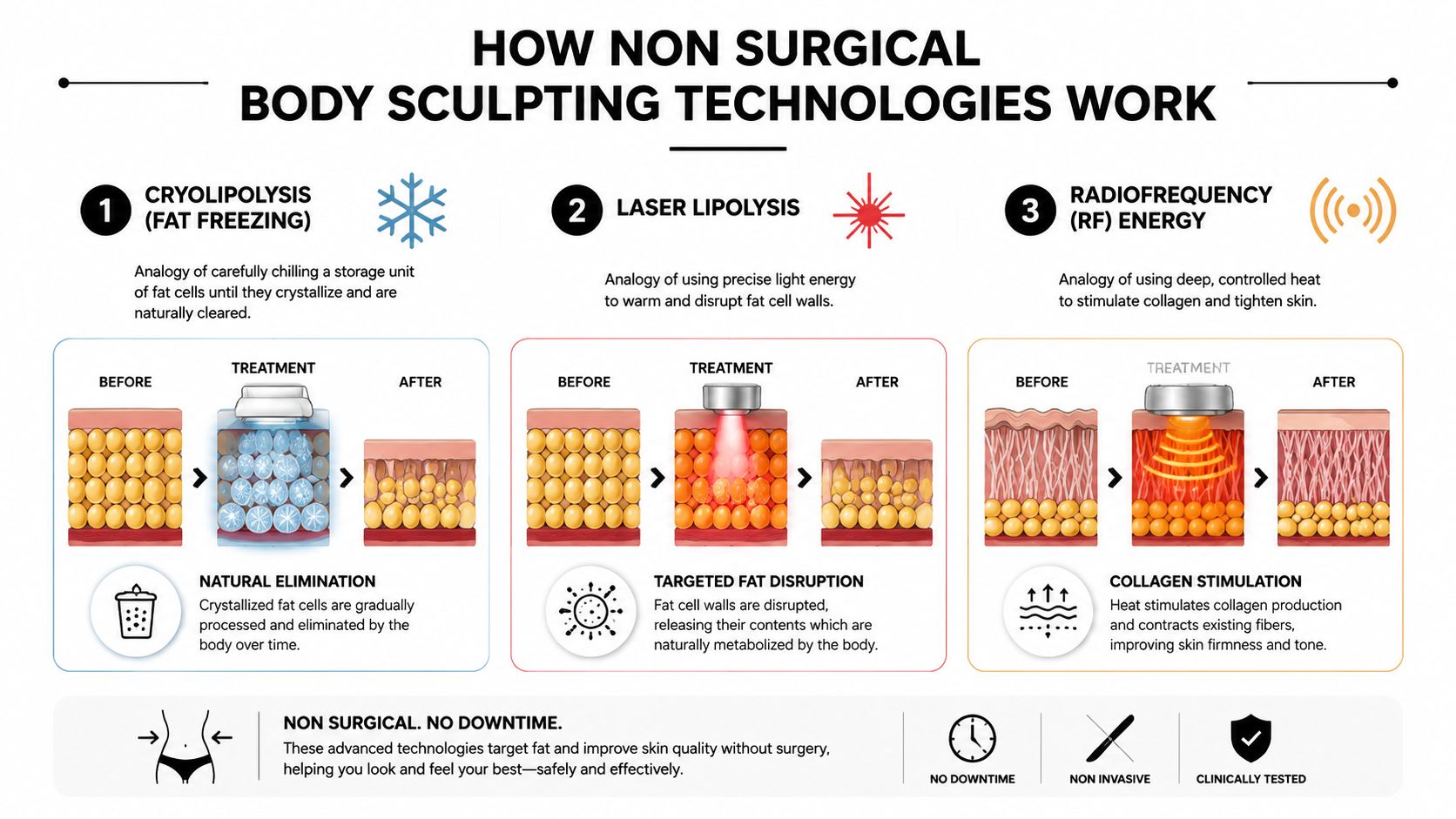
Cryolipolysis
Cryolipolysis, often called fat freezing, uses controlled cooling to affect fat cells. A treatment applicator draws a fold of tissue into its cup and cools the target layer. A simple analogy is chilling a storage compartment containing fat cells while protecting the surrounding structures from the same exposure.
The treated cells undergo a delayed biological response and are gradually processed by the body. The visible change develops over time, so the treatment isn't judged by what the area looks like immediately after the applicator is removed. Cryolipolysis suits defined, pinchable pockets more than diffuse weight gain.
Ultrasound cavitation
Ultrasound cavitation delivers sound energy into the treated tissue. The energy can create microscopic bubbles in fluid around fat cells. As those bubbles change and collapse, they place mechanical stress on the cell membranes.
The body then processes the affected contents through its normal systems. Providers use this approach for localised contouring, but treatment selection still depends on tissue thickness, skin quality, health history, and the device protocol. It shouldn't be described as a way to remove visceral fat or treat obesity.
HIFU
High-Intensity Focused Ultrasound, or HIFU, concentrates acoustic energy at a chosen depth. Rather than heating the entire surface evenly, the practitioner aims energy into a defined tissue plane. That makes depth selection and mapping particularly important.
Depending on the device and protocol, HIFU may be used to affect subcutaneous tissue and encourage tightening through controlled thermal injury. It's often considered when a client has both localised fullness and some skin laxity, although significant excess skin may require a different clinical discussion.
For readers comparing these approaches, this guide to HIFU versus radio frequency explains why the technologies aren't interchangeable.
Radiofrequency
Radiofrequency, or RF, uses electromagnetic energy to create controlled heat in the dermis and, with suitable equipment, deeper tissue. Practitioners use that heat to encourage collagen remodelling and improve the appearance of lax or uneven skin.
RF can be useful when skin quality is the priority, particularly where a client wants firmer-looking tissue rather than substantial fat reduction. It may also form part of a combination protocol, but the treatment depth and thermal control need to match the tissue being addressed.
Shockwave therapy
Shockwave treatments deliver acoustic pulses through the skin. These pulses are used to influence circulation and the appearance of fibrous, uneven tissue associated with cellulite. The treatment isn't primarily a fat-removal method.
That distinction matters. Someone with a small fat pocket and loose, dimpled skin may need a different plan from someone with a thicker, well-defined area of subcutaneous fat. Shockwave can be considered when texture is the dominant concern.
Powersculpt
Powersculpt uses electrical muscle stimulation alongside energy-based body treatment. The electrical component creates repeated muscle contractions, similar in principle to the signal that tells a muscle to tighten during exercise. It can be considered when muscle tone and visible definition matter as much as the fat layer above it.
Anyone researching electrical stimulation should also understand the differences between consumer and clinic equipment. This resource on choosing the right EMS device provides helpful background on how EMS devices can vary in purpose and design.
A short visual overview can help you compare the physical principles before discussing a treatment plan:
No technology guarantees the same result for every body. The applicator, energy level, treatment depth, spacing, and target area all influence the final outcome, which is why a generic package may be less appropriate than an individually mapped programme.
Expected Results and Realistic Timelines
A client may notice a smaller abdominal pocket while their body weight stays almost unchanged. That is the right starting point for understanding non-surgical body sculpting. These treatments aim to alter a local contour, not produce instant weight loss. Evidence summaries report reproducible circumference reductions of 2 cm or more in treated areas such as the abdomen, hips, and thighs after cryolipolysis, ultrasound, radiofrequency, and low-level laser therapy. They also clarify that these methods do not treat visceral fat or overall obesity-related risk. (Evidence summary)
A mapped result needs a mapped assessment. Baseline photographs, circumference readings, and three-dimensional volume measurements can show whether a planned area is changing, even when the bathroom scales do not. The scan also helps the practitioner compare the treated contour with surrounding tissue rather than judging the result by eye alone.
Why timing varies
Fat-cell processing and tissue remodelling happen gradually. In a cryolipolysis benchmark involving 27 patients and 54 body areas, mean skinfold thickness changed from 35.4 ± 9.9 mm before treatment to 22.2 ± 7.6 mm at 12 weeks, a mean change of -40%. The report also found greater improvement with 3 or more cycles than with only 1 to 2 cycles. (Cryolipolysis benchmark)
Those findings describe one measured group, not a guaranteed individual outcome. Tissue thickness, treatment dose, applicator placement, skin elasticity, metabolic health, and the selected technology can all affect the response. Hydration and gentle movement may support normal aftercare, but they cannot correct unsuitable candidate selection or an inaccurate treatment map.
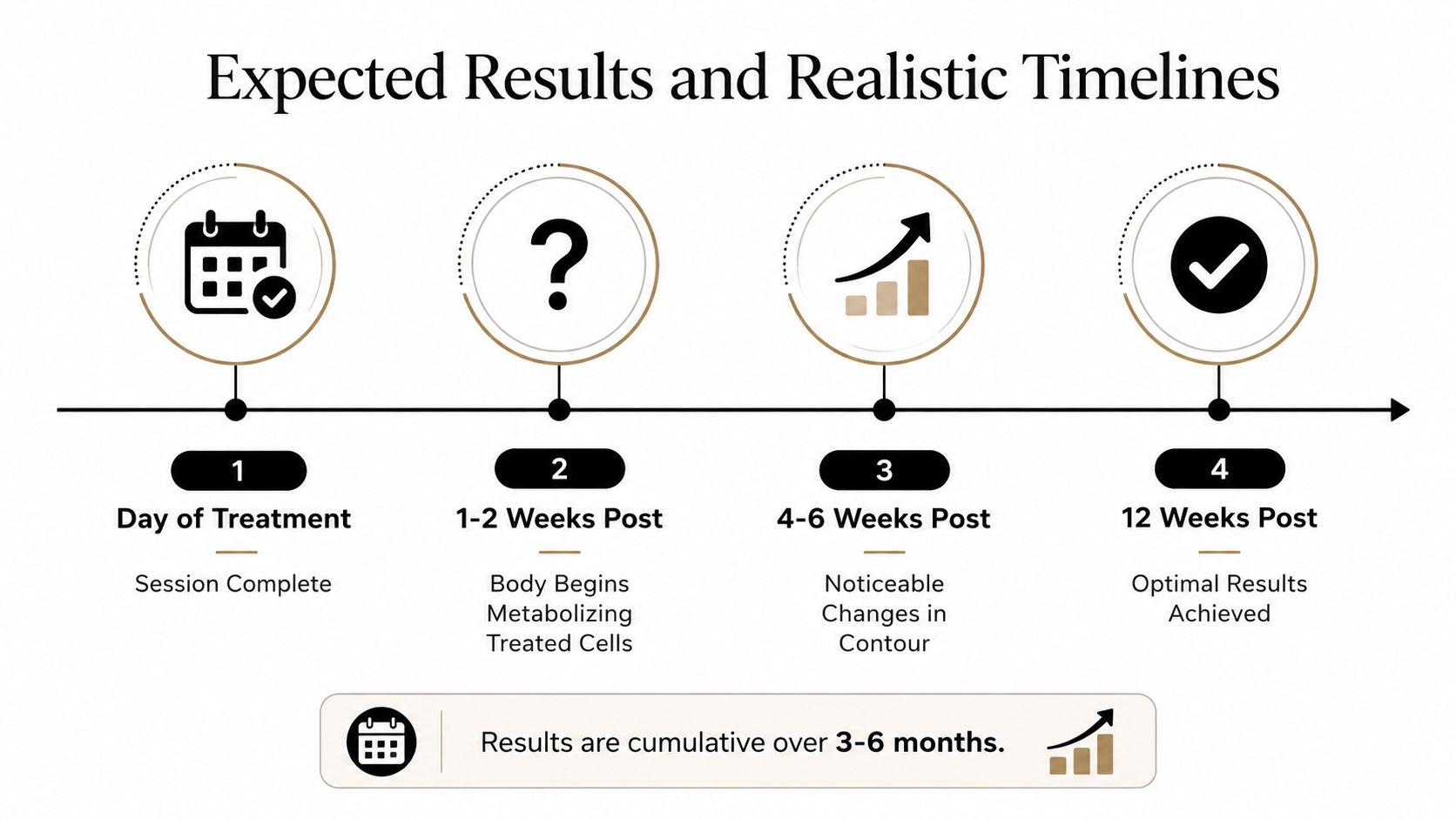
A useful timeline is:
- Treatment day: The session is complete, but the final contour is not visible.
- Early recovery: The body begins processing treated tissue. Temporary sensations or swelling can make the area difficult to assess.
- Around four to six weeks: Some clients begin to see a contour change, although the tissue may still be developing.
- Around twelve weeks: A measured review is more informative, particularly after cryolipolysis.
- Several months: The practitioner can compare scan data and decide whether further refinement or a different treatment priority is appropriate.
“Permanent” also requires precise wording. Treated fat cells may be destroyed or reduced, depending on the technology, but remaining fat cells can still enlarge if body weight rises. Maintaining a stable weight helps preserve the contour, while later weight change can alter the surrounding shape.
Before booking a course, ask which measurements will be repeated and when. A sound plan includes a delayed review and clear scan-based comparison, not only an immediate visual impression. You can also read about how many fat-freezing sessions may be needed before discussing a suitable protocol.
Choosing the Right Treatment for Your Concerns
The “best” treatment depends on the tissue, not the most familiar brand name. Start by identifying the feature you want to change, then match the mechanism to that feature.
| Primary Concern | Recommended Technology | How It Works | Typical Sessions |
|---|---|---|---|
| A defined pocket of subcutaneous fat | Cryolipolysis or ultrasound cavitation | Cooling or acoustic energy targets localised fat tissue | Determined after assessment |
| Mild skin laxity | RF or HIFU | Controlled heat or focused ultrasound encourages tissue remodelling and tightening | Determined by area and response |
| Cellulite and uneven texture | Shockwave therapy, sometimes combined with RF | Acoustic pulses address fibrous texture and circulation-related appearance | Planned as a course when appropriate |
| Limited muscle definition | Powersculpt | Electrical stimulation creates repeated muscle contractions alongside body contouring energy | Based on muscle tone and goals |
| Fat plus laxity | A staged combination plan | One technology addresses fullness while another focuses on skin quality | Sequenced according to tissue response |
When fat is the main concern
Cryolipolysis may suit a discrete, graspable pocket that remains despite stable habits. Ultrasound cavitation may be considered when the practitioner believes acoustic treatment is appropriate for the tissue and area. Neither choice should be made from a treatment menu alone, because tissue depth and skin behaviour affect applicator placement and safety.
When skin is the main concern
RF is generally more focused on heat-driven collagen remodelling and surface-to-deeper skin quality. HIFU concentrates energy at a selected depth, which can make it useful when the practitioner needs to target a deeper tissue plane. Neither is a substitute for surgery where there is substantial excess skin or pronounced laxity.
A useful question to ask: “Which tissue are you treating, and how will you measure whether that tissue has changed?”
Combination protocols can make sense when a client has more than one issue, such as a fat pocket with mild laxity or uneven texture. However, layering treatments shouldn't mean adding every available device. The practitioner should explain the order, spacing, intended contribution of each technology, and the point at which further treatment may no longer add meaningful refinement.
The Role of 3D Body Scanning in Personalised Plans
A visual consultation can identify a concern, but it can't reliably show every asymmetry, circumference difference, or change in volume. Three-dimensional scanning adds a measurable baseline, allowing the practitioner to assess the body as a shape rather than relying only on memory, tape placement, or front-facing photographs.
At 3D Aesthetics Leamington Spa, complimentary 3D body scanning is used during consultation to capture body contours, distribution, and asymmetries before treatment planning. The scan creates a digital representation that can help the practitioner define treatment zones with greater precision than a generic “abdomen” or “thighs” label.
How mapping changes the plan
Suppose the left and right flanks don't hold the same volume. A standard protocol may apply identical treatment to both sides, while a mapped plan can account for the difference. The same principle applies to applicator selection, HIFU depth, RF coverage, and the order in which combination treatments are delivered.
3D data can support decisions such as:
- Zone definition: Marking the exact pocket rather than treating a broad region.
- Applicator choice: Selecting an applicator that matches tissue size and shape.
- Depth planning: Aligning HIFU or RF settings with the tissue being addressed.
- Asymmetry management: Adjusting treatment distribution when one side differs from the other.
- Outcome tracking: Comparing later scans with the original baseline.
The scan doesn't make a treatment effective by itself. It improves the information available to the practitioner, while clinical judgement still determines whether treatment is suitable. It also helps clients understand why a plan may differ between two people who appear to have a similar concern.
Repeat scanning provides a more objective follow-up than relying on changing lighting, posture, or camera angle. The body measurement tracking service explains how repeated measurements can help document contour changes over time.
For clients who want predictable planning, the key benefit is clarity. You can see where treatment starts, what the practitioner is targeting, and whether the later result corresponds to the original objective.
Common Misconceptions About Body Contouring
A client may want a flatter abdomen after losing weight, yet still describe the goal as “weight loss.” That wording matters. Body contouring, skin tightening, muscle stimulation, and weight management address different concerns, so a consultation should separate them before treatment begins.
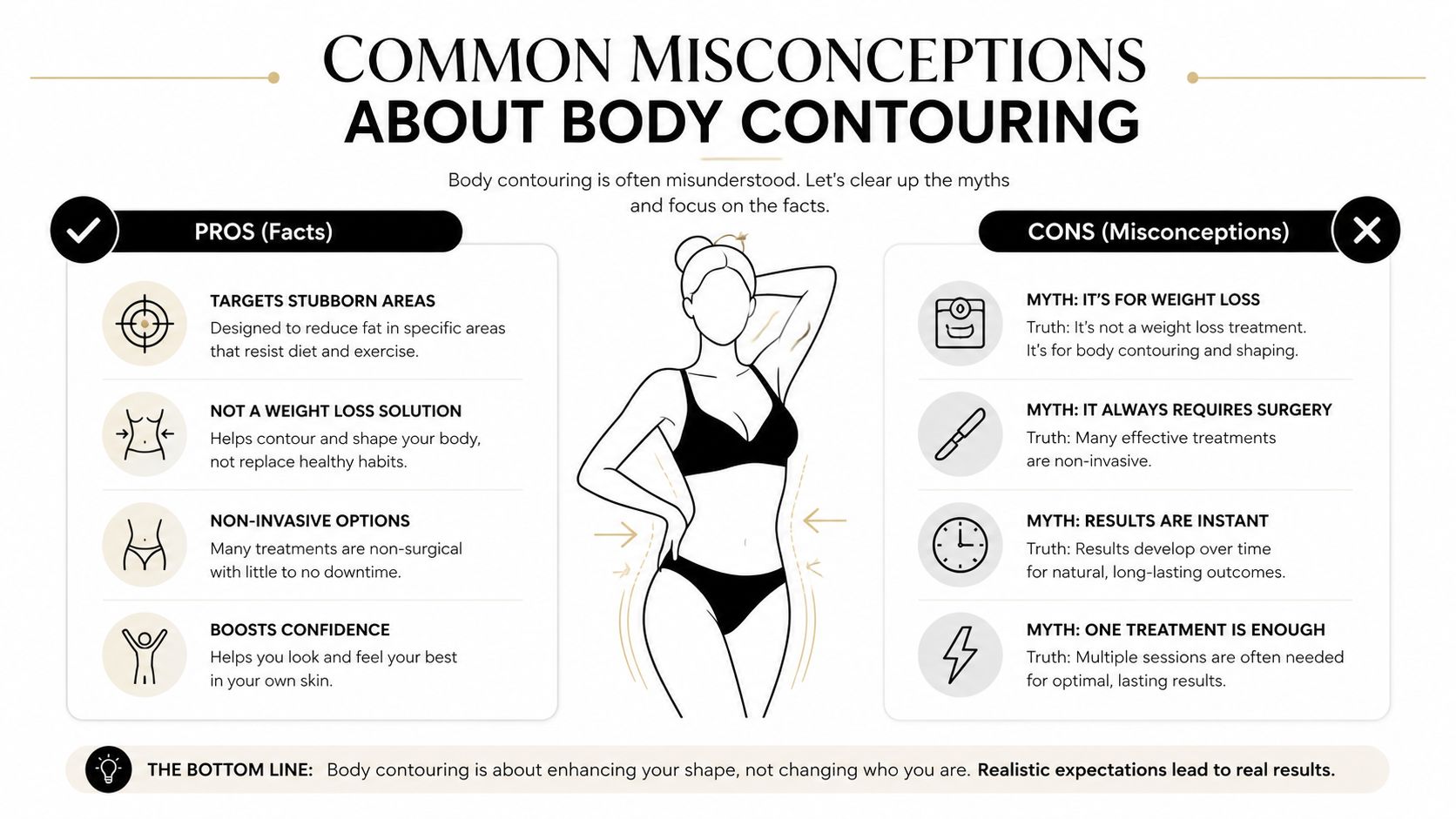
Myth one, contouring is weight loss
Reality: Non-surgical treatments address localised tissue rather than overall body weight. Clinical summaries report measurable circumference changes in treated areas, while noting that these methods do not address visceral fat or obesity-related health risks. The result is closer to refining one section of a garment than shrinking the whole garment. (Clinical evidence summary)
UK reporting on a meta-analysis described pooled findings from more than 3,000 participants across 30 trials, including average reductions of about 1.8 BMI points and 3.56 cm in waist circumference, more than 80% reporting satisfaction, and mainly minor side effects such as numbness, redness, and pain. (UK reporting on the meta-analysis) These results do not make body sculpting a substitute for medical obesity care.
Myth two, one session creates a dramatic transformation
Reality: Results depend on the treated area, the technology, and the planned treatment dose. One session may suit a small refinement, while a larger or more resistant area may need a course followed by delayed reassessment. Ask what a single session is expected to change before agreeing to additional appointments. A carefully mapped plan is more useful than a promise based on the device name alone.
Myth three, non-surgical means every body type responds equally
Reality: Skin quality affects what contouring can show. Significant laxity, particularly after major weight loss, may limit visible improvement. UK-facing guidance describes contouring as more suitable for mild-to-moderate concerns, while substantial loose skin may require surgery for meaningful correction. (Post-weight-loss body contouring guidance)
Myth four, destroyed fat automatically appears elsewhere
Reality: Treated cells do not migrate to another body area. Untreated cells can enlarge if overall weight rises, changing proportions and reducing definition. Stable weight therefore supports a more consistent contour, although it does not prevent every change in body shape.
Ask for limits, not just benefits. A responsible consultation should explain who may not be suitable, what the treatment cannot change, and when another option would make more sense.
Clients taking GLP-1 medicines or losing substantial weight should discuss treatment order before booking. Changing body composition and skin laxity may alter the priority, so methods from Trim's weight loss experts can provide useful context for that discussion.
Your Next Steps at 3D Aesthetics Leamington Spa
Start with a complimentary consultation rather than selecting a device online. The practitioner should discuss your goals, relevant medical history, weight stability, skin quality, previous treatments, and any concerns about discomfort or downtime.
The 3D body scan then helps identify the treatment zones and asymmetries. Your plan can outline the recommended technology, the likely number of sessions, the spacing between appointments, the measurement method, and the point at which results will be reviewed.
Pricing depends on the number of areas treated and whether technologies are combined. Ask whether package options are available, and request a clear explanation of what each package includes before making a decision.
Aftercare commonly includes following the clinic's specific instructions, maintaining hydration, and keeping up light movement where appropriate. Follow-up appointments and repeat scans help distinguish genuine contour change from temporary swelling or differences in posture.
There's no need to commit before you understand the plan. For people in Leamington Spa and surrounding Warwickshire areas, an in-person assessment provides a more useful starting point than comparing generic claims about fat freezing, RF, HIFU, or cavitation.
3D Aesthetics Leamington Spa offers complimentary consultations with 3D body scanning and personalised planning for treatments including fat freezing, ultrasound cavitation, Powersculpt, shockwave, HIFU, and radiofrequency. Visit 3D Aesthetics Leamington Spa to discuss your target area, understand realistic outcomes, and arrange a measured treatment plan.
← Back to Home