

You've lost weight, finished breastfeeding, or noticed that your abdomen, thighs, or upper arms no longer feel as firm as they once did. Exercise may have improved the muscle underneath, but the skin still looks crepey or gathers when you sit. That's a common situation, and it doesn't mean you've failed to work hard enough.
The right skin tightening treatments for body concerns can improve mild to moderate laxity, texture, and firmness without surgery. They can't remove a large apron of excess skin or reproduce a body lift. Understanding that difference before you book a consultation is the best way to choose a treatment that matches your anatomy rather than a heavily edited before-and-after image.
Table of Contents
- Understanding Skin Laxity and Why It Happens
- How Non-Surgical Skin Tightening Technologies Work
- Comparing the Main Body Tightening Treatments
- What a Typical Treatment Pathway Looks Like
- When These Treatments Are Suitable and When They Are Not
- Safety, Aftercare and Combination Strategies
- Planning Your Next Steps at 3D Aesthetics Leamington Spa
Understanding Skin Laxity and Why It Happens
A client may come in after significant weight loss, pleased with her new shape but frustrated by loose skin around the lower abdomen. Another may have relatively little excess tissue but notice fine creping over the thighs or upper arms. Both describe “loose skin”, yet the underlying problem and the most suitable treatment may be quite different.
Skin laxity develops when the supporting structures within the dermis lose some of their strength and organisation. Collagen provides structure, while elastin helps skin recoil. Ageing, pregnancy, changes in body volume, genetics and sun exposure can all affect how well those fibres support the surface. Diet and exercise can reduce fat and build muscle, but they can't directly replace stretched skin or fully restore depleted collagen.
Why body zones behave differently
The abdomen often shows a mixture of stretched skin, altered fat distribution and, after pregnancy, possible changes in the abdominal wall. The upper arms may show fine wrinkling with only a small amount of loose tissue. Thighs can present with laxity alongside cellulite or localised fat, which means a single device may not address every concern.
The quality of the looseness matters more than the label. Skin that looks slightly crinkled and still retracts when gently pinched is more likely to respond to energy-based tightening. Skin that hangs in a heavy fold contains a larger amount of excess tissue and may need surgical assessment.
A realistic starting point
The UK aesthetics market provides useful context for the popularity of these services. An independent UK industry source reports that the wider medical aesthetics market exceeded £3.6 billion annually, with non-surgical procedures accounting for about 85% of aesthetic treatments performed in the UK. The same source places body contouring and related skin treatments within that broader demand. UK medical aesthetics market context
Practical rule: If your main concern is a heavy fold of skin, ask whether the proposed treatment can physically remove tissue. If it can't, expect refinement rather than removal.
Non-surgical options exist because many people don't need, or don't want, an operation for early laxity. They work best when the treatment goal is firmer-feeling, smoother-looking skin, not a dramatic change in the amount of skin present.
How Non-Surgical Skin Tightening Technologies Work
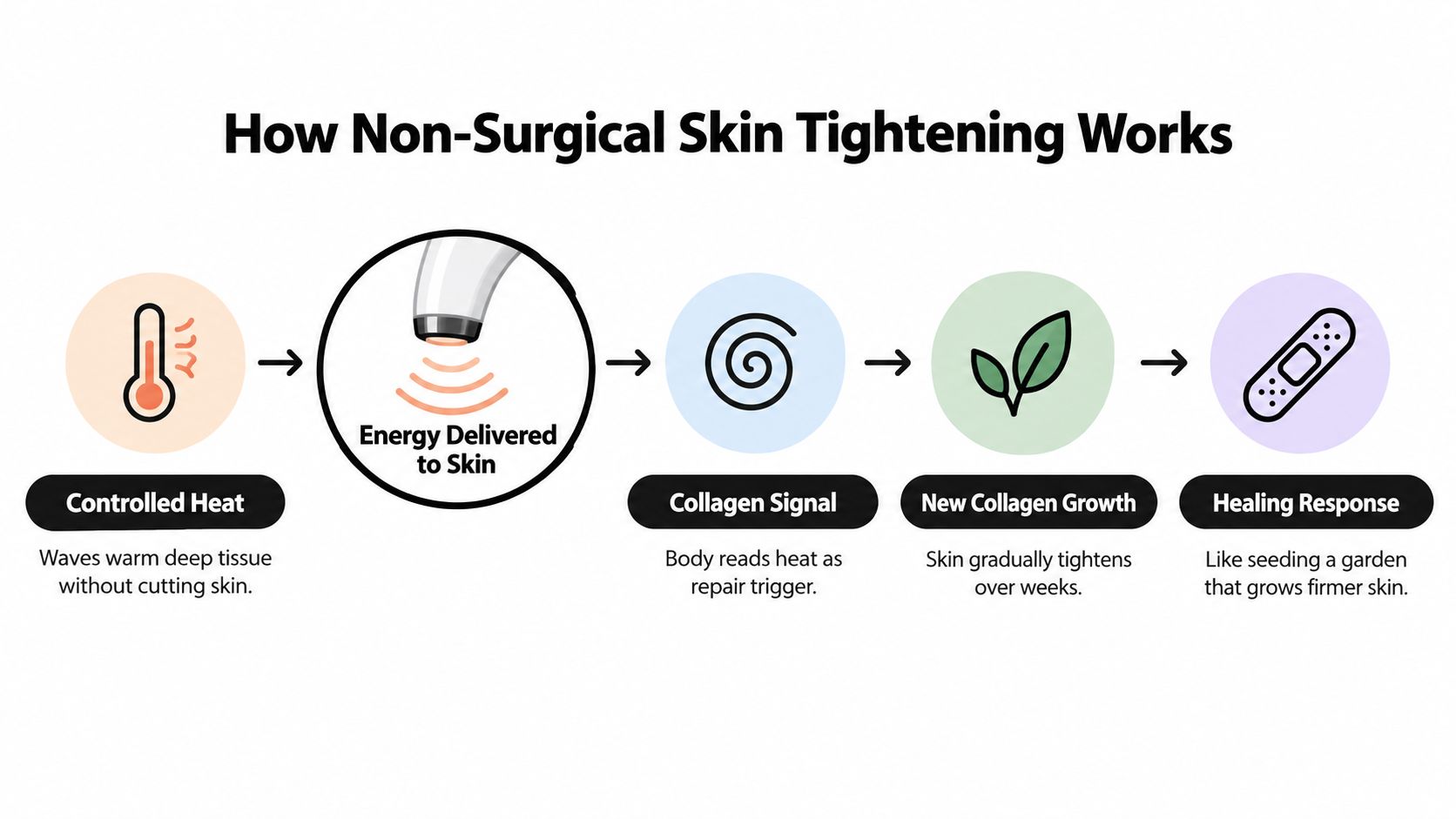
A client with mildly loose, crepey skin may notice little immediately after treatment, then see a gradual change as the tissue remodels. Non-surgical devices use energy beneath the surface without a surgical incision. Depending on the technology, that energy either warms a broader area or concentrates at selected depths. The body responds through repair and collagen remodelling, which can support firmer-feeling, smoother-looking skin over time.
The dermis contains collagen and elastin that help skin hold its shape. Radiofrequency and focused ultrasound do not remove the skin. They create a controlled stimulus within existing tissue, encouraging structural remodelling rather than physically cutting away excess. This distinction sets the right expectation: the treatments can refine mild laxity, but they cannot remove a heavy fold.
Heating versus focused delivery
Radiofrequency, or RF, delivers electromagnetic energy that produces controlled dermal heating. UK evidence summaries report measurable but generally modest improvements in facial and body laxity with monopolar and bipolar RF. Benefits are strongest for mild-to-moderate looseness, rather than large folds of excess skin. Side effects are usually minor and temporary, while major complications appear more frequent with monopolar than bipolar systems. UK radiofrequency evidence summary
Body HIFU uses high-intensity focused ultrasound to concentrate energy at selected tissue depths. Its delivery pattern differs from RF, although the intended outcome is also collagen remodelling. A systematic review published in 2025 assessed 45 clinical studies from January 2010 to October 2024 and concluded that HIFU is an effective and safe non-invasive option for skin tightening and body contouring. 2025 HIFU systematic review
Across the reviewed studies, reported laxity improvement was around 18% to 30%. Results usually build over months, so HIFU suits clients prepared to wait for a gradual response. Treatment choice should reflect tissue thickness, laxity, comfort, and the amount of change realistically possible. A clinic's explanation of radio frequency skin tightening can provide further context on one RF approach.
What topical products can and can't do
A well-formulated skincare routine can improve surface hydration and make crepey skin appear smoother. It does not deliver controlled energy into deeper tissue or tighten substantial excess skin. This guide to peptides for youthful looking skin provides background on the cosmetic role of peptides and related ingredients.
Topicals can support the skin's appearance alongside a treatment plan. They are not a substitute for an assessment when laxity is the main concern. Across these technologies, the practical limit remains clear: skin remodels gradually, while no external device directly removes substantial excess skin.
Comparing the Main Body Tightening Treatments
The most useful comparison starts with the problem each treatment is designed to address. RF and body HIFU are primarily tightening technologies. Shockwave may be selected for tissue texture and cellulite-related concerns. Ultrasound cavitation and cryolipolysis are mainly fat-reduction tools, so any improvement in skin appearance is indirect and depends on how the skin responds after volume changes.
| Treatment | Primary action | Best suited concern | Typical session approach | Downtime | Ideal candidate |
|---|---|---|---|---|---|
| Radiofrequency | Controlled heating that encourages collagen remodelling | Mild to moderate laxity, crepey texture and some cellulite-related concerns | Often planned as a course, with the schedule determined by the device and assessment | Usually minimal, though warmth or temporary sensitivity can occur | Someone wanting gradual improvement in skin firmness without surgery |
| Body HIFU | Focused ultrasound energy delivered to selected tissue depths | Mild to moderate laxity where a gradual tightening effect is acceptable | May be delivered as a planned course or selected treatment programme, depending on the area and device | Usually limited, but the practitioner should explain expected sensations | Someone prioritising deeper focused energy and accepting delayed results |
| Shockwave therapy | Mechanical acoustic pulses that target tissue quality and circulation-related texture concerns | Cellulite appearance, fibrous tissue and uneven texture | Usually requires repeated visits because texture responds progressively | Typically limited, with temporary tenderness possible | Someone whose main concern is dimpling or tissue texture rather than loose skin alone |
| Ultrasound cavitation | Ultrasound energy used primarily for localised fat reduction | Localised fat where reducing volume may improve the outline | Commonly delivered through a planned series selected after assessment | Usually minimal | Someone with a fat-dominant concern and enough skin recoil to adapt |
| Cryolipolysis adjuncts | Controlled cooling used primarily for localised fat reduction | Discrete pockets of fat that remain after lifestyle changes | Treatment planning depends on the area, tissue thickness and applicator fit | Often limited, although altered sensation can occur | Someone with pinchable localised fat who understands that it isn't a direct skin-tightening treatment |
The distinction between direct tightening and indirect contour improvement prevents many mismatched bookings. A client with a small lower-abdominal fat pocket and mild laxity may benefit from a carefully sequenced combination. A client with a large hanging fold won't achieve surgical skin removal through cavitation or fat freezing.
A device isn't “better” in isolation. It may simply be better matched to the tissue you want to change.
Comfort, timing and maintenance also matter. RF can suit clients who want a progressive course, while HIFU may appeal to those who prefer focused treatment and are comfortable waiting for collagen remodelling. Shockwave has a different role altogether, particularly where cellulite texture dominates. A more detailed comparison of two frequently discussed options is available in this guide to HIFU versus radio frequency.
Topical care can sit alongside any plan. For readers comparing moisturising support for the abdomen, this overview of the best cream for stomach skin may help clarify what a cream can reasonably contribute. It can improve comfort and surface feel, but it won't replace a treatment that targets deeper tissue.
What a Typical Treatment Pathway Looks Like
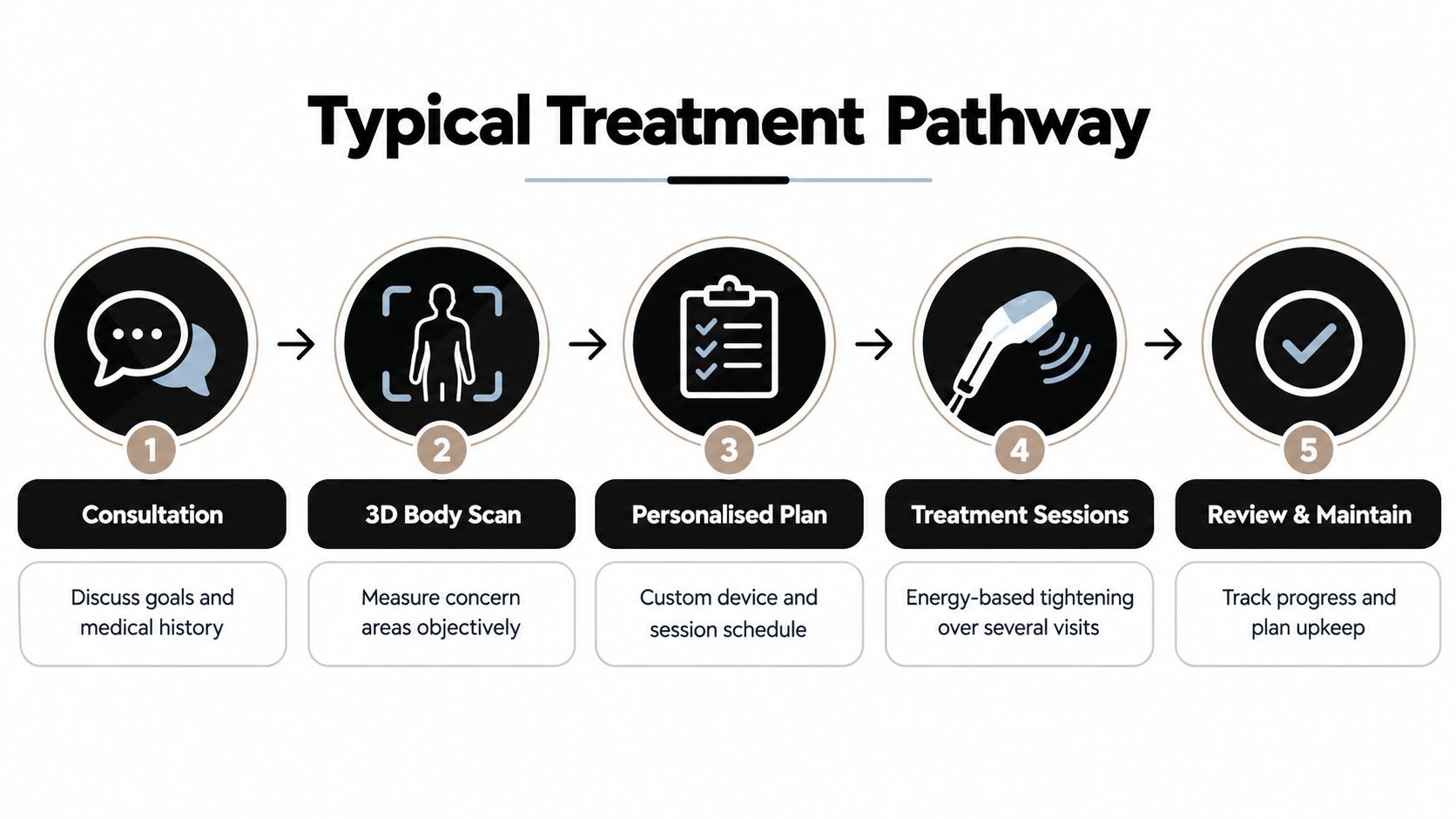
A responsible appointment starts with assessment, not a device. The practitioner needs to establish whether the visible concern comes mainly from lax skin, localised fat, cellulite, stretch-related texture, or a combination. That decision affects both the technology and the order in which treatments should be delivered.
The assessment comes first
During consultation, expect questions about your medical history, recent weight changes, pregnancy, medications, skin sensitivity and goals. A 3D body scan can provide an objective baseline for the areas being assessed, rather than relying only on memory or a single photograph. It also gives the clinic something measurable to review later.
A personalised plan may use one device or combine approaches. For example, a practitioner might prioritise fat reduction when volume is the main issue, then address residual laxity with RF. That sequence shouldn't be assumed in advance. The tissue assessment determines whether combination treatment is sensible.
What sessions feel like
Before treatment, the area may need to be clean and free from products that interfere with device contact. During RF, clients commonly experience progressive warmth. HIFU can feel more focused or intense in selected points. The therapist should explain each sensation, monitor your comfort and adjust settings appropriately rather than treating every body area identically.
Visible change is usually gradual because the desired result depends on tissue remodelling. Early changes may be subtle, while later reviews can show a clearer difference in firmness and texture. The clinic should photograph or scan consistently, because posture, lighting and hydration can make casual comparisons misleading.
Watch this short video for a visual introduction to the treatment experience:
Aftercare usually includes following the clinic's instructions about heat, sun exposure, skincare and activity. Results aren't permanent protection against ageing, weight fluctuation or future skin stretching. Maintenance may be discussed once the initial course has been reviewed, but it should follow the response of your skin rather than an automatic schedule.
When These Treatments Are Suitable and When They Are Not
Non-surgical tightening is most appropriate when the skin is mildly to moderately loose, still has some ability to retract and looks crepey rather than heavily redundant. Common examples include early laxity on the abdomen after weight change, mild upper-arm looseness, or texture changes over the thighs. In these situations, RF or HIFU may produce a meaningful improvement in firmness and surface appearance, provided expectations stay measured.
The boundary becomes clearer after substantial weight loss. If skin hangs in a sizeable fold, an energy device may improve the quality of the remaining skin but can't cut away the excess. Independent UK guidance describes non-surgical options as better suited to crepiness, fine lines and selected body concerns, rather than major loose-skin correction. UK skin-tightening guidance
A simple suitability check
Ask yourself:
- Is the issue mainly texture or volume? Fine creping and mild laxity are different from a heavy fold.
- Does the skin retract? Some recoil suggests a greater chance of visible tightening.
- Would removing tissue solve the concern? If the answer is yes, discuss surgical options rather than expecting a device to imitate them.
- Can you accept gradual change? Collagen-based improvement isn't an instant lift.
A body lift, tummy tuck or other surgical procedure may remain the only durable route for substantial post-weight-loss skin redundancy. That doesn't make non-surgical treatment useless. It means the two approaches solve different problems, and a good consultation should say so before you spend money.
Safety, Aftercare and Combination Strategies
A safe treatment starts with screening, not with the device name. The practitioner should check medical history, skin condition, sensation, pregnancy status and any implanted devices before deciding whether treatment is appropriate. They also need to match the equipment and settings to the treatment depth and body area.
Explain possible reactions before the appointment, including temporary redness, warmth, tenderness or swelling where relevant. Clear consent should cover what the treatment can improve, what it cannot change and when the client should contact the clinic. For RF, device selection, operator training and controlled settings matter because the skin can be injured when energy is poorly matched to the tissue.

Sensible aftercare
Follow the clinic's instructions for the specific device. In general:
- Protect the area from sun exposure: Sun damage can undermine long-term skin quality.
- Keep the skin comfortable: Use recommended products and avoid unapproved active skincare immediately afterwards.
- Respect temporary sensitivity: Pause activities that increase discomfort until the area settles.
- Report unexpected symptoms: Contact the clinic about worsening pain, blistering, marked swelling or changes that do not improve.
- Attend review appointments: Your response should be assessed before settings, timing or treatment areas are changed.
Combination treatment can help when separate concerns affect the same area. Fat reduction may improve the outline, while RF or HIFU targets laxity. Shockwave may be considered when cellulite texture remains a priority. Sequence the treatments deliberately, allowing enough time to assess tissue response rather than stacking procedures automatically.
A package should have a defined purpose for every technology, a clear safety rationale and an agreed method for judging progress. This approach helps body tightening succeed where mild laxity is the problem, without presenting it as a substitute for removing substantial excess skin.
Planning Your Next Steps at 3D Aesthetics Leamington Spa
If you aren't sure whether your concern is loose skin, localised fat, cellulite or a mixture, the most sensible next step is a consultation with objective assessment. A complimentary consultation and full 3D body scan can help map the treatment area, record a baseline and identify whether the proposed goal is realistic for non-surgical care.
The scan doesn't turn a consultation into a sales pitch. Used properly, it helps the practitioner compare areas consistently, explain what each device can target and build a plan around your anatomy. It also creates a reference point for reviewing progress instead of relying on changing lighting or how your body looks on a particular day.
Choosing a flexible plan
A clinic with several body technologies can select the tool according to the tissue rather than forcing every client into the same protocol. The portfolio at 3D Aesthetics Leamington Spa includes radiofrequency, body HIFU, shockwave, ultrasound cavitation and cryolipolysis, allowing separate concerns to be assessed within one treatment-planning conversation.
The clinic's body contouring treatments in Leamington Spa are relevant for clients who want to explore tightening alongside fat reduction or texture work. The important question isn't which treatment is most fashionable. It's whether the selected technology can affect the specific tissue causing your concern.
Before booking, ask what improvement is realistic, whether the plan targets skin or fat, how progress will be measured, what side effects to expect and when surgical advice would be more appropriate. Clear answers are a better sign than dramatic promises.
3D Aesthetics Leamington Spa offers complimentary consultations with full 3D body scans, followed by personalized plans using options such as RF, body HIFU, shockwave, cavitation and cryolipolysis. Visit 3D Aesthetics Leamington Spa to discuss your skin laxity concerns and find out whether non-surgical tightening is suitable for your body.
← Back to Home