

You're probably here because you've searched for ultrasonic cavitation side effects after feeling warmth, hearing a buzzing sound, or noticing redness following a body-contouring appointment. The sensible question isn't just whether cavitation is “safe”. It's which device was used, at what output, for how long, on which area, and by whom.
At our clinic, we treat safety as a screening and technique issue, not a slogan. Ultrasonic cavitation is intended for body contouring, and results vary from person to person. Mild, short-lived reactions can happen, but persistent pain, blistering, altered sensation or significant skin changes aren't effects to ignore.
Table of Contents
- What Ultrasonic Cavitation Side Effects Actually Are
- How Ultrasonic Cavitation Works and Why Reactions Happen
- Common and Mild Ultrasonic Cavitation Side Effects
- Less Common but More Serious Side Effects to Watch For
- Who We Turn Away for Cavitation at Our Clinic
- Why One Cavitation Device Is Not the Same as Another
- How to Reduce Your Own Risk Before During and After Treatment
- When to Seek Help and How to Book a Consultation With Us
What Ultrasonic Cavitation Side Effects Actually Are
Ultrasonic cavitation side effects are the body's response to acoustic energy during or after a treatment, ranging from temporary warmth and redness to reactions that need clinical assessment. A large share of those who notice a response describe the treated area as warm, mildly tender, pink or slightly full. Some also report thirst, increased urination, a short-lived headache, tiredness, or a faint buzzing or ringing sensation.
Those effects aren't automatically a sign of injury. A moving handpiece, suitable coupling gel and controlled output can create sensations that settle quickly. In our Leamington Spa clinic, we explain that cavitation is better described as low-downtime, not no-downtime. A client may return to normal activities, but their skin and tissues can still show a temporary response.
The important distinction is between a mild reaction that improves and a warning sign that persists or worsens. Pain that feels sharp rather than warm, marked swelling, broken skin, blistering, unusual bruising, numbness or continuing redness needs more attention than ordinary post-treatment pinkness.
Why the word ultrasound isn't enough
UK government guidance explains that ultrasound-related tissue effects can arise through heating and acoustic cavitation. At high exposure levels, thermal and mechanical interactions can produce recognised acute effects and tissue damage, while the same guidance found no established evidence of specific hazards from ultrasound at commonly used diagnostic levels. Read the GOV.UK ultrasound safety guidance for the distinction.
That's why diagnostic scanning evidence can't automatically be applied to cosmetic devices. Equipment, frequency, intensity, treatment duration, handpiece design and target tissue can differ. The XO guide to fat reduction offers broader context on non-surgical body-contouring choices, but your personal suitability still needs a proper consultation.
For a realistic discussion of what clients may notice, see our guide to ultrasonic cavitation results. We'll separate routine sensations from symptoms that warrant a call to the clinic, GP, NHS 111 or urgent care.
How Ultrasonic Cavitation Works and Why Reactions Happen
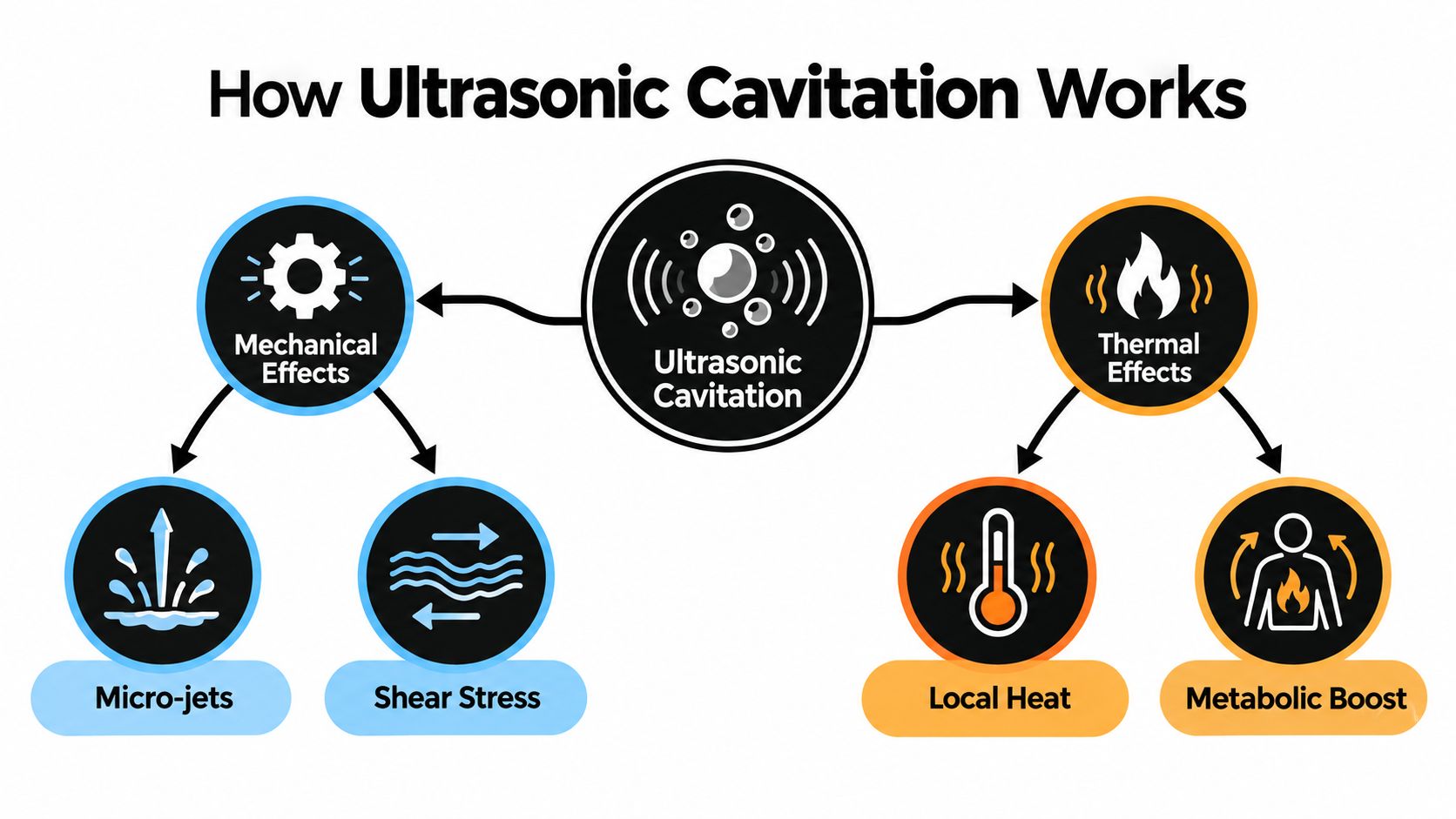
Ultrasonic cavitation can produce reactions through two main pathways, mechanical effects and thermal effects. Mechanical effects come from pressure changes and bubble activity in tissue fluid. Thermal effects happen when acoustic energy is absorbed and creates local heat.
The bubbles aren't a guarantee of damage. They're part of the physical mechanism described by the word cavitation. The concern is excessive or poorly controlled exposure, especially if the handpiece is held still, the output is too high, treatment lasts too long, or the applicator is used over an inappropriate area.
What MI and TI mean in practice
The British Medical Ultrasound Society safety guidelines define the mechanical index, or MI, as an indicator of cavitation likelihood calculated from peak rarefactional pressure and frequency. A higher MI means a higher theoretical likelihood of cavitation. The thermal index, or TI, estimates potential temperature rise during prolonged exposure.
Neither number should be treated as a universal safety stamp. BMUS notes that MI and TI change dynamically with output power and operating mode. That means a setting that behaves acceptably on one device or body area shouldn't automatically be copied to another.
In practical terms, responsible treatment involves:
- Continuous handpiece movement: A therapist shouldn't leave the applicator stationary over one point.
- Consistent gel contact: Coupling helps acoustic energy transfer and reduces uneven contact.
- Comfort monitoring: Sharp pain, excessive heat or unusual sensations should change the session immediately.
- Controlled exposure: Output and dwell time should be kept as low as reasonably practicable for the intended contouring objective.
Practical rule: A client should always be able to say “that feels too hot” or “that feels sharp” without being told to tolerate it.
The phrase “ultrasonic cavitation” covers more than one technical design. Understanding whether ultrasonic cavitation works for a particular person also requires realistic expectations, accurate assessment and honest discussion of what the evidence doesn't establish.
Common and Mild Ultrasonic Cavitation Side Effects
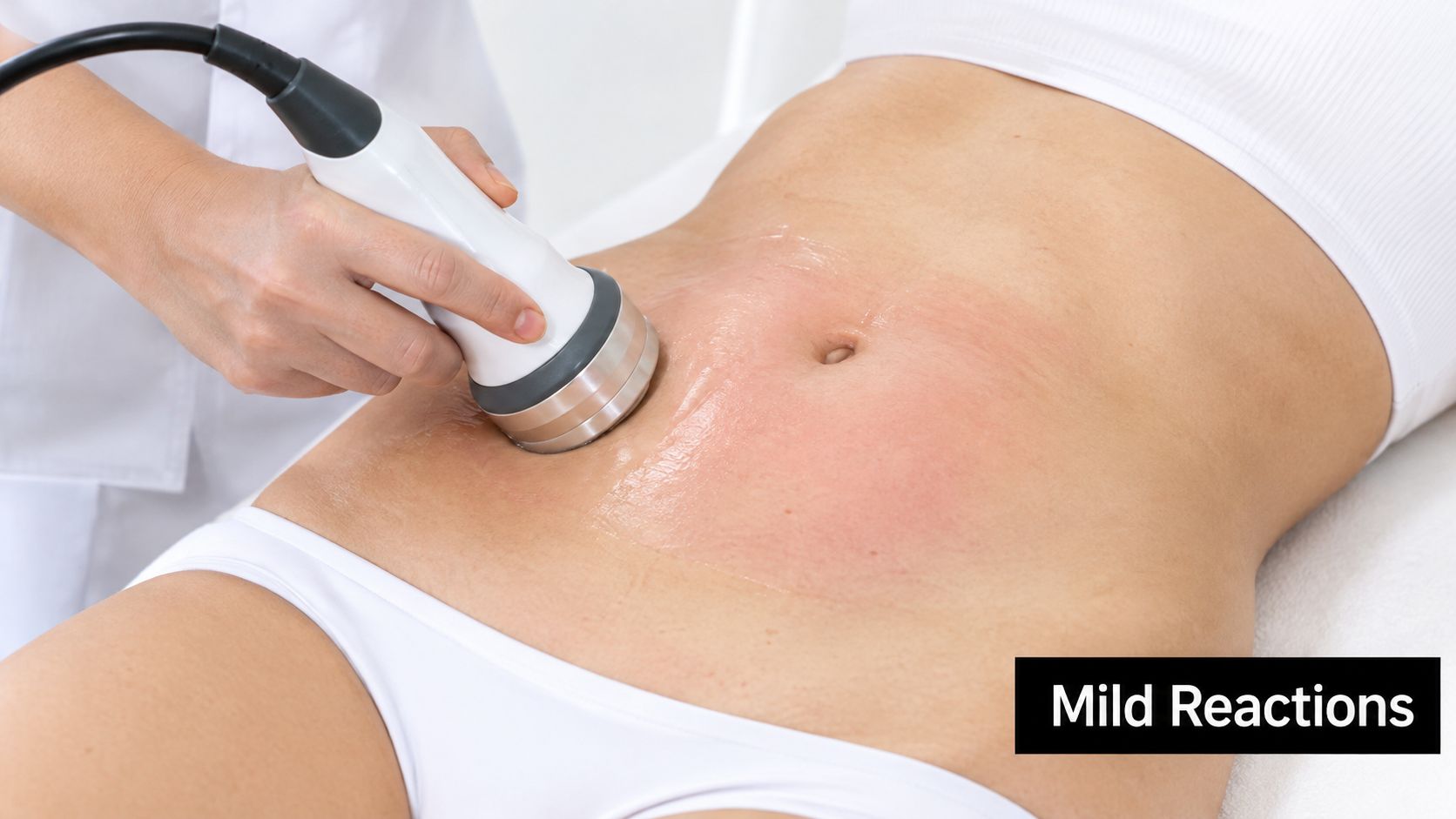
A client may leave a session with warm, pink skin and mild tenderness around the treated area. Those reactions are generally short-lived, but they are not guaranteed, and their intensity depends on the device, settings, treatment area and individual sensitivity. The safety question is therefore personal: what equipment was used, how was it operated, and was the client screened appropriately?
Common mild reactions include temporary warmth, redness, mild tenderness, thirst, increased urination, tiredness and occasional headache. A slight feeling of fullness or sensitivity can continue for a short time. Some clients also notice buzzing or ringing in the ears while the handpiece is operating, especially when its sound travels through the body.
What you can do after a mild reaction
Warmth, pinkness and mild tenderness often ease within a few hours, although tiredness or sensitivity can remain into the following day or two. Thirst, urination or bowel movements may temporarily increase. We treat these sensations as possible responses, not evidence that a specific result has occurred.
Our clinic advice is practical:
- Drink water regularly: Keep fluids steady around the appointment rather than forcing excessive amounts.
- Take a gentle walk: Light movement is reasonable if you feel well.
- Avoid alcohol immediately afterwards: It may worsen dehydration and make your response harder to judge.
- Observe rather than panic: Check whether warmth, redness and tenderness are gradually reducing.
The UK NIHR Health Technology Assessment trial examined therapeutic ultrasound for leg-ulcer care, not cosmetic fat reduction. It recorded pain or tingling, erythema, an allergic reaction to conducting gel and pinhead bleeding. Fewer than 1 in 10 participants experienced pinhead bleeding, but that result cannot provide a cosmetic cavitation complication rate.
For further context on ultrasonic cavitation risks, judge the direction of the reaction. Improving mild warmth or redness is different from pain, worsening symptoms or visible skin injury.
Less Common but More Serious Side Effects to Watch For
A small patch that becomes hotter, more painful or visibly damaged after treatment needs prompt attention. Bruising, blistering, burns, prolonged swelling, gel irritation and altered sensation require a different response from ordinary warmth or temporary pinkness. The device, settings, contact with the skin and the operator's technique all affect personal risk, so the label “ultrasonic cavitation” does not describe one uniform treatment.
Bruising may mean that small vessels have been stressed. Itching, redness, rash or local irritation can indicate a reaction to the conducting gel. Tingling may settle, while persistent numbness or altered sensation should be reported rather than accepted as routine.
Signs that need clinical review
Arrange prompt assessment for a blister, broken skin or burn-like area. Seek advice for sharp or worsening pain, swelling that does not settle, marked discolouration, or skin that becomes increasingly hot and tender. Do not treat the affected area again until a suitably qualified clinician has assessed it.
The UK NIHR Health Technology Assessment trial recorded pain or tingling, erythema, an allergic reaction to conducting gel and pinpoint bleeding during therapeutic ultrasound for leg-ulcer care. Fewer than 1 in 10 participants experienced pinhead bleeding. That finding cannot provide a complication rate for cosmetic cavitation because the treatment purpose, device, intensity and skin condition may differ.
We use this evidence to support candid consent and sensible escalation, not to assign a precise risk figure to an individual cosmetic session.
- Redness that is mild and improving: Monitor it and follow the aftercare advice.
- Persistent irritation or rash: Contact the clinic, particularly if gel sensitivity is possible.
- Bruising or pinpoint bleeding: Tell the therapist, and seek advice if it spreads or fails to settle.
- Blistering, broken skin or severe heat: Arrange prompt medical review.
- Numbness or continuing tingling: Contact the clinic or your GP before booking another session.
For general background on pain-relief options discussed elsewhere, see River of Life joint comfort support, but do not use general information to self-manage blistering, broken skin or persistent pain. Seek clinical assessment first, and do not start supplements or medication for a concerning reaction without suitable advice.
Who We Turn Away for Cavitation at Our Clinic
A booking does not guarantee treatment. We decline a session when your health history, the treatment area, or the device settings create an avoidable risk. Pregnancy, implants, bleeding risk, vascular disease, cancer concerns and damaged skin all require careful screening before we decide.
Our starting point is the Royal Berkshire NHS Foundation Trust therapeutic ultrasound guide. It concerns therapeutic ultrasound, not every cosmetic cavitation machine, so we use it as a cautious reference rather than treating it as a universal rulebook.
Before accepting a booking, we ask about the intended area, your medical history, recent illnesses and any changes since consultation. We may pause treatment or ask you to speak with your GP when the decision needs medical input.
We will not treat:
- During pregnancy, or over active growth plates in children.
- Near an electronic implant until its location and the proposed treatment area have been properly considered.
- Over recent infection, broken skin or unhealthy tissue, because the area needs recovery or assessment first.
- Where bleeding is current or likely, including haemophilia without factor replacement.
- Over an area affected by recent radiotherapy without suitable medical guidance.
- With deep-vein thrombosis, emboli or severe arteriosclerosis unless a clinician confirms that treatment is appropriate.
- Over cancer or suspected cancer in the proposed treatment area.
- When you cannot provide informed consent.
The device and its settings still matter. A restriction relevant to therapeutic ultrasound may not map perfectly onto every cosmetic system, but uncertainty is a reason to investigate, not to guess. We record the treatment area, check the relevant contraindications and consider whether the operator, equipment and proposed exposure are suitable for you.
Our consultation is a clinical judgement, not a box-ticking exercise. We may recommend another option, such as non-surgical fat removal in the UK, or refer you to your GP. Turning someone away is the right outcome when we cannot justify proceeding safely.
Why One Cavitation Device Is Not the Same as Another
A client may tolerate one cavitation session well and react differently to another. The safety profile depends on the device, settings, treatment area, duration and operator, not the treatment name alone. “Cavitation” describes a physical mechanism, not one standardised machine.
UK government material distinguishes between focused and non-focused ultrasound, thermal and non-thermal devices, and combination systems. Their handpiece design, target depth, operating parameters and exposure patterns can vary. Results and risks associated with one category therefore should not be applied automatically to another.
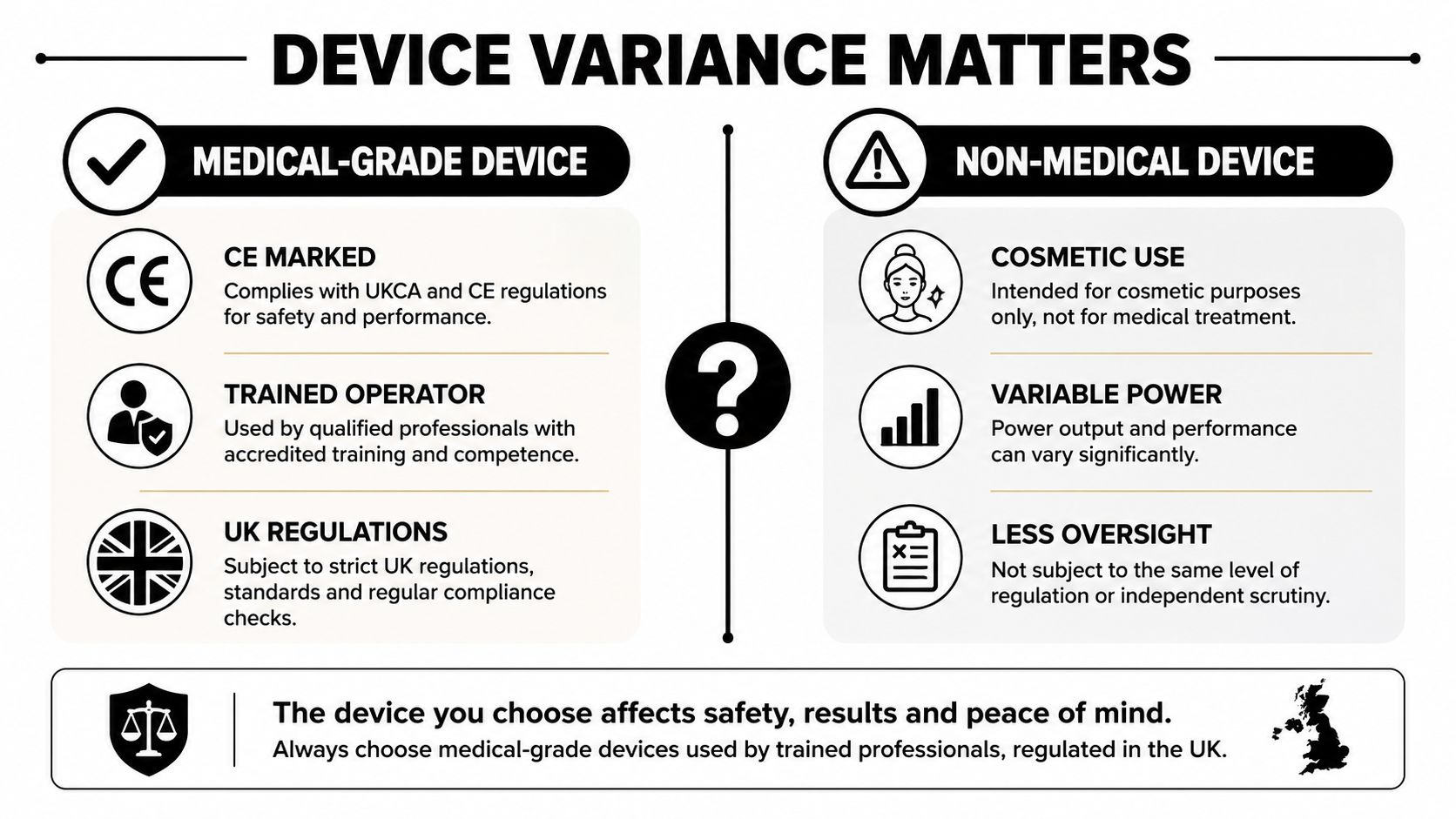
Before booking, ask the provider:
- What is the device make and model? The clinic should identify its equipment clearly.
- What tissue depth is intended? Treatment should target a defined area rather than being applied indiscriminately.
- Which contraindications are screened? Ask how pregnancy, implants, bleeding, circulation, cancer history and skin condition are assessed.
- What training does the operator have? It should match the equipment and procedure being delivered.
- What happens if I react? You should receive clear advice about escalation and follow-up.
- Is there an assessment process? Depending on the device and gel, a consultation or patch-test-style assessment may be appropriate.
The operator's judgement matters as much as the machine. We should be able to explain why a setting suits the proposed area, how exposure is controlled and what would make us stop.
UK government material records an IEC upper acoustic-intensity limit of 3 W/cm² for protection during physiotherapy ultrasound. This does not define the settings or safety of cosmetic cavitation equipment, because the devices and treatment purposes may differ.
Clients comparing clinics in Warwick, Kenilworth and Leamington Spa should ask for equipment-specific answers rather than accepting a general claim that cavitation is “safe”. Your personal risk is shaped by the machine, its settings, the operator and the screening process.
How to Reduce Your Own Risk Before During and After Treatment
You can reduce your personal risk by preparing properly, communicating during treatment and observing the area afterwards. Risk reduction isn't risk elimination, and no responsible therapist should promise otherwise.
Before your appointment, keep hydration steady for the 24 to 48 hours around treatment, avoid alcohol on the day, and eat a light meal beforehand. Remove jewellery or metal from the treatment area, and tell us about any change in medication, health or skin condition since your consultation.
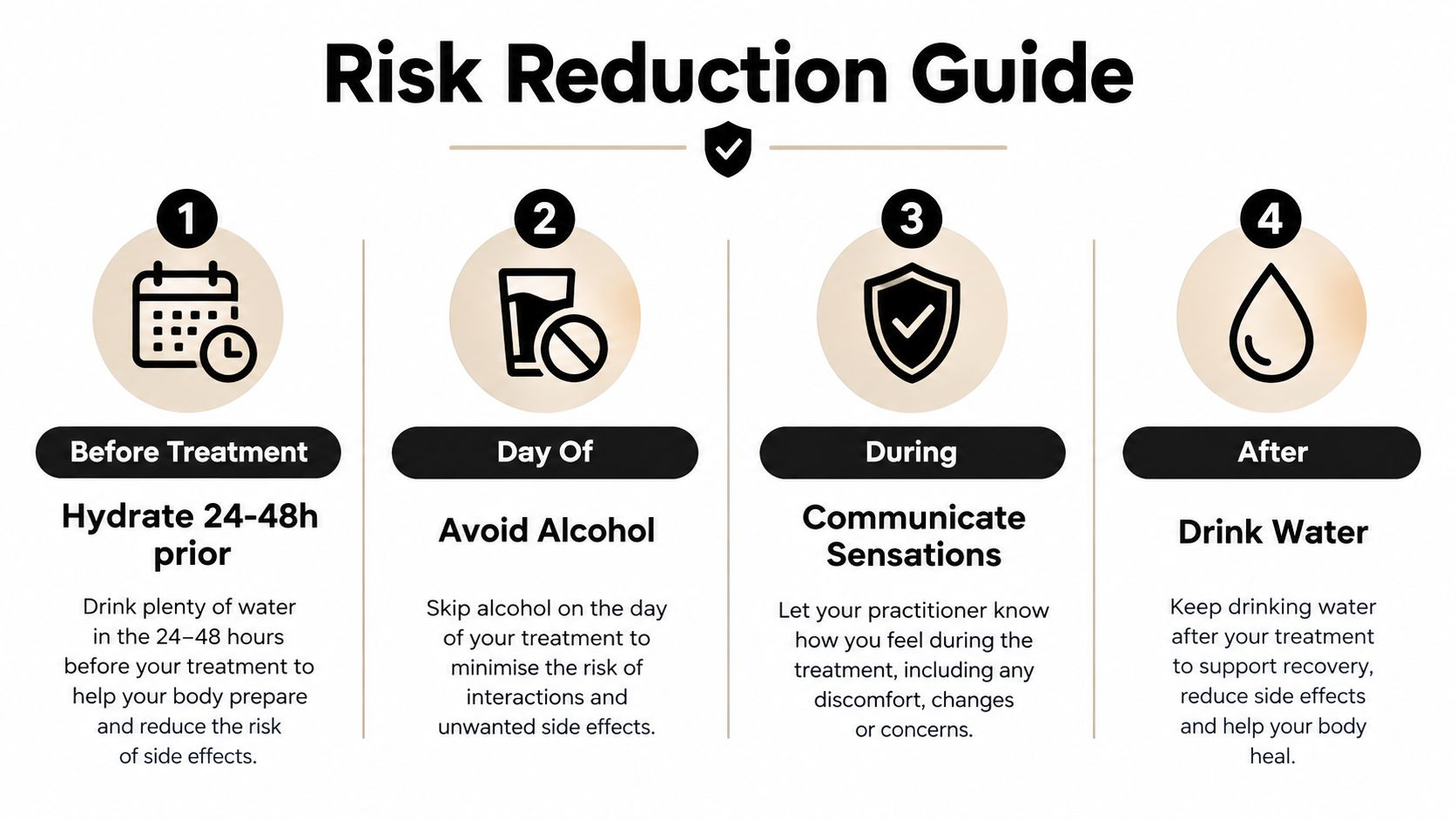
During treatment, the handpiece should keep moving with consistent gel contact. Speak up immediately if the sensation becomes sharp, unusually hot or uncomfortable. You don't earn better results by staying silent while a treatment feels wrong.
Afterwards, take a short walk, continue drinking water and avoid very hot baths, saunas and intense exercise for 24 hours. Watch the area over the following 48 hours for increasing pain, marked swelling, blistering, broken skin, unusual colour changes or altered sensation.
When to Seek Help and How to Book a Consultation With Us
Contact us or seek medical advice if pain persists, swelling increases, skin blisters or breaks, numbness continues, or an allergic reaction develops. Severe symptoms need urgent medical help through NHS 111 or A&E, depending on their seriousness.
| Side effect | How common | Typical duration | What to do |
|---|---|---|---|
| Warmth or mild redness | Common mild response | Usually short-lived | Monitor and follow aftercare |
| Mild tenderness or fullness | Can occur | Short-lived, sometimes into the next day | Rest the area and contact us if it worsens |
| Thirst or increased urination | Some clients report it | Temporary | Drink water normally |
| Gel irritation or rash | Less common | Until the irritant settles | Contact the clinic for advice |
| Bruising or pinpoint bleeding | Less common | Varies by person | Report it, especially if spreading |
| Persistent pain, blistering or broken skin | Needs assessment | Not a routine response | Contact us, your GP, NHS 111 or A&E |
At our clinic at 11 Guys Place East, Leamington Spa, Warwickshire CV32 4RG, we review your medical history, carry out a 3D body scan and discuss what cavitation can and can't do. Results vary from person to person, and we'll be honest if we don't think treatment is appropriate. You can book a free consultation or call 01926 315764.
We offer cavitation, fat freezing, body sculpting, 3D Powersculpt, cellulite reduction, skin tightening and 3D body scanning, with consultation-led screening for ultrasonic cavitation side effects. Visit 3D Aesthetics Leamington Spa to explore your options and arrange a conversation about your goals.
← Back to Home