
You're standing in front of the mirror, pinching the same lower-abdomen fold you've been training around for months. Your eating is organised, your gym routine is consistent, but that small pocket still catches your eye. At the consultation, the question usually arrives quickly: ultrasound cavitation or cryolipolysis?
The two treatments are often advertised side by side because both belong to the non-surgical body-contouring market. UK demand is growing, with the body-contouring devices market estimated at about $101 million in 2024 and projected to reach $180.5 million by 2029, while the related treatments market is estimated at $72.2 million in 2024 and projected to reach $111.7 million by 2029. Those are market projections, not promises about an individual result, but they explain why clients are seeing both options everywhere. (UK body-contouring market estimates)
The useful question isn't which device looks more impressive online. It's what you want changed. Cavitation is generally chosen for gradual circumference-focused contouring. Cryolipolysis is usually the stronger choice for a defined, pinchable pocket of fat. The comparison below gives the short answer, then the important detail follows.
Table of Contents
- The Choice Most Clients Are Actually Trying to Make
- How Each Treatment Actually Works
- Side-by-Side Comparison on the Decisions That Matter
- What the UK Evidence Really Says About Results
- Matching the Treatment to Your Specific Goal
- Safety, Side Effects, and Candidacy in the Real World
- How 3D Aesthetics Leamington Spa Layers These Treatments
- Your Next Step and Practical Questions Answered
The Choice Most Clients Are Actually Trying to Make
A client may arrive after a training session, still wearing gym clothes, and point to the lower stomach. They don't necessarily want weight loss. They want the fold under the waistband to look less prominent, or they want their waistline to look smoother in fitted clothing.
That distinction matters because body contouring isn't a substitute for weight management. Neither ultrasound cavitation nor cryolipolysis is designed to remove a large volume of fat, repair significant skin laxity, or replace a stable diet and regular movement. Both are tools for localised concerns, and the quality of the recommendation depends on identifying the concern accurately.
The short comparison
| Your main goal | More logical starting point | Why |
|---|---|---|
| A specific, pinchable lower-abdomen pocket | Cryolipolysis | The applicator targets a defined area of subcutaneous fat |
| Gradual smoothing across a broader area | Ultrasound cavitation | The practitioner can move the handpiece across a wider contour |
| Little or no visible treatment interruption | Ultrasound cavitation | There's no suction-based applicator and usually minimal aftercare disruption |
| A targeted treatment with fewer planned visits | Cryolipolysis | It's designed around an individual pocket and a longer clearance period |
| Skin looseness after fat reduction | Neither alone | A skin-tightening treatment may be needed alongside fat reduction |
| Paying for both modalities | Only after assessment | Combination treatment hasn't consistently shown extra anthropometric benefit |
The last row is the one many glossy adverts skip. Adding cavitation to fat freezing may sound like an obvious upgrade, but the available UK-relevant comparative evidence doesn't support assuming that two technologies automatically produce twice the value.
My practical view: decide whether you're treating a pocket or a broader contour first. The technology comes second.
A proper consultation should also consider tissue thickness, skin quality, weight stability, the shape of the area, your tolerance for cold and temporary numbness, and how soon you need to judge the result. A good practitioner won't recommend a package before answering those questions.
How Each Treatment Actually Works
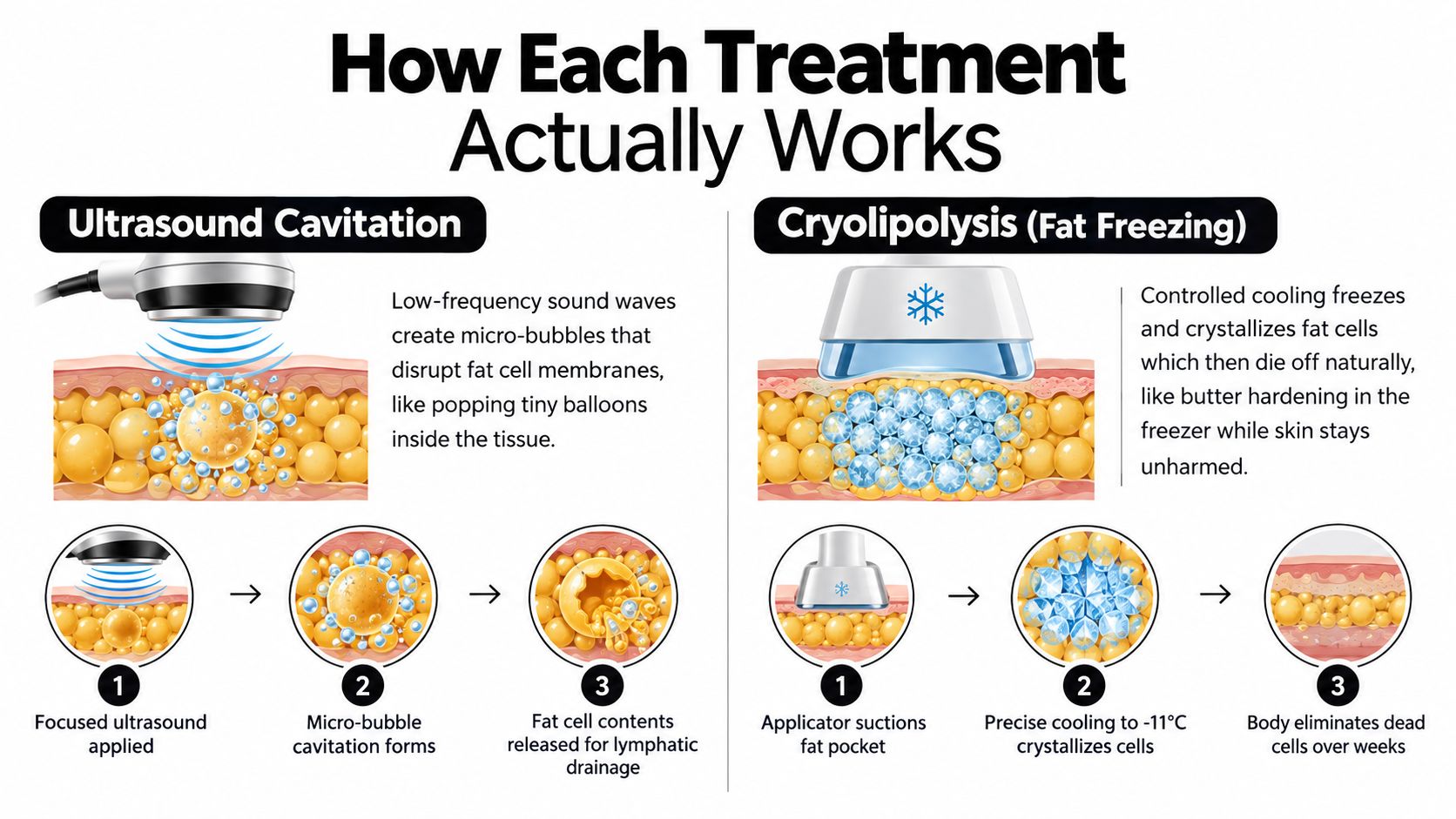
Ultrasound cavitation uses low-frequency sound energy delivered through a moving handpiece and conductive gel. The pressure changes created by ultrasound can produce micro-bubble activity in the tissue. The treatment is often described as disrupting fat-cell membranes, after which the released contents are processed by the body.
The simplest analogy is a sealed water bottle being shaken repeatedly. Pressure changes stress the structure inside, rather than removing the contents with a surgical instrument. In the treatment room, clients commonly notice warmth, vibration, or a high-pitched sound. The practitioner controls the handpiece movement, coverage, contact and treatment settings.
Cryolipolysis, commonly called fat freezing, uses controlled cooling through an applicator placed over a suitable fat pocket. The applicator draws the tissue into a cup, cools the subcutaneous layer and triggers a process in which targeted fat cells are gradually cleared by the body. The skin is protected by the device system and correct applicator placement.
A useful analogy is butter becoming firm in a cold environment. The treated fat cells are affected by cooling, then the body takes time to process the cellular debris. Cryolipolysis is therefore a cell-clearance treatment, not an instant suction procedure. Clients usually feel pulling and intense cold initially, followed by numbness that can persist temporarily.
What the difference means for your result
Cavitation is generally series-led and practitioner-led. It suits someone prepared to attend repeated appointments and follow the clinic's aftercare instructions. Hydration and normal movement are commonly discussed because the body still has to process what the treatment releases. That doesn't make water a magic fat-loss ingredient, but poor aftercare can make the experience harder to assess.
Cryolipolysis is more area-specific and time-dependent. It can be a better fit when a practitioner can clearly position an applicator over a discrete pocket. The visual change isn't immediate, and the body needs time to clear the affected cells.
Neither treatment tightens loose skin by itself. If the skin is lax, reducing a pocket without addressing firmness can leave the overall contour less satisfying than expected. You can read a fuller explanation of the cavitation approach in this guide to how ultrasonic cavitation works.
The central decision is straightforward. Choose cavitation when the treatment plan needs flexibility across a broader contour. Choose cryolipolysis when the practitioner can isolate a suitable pocket and you're comfortable waiting for a gradual result.
Side-by-Side Comparison on the Decisions That Matter
Marketing language tends to flatten the differences. In practice, the important details are candidate suitability, treatment commitment, recovery experience, risk and total cost, not just the name printed on the machine.
| Criterion | Ultrasound Cavitation | Cryolipolysis (Fat Freezing) |
|---|---|---|
| Best suited to | Gradual contour refinement and broader circumference-focused work | A defined, pinchable pocket of subcutaneous fat |
| Treatment experience | Moving handpiece, warmth, vibration and gel | Fixed applicator, suction, cold and temporary numbness |
| Visit pattern | Usually planned as a course, based on the device protocol and response | Often planned around one or more applications to an area |
| Downtime | Usually minimal, though aftercare still matters | Daily activities may continue, but bruising, swelling or numbness can be noticeable |
| Measuring progress | Best tracked through consistent circumference, photos and area mapping | Best assessed over the clearance period with repeat photos and measurements |
| Main practical limitation | It isn't a single-visit pocket-sculpting solution | The applicator must fit the tissue and area appropriately |
| Skin laxity | Doesn't correct laxity on its own | Doesn't correct laxity on its own |
| Risk discussion | Technique, device maintenance, skin response and individual contraindications matter | Includes temporary sensory changes and a rare risk of paradoxical adipose hyperplasia |
| Cost structure | More appointments can mean a lower individual visit price but a larger course commitment | A higher individual treatment price may be offset by fewer planned visits |
| Evidence position | UK-searchable literature is more strongly represented by mechanism and engineering research | Supported by a larger clinical evidence base, including UK-linked research |
Candidate profile matters more than a BMI label
A practitioner shouldn't choose a treatment from a number alone. The area needs enough soft, pinchable tissue for the selected technique, while the person's overall goal needs to be localised contouring rather than substantial weight reduction.
Significant laxity changes the conversation. If the skin hangs or folds independently of the fat pocket, neither modality should be sold as a tightening treatment. Radiofrequency, body HIFU or another skin-quality approach may be considered, depending on the assessment and the cause of the laxity.
Sessions and downtime
Cavitation is generally a course treatment. The clinic should explain the planned frequency, what will be measured and when the course will be reviewed. Cryolipolysis has a longer observation window, so booking another intervention too quickly can make it difficult to judge what the first treatment achieved.
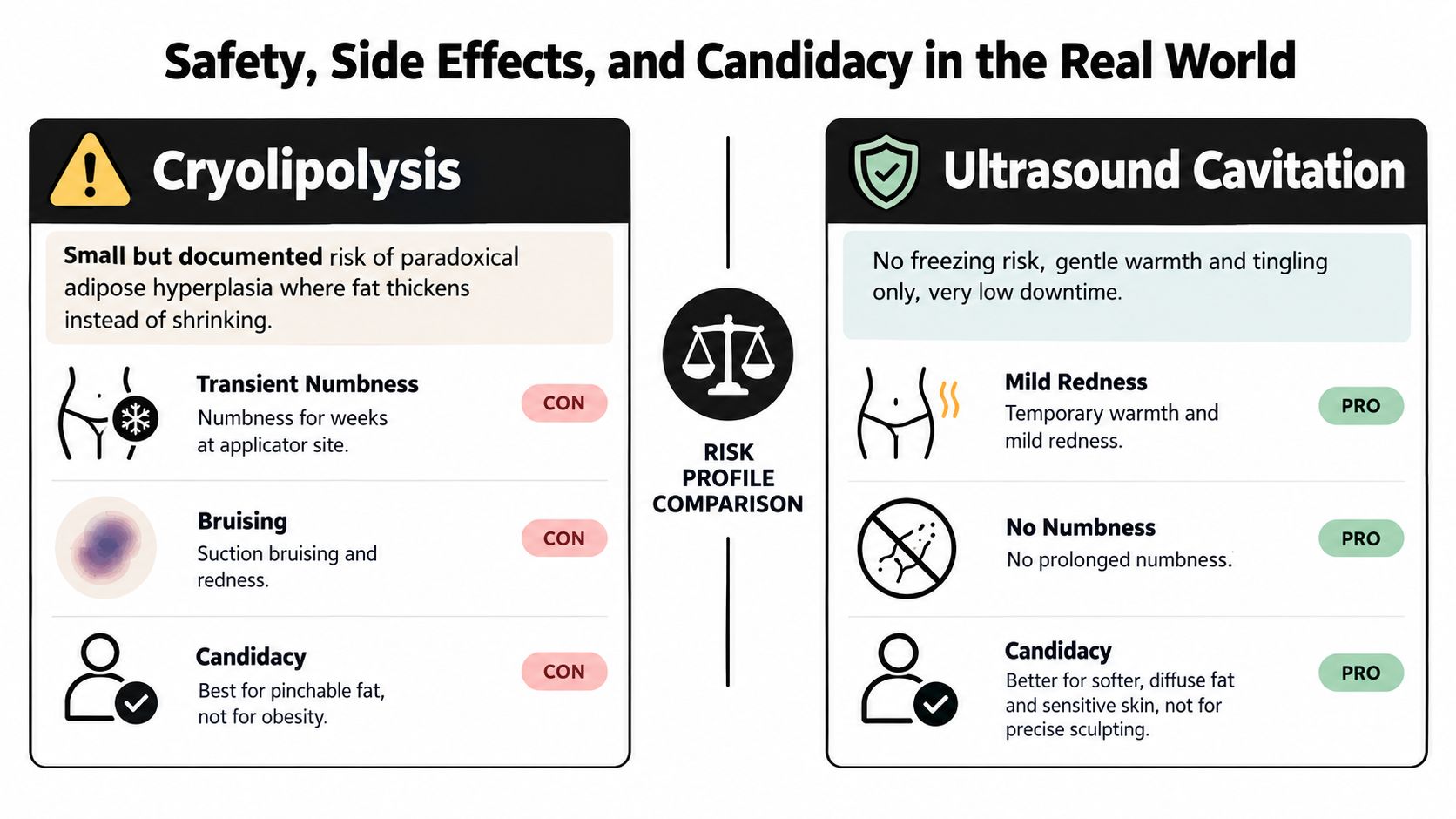
The downtime language also needs precision. Cavitation usually doesn't create suction bruising or prolonged numbness, but clients may still experience warmth or temporary redness. Cryolipolysis can leave the area numb, tender, swollen or bruised for a period, even though it isn't surgery.
Cost isn't just the price on the menu
A single cavitation appointment may look cheaper, but a complete course changes the calculation. Cryolipolysis may carry a higher cost per treatment area, but the assessment should account for applicator cycles, area size, possible repeat treatment and the time needed to see the outcome.
The cheapest appointment isn't necessarily the cheapest route to the result you actually want.
Before booking, ask how the clinic prices by area, how many appointments it expects, whether measurements are included, and what happens if the area isn't suitable. The clinic's fat-freezing results information should support a consultation, not replace one.
What the UK Evidence Really Says About Results
Cryolipolysis has the clearer clinical evidence base in UK academic literature. A 2025 systematic review and meta-analysis included 30 studies and 3,158 participants, reporting significant reductions in BMI, waist-to-hip ratio, abdominal circumference and suprailiac fat at three months. (Systematic review and meta-analysis)
That finding supports cryolipolysis as a credible option for localised fat reduction, but it doesn't tell every client exactly how many centimetres they'll lose. Outcomes depend on the treated area, device, applicator fit, baseline tissue, protocol and lifestyle. A meta-analysis can show a pattern across studies, not guarantee an identical contour change for one person.
The combination question
The most useful UK-relevant comparison involved 90 women aged 18 to 65. The study compared diet alone with cryolipolysis alone and a combination of ultrasound cavitation, cryolipolysis and diet over eight weeks. Both active-treatment groups improved compared with diet alone, but the combination didn't significantly outperform cryolipolysis alone for body fat mass, weight, BMI or abdominal circumference. The authors concluded that the combination was no more effective than cryolipolysis alone. (UK-relevant pilot study)
| Study or modality | Average reduction reported | Session count to result | Notes |
|---|---|---|---|
| Cryolipolysis meta-analysis | Significant reductions in several body measurements at three months | Varied across included studies | Evidence base included 30 studies and 3,158 participants |
| Cryolipolysis in the UK-relevant pilot | Significant improvement compared with diet alone | Assessed after eight weeks | Combination treatment did not significantly beat cryolipolysis alone on core anthropometric outcomes |
| Ultrasound cavitation evidence | No equivalent large, standardised UK clinical evidence base established in the supplied literature | Device and protocol dependent | UK-searchable work more often examines mechanism and physical effects |
| Combination cavitation and cryolipolysis | Measurable reductions were reported, without a significant advantage over cryolipolysis alone | Assessed within the study protocol | Extra treatment time and cost may not produce extra fat-loss value |
What the evidence cannot promise
The evidence doesn't establish a universal centimetre reduction per appointment. It also doesn't settle every question about long-term fat re-accumulation at twelve months or response in people with a BMI of 30 or above. Those gaps are reasons to avoid guaranteed outcomes, not reasons to dismiss either modality.
NICE project information also shows that non-invasive fat-reduction and body-contouring interventions weren't selected for formal interventional guidance. There is therefore no NICE-endorsed UK benchmark proving that cavitation is superior to cryolipolysis. (NICE project information)
My recommendation is blunt: don't pay for a combination protocol because it sounds more advanced. Add cavitation only when there is a separate contouring reason, such as a broader area or a different treatment objective, and make the incremental value explicit before you commit.
Matching the Treatment to Your Specific Goal
The same person can be suitable for one modality on the abdomen and another on the thighs. Tissue shape, mobility, skin quality and the desired finish matter more than a generic promise that one device “works everywhere”.
Lower abdomen after consistent training
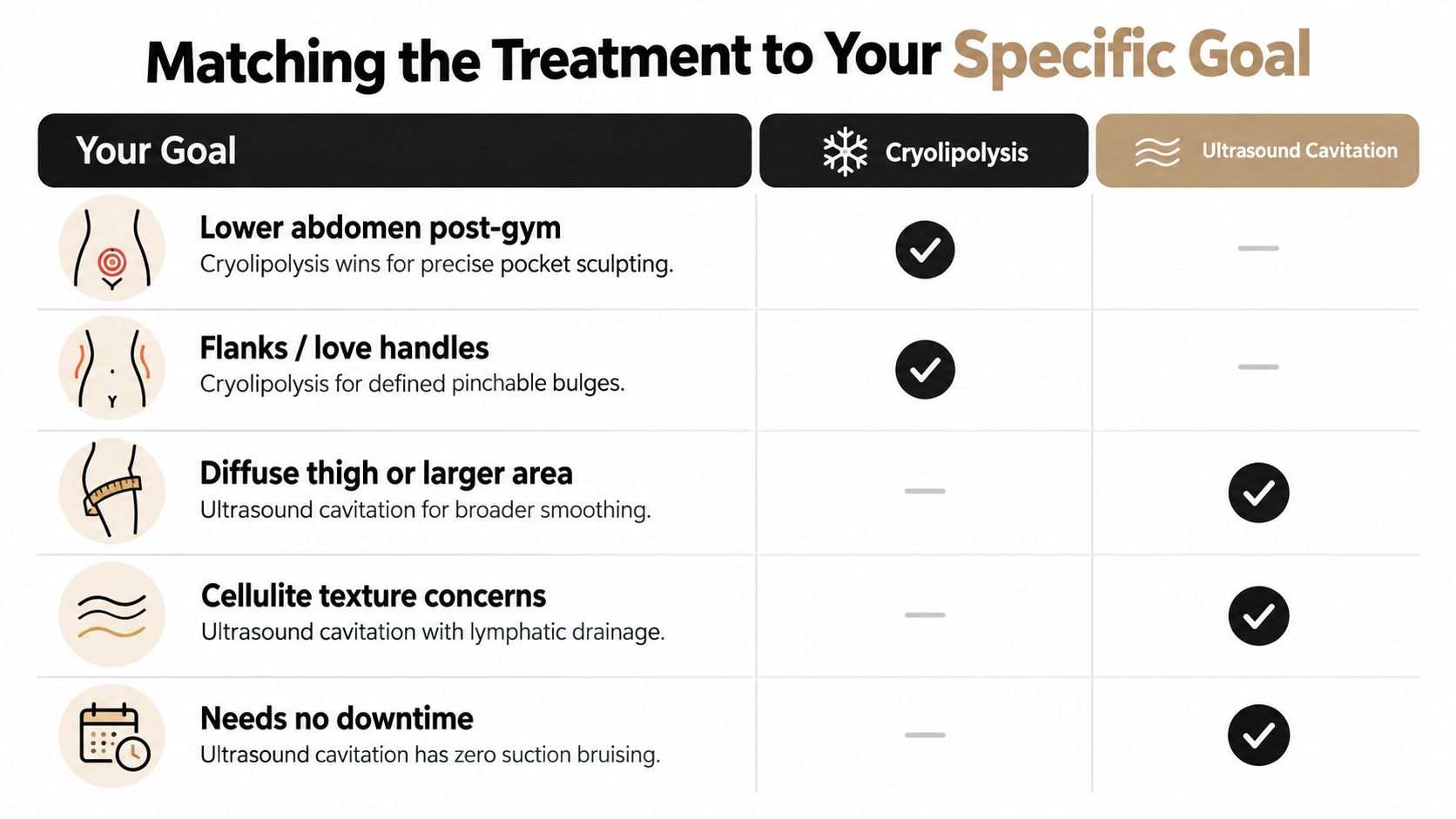
If you can pinch a defined fold below the navel and your overall weight is stable, cryolipolysis is usually the more logical starting point. The applicator can be mapped to the pocket, and the treatment is designed for targeted subcutaneous fat rather than general waist movement.
The result still develops gradually, and the pocket must be suitable for the applicator. If the concern is mostly loose skin or abdominal muscle separation, freezing fat won't solve the main problem.
Recommendation: choose cryolipolysis for a clearly defined lower-abdominal pocket, provided the consultation confirms suitable tissue.
Flanks and love handles
Flanks can present as two different problems. A distinct bulge may respond better to targeted cooling, while a broad area of thickness may suit a moving handpiece and a course focused on overall contour refinement.
Don't let the phrase “love handles” decide the treatment. Ask whether the area is a discrete bulge or a wide transition from the back to the waist.
Recommendation: choose cryolipolysis for defined pinchable bulges, and consider cavitation when the goal is broader smoothing.
Inner thighs
Inner-thigh tissue is often mobile and can be difficult to position consistently in an applicator. That doesn't automatically rule out cryolipolysis, but it makes assessment particularly important. Cavitation may be easier to use across a wider or less uniform area, while a layered plan can address contour and texture separately.
Recommendation: favour cavitation for diffuse inner-thigh fullness unless the practitioner can demonstrate a stable, suitable pocket for cooling.
A post-pregnancy pouch
A post-pregnancy abdomen may include a combination of fat, skin laxity, altered abdominal contour and, in some cases, concerns that need medical assessment. Fat reduction alone may leave the skin quality unchanged, so the more useful plan may include a skin-focused treatment such as radiofrequency after candidacy has been confirmed.
Lifestyle guidance remains relevant too. For broader, non-device support, this resource on how to lose belly fat in 2026 can help place a contouring appointment within a sustainable health routine.
Recommendation: assess the pouch as a skin-and-tissue problem, not just a fat problem, then consider targeted reduction with a separate firming strategy.
Double chin
A defined submental pocket can suit cryolipolysis when a purpose-designed applicator fits the area. The treatment is still for localised fat, not every cause of a fuller jawline. Skin laxity, anatomy and the position of the chin all affect the result.
HIFU and RF may be reasonable alternatives when laxity is the dominant concern rather than fat thickness.
Recommendation: choose cryolipolysis for suitable submental fat, and discuss HIFU or RF if skin laxity is the bigger issue.
Safety, Side Effects, and Candidacy in the Real World
The phrase “non-surgical” doesn't mean risk-free. Cryolipolysis commonly causes temporary redness, swelling, bruising, tenderness and numbness. Rare complications include nerve injury, contour irregularity and paradoxical adipose hyperplasia, where the treated fat appears to enlarge rather than reduce. One UK patient leaflet describes PAH as extremely rare, at about 0.0051%. (ACE UK patient leaflet)
Ultrasound cavitation usually avoids freezing and suction effects, but treatment still depends on correct technique and equipment maintenance. Warmth, mild redness and altered sensation can occur, while poorly maintained or incorrectly used probes may create avoidable skin injury. A high-pitched sound in the ears can also be unpleasant for some clients.
Screening should be specific
A consultation should check for:
- Pregnancy and recent surgery: treatment should be deferred where appropriate, with medical advice when the history is relevant.
- Implanted devices and medical conditions: pacemakers, circulation concerns, cold sensitivity and other contraindications must be assessed against the device protocol.
- Hernias, infections and unexplained lumps: these require assessment before treating the area.
- Tissue suitability: cryolipolysis needs enough pinchable fat for safe applicator contact, while cavitation isn't a solution for major obesity or high-volume removal.
- Skin quality: pronounced laxity may require a different or additional treatment plan.
A patch test and full consultation should come before any protocol. Serious complications have also been encountered in real-world aesthetic practice, with UK professional commentary reporting that BAAPS members had dealt with serious complications and some patients required surgery over a three-year period. That is why “zero downtime” should never replace proper consent.
No non-invasive device matches surgical liposuction for high-volume fat removal. If your goal is a major change, a GP or appropriately qualified medical practitioner should explain the relevant options.
How 3D Aesthetics Leamington Spa Layers These Treatments
A sensible combination plan gives every treatment a defined job. Cryolipolysis or cavitation addresses the localised contour concern. RF is used when skin firmness needs attention. Shockwave may be included for circulation and texture work, while Powersculpt focuses on muscle stimulation and visible definition rather than removing a large fat volume. Body HIFU can be considered when deeper tissue tightening is part of the assessment.
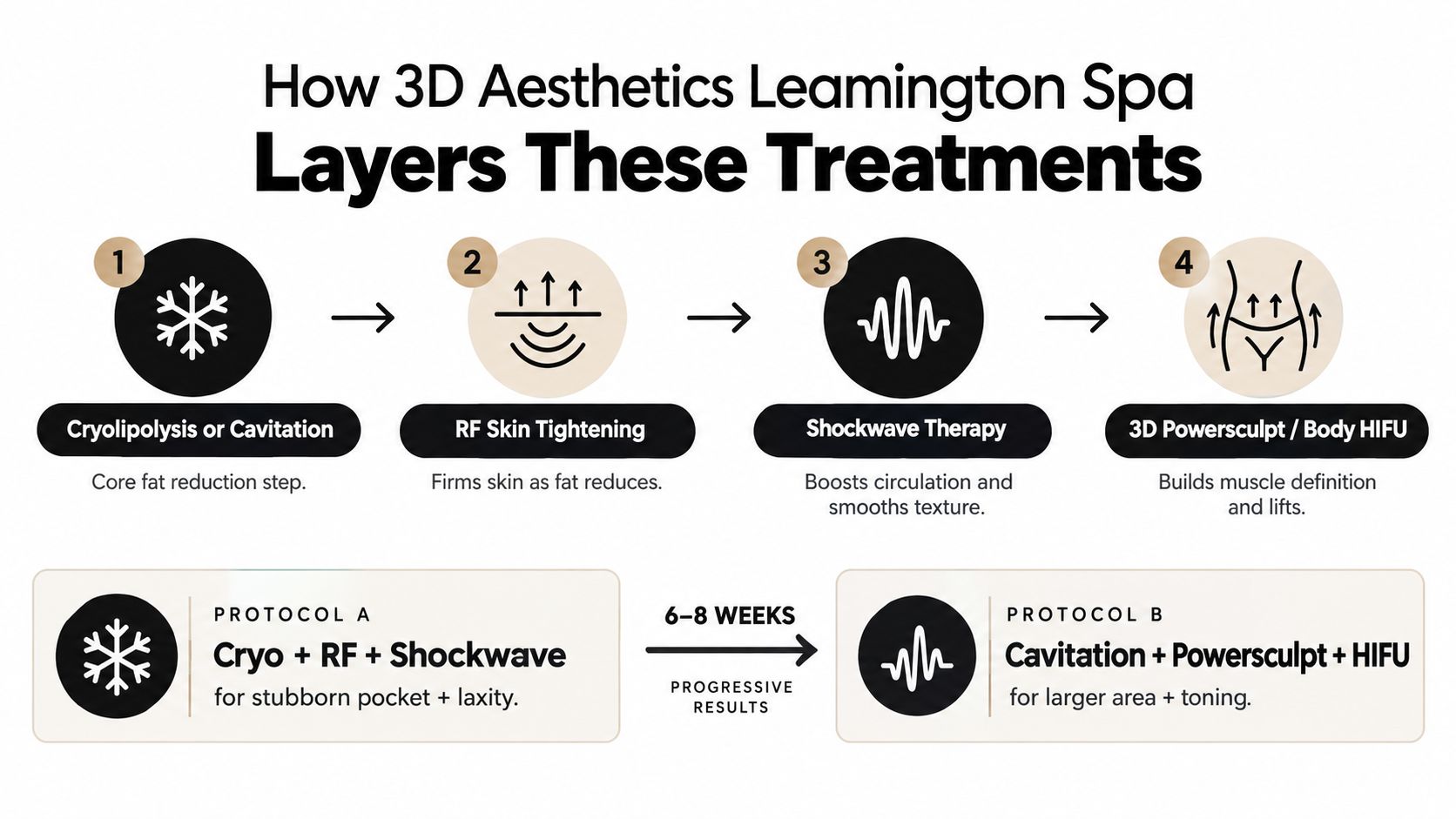
Two examples of treatment logic
For a defined lower-abdomen pocket with mild laxity, a plan might begin with cryolipolysis, followed by RF and selected shockwave appointments during the review period. The reason is sequencing, not stacking everything into one appointment. The pocket receives the primary reduction treatment, then the surrounding skin and texture are assessed rather than assumed.
For broader thigh fullness with a need for tone, cavitation may come first, followed by Powersculpt for muscle definition and body HIFU if tightening is clinically appropriate. The plan should include clear gaps between modalities, based on the device instructions and the practitioner's assessment, so each response can be measured properly.
A clinic consultation can discuss non-surgical fat removal alongside RF, shockwave, Powersculpt and body HIFU. Ask which device generation is being used, which applicator size matches your area, who performs the treatment, what training they hold, and how the clinic will record your baseline measurements.
The clinic should also explain what happens if the first treatment doesn't produce the expected change. A written plan is more valuable than a package built around vague promises.
Your Next Step and Practical Questions Answered
Use this checklist before booking:
- Goal: Is it a defined pocket or broad circumference change?
- Tissue: Is there enough suitable, pinchable fat for the proposed applicator?
- Skin: Is laxity a separate issue?
- Tolerance: Are cold, suction, numbness or repeated visits acceptable?
- Value: Has the clinic explained why one modality, or a combination, is appropriate?
At a consultation, expect a body assessment, baseline photographs, circumference or caliper measurements, treatment mapping and a written plan covering sessions and pricing before treatment begins. A three-dimensional scan may also help document the starting contour and track change over time.
Common questions
Are results permanent? Treated fat cells may be reduced, but remaining fat cells can enlarge if weight increases. Lifestyle still matters.
When will photographs show change? Cavitation is assessed across its planned course. Cryolipolysis needs a longer clearance period, so early photographs can understate the eventual contour.
Can both treatments happen in the same week? Don't assume so. The practitioner should set the spacing according to the devices, the area and your response.
What if my weight or health makes me unsuitable? The correct answer is to pause, address the underlying issue or seek medical advice. No reputable clinic should force a device choice.
For a client in Leamington Spa, 3D Aesthetics Leamington Spa offers a complimentary consultation with body assessment and planning across cryolipolysis, ultrasound cavitation and complementary body-contouring treatments. Book an assessment before buying a package, so your recommendation is based on your actual pocket, skin quality and desired outcome.
Visit 3D Aesthetics Leamington Spa for a no-obligation consultation focused on whether ultrasound cavitation or cryolipolysis fits your goal. Ask the team to map the area, explain the expected timeline and provide a written treatment plan before you commit.
← Back to Home