
You're standing in front of the bathroom mirror, raising your eyebrows, smiling, then relaxing your face to work out whether those lines are new or just more noticeable in today's light. A quick search for the best treatment for wrinkles brings up Botox, fillers, lasers, radiofrequency, microneedling, LED masks and a long list of creams. Before-and-after photographs rarely explain which type of wrinkle was treated, how much downtime was involved, or whether the result would suit your skin.
There isn't one universal winner. The right option depends on whether your lines are caused mainly by muscle movement, loss of structural support, or changes in skin texture. Your skin tone, sensitivity, health, budget and tolerance for recovery matter too.
This guide uses a practical consultation framework. First, identify the wrinkle type. Then match it to the skin job to be done, whether that means relaxing a muscle, rebuilding skin quality, restoring support or tightening lax tissue. The comparison below gives you an early overview, while the detailed sections explain where each treatment fits and where claims need more caution.
| Treatment | Best for | Results timeline | Downtime |
|---|---|---|---|
| Topical retinoids | Fine lines, photoageing and texture | Gradual improvement with consistent use | Usually minimal, although irritation can occur |
| Botulinum toxin | Dynamic forehead, frown and crow's-foot lines | Short-term smoothing after treatment | Usually limited, but injection-related effects are possible |
| Microneedling and RF microneedling | Texture, fine lines and mild laxity | Progressive skin remodelling | Redness and sensitivity can follow |
| Fractional CO2 laser | Static lines, uneven texture and resurfacing | Healing followed by ongoing remodelling | More noticeable recovery |
| Fillers | Volume-related folds and hollows | Visible structural change after treatment | Swelling or bruising may occur |
| HIFU and RF | Mild laxity and tightening | Gradual tightening and skin-quality change | Often limited, treatment-dependent |
| LED and HydrO2 facials | Supportive skin-quality care | Temporary freshness or gradual supportive benefits | Little to none, depending on treatment |
The practical rule: Treat the cause you can identify, not simply the line you can see.
Table of Contents
- Introduction to Finding Your Best Wrinkle Treatment
- Understanding Wrinkle Types and What Causes Them
- Detailed Comparison of Leading Wrinkle Treatments
- Evidence Quality and UK Safety Standards to Know
- Choosing the Right Option by Age Skin Type and Concern
- What to Expect From Consultation to Aftercare
- Our Recommendation and Next Steps for Smoother Skin
Introduction to Finding Your Best Wrinkle Treatment
A patient may point to forehead lines and ask for filler. Another may describe under-eye crepiness but expect Botox to rebuild thin skin. Both requests make sense when every treatment is marketed as facial rejuvenation, but the underlying problems differ.
A calm assessment starts with the face at rest and during expression. If a line appears when you frown but softens when your forehead relaxes, muscle activity is involved. If it remains visible at rest, the skin and supporting tissues need attention. If the main complaint is roughness, dryness or fine crinkling, the treatment target is skin quality rather than facial movement.
That distinction prevents over-treatment. A muscle-relaxing injection can be useful for expression lines, but it won't replace lost volume. A resurfacing treatment can improve texture, but it won't reproduce the effect of relaxing an overactive frown muscle. Skincare can support gradual improvement, but it can't provide the same structural correction as a procedure.
The UK context matters as well. Cosmetic wrinkle treatment is generally a private-care decision, while NHS funding is usually reserved for medical indications rather than appearance alone, as outlined in UK guidance on NHS botulinum toxin access. That means your consultation should cover suitability, likely benefit, risks, aftercare and total treatment planning, not just a price or a device name.
You'll find the options organised around three questions:
- What type of wrinkle is present? Dynamic, static or textural.
- What job needs doing? Relaxing movement, improving skin, restoring support or tightening tissue.
- What trade-off suits your life? Minimal downtime, stronger resurfacing, gradual change or a more immediate structural result.
Age can influence the pattern, but it doesn't decide the treatment on its own. Two people of the same age may have very different sun exposure, facial movement, skin sensitivity and expectations. A good plan is therefore staged and personal, often beginning with the least invasive option that can reasonably address the concern.
Understanding Wrinkle Types and What Causes Them
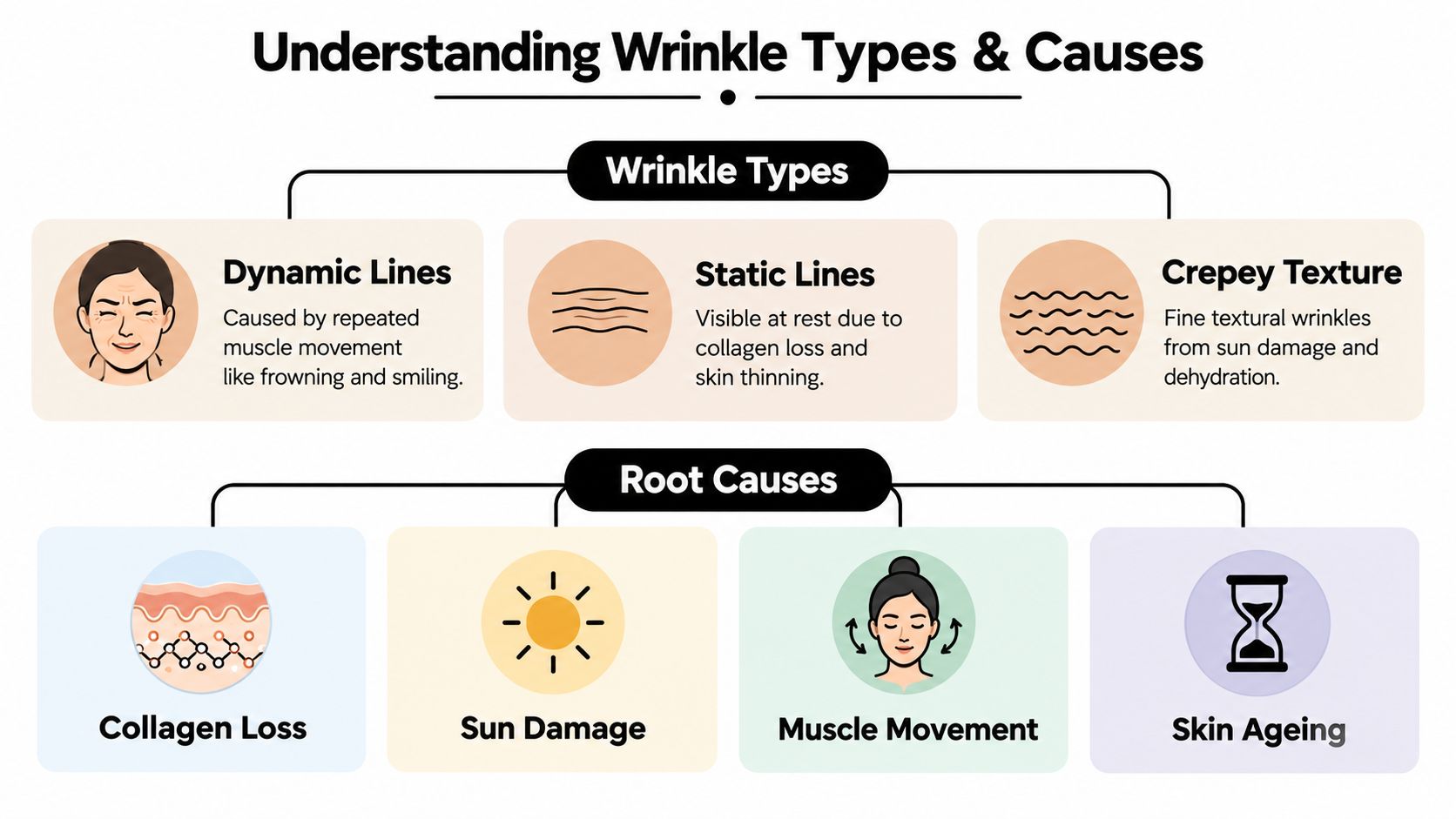
Wrinkles become easier to treat once you know where they begin. Look at your face in a relaxed position, then repeat the same expressions you make when smiling, concentrating or squinting. The change between those two views gives useful information.
Dynamic lines
Dynamic wrinkles appear or deepen when facial muscles contract. Forehead lines may show when you lift your eyebrows. Frown lines become stronger when you concentrate. Crow's feet appear with smiling or squinting.
The skin may look relatively smooth when your face is completely relaxed. Treatments that reduce excessive muscle activity, such as botulinum toxin, are designed for this pattern. The aim should be a softer expression, not an immobile face.
Static lines
Static wrinkles remain visible when you're not making an expression. They develop as the skin loses thickness, elasticity and underlying support, with sun exposure and normal skin ageing contributing to the change.
These lines need a different strategy. Topical retinoids, resurfacing treatments, collagen-stimulating procedures and, in selected cases, fillers may address parts of the problem. The appropriate option depends on whether the line is mainly etched into the skin, associated with volume loss, or accompanied by laxity.
Crepey texture
Crepey skin looks finely crinkled or paper-like. It's common around the eyes, cheeks, neck and other areas affected by sun exposure, dryness or reduced skin resilience. Dehydration can make the surface look worse, but hydration alone won't correct every structural change.
Think of the face as a layered system:
- Surface layer: Dryness, uneven tone and fine texture may respond to skincare, peels, LED support or gentle resurfacing.
- Dermal layer: Reduced collagen and altered elasticity may respond to microneedling, radiofrequency, fractional laser or regenerative approaches.
- Muscle layer: Repeated contraction may respond to a carefully planned neuromodulator treatment.
- Support and volume: Hollowing or folds may require assessment for filler or another structural approach.
Lifestyle also affects how quickly lines become noticeable. Sun protection, avoiding smoking and maintaining a consistent routine can help protect skin quality. For readers interested in supportive habits, this overview of how steamers help skin firmness discusses the place of steam and general skin care, although a steamer shouldn't be treated as a replacement for clinical wrinkle treatment.
Use this self-check before booking:
- Do the lines appear mainly during expression?
- Are they still visible when your face is relaxed?
- Is the concern a fold, a hollow, or a fine crinkled texture?
- Does the area feel dry, sensitive or easily irritated?
- How much recovery time can you realistically allow?
The answers won't diagnose your skin, but they'll help you ask more precise questions.
Detailed Comparison of Leading Wrinkle Treatments
The most useful comparison isn't “which treatment works best?” It's “which treatment performs the job I need, with a trade-off I can accept?”
| Treatment | Best for | Results timeline | Downtime |
|---|---|---|---|
| HIFU | Mild laxity, brow and jawline support | Gradual tightening | Usually limited, though sensitivity can occur |
| Radiofrequency | Fine lines, mild laxity and skin firmness | Progressive improvement | Commonly limited |
| Microneedling and 3D Dermaforce | Fine lines, pores, scarring and texture | Gradual collagen remodelling | Redness and sensitivity for a short period |
| Fractional CO2 laser | Static lines and uneven texture | Healing followed by remodelling | More substantial resurfacing recovery |
| Botulinum toxin | Dynamic expression lines | Smoothing develops after injection | Usually limited, with medical risks to discuss |
| Dermal fillers | Volume loss and selected folds | Structural change can be visible promptly | Swelling or bruising may occur |
| Dermalux LED | Supportive skin-quality care | Gradual or temporary supportive effects | Minimal |
| HydrO2 facial | Hydration and surface freshness | Often short-term freshness | Minimal |
HIFU for laxity
High-intensity focused ultrasound targets deeper tissue with focused energy. It's generally considered when the concern is mild laxity, a less defined brow or jawline, or a desire for tightening without an ablative resurfacing process.
HIFU isn't a direct substitute for Botox. It doesn't primarily relax expression muscles, and it won't erase every etched line. Results develop gradually, so the consultation should define whether the target is lifting, firmness or general rejuvenation.
Radiofrequency for firmness
Radiofrequency heats tissue in a controlled way to support tightening and remodelling. It may suit people with mild laxity, fine lines and a preference for limited visible recovery. Face and eye RF can be particularly relevant where the skin looks less firm but the concern isn't a deep fold.
Comfort varies with energy, area and settings. A practitioner should explain the sensation, the treatment sequence and how they'll protect sensitive areas.
Lifting and smoothing are different jobs. HIFU and RF may support firmness, while Botox targets movement and resurfacing treatments target the skin surface and dermis.
Microneedling and 3D Dermaforce
Microneedling creates controlled micro-injuries that stimulate a healing response. It can be useful for fine lines, uneven texture, enlarged pores and some scarring. Radiofrequency microneedling adds heat beneath the skin, which may make it more suitable when texture and mild laxity occur together.
Expect a gradual process rather than an instant correction. Treatment depth, skin sensitivity and aftercare influence the experience. Active irritation, infection or certain medical conditions may mean postponement.
Fractional CO2 laser
Fractional CO2 resurfacing removes or heats selected microscopic columns of skin, encouraging renewal and collagen remodelling. It's considered for etched lines, rough texture, sun-related change and certain scars, but it carries a more visible recovery period than LED or a gentle facial.
If you're considering deeper resurfacing, review the practical details of fractional CO2 laser treatment before deciding. A consultation should include skin-tone considerations, sun avoidance, aftercare and the possibility that more than one stage may be appropriate.
Botox and fillers
Botulinum toxin temporarily reduces selected muscle activity, making it a logical option for dynamic forehead, frown and crow's-foot lines. It's not designed to fill a hollow or rebuild crepey skin.
Fillers work differently by restoring or adding volume in carefully selected areas. They may be considered for folds or hollows associated with structural change, but facial anatomy and vascular safety are critical. For a plain-language overview of the procedure itself, BeautyGuide's Botox treatment page provides useful background, although your UK consultation should focus on the prescribing clinician, product choice and safety arrangements.
LED and HydrO2 facials
LED treatments and HydrO2 facials usually sit at the gentler end of a treatment plan. They may support hydration, comfort and surface appearance, but they shouldn't be presented as equivalent to neuromodulators or fractional laser resurfacing.
The UK advertising standard is important here. The ASA has challenged unsupported claims around electrical-current beauty devices and LED masks, so ask what evidence supports the exact device and claim being offered.
Evidence Quality and UK Safety Standards to Know
A treatment may sound advanced while evidence for its specific promise remains limited. Assess the outcome, treatment area and proposed protocol together. A device can have evidence for temporary tightening, for example, without proving that it rebuilds collagen or softens established wrinkles.
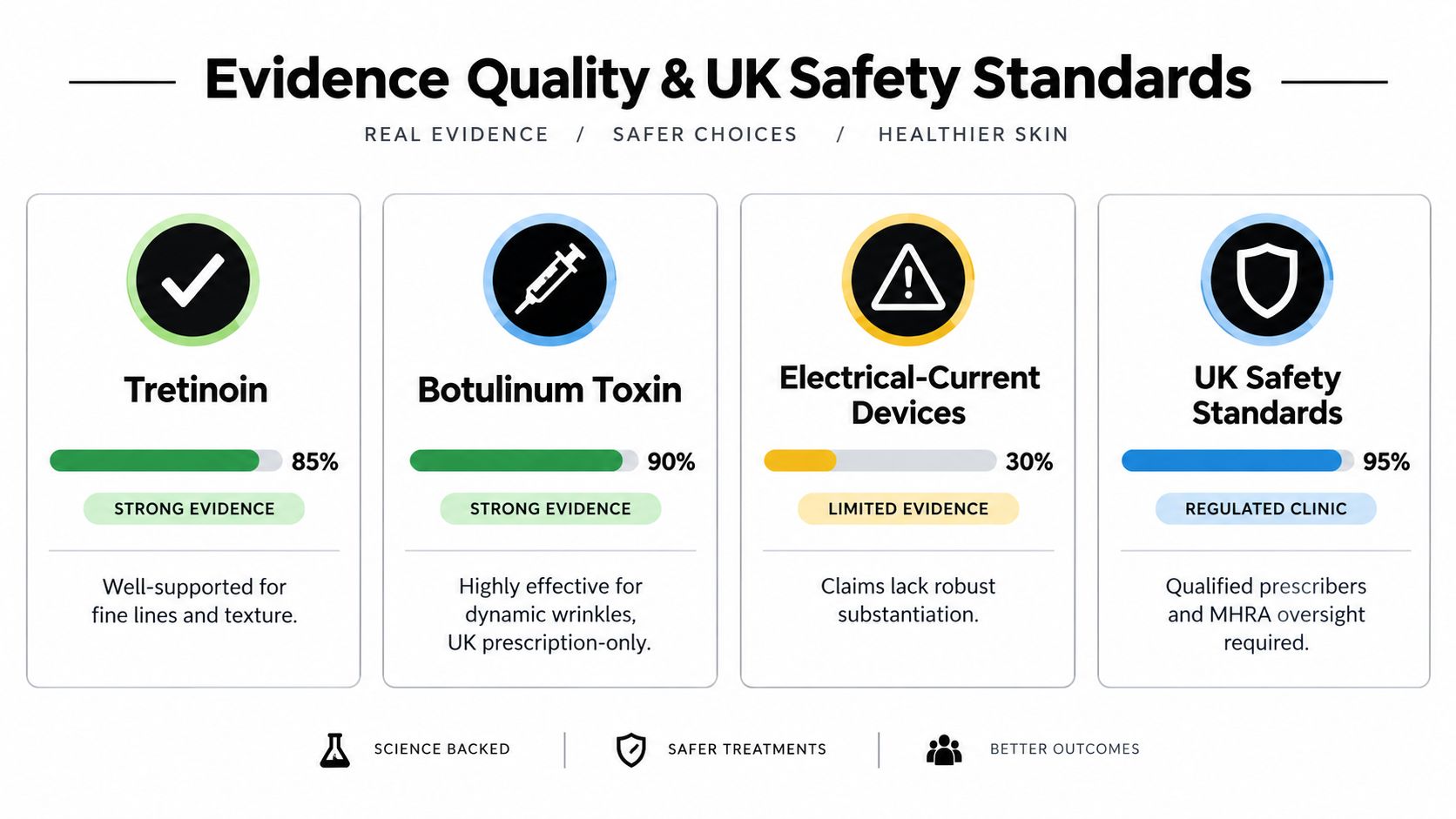
Topical tretinoin has one of the clearest independent evidence bases among non-surgical wrinkle treatments. A 2025 systematic review and meta-analysis of 8 randomised trials involving 1,361 patients reported statistically significant improvement over vehicle for fine and coarse wrinkles, with mean differences of 0.412 and 0.245, respectively, in the review of skin-booster modalities and aesthetic dermatology. Tretinoin is prescription-only and may irritate the skin, so gradual introduction and professional advice are important.
Botulinum toxin has practical support for dynamic wrinkles. A NICE-linked regional policy summary reported that one session was more effective than placebo for wrinkle improvement for up to 120 days, as described in the NICE-linked regional policy summary. A review of intradermal botulinum toxin A found improvements across several skin-quality measures in 10 studies. However, none reached the required information size in trial sequential analysis, so claims about long-term superiority or repeated protocols require restraint. The evidence is discussed in the PubMed review of intradermal botulinum toxin A.
Why provider safety matters
Botulinum toxin is widely used in the UK, with an estimated 900,000 cosmetic injections each year. The same UK evidence base estimated an expected 16% complication rate for upper-face administration, equivalent to roughly 144,000 potential complications annually if applied across that treatment estimate, as reported in the UK regional policy evidence summary. These figures do not predict an individual result. They show why anatomy, prescribing, consultation and follow-up deserve more attention than a discount.
UK public-health reporting recorded 41 clinically confirmed cases of iatrogenic botulism linked to cosmetic injections between 4 June and 6 August 2025, according to the UK botulism investigation reported by the BBC. A separate investigation identified 38 cases between 4 June and 14 July 2025, including 29 in North East England, indicating how poor supervision can become a public-health concern.
The ASA has said it has not seen convincing evidence that electrical-current beauty devices do more than temporarily tighten skin. It also found a 2026 LED mask claim about reducing wrinkles in 4 weeks inadequately supported because of evidence problems. Ask for the exact outcome, study design, treatment settings, adverse effects and practitioner qualifications before accepting broad claims about “lifting” or “rebuilding.”
Choosing the Right Option by Age Skin Type and Concern
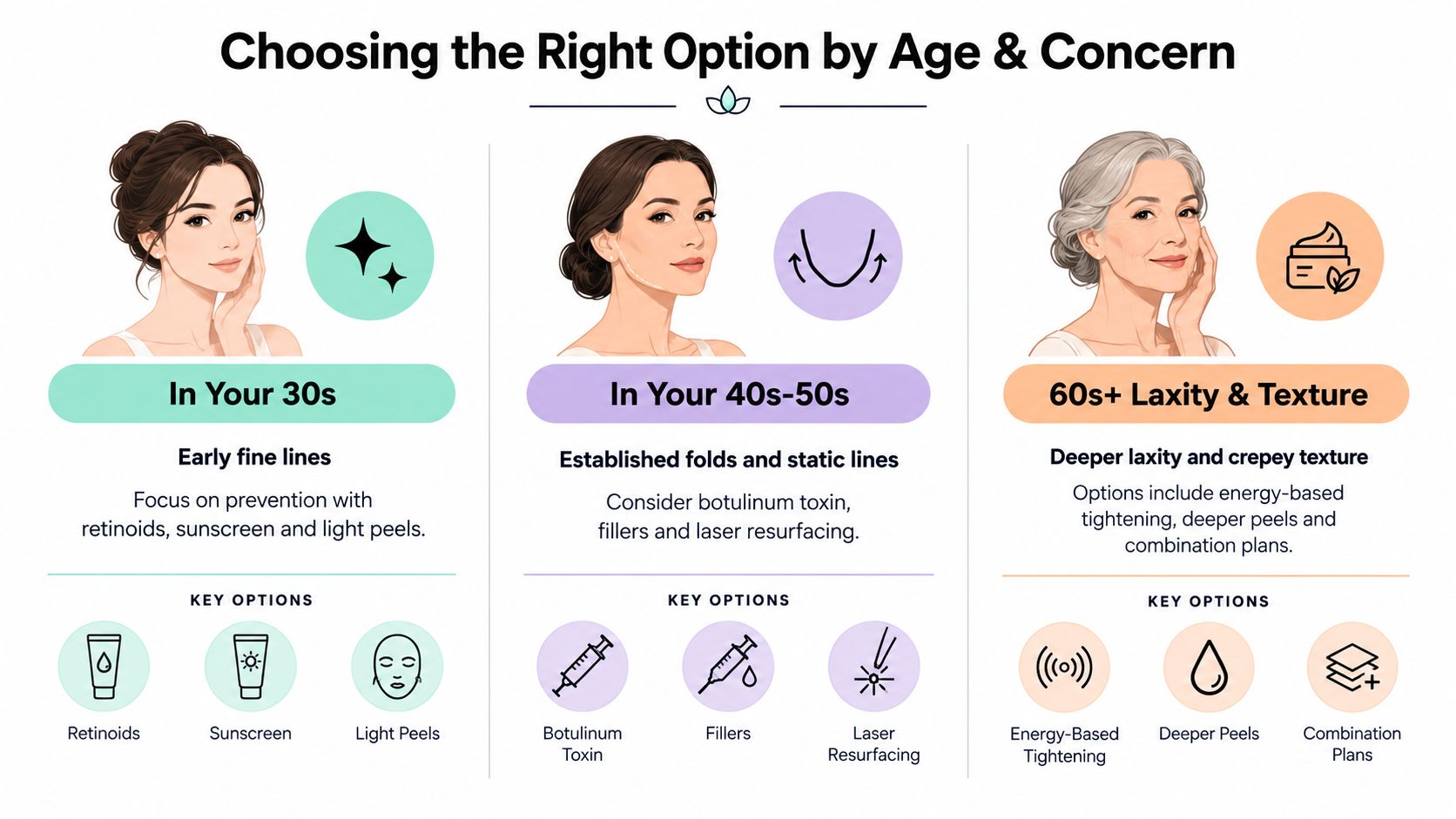
Age is a useful starting point, not a prescription. Someone in their 30s may have strong expression lines and excellent skin quality, while someone older may mainly want better hydration and texture rather than a dramatic change in facial shape.
Match the concern to the job
For early fine lines, start with protection and skin quality. A practitioner may discuss sunscreen, retinoids, gentle peels or supportive treatments such as LED. If the main issue is a forehead line that appears only when you raise your brows, a conservative neuromodulator consultation may be more logical than resurfacing.
For established static lines, the plan often needs more than one layer. Tretinoin may provide a conservative foundation, while microneedling, RF or fractional CO2 may address texture and etched change. A fold caused partly by volume loss needs a separate assessment before anyone suggests filler.
For laxity and crepey texture, energy-based tightening or collagen-stimulating treatments may be relevant. Deeper resurfacing can improve texture but requires more planning, particularly for sensitive or pigment-prone skin. You can compare the practical distinction between these energy approaches in this guide to HIFU versus radiofrequency.
A simple decision matrix
| Your main concern | Sensible starting discussion | What to avoid assuming |
|---|---|---|
| Forehead or frown lines during expression | Conservative botulinum toxin assessment | That deeper laser is automatically better |
| Under-eye crepiness | Skincare, RF microneedling or carefully selected skin-quality treatment | That filler will correct thin, crinkled skin |
| Nasolabial folds or marionette lines | Assessment of volume, laxity and skin quality | That the fold should be filled without checking facial balance |
| Rough, sun-affected texture | Medical skincare, microneedling or resurfacing | That an LED mask has proven every advertised claim |
| Mild jawline or brow laxity | HIFU or RF consultation | That tightening energy replaces surgery in every case |
Skin type changes the risk discussion. Dry or reactive skin may need a slower topical routine and careful preparation before procedures. Oily skin may benefit from a plan that also addresses pores and sebum, rather than focusing only on lines. Deeper skin tones can be treated safely, but pigment risk and device settings require experienced assessment, especially with aggressive resurfacing.
Lifestyle is equally practical. Choose a low-downtime option if your work or caring responsibilities make visible recovery difficult. Choose a staged plan if you'd rather assess one change before adding another. The most convincing result is usually the one that matches your priorities and remains believable to you.
What to Expect From Consultation to Aftercare
A sound wrinkle consultation should feel like an assessment, not a conveyor belt. The practitioner should review your medical history, medication, allergies, previous treatments, pregnancy status where relevant, skin condition and expectations before recommending a procedure.
Photographs in consistent lighting can help track change. Some clinics also use structured face or body scanning to assess concerns and compare progress over time. At 3D Aesthetics Leamington Spa, a complimentary consultation includes a full 3D body scan used to assess concerns, personalise treatment plans and measure results over time.

Questions to ask before treatment
- Who prescribes and performs the treatment? Ask about qualifications and experience with your specific area.
- What result is realistic? A credible practitioner should explain what the treatment can't do.
- What are the risks? You should hear about common effects, serious complications and the clinic's escalation process.
- What happens afterwards? Get written aftercare and a named contact for concerns.
- Will you need a staged plan? Sequencing HIFU, RF, microneedling, skincare or resurfacing may be more sensible than combining everything immediately.
Comfort varies by procedure. Topical numbing can support microneedling or laser treatments, while injections involve brief discomfort and potential swelling or bruising. Follow aftercare instructions carefully, especially around heat, sun exposure, active skincare and makeup.
LED may be used as a gentle supportive treatment within a broader plan. You can read about the role of Dermalux LED therapy while keeping its claims in proportion to the concern being treated.
NHS pathways are usually relevant when botulinum toxin is prescribed for an eligible medical condition, not ordinary cosmetic wrinkle reduction. For appearance-led treatment, private care should provide clear costs, consent, review arrangements and no pressure to proceed.
Our Recommendation and Next Steps for Smoother Skin
The best treatment for wrinkles depends on the job to be done:
- If lines appear mainly with expression, ask about a conservative botulinum toxin assessment.
- If lines remain at rest, discuss skincare, resurfacing, collagen stimulation and structural support.
- If the skin looks crepey or uneven, prioritise texture and resilience rather than adding volume.
- If laxity is the main concern, compare HIFU and RF with realistic expectations about gradual tightening.
- If evidence is unclear, ask for the exact claim, supporting research and likely limitations.
A sensible plan often starts conservatively, measures the response and adds treatment only when the remaining concern justifies it. That approach protects facial expression, reduces unnecessary procedures and makes it easier to understand what has helped.
Book an assessment with a qualified UK practitioner who can examine your face at rest and during movement, review your skin condition and explain the trade-offs without promising perfection.
At 3D Aesthetics Leamington Spa, you can discuss wrinkle concerns through options including HIFU, RF, 3D Dermaforce microneedling, fractional CO2 resurfacing, Dermalux LED and HydrO2 facials. Visit the clinic to arrange a personalised consultation and build a staged, evidence-led plan around your skin type, wrinkle pattern and available downtime.
← Back to Home