
You've had your first laser session. A week later, some hairs seem to be pushing out, others look unchanged, and a few patches feel smoother than the rest. It's easy to wonder whether it's working properly or whether you're somehow the exception.
That reaction is completely normal.
Most confusion about laser hair removal results comes from one simple mismatch in expectations. People often picture instant hair-free skin. Clinicians measure something different: progressive hair reduction over time. In UK clinical guidance, laser is discussed as a reduction treatment, not a guarantee of complete permanent removal. That small wording difference matters because it changes how you judge your progress, your timetable, and whether your treatment plan is on track.
Table of Contents
- Introduction to Laser Hair Removal Results
- How Laser Hair Removal Works on the Hair Growth Cycle
- Laser Hair Removal Results Timeline Session by Session
- Key Factors That Shape Your Laser Hair Removal Results
- Making Results Last From Aftercare to Maintenance Sessions
- What Before and After Really Looks Like
- Your Next Steps to Confident Lasting Results
Introduction to Laser Hair Removal Results
A realistic way to think about laser is this. It doesn't switch every follicle off in one appointment. It gradually catches the right hairs at the right moment in their growth cycle. That means your early results can look uneven before they look better.
In UK clinical evidence, short-term efficacy is typically 30% to 70% hair reduction up to 6 months after the final treatment, while longer-term studies with alexandrite, diode, and long-pulsed Nd:YAG lasers report about 50% hair reduction at 6 to 20 months with repeated treatments. NHS guidance also notes that complete removal can't be achieved, and some patients may expect up to two-thirds reduction in hair growth according to the NHS clinical evidence summary on laser hair reduction.
That's why good consultations focus on reduction, not perfection.
What many people mistake for failure is often normal progress. Shedding, patchiness, slower regrowth, and finer hair are all common signs that treatment is doing its job.
If you're trying to compare clinics, this is also where communication matters. Clear appointment reminders, sensible spacing, and fast answers to aftercare questions make a real difference to staying consistent. For clinics trying to support that experience, tools like automated call handling for clinics can help patients get practical answers without delays.
What results usually look like in real life
A typical early pattern goes something like this:
- Week one: Hair may still look present. That doesn't mean nothing happened.
- Weeks after treatment: Some hairs start to shed or lift out more easily.
- Later sessions: Regrowth often looks patchier, finer, and slower.
- After a full course: Many people see a clear long-term reduction, but not every hair disappears forever.
The most helpful mindset is to watch for trends, not single hairs. One stubborn patch after one session tells you very little. A gradual drop in density over multiple sessions tells you much more.
How Laser Hair Removal Works on the Hair Growth Cycle
Laser works by delivering light energy into pigment in the hair. That energy heats the follicle and reduces its ability to keep producing the same kind of hair. But there's a catch. The follicle has to be in the right stage of growth.
That's why timing matters so much.
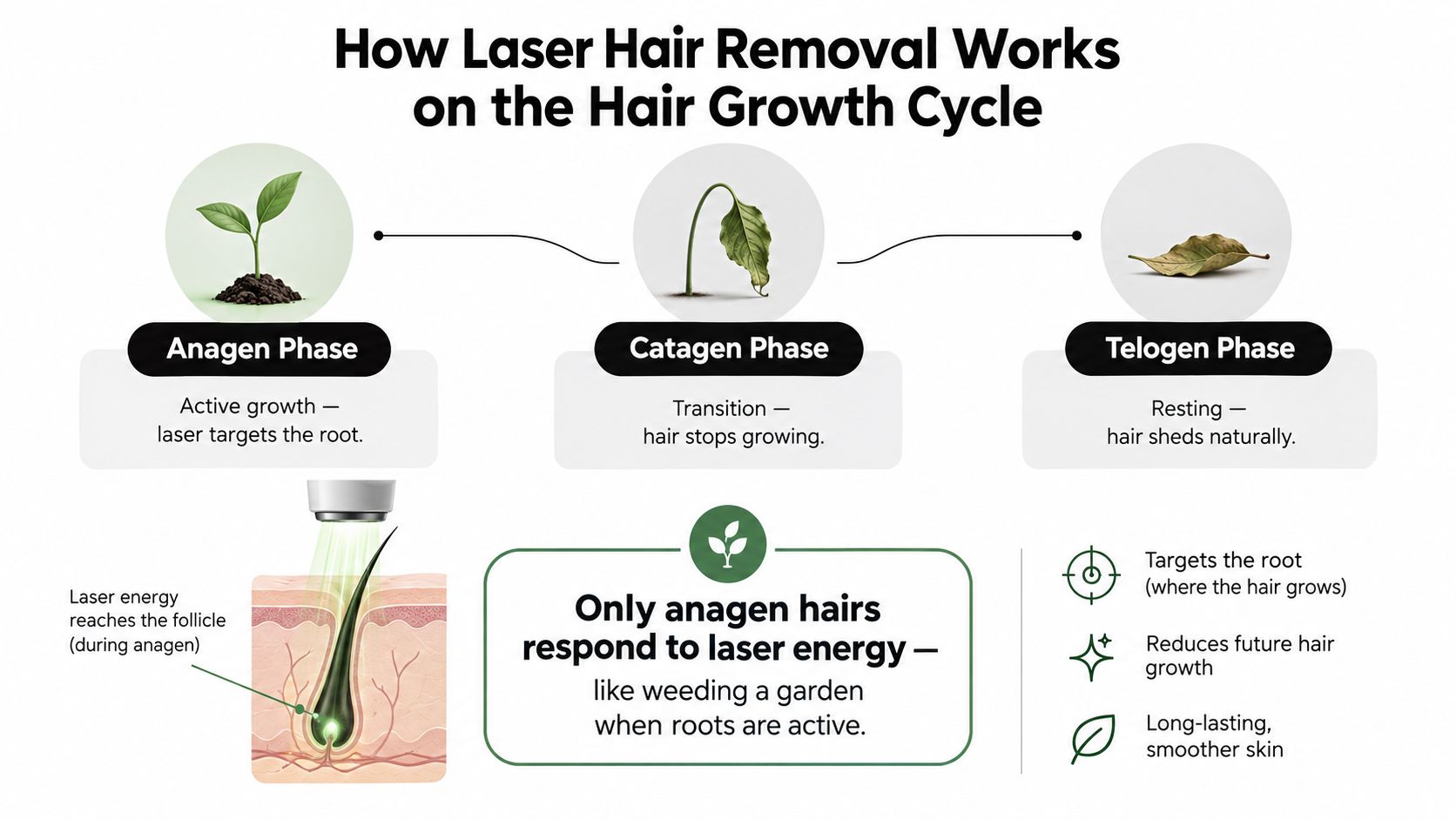
The three phases that matter
Hair doesn't all grow at once. Each follicle follows its own cycle.
- Anagen: This is the active growth phase. The hair is connected more directly to the root structure that laser is trying to affect.
- Catagen: This is the transition phase. Growth slows and the follicle starts changing.
- Telogen: This is the resting phase. The hair is preparing to shed naturally.
The key point is simple. Laser is most effective when the hair is in anagen.
A simple way to picture it
Picture weeding a garden. If you pull weeds when the roots are active and connected, you have a much better chance of disrupting growth properly. If you catch them at the wrong moment, you may remove what's visible above the surface without dealing with the root as effectively.
Hair follicles behave in a similar way. Some are treatable on the day of your appointment. Others are effectively “off schedule” and need a later session.
Practical rule: Laser doesn't miss because your body is unusual. It misses some hairs because not all follicles are ready on the same day.
That's also why hair can seem to “grow” between sessions. Often, what you're seeing isn't treatment failure. It's a mix of untreated follicles entering anagen and treated hairs moving out and shedding later.
Why multiple appointments aren't optional
A proper course spaces treatments to catch new groups of follicles as they cycle into the active phase. If sessions are too close together, some follicles won't have moved into the target stage yet. If they're too far apart, progress can become less efficient.
If you want a fuller explanation of the permanence question, this guide on whether laser hair removal is permanent is useful because it frames the difference between long-term reduction and absolute removal in plain language.
Here's the part many people find reassuring once they understand it:
- Not all hairs are targetable at once
- Not all body areas cycle at the same speed
- Results build layer by layer, not all at once
That's why “reduction” is the medically sensible word. It matches how follicles behave in the world.
Laser Hair Removal Results Timeline Session by Session
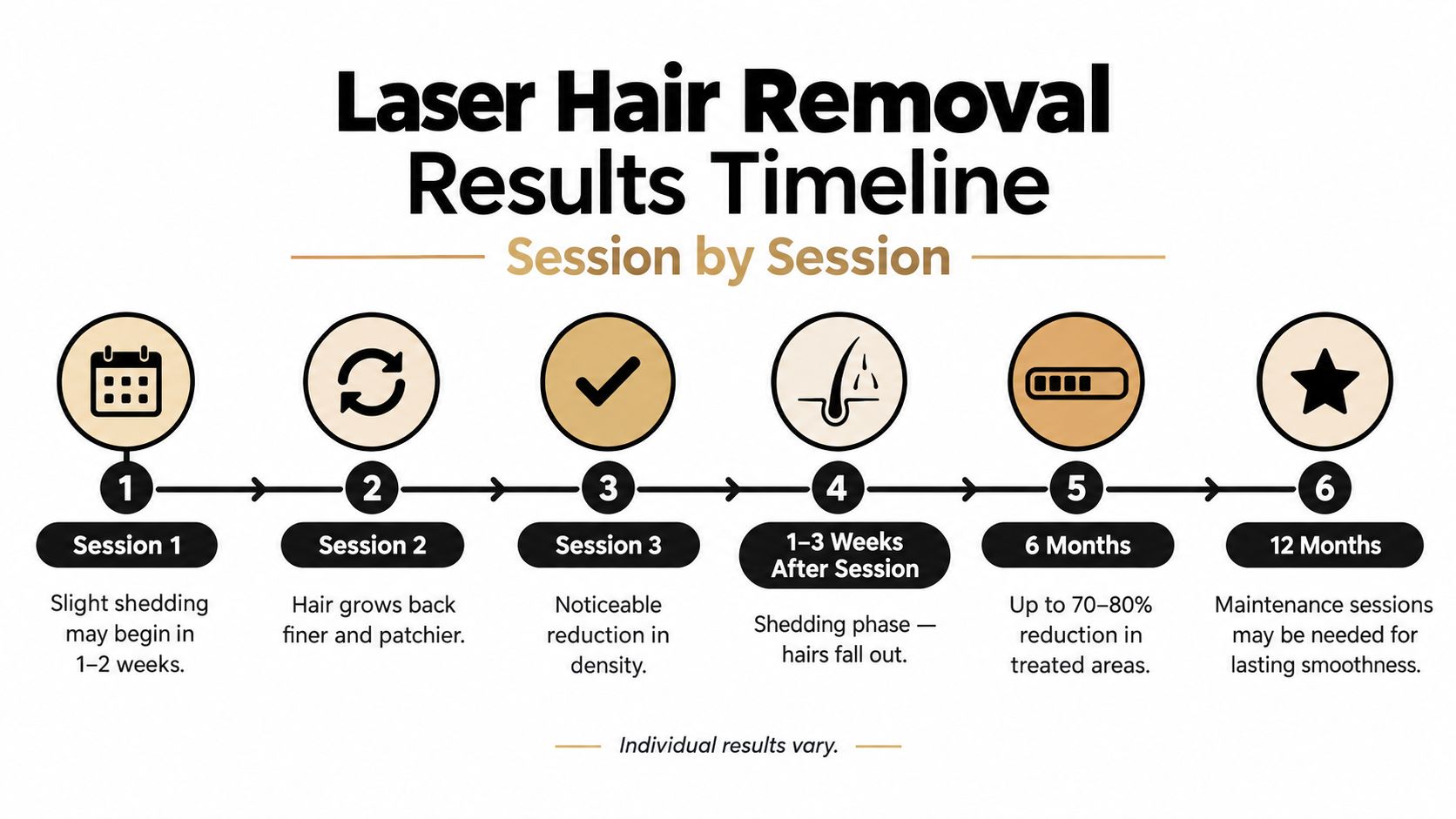
The treatment timeline often feels odd if nobody prepares you for it. Session one rarely gives a dramatic mirror moment. Session three often tells a much clearer story. The biggest mistake is judging the whole process too early.
After session one
In the first stretch after treatment, many people expect smoothness straight away. Instead, the area can look almost unchanged at first. Then the treated hairs begin to loosen and shed.
What tends to confuse people is that shedding doesn't always happen neatly or evenly. One patch may clear sooner than another. Some hairs may seem to sit there before finally releasing.
Common things people notice:
- Patchy shedding: Some hairs fall away while nearby hairs stay visible longer.
- A rough “peppery” look: Tiny dark dots can appear as treated hairs work their way out.
- A false sense of regrowth: Hairs can look as if they're growing when they're in fact shedding.
After sessions two and three
This is often where the pattern becomes easier to recognise. Regrowth may not vanish, but it often appears finer, patchier, and slower than before. Shaving may feel less frequent, and the texture can start to change.
You're not usually looking for complete bare skin yet. You're looking for a shift in density and pace.
A good question after the early sessions isn't “Is every hair gone?” It's “Is there less of it, and is what returns softer or slower?”
Mid-course changes
By the middle of a treatment plan, many people can see that the area behaves differently. Some zones respond quickly. Others seem more stubborn, especially areas influenced more strongly by hormones or faster cycling follicles.
A course is often planned across several appointments rather than one-off treatments. In UK practice, that fits the long-standing commissioning view that laser for cosmetic purposes isn't routinely commissioned and that meaningful benefit usually comes through repeated sessions, with historical policy language framing outcomes as reduction rather than guaranteed removal in the NHS England commissioning policy context.
What “on track” usually means
Rather than fixating on an exact number of sessions for everyone, it helps to look for these signs:
- You're shaving less often
- The hair that returns is less dense
- The pattern becomes irregular rather than evenly full
- Some areas clear faster than others
- Each session builds on the last, even if slowly
The plateau phase
Toward the end of a course, progress can feel less dramatic. That doesn't mean treatment has stopped working. It often means the easy-to-target hairs have already responded, and what remains is finer, lighter, hormonally influenced, or cycling differently.
That's when treatment plans often become more personalised. Session spacing may need adjusting. Device settings may need reviewing by your practitioner. A top-up approach may make more sense than expecting the same rate of change forever.
Months after your course
Long-term success usually looks like lower overall density, less daily bother, and regrowth that's easier to manage. Some follicles stay quiet for a long time. Others may need occasional maintenance, especially if your body area or hormones make regrowth more likely.
The most reliable way to judge laser hair removal results is over months, not days.
Key Factors That Shape Your Laser Hair Removal Results
Two people can use similar technology and still see very different outcomes. That doesn't automatically mean one treatment was “better” and the other failed. It usually means the starting conditions weren't the same.
Body area changes everything
One of the biggest variables is where you're treating. UK clinical evidence shows that long-term reductions are highest on leg hair and lowest on facial hair. The reason is timing. Leg follicles have a longer growth cycle that tends to match treatment intervals better, while facial hair regrows faster and is more likely to miss the anagen phase targeted by laser, as discussed in the University of Aberdeen clinical review on body site and hair-cycle timing.
That's why one-size-fits-all treatment plans can be frustrating.
| Treatment Area | Growth Cycle Trait | Expected Responsiveness |
|---|---|---|
| Legs | Longer cycle, often easier to match with treatment intervals | Often responds well over time |
| Underarms | Regular regrowth pattern in many people | Often shows visible reduction steadily |
| Face | Faster regrowth, more chance of missing the target phase | Often needs more patience and maintenance |
| Bikini area | Can be influenced by both cycle timing and hormones | Often responsive, but can vary |
| Back or chest | Larger area, mixed density and cycle behaviour | Progress can be uneven across zones |
Skin tone and device choice both matter
Older advice often suggested that darker skin automatically meant poorer results. The more useful truth is more nuanced. A recent clinical study found similar short-term efficacy across skin types I to IV and V to VI, with mean hair reduction of 45.5% versus 40.3% at 3 months in the study groups, according to the clinical study on multi-wavelength laser treatment across skin types.
At the same time, NHS guidance has historically noted a higher incidence of adverse effects in darker skin with certain older lasers. So the practical takeaway isn't “skin tone doesn't matter.” It's that device choice and operator skill matter more than simplistic assumptions.
Hair colour and thickness affect the target
Laser needs pigment in the hair to absorb energy well. Dark, coarse hair usually gives the laser a clearer target. Very light, grey, red, or fine hair can be less straightforward because there may be less pigment to work with.
This is one reason consultations should assess the actual hair in the treatment area, not just tick a box marked “suitable”.
If you're comparing technologies, this overview of laser hair removal vs IPL can help you understand why different devices may suit different skin and hair combinations.
Hormones and consistency influence the finish line
Hormonal patterns can make some areas more persistent. Facial hair is the classic example, but it's not the only one. You can still get worthwhile reduction, but the journey may look slower and need more upkeep.
Consistency matters too. Missed appointments, waxing between sessions, or poor aftercare can interrupt the plan and muddy the results.
The fairest comparison isn't person against person. It's your hair now versus your hair before treatment started.
Making Results Last From Aftercare to Maintenance Sessions
Results don't depend only on the laser. They also depend on what you do before, between, and after appointments. Small habits can either support the plan or work against it.
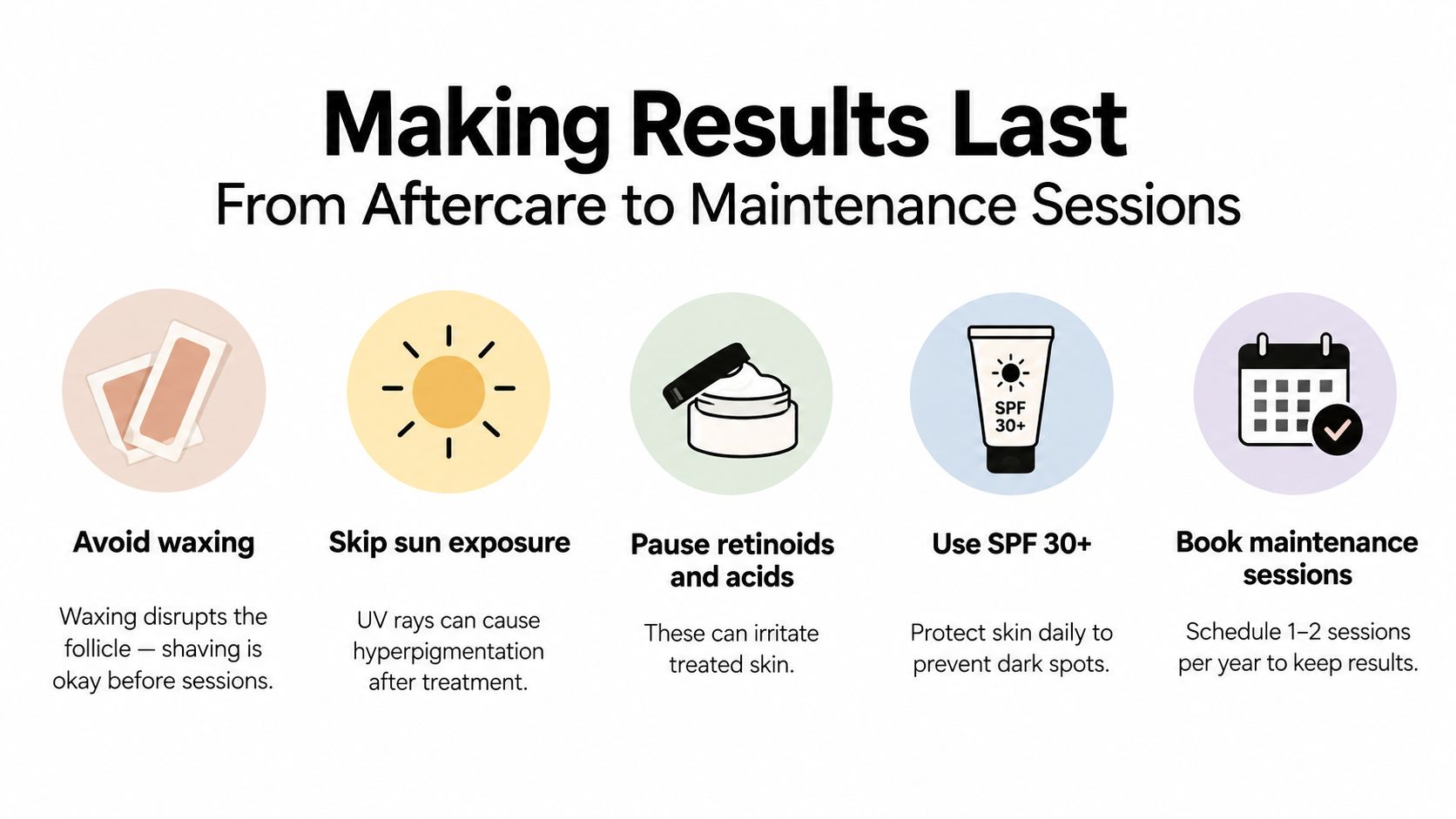
The habits that protect your progress
Some rules matter because they protect the follicle target. Others matter because they protect your skin.
- Avoid waxing and plucking: These remove the hair from the follicle, which gives the laser less to target at your next visit.
- Shave if your clinic advises it: Shaving removes surface hair without pulling the follicle out.
- Be careful with sun exposure: Recently tanned or irritated skin can make treatment planning more cautious.
- Pause harsh skincare where advised: Active ingredients can leave the skin more reactive.
- Follow your clinic's timing: Turning up too early or waiting too long can disrupt the rhythm of treatment.
Why maintenance is normal
Honest language helps here. Laser is best thought of as long-term reduction with possible maintenance, not a once-in-a-lifetime switch-off for every follicle.
That's also consistent with UK policy history, where cosmetic laser hair removal has long been framed as a non-routine service and, clinically, as a reduction treatment rather than a guaranteed complete removal. In everyday terms, that means top-ups aren't a sign that your original course “didn't work”. They're often part of how people keep a good result looking good.
A sensible maintenance mindset
A practical plan often includes three parts:
- Finish the initial course properly
- Review how the area behaves over time
- Book occasional maintenance if regrowth becomes noticeable
For people who want a clearer idea of the treatment journey from preparation to review, this guide to the laser hair removal process helps set expectations in a simple, step-by-step way.
Some clinics also build result tracking into the consultation process. For example, 3D Aesthetics Leamington Spa includes a consultation with a 3D body scan, which can help document visible changes over time rather than relying only on memory.
Maintenance is easier to accept when you stop treating it as a setback and start treating it as part of the plan.
What Before and After Really Looks Like
Before and after photos can be useful, but they can also be misleading if you expect a dramatic all-or-nothing transformation. In real life, laser hair removal results usually show up as changes in density, texture, speed of regrowth, and how often you need to shave.
That's why “after” often means less effort rather than zero hair forever.
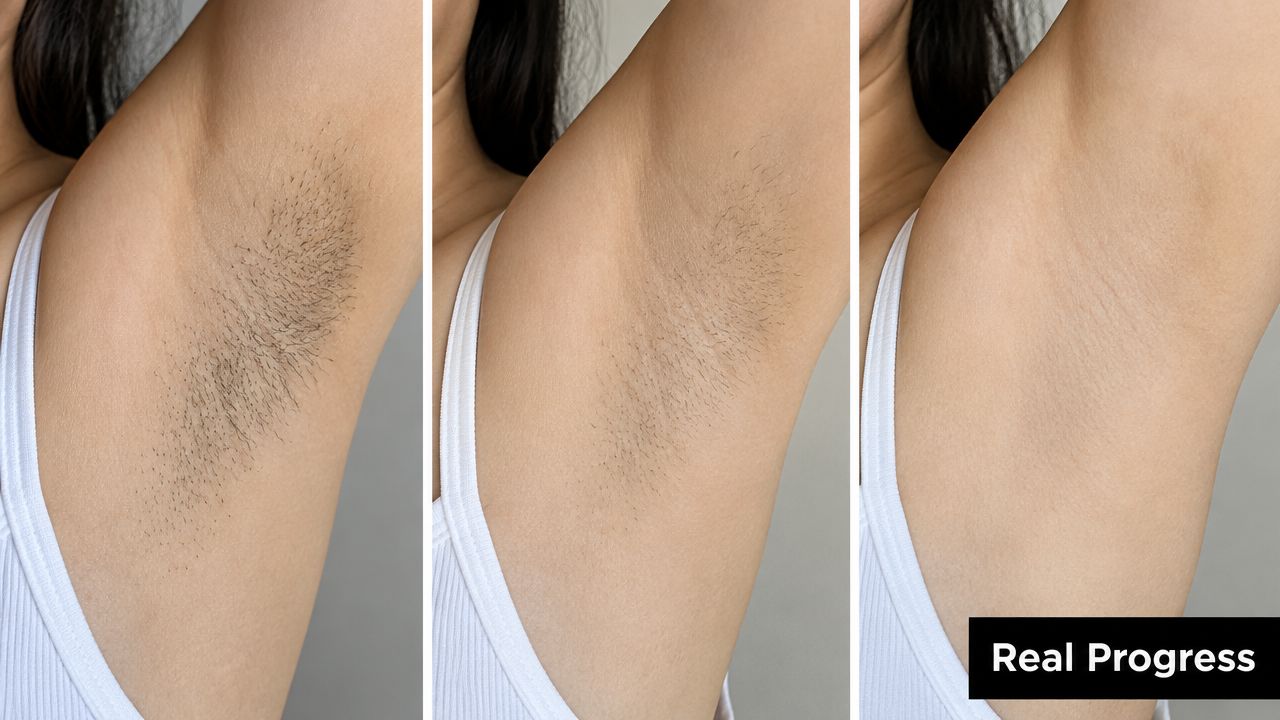
What good progress usually looks like
A realistic before and after sequence often includes:
- Less bulk: The treated area looks less crowded with hair.
- Finer return hairs: Regrowth can seem softer and less obvious.
- Slower comeback: You may notice longer gaps before the area feels prickly again.
- Patchiness in a good way: Hair no longer returns in a uniform pattern.
The skin itself may also look calmer over time if you used to get shaving irritation or ingrown hairs, although the exact change varies from person to person.
What normal temporary reactions can look like
Straight after treatment, some redness or a bumpy “goosebump” effect around follicles can happen. Many people find this settles. What matters is knowing the difference between an expected short-term skin response and a reaction that needs your practitioner's advice.
Useful progress photos are boring on purpose. Same lighting, same angle, same distance, same time gap.
Here's a video that helps put the visual side of treatment into context:
When to ask for a treatment review
It's worth checking back with your practitioner if:
- The pattern isn't changing over several sessions
- You're seeing more irritation than expected
- One area is responding very differently from the rest
- Your hair or hormones have changed noticeably since you started
For darker skin tones, careful device choice remains especially important. Modern systems have improved the outlook for many people, but safety still depends heavily on matching the technology and settings to the person in front of you.
Your Next Steps to Confident Lasting Results
The most useful shift you can make is this one: judge laser by reduction over time, not by the hope of instant total removal. Once you do that, the whole process becomes easier to read. Patchy shedding makes sense. Slower regrowth becomes meaningful. Maintenance stops feeling like bad news.
If you're preparing for a consultation, go in with a short checklist.
Questions worth asking
- Which device are you using for my skin tone and hair type?
- Which body areas usually respond fastest, and which need more patience?
- How will you space my sessions for this specific area?
- What sort of reduction should I realistically aim for?
- What should I do between sessions, and what should I avoid?
- How will we decide if I need maintenance later?
A grounded way to judge your own progress
Use these markers instead of expecting perfection:
- Hair is returning more slowly
- The area feels less dense
- Regrowth looks finer or more irregular
- You need less day-to-day hair removal
- Your practitioner can explain any stubborn patches clearly
That's the route to confident expectations. Not flawless promises, but informed ones.
If you want a plan, a proper assessment should look at your body area, skin tone, hair type, and scheduling needs together rather than treating laser as a standard package for everyone.
If you're considering treatment, 3D Aesthetics Leamington Spa offers laser hair reduction alongside an in-depth consultation and 3D body scan, so your plan can be matched to your treatment area, hair pattern, and goals. If you want clearer expectations before you commit, it's a practical place to start that conversation and map out what lasting results could realistically look like for you.
← Back to Home