
Laser tattoo removal in the UK is generally described as moderately uncomfortable rather than unbearable, with a small pilot study recording an average pain score of 4 out of 10 and people commonly comparing the sensation to a warm elastic band snapping against the skin. We tailor pain management to each client during consultation rather than expecting everyone to tolerate the same approach.
Perhaps you've found a photograph where you're hiding your arm again, or you're choosing clothes around a tattoo you no longer want. You're ready to explore removal, but you don't want to swap one regret for an experience you weren't prepared for.
At our clinic in Leamington Spa, we start with your skin, your tattoo and your concerns. Pain tolerance is only part of the assessment, not a test you have to pass.
Table of Contents
- Why People Ask Whether Tattoo Removal Hurts
- What Laser Tattoo Removal Actually Does
- The Factors That Change How Much Removal Hurts
- Anaesthetic Options and How We Manage Pain
- What a Session Feels Like From Start to Finish
- Aftercare That Lowers Discomfort Between Sessions
- Common Questions and Who We Would Not Treat
Why People Ask Whether Tattoo Removal Hurts
Laser tattoo removal involves expected discomfort during treatment, possible soreness afterwards and a personal decision about whether the commitment feels worthwhile. The Sandwell and West Birmingham NHS Trust patient guide says most patients experience pain and describes the warm elastic-band sensation. Its supporting evidence includes a pilot involving 10 participants aged 20–60, whose mean pain score was 4 on a 0–10 scale. That's useful context, not a prediction for your appointment. A small average can't tell us how a dense wrist tattoo or a multicoloured cover-up will feel for you. We discuss comfort, recovery and your reasons for removal before agreeing a plan. The question isn't whether you're tough enough. It's whether we can offer an appropriate treatment approach, explain its limitations and help you make an informed choice without pressure. Results vary from person to person.
What are you really worried about?
You might be comfortable with a sharp sensation but anxious about being unable to stop. Someone else may be less concerned about the appointment and more worried about how their skin will look at work afterwards.
Consider someone who has spent years covering an old name with a sleeve. Booking a consultation doesn't necessarily mean they want treatment immediately. They may want to understand their options without being judged.
We make space for that conversation. Our guide to tattoo regret discusses the reasons someone might reconsider a tattoo without assuming removal is the right choice for everyone.
- During treatment: Tell us what you're concerned about, including previous difficult experiences.
- After treatment: Explain your work, clothing and practical commitments so we can discuss recovery.
- Before committing: Ask what improvement is realistic for your particular tattoo. Results vary from person to person.
Our starting point: You don't need to prove your pain tolerance to deserve a careful consultation.
For clients travelling from elsewhere in Warwickshire, we'd rather use the first appointment to answer questions properly than rush towards switching on a laser.
What Laser Tattoo Removal Actually Does
Laser tattoo removal uses targeted light to break tattoo pigment into smaller fragments that the body can gradually clear, but targeting ink doesn't mean the surrounding skin has no risk. The NHS patient information linked in our pain-management discussion describes treatment and its associated precautions; the important distinction is between selective targeting and a promise of no skin reaction.
The process is easier to understand visually.
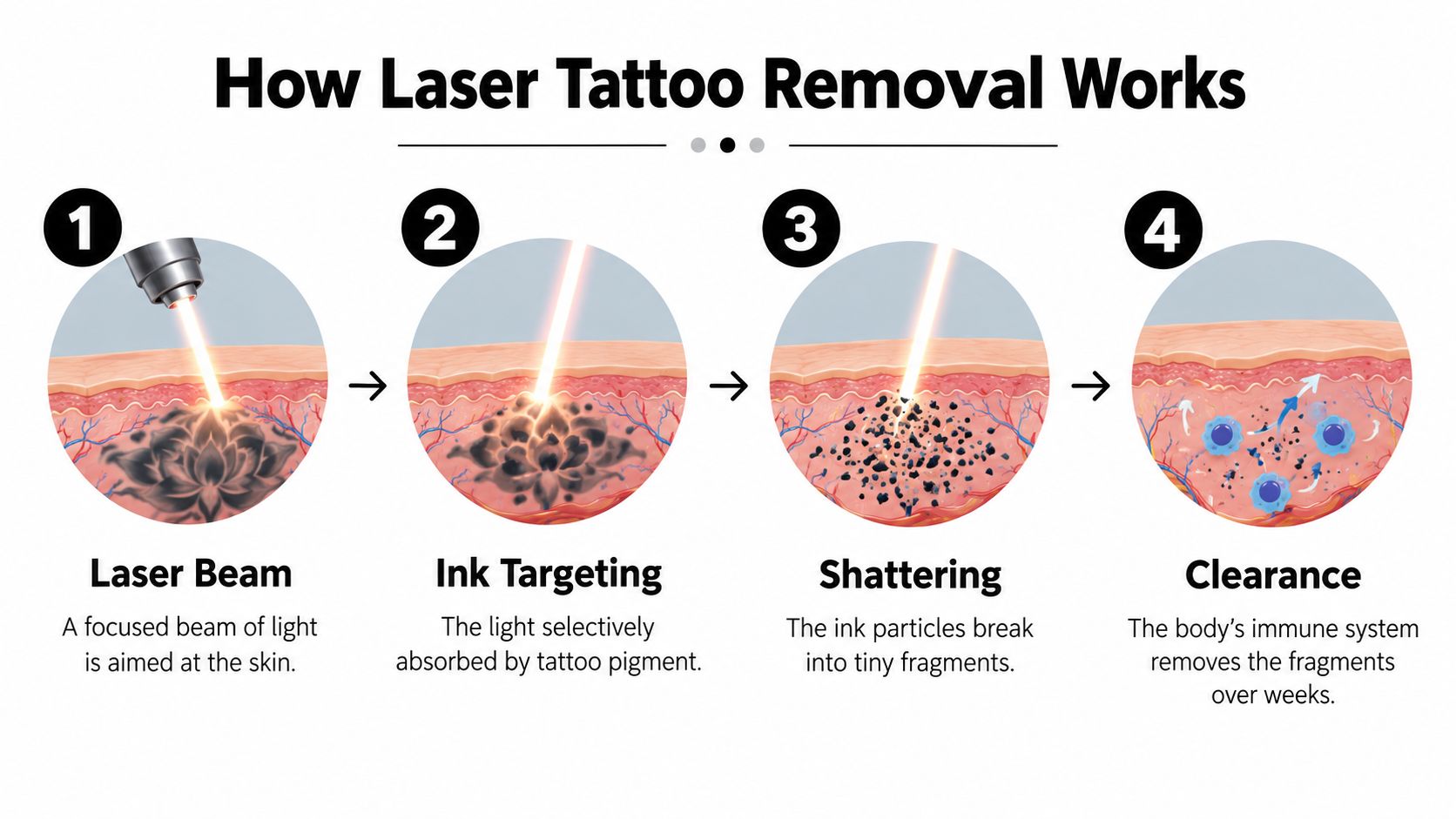
Why does the explanation matter?
A laser isn't rubbing a tattoo off the surface. The treatment needs to interact with pigment within the skin, which is why a sensible discussion includes both the ink and the skin around it.
You may encounter Nd:YAG, the name of a laser technology, while researching removal. The name alone doesn't tell you which settings are appropriate, how treatment will feel or whether a particular tattoo is a sensible candidate. We explain the equipment and proposed approach during assessment rather than asking you to choose from technical terminology.
Our laser tattoo removal treatment page is the relevant starting point for understanding what we offer locally. We assess your tattoo before suggesting a treatment course, and results vary from person to person.
- The ink needs assessment: Colour, density and previous work belong in the discussion.
- The skin needs assessment: Your current skin condition matters as much as the tattoo.
- The plan needs review: We don't treat an initial estimate as permission to ignore your skin's response later.
Why isn't pain just about the laser?
For a separate, general explanation of pain perception, MEDISTIK's resource on understanding pain pathways in the brain provides background reading. It isn't a UK tattoo-removal guideline or a substitute for assessing your tattoo.
Our practical position is straightforward: understanding the process can help you ask better questions, but it doesn't oblige you to proceed. You should leave a consultation knowing what we intend to do, what we can't predict and what would make us reconsider treatment.
The Factors That Change How Much Removal Hurts
Laser tattoo removal discomfort varies with the person, tattoo location, ink density and laser settings, while skin tone adds an important safety consideration rather than a simple higher-or-lower pain rating. The NHS guidance discussed earlier supports looking at these factors together.
We don't rank clients by toughness. We assess the treatment area and the trade-offs involved.
Does skin tone matter more than pain tolerance?
For treatment planning, it can. The older Sandwell and West Birmingham NHS tattoo-removal leaflet identifies hyperpigmentation, meaning darker patches of skin, as the most common risk and says it is more likely in people who tan easily or have darker skin.
That doesn't establish that darker skin necessarily feels more pain. It establishes why comfort alone isn't enough to judge whether an approach is appropriate.
The same NHS leaflet discusses hypopigmentation, meaning lighter patches, and notes that iron-containing cosmetic pigments can rarely darken immediately and turn black. Tell us if the area is cosmetic tattooing rather than a conventional decorative tattoo.
What do we need to know about your ink?
A small, lightly inked design and a dense cover-up shouldn't receive an identical discussion because they occupy the same body area. We also won't tell you that an older tattoo must hurt less or need fewer visits purely because it has faded.
The checklist below illustrates the questions that commonly arise. Its age and location labels shouldn't be read as reliable predictions for an individual tattoo.
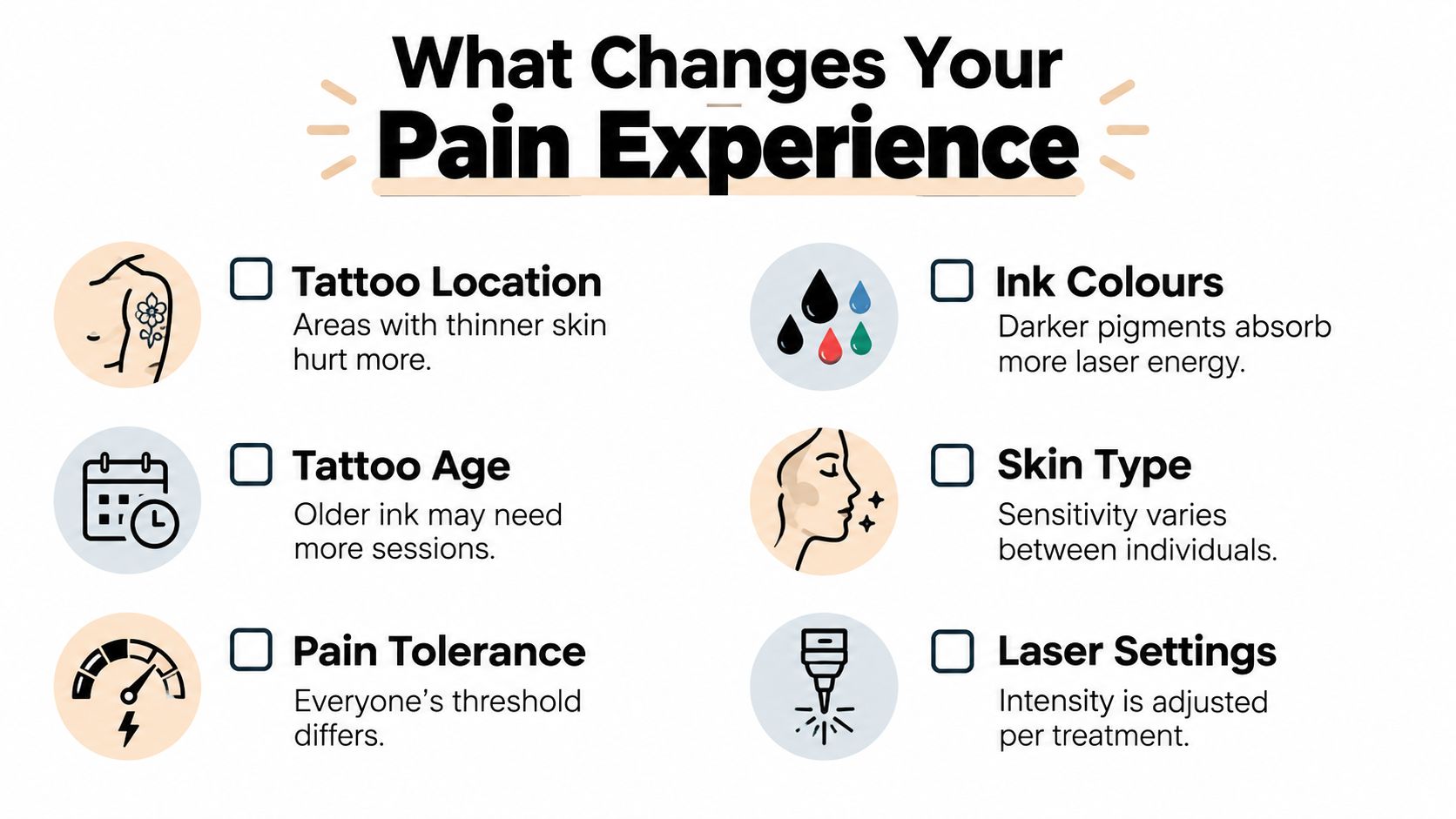
Before recommending treatment, we ask about:
- Location and size: Where is the tattoo, and how much area needs assessment?
- Colour and layering: Is it multicoloured, heavily shaded or a cover-up?
- Skin history: Do you tan easily, and have you noticed colour changes after previous skin treatments?
- Tattoo history: Has anyone treated it before, and how did your skin respond?
- Your priorities: Are you more concerned about discomfort, visible recovery or the uncertainty of fading?
Our guide to how many tattoo-removal sessions may be needed addresses the planning conversation. Results vary from person to person.
A treatment you can tolerate isn't automatically the right treatment for your skin.
That's the difference between answering “Does tattoo removal hurt?” with a score and answering it with a useful assessment.
Anaesthetic Options and How We Manage Pain
Laser tattoo removal discomfort may be managed with cooling, clinician-approved topical anaesthetic cream and, where appropriate, advice about paracetamol. The Sandwell and West Birmingham Hospitals patient leaflet specifically supports discussing numbing cream with the treating clinician and mentions paracetamol beforehand.
Don't apply a numbing product or take pain relief just because an online account recommends it. We need to know what you intend to use before your appointment.
What can each option realistically offer?
| Option | How we approach it | What we won't promise |
|---|---|---|
| Topical anaesthetic cream | Discuss suitability and application instructions beforehand | An appointment without sensation |
| Cold-air cooling | Use cooling as part of our comfort approach during treatment | That cooling replaces careful settings |
| Paracetamol | Discuss whether professional advice is needed before taking it | That it is appropriate for every client |
| Pauses and communication | Agree how you'll tell us you need a break | That you must continue because treatment has started |
We use cold-air cooling during appointments at our Leamington Spa clinic. We also discuss whether numbing cream is appropriate rather than making it an automatic requirement.
For a small tattoo, preparation may involve more time than the laser portion of the appointment. That doesn't make your concerns less important or mean we should dismiss a request to discuss numbing.
What should you avoid doing yourself?
The least helpful approach is arriving with an undisclosed combination of creams, supplements or pain-relief products. Bring questions instead, and tell us about anything you already use.
You may encounter resources that compare CBD delivery methods for pain, including HempWell USA's material. That is general commercial information, not UK clinical guidance for laser tattoo removal, and we don't use it as evidence to recommend CBD for your session.
- Before the appointment: Check any proposed cream or medicine with the appropriate clinician or pharmacist.
- During treatment: Tell us promptly if the sensation feels unmanageable.
- Before leaving: Make sure you understand the agreed aftercare and how to contact us.
Comfort rule: Speak up early. We'd rather pause and reassess than have you quietly endure more than you're comfortable with.
What a Session Feels Like From Start to Finish
Laser tattoo removal appointments at our clinic begin with assessment and preparation, followed by agreed treatment and a review of your skin before you leave. We explain the sequence beforehand so you're not trying to absorb unfamiliar instructions while worrying about the first pulse.
The photograph below shows a laser-treatment setting, but it depicts hair treatment rather than tattoo removal.
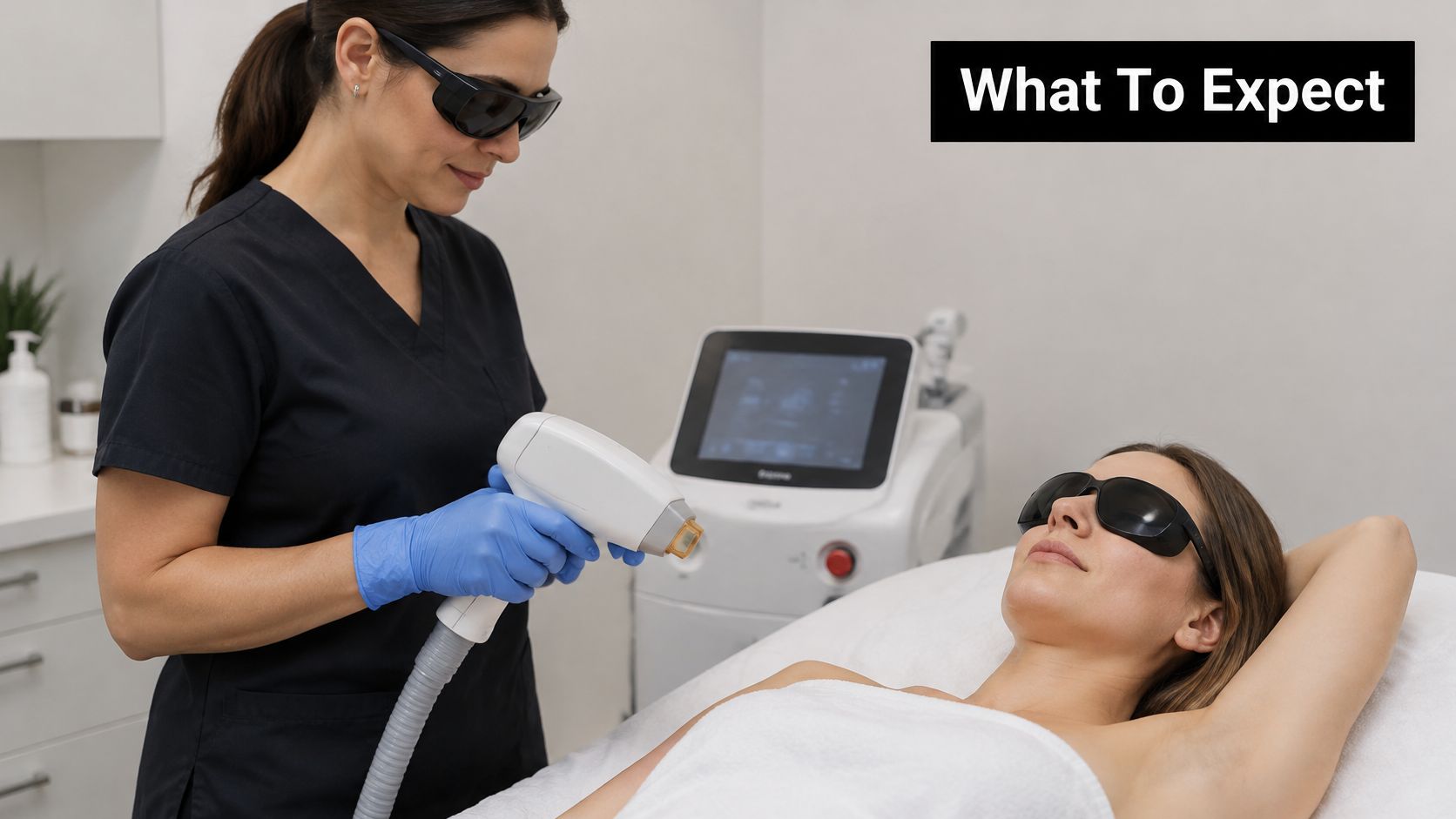
What happens before the first pulse?
We review your medical information, check the area and confirm the plan. We explain eye protection, positioning, cooling and how to ask us to stop.
Our service information describes a patch test before treatment to help assess the skin's reaction and guide the proposed settings. A patch test is useful preparation, not a prediction of every sensation or response during a course.
- Preparation: We check that you understand the appointment and any changes since consultation.
- Treatment: We watch your skin and listen to your feedback rather than relying on a pain score alone.
- Review: We explain what to monitor afterwards and whether anything changes the next appointment.
How many appointments should you expect?
Laser tattoo removal generally involves a course rather than a single visit, but we won't invent a session count or fixed spacing before assessing you. The NHS Scotland tattoo-removal evidence summary highlights treatment time, session numbers, adverse effects and cost as considerations.
That summary lists temporary blistering, swelling and crusting, alongside possible pigment changes, altered texture, scarring and incomplete removal. These are reasons to discuss recovery properly, not reasons to assume every reaction will happen to you. Results vary from person to person.
We also don't promise that each successive appointment will hurt less. Your feedback and skin response need reviewing throughout the course.
If you'd like a visual introduction before your consultation, the following video provides additional context.
You should leave knowing what was done, what to expect next and whom to contact. Uncertainty after an appointment is something we can address through clear instructions.
Aftercare That Lowers Discomfort Between Sessions
Laser tattoo removal aftercare should follow the written instructions agreed for your skin, rather than a generic recovery timetable borrowed from someone else. The NHS Scotland evidence discussed above explains why swelling, crusting and blistering deserve attention after the laser portion has finished.
Think practically about going home: will a sleeve rub the area, are you planning to swim, and do you know which products you've been advised to use? These are useful questions before treatment, not details to work out afterwards.
What should your home-care plan cover?
Our tattoo-removal aftercare guide provides a starting point, alongside the individual instructions we give you.
- Cooling: Ask us how to use a cool compress appropriately rather than applying ice directly or improvising.
- Cleaning and products: Follow the agreed cleaning, drying and moisturising instructions. Don't add new products because they sound soothing.
- Heat and water exposure: Ask when hot baths, saunas and swimming can resume for your treated area.
- Blisters and crusts: Don't pick or deliberately open them; contact us if you're unsure how to care for the area.
- Sun exposure: Discuss protection and tell us about tanning before arranging another session.
Pain Influencers at a Glance
| Factor | Effect on Pain | Why It Matters |
|---|---|---|
| Individual sensitivity | Changes how treatment is experienced | We need your feedback |
| Tattoo location and ink density | Can affect discomfort during treatment | The tattoo needs assessment |
| Laser settings | Influence the treatment experience | Settings need clinical judgement |
| Skin tone and tanning | Don't provide a reliable pain ranking | Pigment-change risk needs separate consideration |
| Recovery reactions | Can extend discomfort beyond the appointment | Aftercare and review matter |
The table draws together the NHS considerations discussed earlier; it isn't a scoring system.
When should you ask for a review?
Our clinic advice is to contact us if pain is worsening rather than settling, redness is spreading, you notice discharge or you feel unwell. Don't assume an unexpected reaction should wait until the next booked appointment.
For clients in Leamington Spa, Warwick and Kenilworth, we can discuss whether a clinic review is appropriate. If you feel acutely unwell or need urgent help, seek medical assessment rather than waiting for us to reply.
Common Questions and Who We Would Not Treat
Laser tattoo removal isn't appropriate to proceed with when the treatment area is infected, broken or otherwise unsuitable on assessment, and we will postpone or decline treatment rather than work around a safety concern. Royal Borough of Greenwich's laser licence conditions provide a concrete UK example: they require consultation, medical history and visual assessment, and prohibit treatment on or within 10 centimetres of infected skin, a rash, a cut, broken skin or another wound.
Those are Greenwich's conditions, not a claim that every council uses identical wording. They demonstrate why a proper assessment matters.
What might stop us treating you?
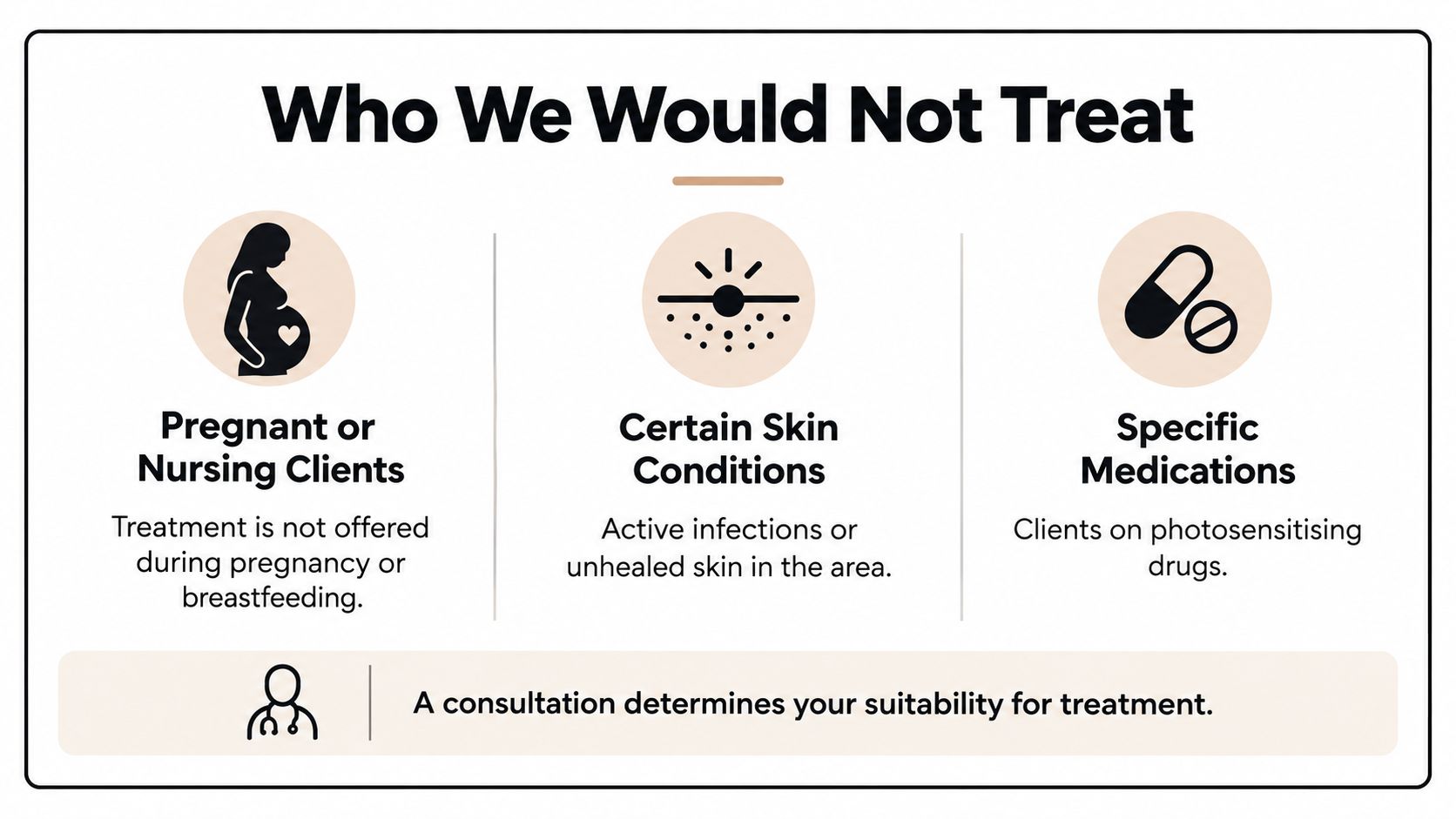
Our clinic policy is to defer treatment during pregnancy or breastfeeding and to review relevant medical conditions, medicines and recent tanning before deciding suitability. Medicines that increase sensitivity to light need particular discussion; don't stop any medicine to make yourself eligible.
The exclusions below are prompts for consultation, not a complete medical checklist.
Is removal worse than getting tattooed?
Laser tattoo removal can't be ranked against your original tattoo experience using the small pain study alone. We won't tell you it must be worse, or dismiss your concern by saying it must be easier.
- Will one visit be enough? We don't sell a course on that assumption.
- Are scars inevitable? No, but the older NHS leaflet discussed earlier reports scarring in about 3 in 100 patients. Our tattoo-removal scar guide explains the conversation to have before proceeding; results vary from person to person.
- Can a scanner decide suitability? Our free AI Skin Scanner can support a wider skin-health discussion, but it doesn't replace tattoo assessment.
At 3D Aesthetics Leamington Spa, previously trading as 3D Lipo Leamington Spa, we offer laser tattoo removal with an individual assessment and a frank discussion about comfort, recovery and limitations. Book your free consultation at 11 Guys Place East, Leamington Spa, Warwickshire CV32 4RG, or call 01926 315764 to discuss your tattoo before committing to treatment.
← Back to Home