You're probably not looking at a fresh burn. You're looking at skin that healed months or years ago and never quite settled, a patch that's raised when you run your fingers over it, tight when you stretch, or itchy for no clear reason. We see this weekly in Leamington Spa, and our first job isn't to sell you a laser course. It's to work out whether your scar needs NHS specialist input first, or whether it's a settled scar where clinic treatment for texture and appearance is reasonable.
Table of Contents
- What Burn Scar Treatment Really Involves
- Understanding Burn Scar Types and How They Form
- The Burn Scar Timeline and When to Seek Help
- Conservative and Medical Options Before Any Clinic Treatment
- Clinic Treatments That Can Improve Burn Scars
- What a Course of Treatment Looks Like in Our Clinic
- A Realistic Example of How a Burn Scar Is Assessed
- Costs, FAQs for Burn Scar Treatment
What Burn Scar Treatment Really Involves
Burn scar treatment is a staged pathway, not a single procedure, and the right stage depends on your scar type, maturity, symptoms and skin. Most cosmetic pages skip that triage question and jump straight to a device. We don't, because treating an active, tight or painful scar as a purely cosmetic issue is the wrong call.
A burn from a kettle, oven tray or workplace incident can leave very different tissue behind. Some people have a flat, pale mark that bothers them mainly in photos. Others have hypertrophic scars, meaning raised, thickened scars that stay within the burn boundary and can feel tight or itchy.
Reviewed evidence cited by the UK Health Research Authority summary on early laser for burn scars reports that hypertrophic scars occur after approximately 30% to 70% of burn injuries, depending on burn depth, healing time and patient characteristics. That's why we ask how deep the burn was and how long it took to close before we talk about any device.
What We Can and Cannot Help With
Burn scar treatment in our clinic covers assessment of settled scars and, where suitable, laser skin resurfacing with 3D Vjuve, CO2 fractional laser and 3D Dermaforce RF microneedling (radiofrequency energy delivered through fine needles to support collagen remodelling in the skin). We also explain the NHS first line clearly, including silicone, pressure garments and surgeon led options, because you need the full picture.
We don't provide prescription treatments, and we don't treat open, unhealed or medically unstable scars. If your scar restricts movement, keeps breaking down, or is still rapidly changing, we'll tell you to go back through your GP to NHS burns, dermatology or plastic surgery services.
If a clinic promises to remove a burn scar completely, walk away. Typical improvement means softer, flatter and less noticeable, and results vary from person to person.
Who This Guide Is For
Burn scar treatment here is for adults with a closed, healed scar who want a realistic view of texture, colour and tightness improvement. It's not emergency burn care, and it's not a substitute for an NHS burns review.
If your scar is settled and you want us to assess it face to face, you can book your free consultation at our Leamington Spa clinic. Bring the history with you, when it happened, how it was treated, and how long healing took. Those details change our advice more than a photograph does.
Understanding Burn Scar Types and How They Form
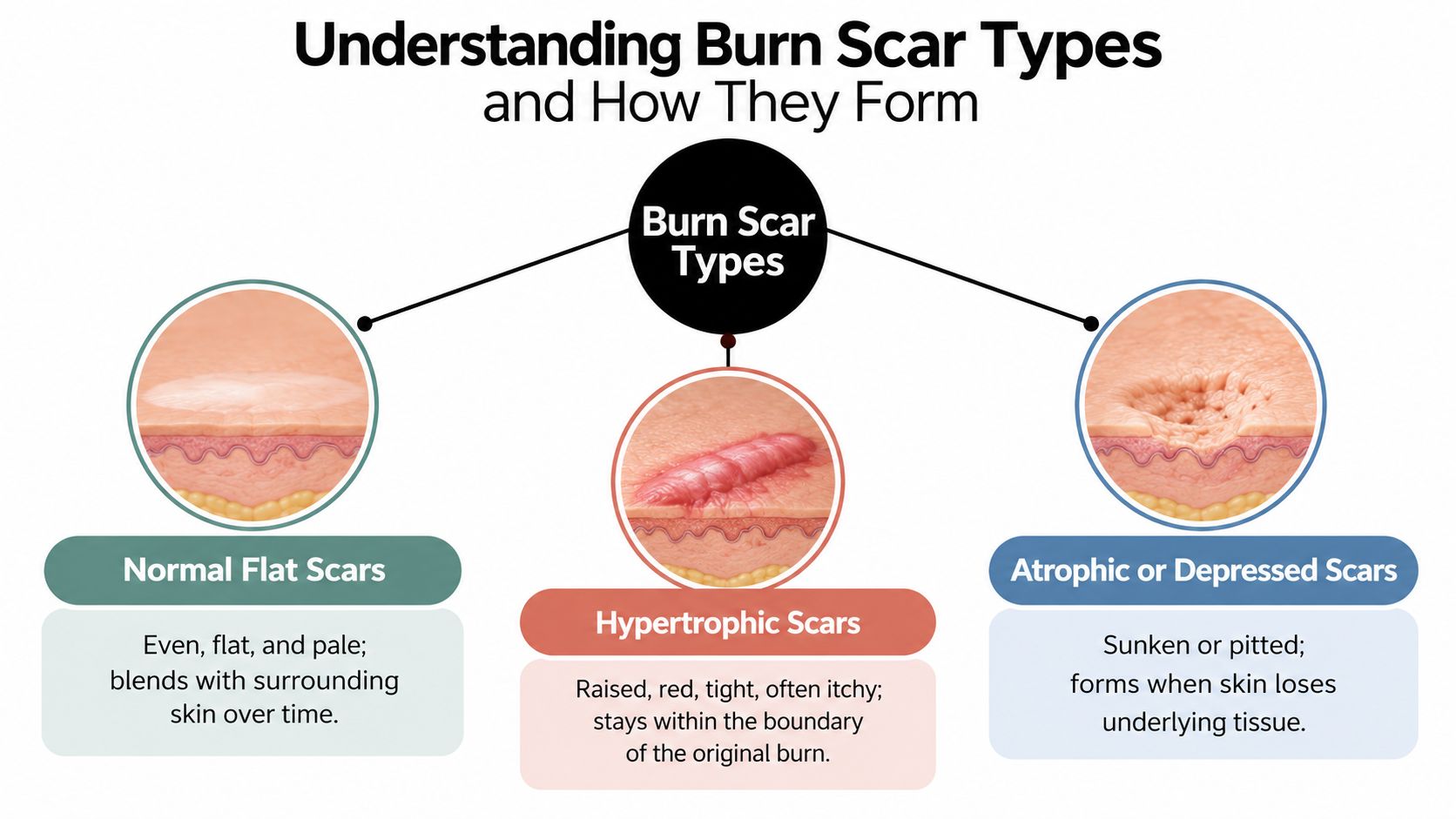
Burn scar types determine treatment, because a flat pale mark, a raised ridge and a tight band across a joint are not the same problem. Naming the pattern in plain English is the first step we take in consultation, before we discuss laser or microneedling.
The infographic below summarises three common patterns we map during assessment.
The Main Patterns We See
- Normal flat scars: Level with surrounding skin, paler over time, and usually a colour or texture concern rather than a functional one.
- Hypertrophic scars: Raised, red, firm and often itchy, staying within the original burn edge. North Bristol NHS Trust describes these as the scars most likely to need structured scar management when they're raised, firm or adherent.
- Atrophic scars: Sunken or pitted areas where tissue underneath has been lost. The approach here overlaps partly with texture work we discuss on our page about the best acne scar removal treatment options, although burn depth and graft history make burn scars a separate assessment.
- Contracture scars: Tight tissue that pulls across a joint or limits stretch. That's a specialist medical issue first, not a cosmetic laser case.
- Keloid scars: Thick growth that extends beyond the original wound edge. We are cautious here and will often turn people away from resurfacing, because stimulating this tissue can make matters worse.
Depth and healing time drive the pattern. Superficial burns that heal quickly often leave little lasting change. Deeper burns, infected wounds and burns needing grafts are far more likely to leave raised or tight tissue. How the original wound was managed matters too, which is why background reading on acute wound treatment at Vein and Wound helps explain why early wound care shapes later scarring, even though your UK follow up should sit with NHS services.
Age, skin tone, body site and tension across the area also influence how a scar behaves. A scar over the chest or shoulder often stays raised longer than one on the forearm. We map all of that, because burn scar treatment chosen without scar typing is guesswork.
The Burn Scar Timeline and When to Seek Help
Burn scar healing runs over months, not weeks, and NHS milestones at two weeks and up to two years tell you a lot about risk and timing. Burns affect approximately 120,000 people annually in the UK, according to the UK Health Research Authority summary cited earlier, so NHS burns services use clear triage rules rather than treating every mark the same way.
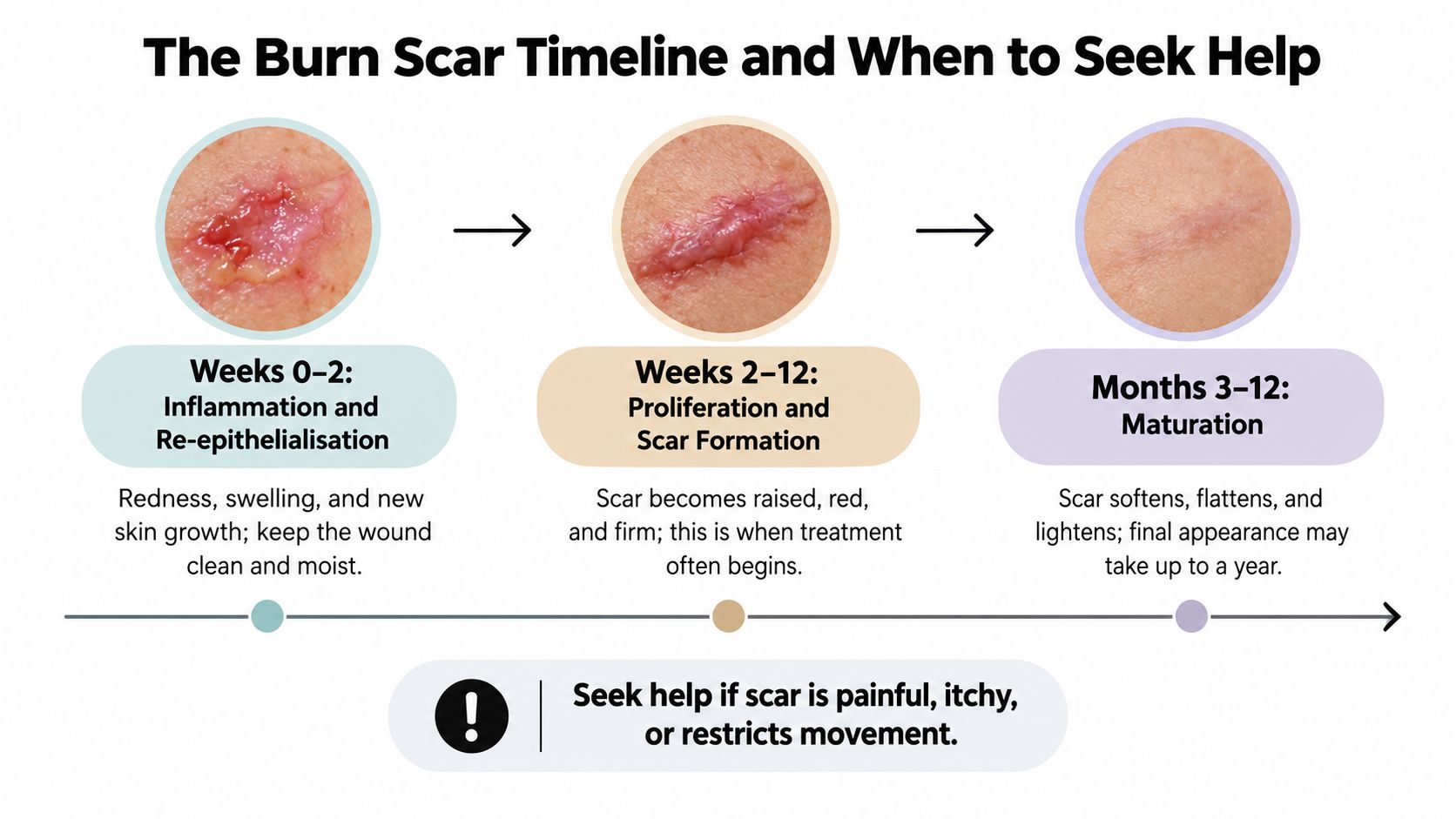
This timeline shows the phases we ask you to place yourself on.
Weeks 0 to 2 and Weeks 2 to 12
Weeks 0 to 2 cover inflammation and re-epithelialisation, meaning new surface skin forming over the wound. North Bristol NHS Trust guidance indicates superficial burns healing within two weeks are less likely to need specialist scar treatment.
Weeks 2 to 12 are active remodelling. If a burn hasn't healed by two weeks, needed a skin graft, or the scar becomes raised, red, firm, itchy, painful or swollen, NHS scar management input is appropriate. That's the point to ask your GP or burns team for referral, not to book private resurfacing.
The short video below gives useful visual context on healing stages before we move to longer term maturation.
Months 3 to 24
From three to twelve months, a scar may stay red, raised and itchy while collagen reorganises. NHS sources state scars can keep changing for up to two years, usually softening and flattening gradually. Earlier intervention isn't automatically better. Wound closure, location, symptoms and maturity decide timing.
Scale matters here. The PEGASUS feasibility trial reported by the University of Birmingham found NHS burns services treated 2,845 patients per year in the participating service context, with 1,476 children and 1,369 adults. Burn scar care is a long rehabilitation pathway for many people.
Practical rule: If movement is limited, pain persists, or the scar is still thickening, get an NHS specialist opinion first. Cosmetic texture work comes after that, if it comes at all.
Conservative and Medical Options Before Any Clinic Treatment
Conservative burn scar treatment comes first in UK care, and for many active scars it's the main treatment, not a warm up for laser. In NHS burn services, management after complete wound healing typically combines moisturising, scar massage, silicone therapy, pressure garments and stretching, with laser considered where indicated, as described by North Bristol NHS Trust aftercare guidance.
The checklist below sets out the options we expect the majority of people with significant scars to have discussed already.
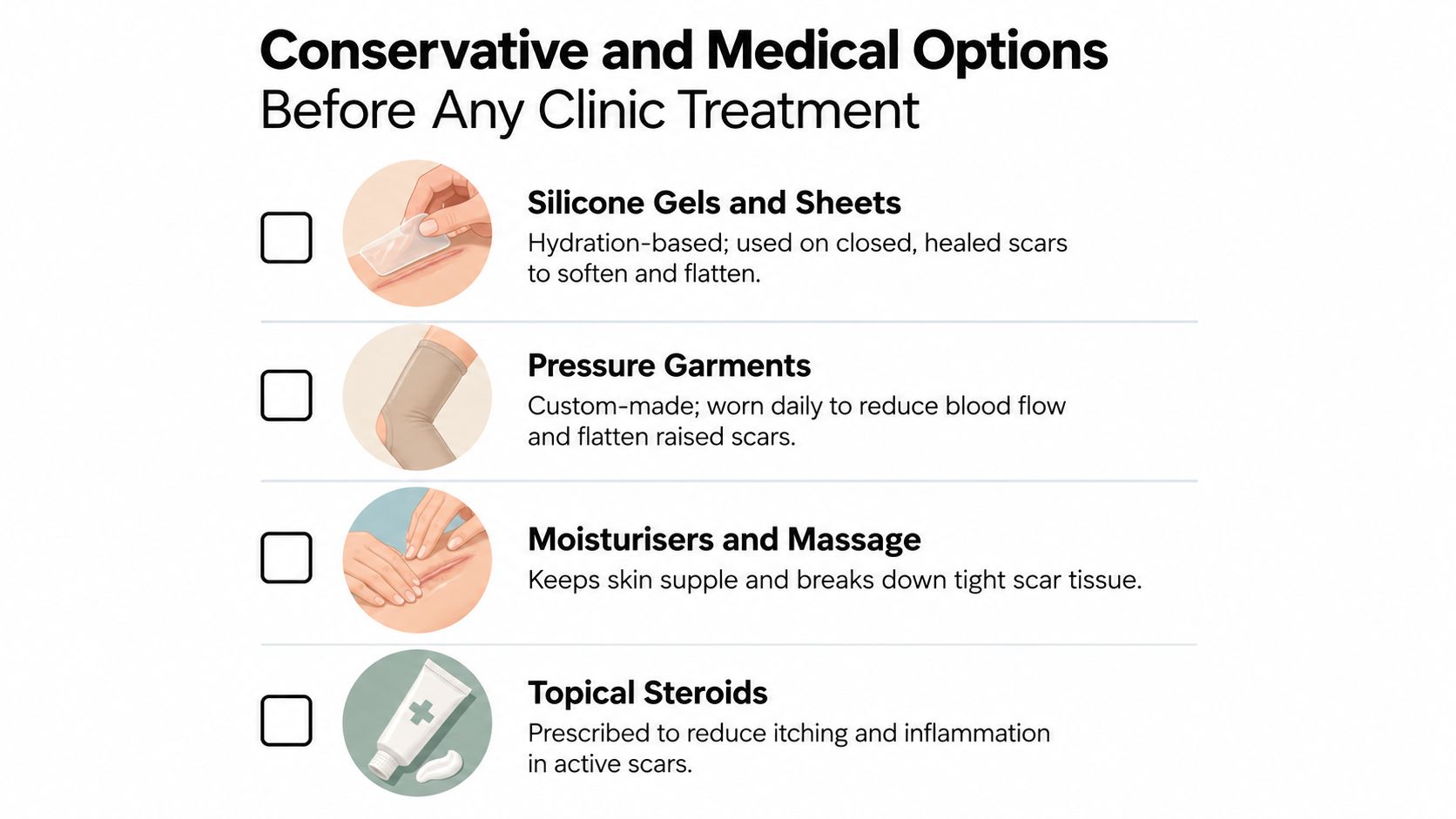
Silicone, Pressure and Massage
Silicone gels and sheets maintain hydration at the scar surface on closed skin and may reduce itch, according to North Bristol NHS Trust. They need consistent use and can irritate sensitive skin, so stop and seek advice if you develop a rash or breakdown.
Pressure garments are custom made to provide sustained compression. North Bristol NHS Trust advises garments may be required for up to two years and are generally worn for approximately 23 hours per day, removed only for washing, moisturising and garment changes. Poorly fitted pressure can cause discomfort, skin injury or circulation problems, which is why fitting belongs with specialist teams, not online ordering.
Moisturising and scar massage help keep healed tissue supple once your burns team says massage is safe. Don't massage open or fragile skin. General principles for soft tissue care overlap with advice to reduce scar tissue after surgery, but burn scars over joints or grafts need individual NHS instruction. Similar caution applies to other healed marks, which we cover when discussing a tattoo removal scar, where timing and skin integrity also come first.
Medical Options We Do Not Provide
Corticosteroid injections into raised scars and surgical revision are medical or surgeon led options within NHS or private medical care. We mention them so you recognise mainstream UK management, not because we offer them at our clinic. We will signpost you back to your GP or specialist if your scar pattern suggests you need that review.
Adherence is the hard part. Garments for most of the day, daily silicone and regular moisturising demand months of routine. If you can't sustain that, tell your burns team so the plan can be adjusted. Skipping the foundation and booking laser instead rarely gives the result people hope for, and results vary from person to person.
Clinic Treatments That Can Improve Burn Scars
Clinic burn scar treatment in our setting means fractional CO2 laser for thicker, textured scars or 3D Dermaforce RF microneedling for milder texture concerns, after specialist triage where needed. We offer laser skin resurfacing with 3D Vjuve at 3D Aesthetics Leamington Spa, and we assess burn scars individually before agreeing to use it.
This comparison separates what we offer from surgical routes that sit outside our clinic.
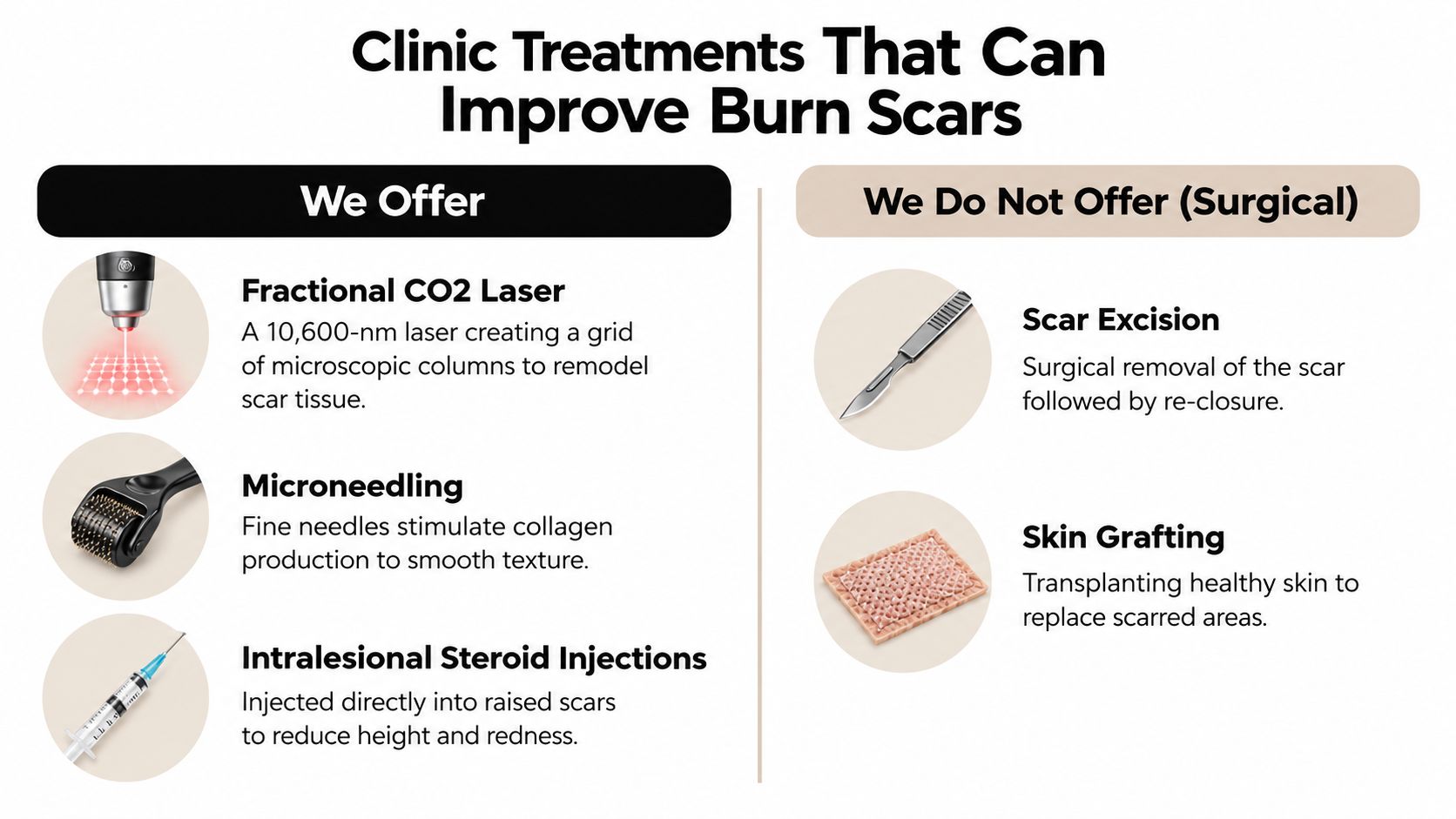
Fractional CO2 Laser Versus RF Microneedling
Fractional CO2 laser is a 10,600 nanometre laser (a wavelength absorbed by water in skin) that creates a grid of microscopic treatment points rather than treating the whole surface continuously. Birmingham Women's and Children's NHS Foundation Trust patient information describes fractional CO2 treatment as particularly useful for thick, lumpy, itchy and tight burn scars, with improvement generally described as mild to moderate. NHS guidance in that leaflet explains the controlled micro injury is intended to stimulate collagen remodelling, which may make a scar softer, flatter and more flexible.
3D Dermaforce RF microneedling delivers radiofrequency through fine needles. In our clinic we usually reserve it for settled scars where surface texture is the main issue and downtime needs to be shorter. It isn't a substitute for medical management of a thick, actively tightening scar.
| Concern | Typically considered first | Why |
|---|---|---|
| Thick, lumpy texture | Fractional CO2 laser | Deeper fractional resurfacing for collagen remodelling |
| Milder uneven texture | RF microneedling | More gradual texture work with shorter recovery |
| Movement restriction | NHS plastics review | Possible surgical or specialist pathway |
Laser choice in NHS services also depends on colour and blood vessels, and wider reading such as Athena Plastic Surgery laser scar advice underlines why scar features, not marketing claims, should drive selection. For detail on our device approach, see our page on CO2 laser scar removal, keeping in mind removal means improvement in appearance, not erasure.
Surgical scar revision or grafting for contracture sits with NHS burns and plastic surgery teams. If that's your situation, we won't dress it up as a laser case. Results vary from person to person, and darker skin tones need particularly careful assessment for pigment change risk after resurfacing.
What a Course of Treatment Looks Like in Our Clinic
Burn scar treatment with us starts with a free consultation and scar mapping, and we will turn you away if the scar isn't suitable for clinic resurfacing. That's not a sales tactic. It's how we protect people with active or functional scars from the wrong treatment at the wrong time.
We record scar type, maturity, colour, thickness, location and symptoms, plus burn history and previous NHS care. Our free AI Skin Scanner supports that assessment, but it doesn't replace hands on examination of pliability and stretch, especially across joints.
Who We Will Not Treat
- Open or unhealed skin: No resurfacing until fully closed and medically settled.
- Suspected contracture: Tight bands limiting movement need NHS burns or plastics review first.
- Rapidly changing raised scars: Active thickening, persistent pain or repeated breakdown need specialist input.
- Keloid prone patterns: We may decline laser where stimulation risk outweighs likely benefit.
How Many Sessions Does Fractional CO2 Laser Take
Fractional CO2 laser for a burn scar typically takes three to six sessions spaced approximately six to twelve weeks apart, according to a UK NHS patient information leaflet from Queen Victoria Hospital. We apply topical anaesthetic in advance, treat in a fractional grid, then review healing and texture change before the next session. Patients in our clinic generally see gradual softening and flattening across a course rather than a dramatic change after one visit. Expect several days of redness, dryness and flaking, strict sun protection, and no picking at the treated area. We space sessions to let collagen remodel and to check pigment response, particularly on deeper skin tones. If progress stalls or symptoms suggest medical review, we pause and refer you back rather than continuing. Results vary from person to person.
RF microneedling usually involves a shorter recovery, with redness settling faster across the board. If you're weighing session numbers, our guide on how many microneedling sessions explains why we plan courses rather than single appointments.
We describe the typical case in consultation, including downtime, aftercare and cost per course. We never promise a specific outcome, and we photograph with consent so change is judged over months, not under clinic lighting on day one.
A Realistic Example of How a Burn Scar Is Assessed
Burn scar assessment follows the same logic whether you visit us from Leamington Spa, Warwick or Kenilworth, and a typical forearm scald shows why we sometimes delay laser. This is a representative example, not a named client, and it mirrors cases we discuss across Warwickshire each month.
Take a healed scald that took three weeks to close. At one year, there's a raised, red, slightly tight patch on the forearm that's still itchy in warm weather. It doesn't stop wrist movement, but the texture catches on sleeves and the colour hasn't faded as expected.
How We Work Through That Scar
First, we classify it. Healing beyond two weeks, raised tissue within the burn edge and ongoing itch point to a maturing hypertrophic scar. The AI Skin Scanner helps document colour and texture, while manual assessment checks thickness and pliability.
Second, we check the foundation. Is silicone being used consistently on closed skin? Is moisturising and sun protection in place? Has an NHS burns or GP review happened since healing slowed? If those basics are missing, we address them before resurfacing.
Third, we map options:
- Continue conservative care: Often still appropriate while the scar is changing within the two year maturation window described by North Bristol NHS Trust in its skin graft and donor site guidance.
- Plan fractional CO2 laser later: Usually our next clinic step for thick, lumpy texture once the scar is settled enough.
- Consider RF microneedling: A milder alternative if texture is modest and downtime must stay short.
- Refer back to NHS: Needed if tightness progresses, pain persists, or medical injection or surgical opinion is the right route.
A good plan often sounds boring at first, moisturise, protect, review, then resurface only when the tissue is ready. Boring plans protect skin.
Every scar differs in depth, site and pigment risk. The only way to turn this framework into your plan is an in person assessment where we can feel the tissue, test movement and say plainly if we should not treat.
Costs, FAQs for Burn Scar Treatment
Burn scar treatment costs depend on scar size, body area, device choice and number of sessions, so we confirm exact pricing at consultation rather than quoting a generic figure online. You can review current resurfacing fees on our page for CO2 laser resurfacing pricing, then we'll map a course cost to your scar specifically.
NHS or Private, Which Route Fits
Choose NHS first if you have restricted movement, contracture, persistent pain, repeated skin breakdown, a scar still thickening, or a burn that needed grafting and hasn't had scar follow up. Go through your GP to NHS burns, dermatology or plastic surgery services.
Consider private clinic treatment if your scar is mature, closed and medically settled, and your main goals are texture, softness and appearance. That's the boundary we work to, and we'll redirect you if your presentation crosses it.
Quick Questions We Hear Weekly
Can a burn scar be removed? Typically no. Fractional CO2 laser and RF microneedling can soften, flatten and blend a settled scar, but they don't erase it. Results vary from person to person.
How long until I see change? Change is typically judged across a course over several months, because collagen remodelling is gradual and sessions are spaced weeks apart.
Is there downtime? Fractional CO2 laser usually means several days of redness and flaking. RF microneedling typically settles faster, although aftercare and sun protection still matter.
Can darker skin tones be treated? Sometimes, with caution. Resurfacing carries pigment change risk, so we assess skin tone, tanning, previous pigment response and scar history, and we may decline or modify treatment where risk is too high.
What increases cost? Larger areas, thicker scars needing more sessions, and combined plans over a longer course. Smaller, settled texture concerns usually cost less than extensive resurfacing programmes.
Bring a list of previous treatments, allergies and medicines to consultation, even though we don't provide prescription care. That history helps us decide whether to treat, delay, or refer you back for medical review before any burn scar treatment begins.
If you have a settled burn scar and want an honest assessment of fractional CO2 laser or RF microneedling, book a free consultation with us in Leamington Spa and we'll map your scar, explain what we would and would not treat, and refer you back to NHS services if that's the safer route. Visit 3D Aesthetics Leamington Spa to arrange your appointment or call us on 01926 315764.
← Back to Home