

The popular advice is backwards. Patients are often told to pick a laser, book a session, and wait for clear skin. We don't work that way, because most dark spots need a diagnosis and a sun protection plan before they need a device. Treat the wrong type of pigment, or treat it while the trigger is still active, and you can make the mark darker. Dark spots removal in our clinic is a months long maintenance programme, not a single appointment, and results vary from person to person.
Table of Contents
- What Are the Main Types of Dark Spots?
- Who Should Not Have Dark Spot Removal?
- Does Dark Spot Removal Work on Darker Skin?
- Which Dark Spot Treatment Fits Your Spot, and How Does It Work?
- How Long Does Dark Spot Removal Take?
- How Do You Stop Dark Spots Coming Back?
- How Much Does Dark Spot Removal Cost?
- What Happens at a Dark Spot Consultation, and How Do I Book?
What Are the Main Types of Dark Spots?
The same brown mark can come from different causes, and the distinction matters because treatment that suits one type may irritate or worsen another. Most dark spots are areas where the skin has made extra melanin (the pigment that colours skin). The main patterns are sun spots, post-inflammatory hyperpigmentation and melasma.
| Dark spot type | Usual cause | How it typically looks | See a GP first if |
|---|---|---|---|
| Sun spots (solar lentigines) | Cumulative UV exposure | Flat, brown, well-defined; face, hands and arms | Shape, colour or size changes, bleeding or itching |
| Post-inflammatory hyperpigmentation (PIH) | Healing after acne, eczema, cuts or burns | Darker mark where the earlier spot or wound was | It spreads or appears with no known trigger |
| Melasma | Hormonal influence, UV and visible light | Symmetrical brown or greyish patches on cheeks, forehead and upper lip | Patches are one-sided or asymmetric, or any new irregular mark appears |
How the three types differ in practice
Sun spots develop gradually on areas exposed to daylight over time. They are usually flat with a clear edge, and are often called age spots. PIH follows inflammation: acne, a scratch or another skin injury heals, but a darker mark remains in that area. Melasma usually forms broader, symmetrical patches. Light exposure can deepen the colour, so treatment choices need to account for ongoing exposure and maintenance. For a closer comparison, see melasma compared with sun spots.
When a mark needs medical assessment first
A cosmetic treatment is not a substitute for medical assessment when a mark changes or looks unusual. The NHS Hertfordshire and West Essex prescribing guidance describes hyperpigmentation as flat, darkened patches that can vary in size and colour. It says adults over 18 may be considered for secondary care referral if pigmentation is symptomatic, such as burning, itching or soreness, or if it is progressive, atypical or asymmetrically distributed. The British Association of Dermatologists melasma leaflet describes melasma as brown or greyish patches, most often on the face. Affected skin can darken more than surrounding skin when exposed to light.
Start this week: photograph each spot once a month in the same light, noting the date and position. Consistent images can help you describe changes at a consultation.
Who Should Not Have Dark Spot Removal?
Dark spot removal isn't suitable for everyone, and we turn people away when treatment is the wrong choice at that point. That isn't a rejection. It's how we avoid darkening pigment, irritating inflamed skin, or treating a mark that needs a GP first.
Who we would not treat yet
- A new or changing mark: anyone with a mark that's new, changing in size or colour, bleeding, itching or asymmetric should see a GP first, following NHS guidance.
- Pregnancy or breastfeeding: anyone who is pregnant or breastfeeding should check with their GP first, as the NHS advises checking treatment suitability in that situation.
- Recent tan or sunbed use: anyone with a recent sun tan, sunbed use or intense sun exposure, because the British Association of Dermatologists notes treated skin can darken more easily after sun exposure.
- Active skin problems in the area: anyone with active acne, eczema, cold sores or open wounds where treatment would be applied.
- Raised scarring history: anyone with a history of keloid or raised scarring.
- Recent medicines: anyone who has recently finished a course of prescription acne or skin medicines, or who takes photosensitising medicines (medicines that make skin more sensitive to light), which we check at consultation.
- Single session expectations: anyone expecting one session to clear every mark.
What we do instead is straightforward. We refer you to a GP or dermatologist where the mark needs medical review, or we agree a waiting period and rebook once the mark or skin has settled. We'd rather delay treatment in Leamington Spa than proceed on skin that isn't ready, because treating inflamed or tanned skin is one of the fastest ways to create new pigment.
Does Dark Spot Removal Work on Darker Skin?
Dark spot removal depends on skin tone, so we assess each client individually rather than applying one protocol to everyone. There's no single setting we use for every face. Skin tone, pigment type and recent sun exposure all change which option we'd consider, and whether we'd treat at all that day.
Post-inflammatory hyperpigmentation (PIH) is central here, because it's both a reason people seek treatment and a possible response to treatment itself. If laser energy inflames the skin, pigment cells can react by making more colour. That's the trade-off we're weighing at consultation, and it's why a gradual option or a waiting period is sometimes the right first step.
The University of Nottingham Skin of Colour laser therapy resource identifies a published systematic review of laser treatments for post-inflammatory hyperpigmentation by Agbai, Hamzavi and Jagdeo in JAMA Dermatology, and lists evidence reviews on non-ablative fractional laser resurfacing in skin of colour. The Nottingham resource doesn't present laser as a universal solution or one protocol for every person. The JAMA review is US published research, and we cite it here as evidence rather than as UK guidance.
In our clinic we check the nature of the pigment, your skin tone and your recent sun exposure before choosing laser settings. We may use a small test area, choose conservative settings, or say plainly that we wouldn't treat yet. Our page on laser treatment for hyperpigmentation explains how that assessment shapes the plan. Results vary from person to person.
Inflammation after treatment can change skin colour, so slower is often safer than stronger.
Which Dark Spot Treatment Fits Your Spot, and How Does It Work?
Most dark spots need a diagnosis and a sun-protection plan before they need a laser. Treatment choice depends on the mark's cause, depth, texture and your skin tone. A course is usually a months-long maintenance programme, not a single session. The table compares the options covered here, including their limits and likely downtime.
| Option | Best suited for | Not suitable for | Downtime | Sessions |
|---|---|---|---|---|
| OTC topicals | Mild, recent marks and stable sun spots | Marks that are changing or bleeding, or anyone expecting fast change | None | Daily use over months |
| RF microneedling (3D Dermaforce) | Textured marks and mild pigmentation | Active acne, cold sores or open wounds in the treatment area | A few days of redness | Course set at consultation |
| Fractional CO2 laser | Pigment linked to acne scarring and deeper texture | Recent tan, active acne, or a history of keloid or raised scarring | Typically several days to a week | Small number, set at consultation |
| Nanosure pigmentation removal | Defined sun spots and pigmented marks, assessed against skin tone | Recent tan, or skin tone not yet individually assessed | Typically minimal, with some flaking | Several sessions, set at consultation |
How each option works
OTC topicals turn down excess pigment gradually. Serums with vitamin C, niacinamide or alpha arbutin can help slow melanin production, but they require daily use over months and may not shift deeper pigment on their own. A Japanese skincare guide for clearer skin outlines gentle daily ingredients that may sit alongside a clinic plan. Topicals are a practical starting point for mild marks, but consistency and sun protection matter.
RF microneedling with 3D Dermaforce uses fine needles to create microchannels, while radiofrequency (RF, energy delivered as heat through the skin) prompts repair. That combination makes it more suited to marks with texture than to isolated surface pigment. Redness can last a few days, and active acne, cold sores or open wounds in the treatment area are reasons to wait. This comparison of microneedling and chemical peel approaches explains how the methods differ.
Fractional CO2 laser treats tiny columns of skin, leaving untreated areas between them to support healing. It may suit pigment associated with acne scarring and deeper texture, but the downtime is typically several days to a week. The NHS Scotland evidence summary on laser surgery for acne scarring reports that fractional CO2 lasers are more effective for pigmentation associated with acne scarring than some other laser approaches. That finding concerns acne-scar-related pigment, not every dark spot.
Nanosure pigmentation removal targets defined pigment rather than resurfacing the whole area. It may suit distinct sun spots or pigmented marks, but the response depends on skin tone, so assessment comes first. Some flaking is possible. Melasma needs a different expectation: the British Association of Dermatologists describes it as a long-term management issue, so treatment should be planned around maintenance rather than a one-off fix.
Before choosing a treatment, consider how long the mark has been present and whether it followed inflammation. Your skin tone, recent tan history and regular sun exposure also affect the decision. Changing or bleeding marks need assessment rather than cosmetic treatment. If the diagnosis or timing is uncertain, delay treatment until those points are clear.
How Long Does Dark Spot Removal Take?
Dark spot removal plans typically run for months rather than weeks, and maintenance usually continues after the course ends. The timescales below are clinic observations, not clinical trial figures. We don't promise a timeline in advance, because pigment depth, skin tone and sun exposure change the picture.
| Option | First visible change | Typical course | Maintenance |
|---|---|---|---|
| OTC topicals | In our clinic we usually see early change within the first few weeks; full change typically takes around 8 to 12 weeks | Daily use over several months | Ongoing daily use |
| Carbon laser peel | Often after the first session | Series set at consultation | As advised after the course |
| RF microneedling (3D Dermaforce) | Set at consultation | Course spaced several weeks apart | Periodic top-up as advised |
| Fractional CO2 laser | Typically after recovery, around 4 to 8 weeks | Small number of sessions, set at consultation | Strict sun protection |
| Nanosure pigmentation removal | Set at consultation | Several sessions spaced weeks apart | Sun protection and periodic review |
In our clinic we usually see early change in the first few weeks with a consistent home routine, but the full picture typically takes several months, and some marks fade only partly despite a well planned course. The British Association of Dermatologists describes melasma as long-term management rather than a one-off fix, which matches how we plan: treat, review, then maintain. Continued sun exposure is the commonest reason progress stalls, picking at spots restarts the inflammation that caused PIH, and stacking strong products on irritated skin can darken the very mark you're trying to fade. That's why we photograph at the same angle and in the same light at each review, compare like with like, and adjust the plan if change is slower than expected instead of increasing intensity. Results vary from person to person.
What slows results most
- Unprotected daylight: even short exposure can restimulate pigment between sessions.
- Picking and squeezing: fresh inflammation creates fresh PIH.
- Over-treatment: layering actives on stinging skin usually sets you back.
How Do You Stop Dark Spots Coming Back?
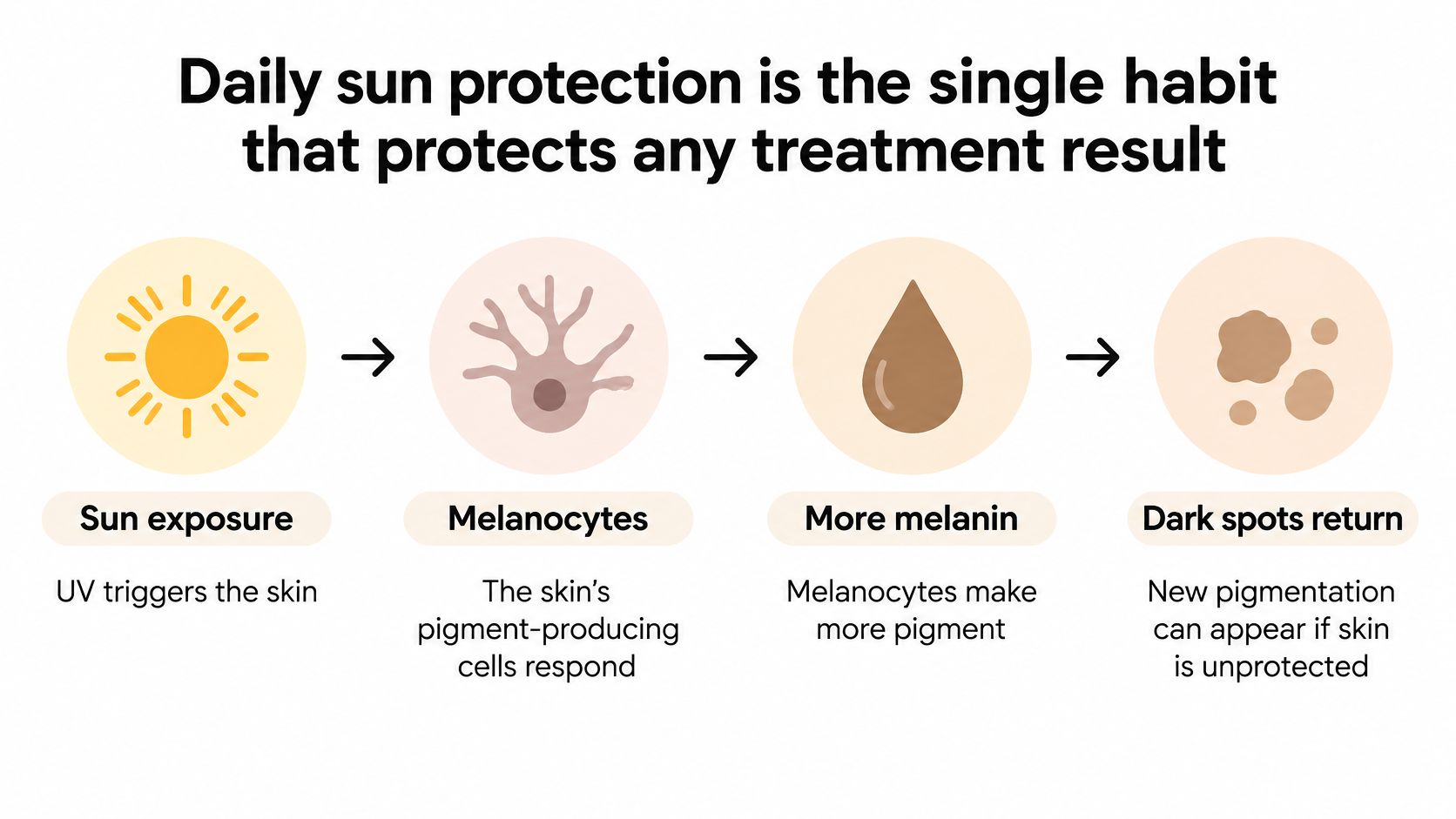
Daily sun protection is the single habit that protects any dark spot removal result. After sun exposure, melanocytes (the skin's pigment producing cells) make more melanin to absorb UV, and previously pigmented areas respond fastest. The diagram below shows that cycle.
The Frimley Health NHS Foundation Trust sunscreen fact sheet recommends a high protection sunscreen of at least SPF 30 with high UVA protection, put on 15 to 30 minutes before going outdoors, reapplied at least every two hours, and reapplied immediately after swimming, perspiring, towel drying or when it has rubbed off. For longer days outdoors, guidance on applying SPF 50 for outdoor activities from maxijournal.com covers reapplication in practical detail. Our own notes on why a skincare routine matters explain how this fits the rest of your morning steps.
Your maintenance routine
- Apply sunscreen every morning: use broad spectrum SPF 30 or above with high UVA protection, including on cloudy UK days.
- Time it properly: put it on 15 to 30 minutes before going outside, reapply at least every two hours outdoors, and reapply after swimming or towel drying.
- Use shade and a hat: seek shade at midday, wear a wide brimmed hat, and avoid sunbeds completely.
- Cover visible light for melasma: consider a formula containing iron oxides, which the British Association of Dermatologists advises may add protection against visible light.
- Treat the trigger: manage acne promptly, reduce friction from tight straps or collars, and avoid over-exfoliating.
- Use topicals as advised: stop any product that stings and tell us at review rather than pushing through.
- Keep monthly photos: same light, same angle, date noted.
- Book each review: we compare photos and adjust before small setbacks become relapse.
The short video below walks through daily protection habits in practice.
How Much Does Dark Spot Removal Cost?
There is no single price for dark spot removal. The cost depends on the diagnosis and the plan, so our current prices are listed on our prices page, and the suitable option is confirmed at consultation.
Three factors shape the total: the treatment chosen, the number of sessions, and whether daily topicals are used alongside in-clinic care. A surface treatment generally costs less than fractional CO2 laser, which also involves recovery time. If the plan includes months of maintenance, topical products add to the ongoing cost.
Many people choose to pay privately for in-clinic options. Daily sunscreen and topicals at home may be the lower-cost route, but sunscreen belongs in the budget from the start, not as an optional extra. Treatment is a maintenance programme, not a one-off purchase: the session count and likely costs should be clear before booking. Outcomes vary, so the cost of a plan cannot guarantee a particular result.
What Happens at a Dark Spot Consultation, and How Do I Book?
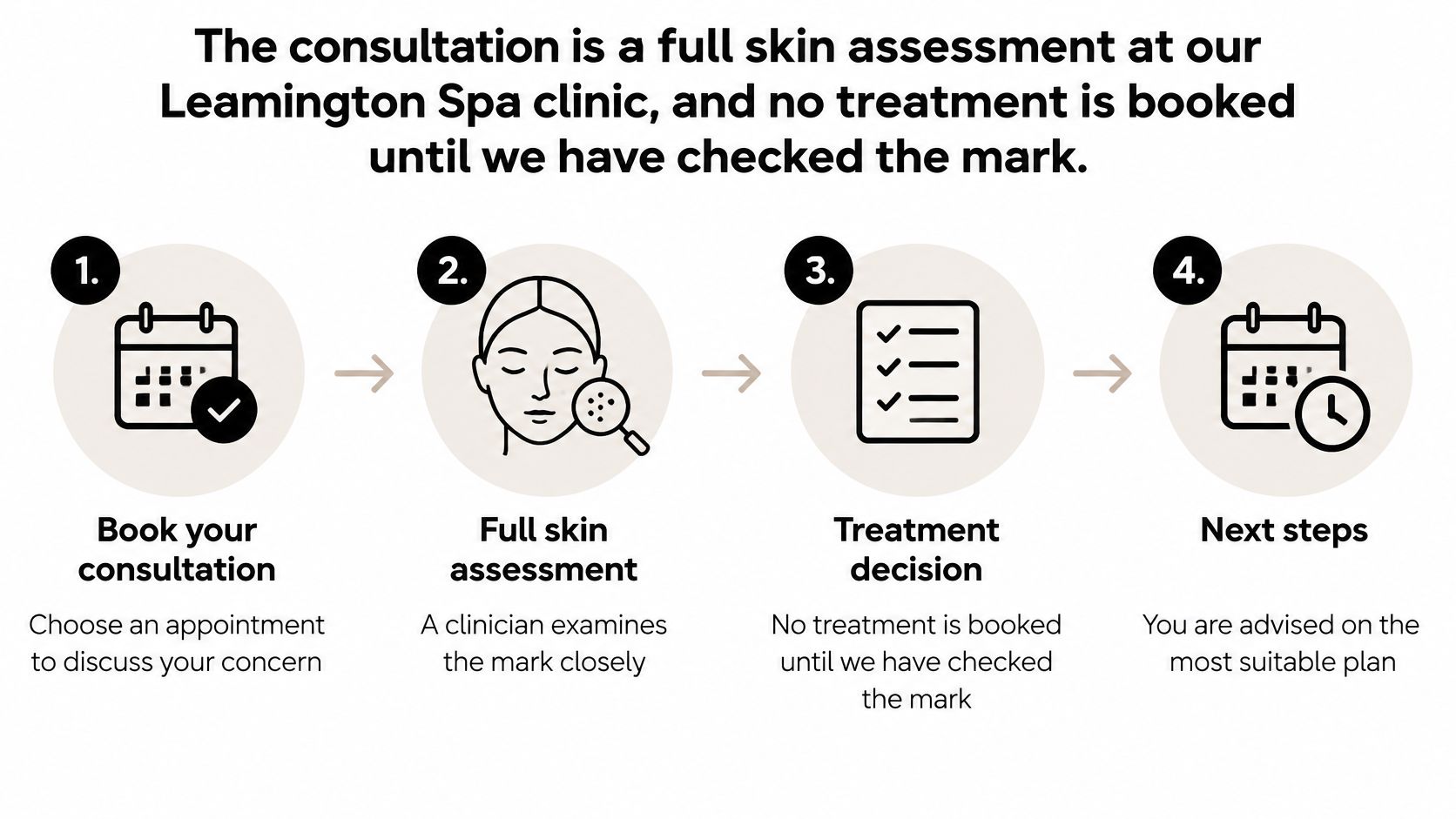
A dark spot consultation should establish what the mark is before anyone chooses a treatment. At our Leamington Spa clinic, the assessment may lead to a treatment plan, advice to start with topicals, a GP referral, or a recommendation to wait. Dark spot removal is often a months-long programme, not a single session, and protecting skin from the sun is part of the plan.
The image below shows the stages we consider before treatment is booked.
The consultation step by step
- Medical history and medicines: we record your medical history and current medicines, including anything that may make your skin more sensitive to light.
- Examination of the mark: we ask whether it is new, changing or asymmetric. If it needs medical assessment, we refer you to a GP rather than treating it.
- Skin tone and sun exposure: we assess your skin tone, recent tan and usual daylight exposure. These factors affect which device and settings may be suitable.
- Photographs: we take photographs at the same angle and in the same light we will use at later reviews, so changes can be compared consistently.
- Test patch: when appropriate, we treat a small area first and assess the response before considering a full session.
- Personalised plan: we explain the treatment option, likely session count, timing and home routine. 3D Nanosure pigmentation removal may be suitable for some marks and skin tones.
- Realistic expectations: we discuss likely timescales and downtime, and explain when treatment is not appropriate.
The consultation also gives us a chance to discuss the risks of treating pigmentation, particularly on darker skin tones, where inflammation after treatment may affect skin colour. A photograph sent ahead cannot replace examining the mark and considering your skin in person. You can book a complimentary consultation online, with no obligation to proceed.
What to bring
- Your medicines list: include prescriptions and anything bought over the counter.
- Your skincare products: bring the names or photographs of product labels so we can check what you use.
- Your monthly photos: bring dated pictures from the last month if you have them.
- A short history: note when the spot appeared and whether it followed an injury, acne or sunburn.
Practical rule: If you are unsure when a mark appeared or whether it has changed, start photographing it this week. That gives you a baseline to discuss at your consultation.
Bring the spot you can photograph clearly. At 3D Aesthetics Leamington Spa, clients receive a complimentary, in-depth consultation that includes a full 3D body scan. For pigmentation, the mark itself still needs assessment before a treatment is chosen. Results vary from person to person.
Book a complimentary consultation through the 3D Aesthetics Leamington Spa website, and bring your dated photos and product list. We will assess the mark, your skin tone and sun exposure before discussing Nanosure pigmentation removal, fractional CO2 laser, carbon laser peel or a topical-first plan. The right outcome may be a clear treatment plan, or a clear reason to wait.
← Back to Home