
Microneedling can give a modest tightening look over a course of sessions, but it doesn't lift the face the way a surgical facelift does, and results vary from person to person. Are you hoping for better-quality skin, or expecting loose cheeks and jowls to move upwards?
That distinction matters more than the treatment name. At our clinic in Leamington Spa, we want you to understand what you're booking, what improvement would count as worthwhile, and when we should say no.
Table of Contents
- Can Microneedling Lift the Face? The Short Answer
- How does microneedling make skin look firmer?
- How Long Results Take and How Many Sessions You Need
- What does the clinical evidence show about microneedling and lifting?
- Who should not have microneedling, and what are the risks?
- How does microneedling compare with RF, HIFU and EMlift?
- How do I book a consultation to find out which treatment fits?
Can Microneedling Lift the Face? The Short Answer
Microneedling may improve the appearance of mild skin laxity, meaning looseness, but it doesn't provide the anatomical lift of a surgical facelift; results vary from person to person. The British College of Aesthetic Medicine describes its treatment targets as skin concerns such as wrinkles and scarring, rather than surgical-style repositioning.
Firming and lifting aren't interchangeable. A surface can look smoother and more supported without changing the position of the tissues underneath it. That's why a photograph showing refreshed skin doesn't necessarily demonstrate that a cheek or jawline has lifted.
What changes, and what doesn't?
Microneedling compared with a surgical facelift
| Question | Microneedling | Surgical facelift |
|---|---|---|
| Improves skin firmness and texture | Yes, gradually over a course of sessions | Yes, but not the main aim |
| Removes excess loose skin | No | Yes |
| Repositions deeper facial tissue | No | Yes |
| Restores lost facial volume | No | No, usually addressed by other methods |
| Time to notice a change | Weeks to months | Weeks, with a longer recovery set by the surgeon |
These are broad distinctions, not individual predictions. Results vary from person to person, and a surgeon would need to explain the scope and recovery of any surgical procedure.
For someone whose main concern is fine lines, uneven texture, acne scarring or slight looseness, a skin-quality treatment may match the goal. For someone expecting substantial excess skin to disappear, it doesn't.
What should you ask before booking?
Ask yourself what you want to see in a photograph: a smoother surface, or a different facial outline? Bring that answer to your consultation rather than choosing a treatment from its name alone.
For a general introduction to the terminology, the guide to rejuvenating skin with microneedling offers additional background. General guides shouldn't replace an assessment of your skin or a discussion of limitations.
Our position is straightforward: we discuss gradual firming, not a dramatic elevation of the face. Results vary from person to person.
The verdict: Microneedling is a skin-quality treatment that may create a modest tightening appearance, not a replacement for a surgical facelift; results vary from person to person.
How does microneedling make skin look firmer?
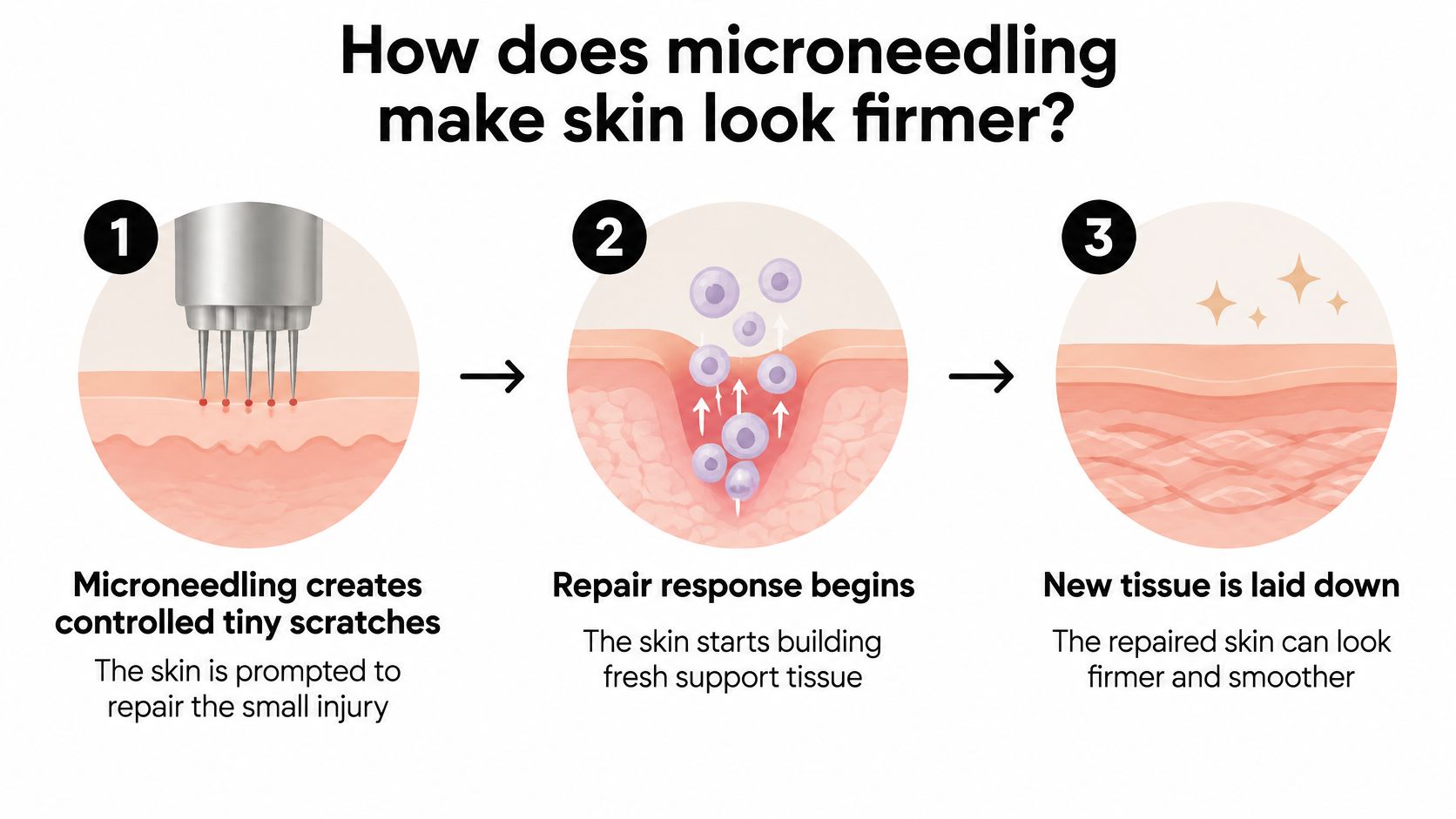
Microneedling makes controlled tiny injuries that prompt skin repair, rather than physically pulling the face upwards. The UK government's consultation on licensing non-surgical cosmetic procedures describes fine needles creating small skin injuries to activate wound healing and collagen production in surrounding tissue.
The sequence below separates the initial injury from the slower repair process.
What happens during skin repair?
The British College of Aesthetic Medicine's microneedling information explains the treatment's collagen-led purpose and notes that needle depth is selected according to the anatomical area and the concern being treated. Its account supports a repair process, not a mechanical lift.
- Controlled injury: A fine-needle device creates small punctures across the selected area. Devices may use a manual roller or an electronic system, as the government consultation describes.
- Repair signals: Growth factors, which are chemical messages involved in healing, activate fibroblasts. These are cells that make structural material within the skin.
- Structural remodelling: The skin gradually reorganises collagen, a support protein, and elastin, a protein involved in stretch and recoil.
In the biological account described by the British College of Aesthetic Medicine, these signals include platelet-derived growth factor and transforming growth factor. Type I collagen is one of the structural components involved.
Say your main concern is a slightly crepey cheek surface. The proposed benefit comes from changing the quality of that skin, not moving the cheek into a new position. Any visible improvement needs time to develop, and results vary from person to person.
Why do depth and photographs matter?
The British College of Aesthetic Medicine's area-specific approach means that deeper isn't automatically better. The practitioner needs to match the protocol to the location, skin condition and treatment goal.
Its clinical explanation also cautions that early swelling can exaggerate apparent tightness. We therefore recommend comparing photographs taken in the same light, at the same angle and with a relaxed expression.
Practical rule: Judge the settled appearance, not the freshly treated face. Results vary from person to person.
Radiofrequency, or RF, adds an energy component to needling. Our explanation of what RF microneedling involves distinguishes the terminology, while the RF microneedling guide from Chernoff Cosmetic Surgery offers supplementary background rather than UK safety guidance.
For a visual explanation alongside the repair sequence, the following video provides another reference.
How Long Results Take and How Many Sessions You Need
Microneedling needs a course-led assessment rather than a next-day judgement, and there isn't a single session count that fits every face; results vary from person to person. A clinical review of facial rejuvenation treatments describes a small study of 10 people receiving six treatments at 14-day intervals, with increased collagen types I, III and VII and tropoelastin, a precursor of elastin.
That's evidence of biological change, not a standard package for everyone. Six sessions is a study reference point, not a promise or an automatic recommendation.
What should you expect at each stage?
Microneedling timeline from session to course end
| When | What typically happens | Source or note |
|---|---|---|
| Immediately after a session | Warmth, sunburn-like redness and possible pinpoint bleeding during treatment | Chelsea and Westminster Hospital NHS patient information |
| Days 1 to 3 | Redness may ease while tightness, soreness or peeling remain | NHS recovery guidance, detailed under risks below |
| Weeks 2 to 4 | An early review can check recovery and look for texture changes | A review window, not an assured onset of improvement |
| Weeks 4 to 12 | Photographs can help assess changes across a course | A planning window, not a measured lifting timetable |
| Months 3 to 6 | A later assessment can consider the settled appearance and maintenance | An assessment window, not a promised completion date |
The later windows are useful ways to organise follow-up, not precise milestones established by the small study. We won't tell you that every face reaches the same stage on the same week.
The clinical review describes ongoing collagen remodelling after treatment. Improvement may therefore continue after the final appointment, but results vary from person to person.
How do we decide the session count?
The concern, treatment area, skin condition and response should inform the plan. A study using conventional microneedling also doesn't automatically establish the correct schedule for an RF device.
Our guide to how many microneedling sessions to consider can help you prepare questions. At consultation, ask for the proposed interval, the review point and the reason for continuing or stopping.
Use a simple comparison checklist:
- Before starting: Take baseline photographs without filters.
- At reviews: Keep lighting, camera distance and facial expression consistent.
- At course end: Compare the agreed concern, not unrelated changes in appearance.
The sources discussed here don't establish a firm duration for how long an individual improvement lasts. Maintenance should be discussed at review, and results vary from person to person.
What does the clinical evidence show about microneedling and lifting?
Microneedling evidence supports collagen remodelling and skin-quality improvement more clearly than a measurable standalone facial lift, according to the facial-rejuvenation clinical review discussed above; results vary from person to person. The important question isn't whether someone liked their treatment, but what the researchers measured.
A clinic article from LMA Clinic summarises a 2025 review of 21 facial-rejuvenation studies involving 723 patients, reporting approximately 83% patient satisfaction alongside substantial variation in protocols and outcome measures. That is a secondary account, not the original review, so it shouldn't be treated as a precise prediction for your face.
Why isn't satisfaction a measure of lift?
Someone may be pleased because their skin looks smoother or their fine lines appear softer. Neither response tells us how far, if at all, a cheek or jawline moved.
The clinical review also highlights a practical difficulty: some studies combine microneedling with other procedures. When treatments are combined, researchers can't easily separate the contribution of needling alone.
Other differences make comparisons harder:
- Treatment protocols: Needle depth, session schedules and technique aren't uniform.
- Assessment methods: Photographs, grading scales and personal satisfaction measure different things.
- Study size: Small groups can identify a possible effect without reliably predicting an individual outcome.
A positive treatment experience isn't the same as evidence that deeper facial tissues have lifted.
What does UK safety history add?
The Health Education England review of non-surgical cosmetic interventions reported that microneedling wasn't addressed in the Keogh Review and could be delivered by anyone at the time of its assessment. It listed bacterial, fungal and viral infection, adverse reactions and worsening of existing skin conditions among the risks.
That is historical context, not a statement of today's law. It explains why a treatment name alone tells you little about practitioner competence, informed consent or infection control.
For current patient information, the NHS, British Association of Dermatologists, Primary Care Dermatology Society and NICE are appropriate UK organisations to consult. Naming an organisation doesn't mean it endorses a particular device or supports a facelift-level claim.
A fair consultation should define what success means before treatment: consistent photographs, a clear description of texture or laxity, and your own assessment of change. We shouldn't substitute a general satisfaction figure for that individual discussion. Results vary from person to person.
Who should not have microneedling, and what are the risks?
Microneedling isn't appropriate over active infection or suntanned skin, and pregnancy, active skin cancer or a history of problematic scarring require a cautious suitability decision. Chelsea and Westminster Hospital's NHS patient information identifies active bacterial, fungal or viral infection, including cold sores, pregnancy and active skin cancer as issues requiring consideration before treatment.
We won't proceed over an active infection. We also won't book treatment on suntanned skin, and we defer treatment where recent tanning, pregnancy or a concerning skin history needs further assessment.
Being willing to book isn't the same as being suitable. Our consultation should establish both whether treatment can be considered safely and whether it can reasonably address your goal.
Which factors change the decision?
Suitability factors for microneedling
| Factor | Often a reasonable fit | Usually not a fit |
|---|---|---|
| Main concern | Fine lines, uneven texture, mild laxity, acne scarring | Marked jowling, heavy skin excess, major volume loss |
| Active infection | None present | Active bacterial, fungal or viral infection, including cold sores |
| Sun exposure | Untanned skin with appropriate sun protection | Suntanned skin or recent fake tan and unprotected sun exposure |
| Skin history | Stable skin, no keloid history | Active skin cancer or history of keloid scarring |
| Pregnancy | Not pregnant | Needs review before treatment |
The British College of Aesthetic Medicine's patient guidance identifies poor wound healing and keloid history as reasons to avoid treatment or seek medical review. A keloid is a raised scar that grows beyond the original injury.
The same guidance reports the British Association of Dermatologists' warning that pain, swelling, infection and scarring can occur. We don't treat a short recovery period as evidence that the procedure has no meaningful risks.
For marked jowling or substantial skin excess, the issue is different: the treatment goal may be outside what needling can deliver. We would rather decline that booking than let you pay for a course built around an unrealistic expectation. Results vary from person to person.
What reactions should you know about?
The NHS leaflet says redness generally improves within 1 to 2 days, while pain or tightness can last 1 to 3 days. It also describes warmth, peeling and pinpoint bleeding during treatment, which explain the early recovery entries in the timeline.
Not every reaction fits that short recovery pattern. A 2023 case report in Clinical and Experimental Dermatology, published by Oxford Academic, described a 28-year-old woman who developed raised facial plaques measuring 10 to 15 mm after her second microneedling procedure.
That is a documented adverse skin reaction, not evidence of lifting. A single case report doesn't tell us how often the reaction occurs, but it does reinforce why new lumps, persistent changes or worsening symptoms deserve assessment.
What preparation and aftercare do we recommend?
Our microneedling aftercare guidance should be read alongside your personalised instructions. Tell us before treatment about cold sores, unusual scars, healing problems and any current skin changes.
- Avoid tanning beforehand. Chelsea and Westminster Hospital advises avoiding fake tan, sunbathing and unprotected sun exposure for seven days before treatment. Tell us about recent exposure rather than covering it with makeup.
- Use daily sun protection while healing. We recommend broad-spectrum protection, meaning protection against both UVA and UVB, with shade and suitable clothing.
- Keep heat exposure low. Our precautionary advice is to avoid saunas, hot baths and excessive heat during the first few days, with the exact restrictions confirmed for your procedure.
- Wait before applying makeup. Don't apply makeup to treated skin until your practitioner confirms when it can be resumed.
- Report concerning changes promptly. Contact us if swelling worsens, pus appears or redness spreads. Don't wait until the end of the first week if symptoms are progressing, and seek urgent medical advice if you feel unwell.
- Attend the review. Bring questions and describe how your skin recovered, not only whether you like the appearance.
Our suitability decision includes a skin check and a candid conversation about expectations. We would rather recommend a different approach, defer treatment or advise medical assessment than book a session that cannot meet your goal.
How does microneedling compare with RF, HIFU and EMlift?
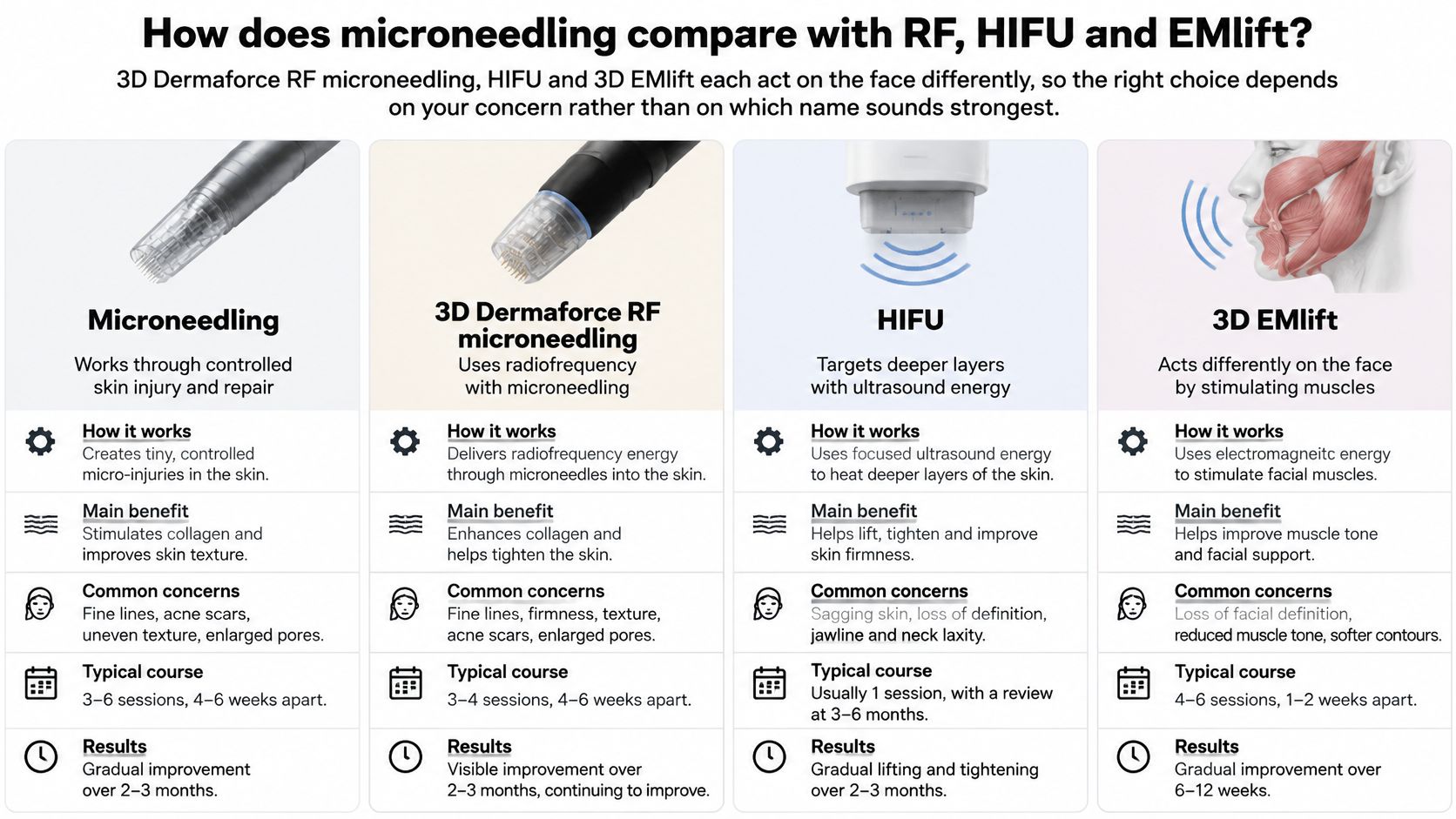
3D Dermaforce RF microneedling, HIFU and 3D EMlift act on the face differently, so we choose between approaches by the concern being assessed, not by which name sounds strongest. Results vary from person to person.
Microneedling, RF, HIFU and EMlift compared
| Treatment | How it works | Typically targets | Timing |
|---|---|---|---|
| 3D Dermaforce RF microneedling | Micro-injuries plus radiofrequency heat for collagen stimulation | Texture, fine lines and mild laxity | Course and session count set after assessment |
| HIFU | Focused acoustic energy creates heat zones at three selected depths | Brow, jawline, nose-to-mouth folds and lines around the eyes | Our treatment information describes changes within four weeks, with further changes up to six weeks |
| 3D EMlift using HIFEM+ | Muscle stimulation for toning and skin tightening | Muscle tone and skin tightening | Schedule and assessment point discussed at consultation |
HIFU means high-intensity focused ultrasound. HIFEM+ refers to high-intensity focused electromagnetic muscle stimulation.
These descriptions reflect the systems and treatment approaches we use. Our HIFU information describes improvement in facial contouring and fine lines within four weeks, with further improvement in tightening and wrinkles up to six weeks; results vary from person to person.
The visual below keeps the different targets separate.
How should you choose between them?
Start with a description of the concern rather than a device request. Uneven cheek texture, a softened jawline and reduced muscle tone aren't interchangeable problems, even when someone describes all of them as ageing.
Our comparison of HIFU and radiofrequency explains the distinction between the energy types. For broader background, treatment insights from Skinsation Aesthetics can help you recognise the vocabulary, but they aren't a substitute for UK guidance or an individual assessment.
A combined approach might be discussed when someone has both surface texture concerns and a deeper contour concern. That doesn't mean more treatment is automatically better, or that combining devices produces a surgical-style outcome. Results vary from person to person.
Choose the target first: Ask what each proposed procedure is intended to change, what it won't address, and how that change will be assessed.
We don't use a general study of conventional microneedling to promise the same outcome from every energy-based device. Each option needs its own discussion of suitability, limitations, recovery and cost.
How do I book a consultation to find out which treatment fits?
Booking takes a few minutes, and the consultation itself costs nothing. You do not need to arrive knowing which technology to choose or whether microneedling is even the right category. Bring a description of what bothers you in ordinary daylight, and tell us whether your main aim is smoother skin, a different contour or both.
Every client at 3D Aesthetics Leamington Spa starts with a complimentary, in-depth consultation that includes a full 3D scan. That gives us a baseline record of your concerns, so any change is measured over time rather than judged from memory and mirror checks.
What should you bring and ask?
- Arrange your appointment. Book your free consultation so we can discuss your concern and medical history.
- Bring useful information. Take clear, unfiltered photographs and a full medical history, including current medicines, previous procedures and any unusual healing or scarring.
- Ask what each option would change. We will explain which concerns respond to collagen-led firming, which would need muscle stimulation or focused ultrasound, and which sit beyond what non-surgical treatment can deliver.
- Ask for a written explanation. Discuss the proposed session plan, recovery, review timing and what would count as a worthwhile change for you.
- Check the full cost. A single session price and a course total are different numbers, so review our current prices and ask what the proposed course would involve before committing.
A consultation is an opportunity to decide against treatment as well as for it. If your photographs or your history suggest microneedling cannot meet your goal, we will say so and explain what, if anything, would come closer. We would rather turn you away than sell you a course that cannot deliver the change you want.
At 3D Aesthetics Leamington Spa, we offer 3D Dermaforce RF microneedling for collagen stimulation and skin tightening from £150, alongside HIFU and 3D EMlift muscle stimulation, with EMlift also from £150. Visit us to discuss whether your concern is skin texture, mild laxity or facial contour, and receive an honest suitability assessment before booking treatment; results vary from person to person.
← Back to Home