
You check your chin in the car mirror after a long day and spot one coarse hair that wasn't there this morning. Later, you tweeze it under the bathroom light, then make a note to book a wax before the wedding next weekend. None of these moments is dramatic on its own, but the repeated checking, covering, plucking and rebooking can become exhausting.
Facial hair removal for women isn't only about achieving smoother skin. It can involve time, irritation, expense and the quiet worry that somebody else has noticed. A UK survey of 2,500 women found that 88% felt self-conscious about unwanted facial hair, while 59% always carried tweezers and 56% tweezed at least once a day (Professional Beauty's coverage of the survey). That maintenance cycle deserves a more useful conversation than a simple list of products.
The right option depends on your hair's colour and thickness, your skin tone, sensitivity, hormonal health, budget and tolerance for upkeep. Some methods give you a clean-looking result for a short time. Others can reduce regrowth over a course of treatment, but only when the hair and skin combination is suitable.
Table of Contents
- Why Facial Hair Removal Feels Like a Never-Ending Job
- Every Method Side by Side at a Glance
- How Hair Type, Skin Tone and Hormones Change the Answer
- At-Home Methods Versus Professional Treatments
- What to Do Before and After Each Session
- When Facial Hair Signals Something Worth a GP Visit
- Choosing a Safe Clinic and Reading the Consultation
- Common Myths, Honest Answers and Your Next Step
Why Facial Hair Removal Feels Like a Never-Ending Job
A razor removes what you can see today. Tweezers deal with the individual hairs you can find under good light. Waxing and threading remove more at once, but regrowth eventually brings you back to the same appointment or bathroom routine.
That cycle can feel particularly intrusive on the upper lip, chin and jawline. You may alter when you wear makeup, avoid bright bathroom lighting, or check your reflection before meeting somebody. The hair itself may be small, but the attention it demands can take up far more space.
The maintenance is emotional as well as practical
Facial hair removal has become a normal part of grooming in Britain. A foundational UK survey of 678 women found that over 99% reported removing some body hair, and it recorded facial depilation becoming more common with age. Within that study, 24.10% of women aged 20 and under, 38.76% of women aged 21 to 30, and 53.51% of women aged 31 to 50 said they had ever removed facial hair (the UK study on normative femininity and hair removal).
Those findings don't mean every woman needs to remove facial hair. They show that the concern is widespread and can become more relevant through adult life. Hormonal changes, including those associated with PCOS or menopause, may also make previously fine hair more noticeable or cause some hairs to become darker and coarser.
Practical rule: Choose a method based on the routine you can live with, not only the smoothness you want immediately after treatment.
A salon appointment may reduce the daily effort but adds travel, booking and ongoing spending. An at-home method may be cheaper per use, yet require constant attention. Professional treatment can offer longer-term reduction for suitable hair, but it involves assessment, a course of sessions and realistic expectations.
The useful question isn't “Which method removes the most hair?” Ask instead, “Which method reduces the most frustration for my particular hair, skin and health profile?”
Every Method Side by Side at a Glance
No single technique suits every face. Shaving is quick and predictable, while waxing and threading pull hair from the root but can irritate reactive skin. Laser and electrolysis require more planning because they target the follicle rather than only cutting or lifting visible hair.
The table below uses qualitative ranges where results, prices and session requirements depend on the treatment area, clinic, device, practitioner and your response. A clinic should give you an individual quote rather than relying on a generic online figure.
Facial Hair Removal Methods Compared
| Method | Lasting Result | Pain (1-5) | Best For | Sessions to Result | Annual Cost (£) |
|---|---|---|---|---|---|
| Shaving | Short-term, usually requiring frequent upkeep | Low | Most hair and skin types, including sensitive skin when performed gently | Repeat as regrowth appears | Low per use, but ongoing |
| Waxing | Short-term to medium-term, until hair regrows | Medium to high | Dark or light hair on skin that tolerates pulling and warmth | Repeat appointments or home treatments | Varies with area and frequency |
| Threading | Short-term to medium-term, especially useful for brows and small areas | Medium | Precise shaping, brows and upper lip; most hair colours | Repeat appointments as needed | Varies by salon and frequency |
| Depilatory creams | Short-term, similar to other surface-removal methods | Low, although irritation is possible | Coarser hair when the skin tolerates the ingredients | Repeat as regrowth appears | Low to moderate, depending on use |
| At-home IPL | Reduction may occur for suitable dark hair and suitable skin contrast | Low to medium | Carefully selected hair and skin combinations | A repeated home schedule followed by maintenance | Device cost plus replacement or maintenance costs |
| Professional laser | Longer-term reduction rather than guaranteed total clearance | Low to medium, depending on device and sensitivity | Dark, pigmented hair with an appropriate skin and laser combination | A course is usually required, followed by assessment and possible maintenance | Clinic-specific |
| Electrolysis | Permanent follicle-by-follicle removal is the intended outcome, but treatment is gradual | Medium to high, depending on the area and person | Individual hairs, lighter hair and situations where laser contrast is limited | Multiple appointments over time | Clinic-specific |
Threading often beats waxing for brows because the practitioner can work with individual hairs and create a precise shape without spreading wax across the surrounding skin. It can also be useful for an upper lip when you want immediate definition, although repeated appointments still form part of the maintenance burden.
For a broader discussion of treatment suitability, a guide to laser hair removal for face can help you understand what a facial laser consultation should assess. You can also compare the wider context of hair reduction treatment before deciding whether a reduction-based approach fits your routine.
Laser sits between temporary removal and follicle-by-follicle electrolysis. It can produce meaningful reduction when the hair contains enough pigment for the device to target, but it shouldn't be described as an instant or universal permanent solution. Electrolysis is slower and more labour-intensive, yet it remains relevant when the hair is light, scattered or unsuitable for laser.
How Hair Type, Skin Tone and Hormones Change the Answer
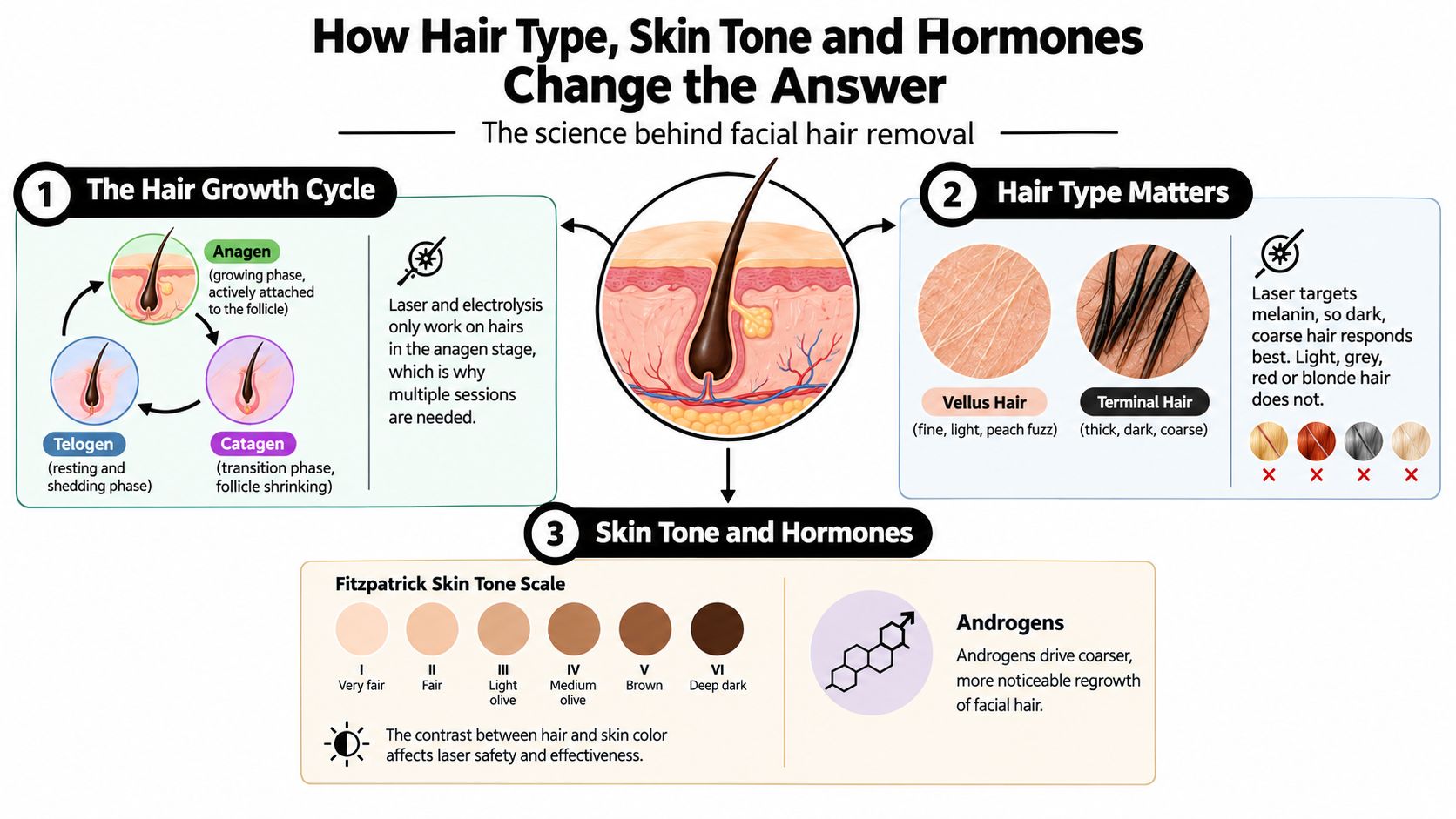
Before choosing a treatment, assess three things: the growth stage of the hair, the contrast between hair and skin, and the reason the growth is changing. These factors explain why one person may respond well to laser while another needs electrolysis or a combination of methods.
Growth stages matter
Hair moves through anagen, the active growing phase, catagen, a transition phase, and telogen, a resting and shedding phase. Laser and electrolysis are most effective when the follicle and hair are in a suitable active stage, so one appointment can't treat every hair equally. That is why a course is needed rather than a single session.
Hair type also matters. Laser relies on pigment, so dark, coarse terminal hair is generally easier to target than fine, pale or barely pigmented hair. NHS Scotland guidance notes that white, grey, blonde and red hair won't respond to laser, while North Bristol NHS Trust describes dark hair on fair skin as a strong indication for Alexandrite systems and identifies long-pulsed Nd:YAG as safer for darker skin types (North Cumbria, Northumberland and Tyne and Wear NHS guidance).
Skin tone changes the safety calculation
The Fitzpatrick scale is commonly used to describe how skin responds to sunlight, from very fair through to heavily pigmented skin. A darker skin tone contains more melanin, so the practitioner must select settings and wavelengths carefully to reduce the risk of unwanted heating, burns or pigment changes.
That doesn't mean darker skin rules out professional treatment. It means you should ask which device is being used, why it suits your skin, whether the practitioner has treated similar phototypes, and how the clinic manages patch testing.
Hormonal drivers add another layer. PCOS, menopause and some medicines can contribute to coarse growth on the chin, jaw or upper lip. If that applies to you, information about hormone health for women with PCOS may be useful alongside advice from your GP, but cosmetic treatment still needs its own skin and hair assessment.
At-Home Methods Versus Professional Treatments
At-home methods give you control. You can shave before work, tweeze a stray chin hair in seconds or use a facial cream without travelling to a clinic. Their drawback is that the work returns to you repeatedly, and some techniques become less convenient when growth is widespread or hormonally driven.
Professional treatments move the effort into a planned programme. Laser and clinic IPL can reduce suitable pigmented hair over time, while electrolysis treats individual follicles. Neither approach removes the need for a proper assessment, and neither can promise the same result for every colour, thickness or skin tone.
At-Home vs Professional Facial Hair Removal
| Method | Typical annual cost (£) | Pain | Downtime | Result longevity |
|---|---|---|---|---|
| Shaving | Low per use, ongoing | Low | None or minimal | Short-term |
| Tweezing | Low per use, ongoing | Low to medium | Minimal | Short-term to medium-term for each hair |
| Waxing or threading | Varies with appointment frequency | Medium to high | Possible temporary redness | Short-term to medium-term |
| Depilatory cream | Low to moderate, ongoing | Usually low, but irritation is possible | None if tolerated | Short-term |
| At-home IPL | Device-dependent | Low to medium | Usually minimal | Reduction may occur for suitable candidates |
| Clinic laser or IPL | Clinic quote required | Low to medium | Usually limited, with aftercare | Longer-term reduction for suitable candidates |
| Electrolysis | Clinic quote required | Medium to high, depending on sensitivity | Usually limited | Follicle-by-follicle permanent removal is the intended goal |
A home IPL device can be appealing when you want privacy, but it has important limitations. Light, grey and red hair provide little or no useful target pigment, and a device may be unsuitable for darker skin. Hormonally driven chin and jaw growth can also require a more individual plan than a home schedule can provide.
Waxing, threading and sugaring remain useful when your priority is shaping or removing hair for an event. Shaving can be the least disruptive option for sensitive skin because it doesn't pull at the follicle, although a blunt regrowth tip may feel rougher.
For a broader treatment comparison, you can compare laser vs. electrolysis costs, keeping in mind that overseas pricing and treatment protocols won't necessarily match a UK clinic. A separate explanation of laser hair removal vs IPL can help clarify why the device, wavelength and practitioner experience matter.
What to Do Before and After Each Session
Good preparation protects the skin and helps the practitioner assess the treatment area clearly. Your clinic may give different instructions if you're using prescription skincare, have a history of pigmentation, or are treating a specific medical condition, so follow its written guidance first.
Before the appointment
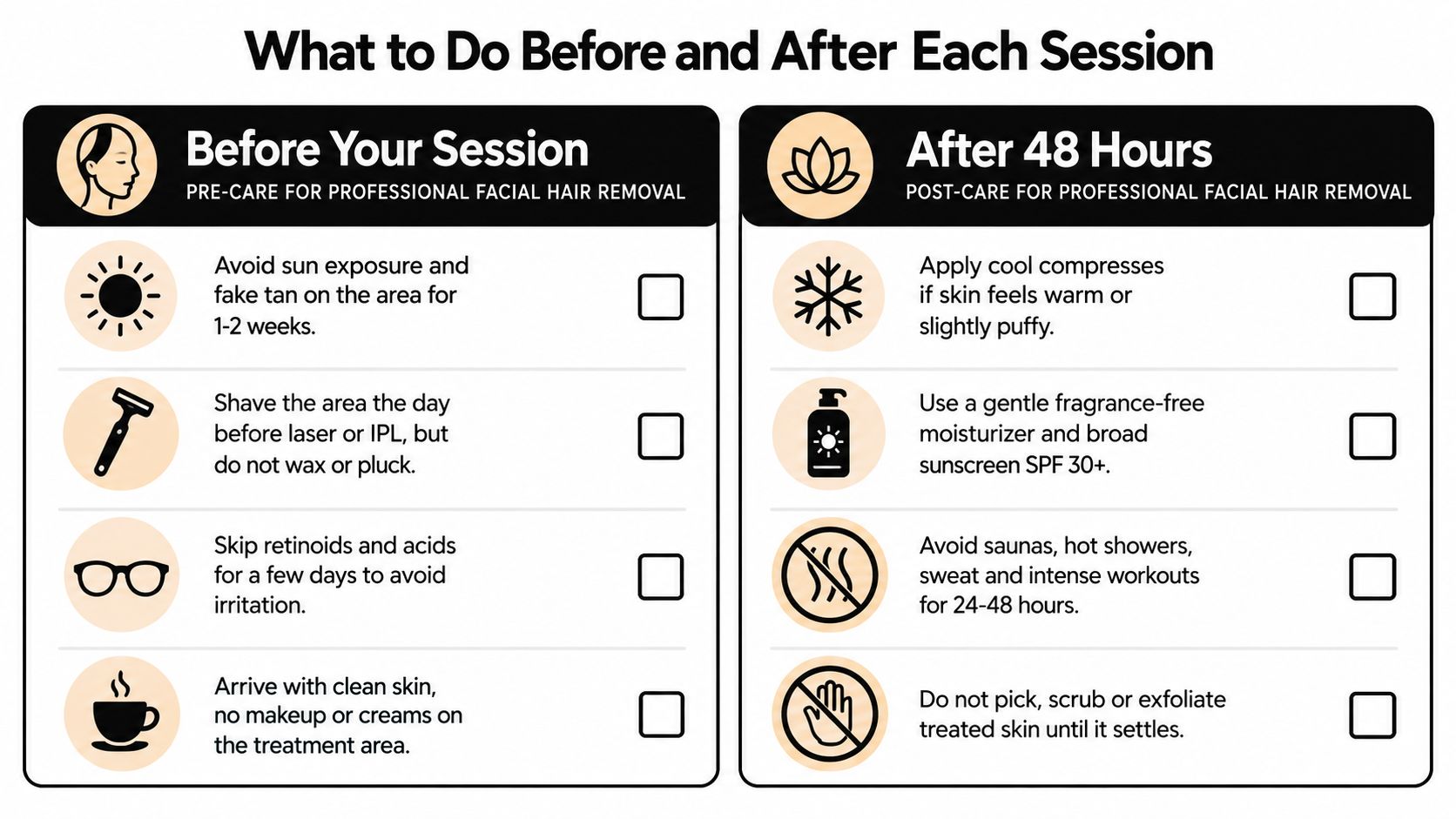
Avoid strong sun exposure and fake tan on the treatment area. Tell the clinic about recent tanning, active skin conditions, cold sores, medication and any history of pigment changes.
For laser or IPL, shave the area rather than waxing, threading or plucking it beforehand. The practitioner needs the follicle and its pigment present beneath the skin, while a surface shave removes only the visible length. Arrive with clean skin and no makeup, oils or creams on the area.
Pause irritating products only as directed by the clinic. Retinoids, vitamin A derivatives, AHAs, BHAs and essential oils can make some skin more reactive, so ask how long you should stop them rather than assuming the same rule applies to every person.
After treatment
Mild redness, warmth or swelling around individual follicles can occur after energy-based treatment. A cool compress and a gentle, fragrance-free moisturiser may help, provided the clinic has approved them for your skin.
Use broad-spectrum sunscreen on exposed areas such as the upper lip and chin. Avoid picking, scrubbing and exfoliating while the skin settles, and avoid saunas, very hot showers, strenuous exercise and other sources of heat for the period advised by your practitioner.
Hair can appear to remain in place before it sheds. The shedding window varies by person and treatment, so don't tweeze hairs between laser appointments unless your clinic specifically tells you to. If you develop blistering, severe pain, spreading swelling or a noticeable pigment change, contact the clinic promptly rather than applying more active skincare.
For advice focused on reducing bumps after hair removal, see this guide to ingrown hair prevention.
When Facial Hair Signals Something Worth a GP Visit
Not every chin hair indicates a medical problem. Hirsutism means coarse, pigmented terminal hair growing in a pattern commonly associated with male hair distribution, such as the upper lip, chin, jawline, chest or back. The British Association of Dermatologists states that hirsutism affects about 5% to 10% of women in Western societies and can be an important sign of androgen excess (British Association of Dermatologists guidance on hirsutism).
Look at the pattern and the timing
Long-standing, isolated hairs may be a cosmetic concern. A sudden or rapidly worsening change deserves a different response, particularly if it appears alongside acne, oily skin, scalp hair thinning, a deeper voice, irregular periods or signs associated with insulin resistance.
A GP may ask when the growth started, how quickly it changed and whether other symptoms appeared. They may arrange blood tests or other investigations to look for an underlying hormonal cause. The exact assessment depends on your symptoms and medical history.
Sudden change matters more than a few stable hairs that have been present for years.
Treatment for an underlying driver may improve the overall situation, but it won't necessarily remove existing hair immediately. Cosmetic reduction remains a valid choice, whether or not a medical cause is found. The important point is to avoid spending months treating a symptom while ignoring a change that needs clinical attention.
If your hair is light or fine, a GP conversation can also prevent unrealistic expectations about laser. Electrolysis may be more appropriate for selected hairs, while a hormonal assessment can help you and the practitioner plan a more sensible route.
Choosing a Safe Clinic and Reading the Consultation
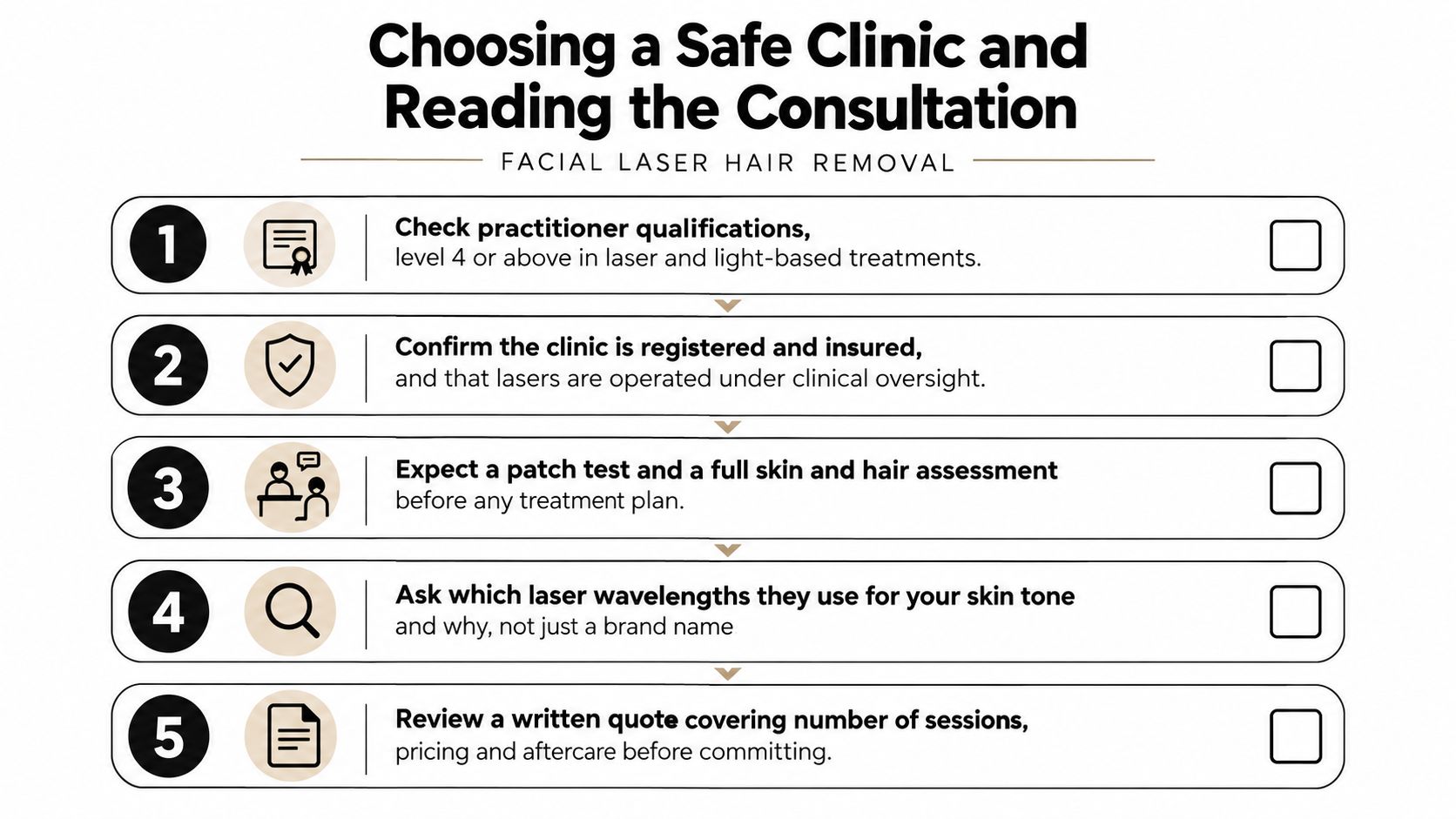
A safe clinic should make the consultation feel like an assessment, not a sales appointment. Look for a practitioner with a recognised laser or light-based treatment qualification, suitable insurance and professional affiliations where relevant, such as JCCP, BABTAC or CIBTAC. Ask what experience the practitioner has with your skin phototype and the exact area you want treated.
What a proper consultation should include
The practitioner should review your medical history, skincare, medication, tanning, previous reactions and hormonal symptoms. They should examine hair colour, diameter, density and distribution rather than promising a result from a photograph or a quick glance.
A patch test should be discussed and carried out according to the clinic's safety protocol before full treatment. You should receive clear aftercare instructions and a written plan explaining the expected course, maintenance possibilities, price and what happens if the hair doesn't respond as anticipated.
Ask these questions directly:
- Which device and wavelength will you use? A brand name alone doesn't explain why the device suits your skin and hair.
- How do you treat darker skin phototypes? Listen for a clear explanation of settings, wavelength choice and pigment-change precautions.
- What happens if my hair is too light or fine for laser? A responsible clinic should discuss electrolysis or another realistic option.
- What is your patch-test policy? You should understand when the test takes place and what the clinic monitors afterwards.
- Will hormonal growth change the plan? The practitioner should welcome this question rather than dismiss it.
- What is included in the quote? Check sessions, maintenance, aftercare and any review appointments.
Red flags include pressure to buy a large package immediately, no patch test, vague answers about the device, guaranteed total clearance and a practitioner who avoids discussing hormonal growth. A lower price isn't a bargain if the consultation doesn't establish whether the treatment is appropriate.
Common Myths, Honest Answers and Your Next Step
Is laser completely permanent? Laser can create substantial reduction for suitable hair and skin combinations, but total lifelong clearance isn't guaranteed. Hormonal changes can activate new growth, and some people need maintenance.
Does shaving make hair grow back thicker? No. Shaving cuts the hair at the surface, so the blunt end can feel coarser as it grows back. It doesn't change the follicle or turn fine hair into a thicker strand.
Is electrolysis always more painful than laser? They feel different. Laser often feels like brief heat or snapping, while electrolysis uses a fine probe to treat individual follicles. Comfort depends on the area, settings, sensitivity and the practitioner.
Can IPL treat every skin tone? No. IPL depends on the contrast between hair pigment and skin pigment and can be unsafe or unsuitable for some darker skin tones. A patch test and a proper device assessment matter.
Will home IPL match a clinic treatment? It may help a suitable user maintain reduction, but home devices are less flexible and may be poorly matched to light hair, darker skin or hormonally driven facial growth. A clinic can adjust its approach after assessing your response.
If you want to move beyond daily tweezing or repeated salon appointments, start with a consultation at a clinic that can discuss both laser and electrolysis. Ask about the device, your skin phototype, your hair colour, hormonal factors, patch testing and the likely maintenance plan before paying for a course.
3D Aesthetics Leamington Spa offers laser hair reduction for facial areas including the upper lip, chin and jawline, with a consultation-led approach to planning treatment. Visit 3D Aesthetics Leamington Spa to discuss your hair and skin profile, ask the right safety questions and arrange an assessment before committing to treatment.
← Back to Home