
You're probably reading this because your tummy, flank or chin doesn't look or feel quite as you expected after treatment, and you're searching late at night with Fat Freezing Gone Wrong in the search bar. We understand that worry. At our clinic in Leamington Spa, we tell clients to judge fat freezing (cryolipolysis, controlled cooling that injures fat cells so the body can clear them) by timing, not by how the area looks on day one. Most effects settle. A small number arrive later and need a proper review.
Table of Contents
- Which symptoms after fat freezing are normal and which need a check?
- What complications can fat freezing cause?
- How to Track the Treated Area in the First Months
- What should I do straight away if something feels wrong after fat freezing?
- Who should I contact after fat freezing, and how quickly?
- How can I lower the risk of problems before and after fat freezing?
- Who should not have fat freezing, and what is the next step?
Which symptoms after fat freezing are normal and which need a check?
A pink, tender area in the first few days usually fits the expected pattern after fat freezing. Blistering, broken skin, severe pain, or a firm area shaped like the applicator that develops months later needs prompt assessment. Track whether a symptom is settling or getting worse.
| Symptom | Usual timing | Action |
|---|---|---|
| Redness, swelling or tenderness | Hours to a few days | Log it and watch for change |
| Bruising | First days after treatment | Photograph it and note the size |
| Numbness, tingling, burning or electric-shock feelings | Can last weeks or months | Arrange a review if it is not improving over several weeks |
| Firm, lumpy area shaped like the applicator | Often months after treatment | Contact a GP or clinic for a review; do not repeat treatment |
| Blistering, open skin or an ulcer | Any time, often early | Call your GP or NHS 111 the same day |
| Severe or worsening pain, spreading redness or fever | Any time | Seek urgent help from NHS 111, A&E or 999 if you feel very unwell |
What feels normal in the first days
The applicator draws tissue in and cools it, so soreness, swelling and pinkness can occur soon after treatment. Bruising may look pronounced before it fades. Numbness can also make the skin feel unusual when clothes brush against it.
Photograph the area and note when changes begin. Comparing images is more useful than relying on memory when redness or bruising fades gradually. For a clearer idea of the pulling, cold and aching sensations discussed before treatment, read our guide to whether fat freezing hurts.
What doesn't fit the normal pattern
Arrange a review if numbness, burning, stinging, electric-shock sensations or oversensitivity are not improving over several weeks. Seek help sooner if the skin blisters, breaks down or changes colour markedly. A firm, rectangular area that appears months later, especially while the surrounding tissue remains softer, needs assessment. Do not book another treatment over it before it has been checked.
Our rule in clinic: if a change is new, spreading, hardening or clearly worse than last week, contact a clinician rather than waiting for your next appointment.
Keep checking the treated area over the following months. An applicator-shaped firm area can appear well after the early redness or bruising has settled, so the timeline matters as much as the first few days. Dated photos taken in the same light, along with a brief note of when each change started, can help a clinician judge whether the area is settling or needs further assessment.
What complications can fat freezing cause?
Fat freezing can cause temporary redness, bruising, swelling and numbness. A rarer, distinctive complication is paradoxical adipose hyperplasia (PAH, growth of fatty tissue in the treated area instead of shrinkage). The treated area becomes larger and firmer, sometimes with a rectangular outline matching the applicator. PAH generally does not resolve on its own and may require surgical removal.
The Aesthetic Complications Expert Group UK patient leaflet gives an incidence of 0.0051%, approximately 1 case per 19,608 treatments or patients, depending on how the denominator is defined. That figure is not a personal risk estimate. PAH can become noticeable months after treatment, so a new, firm, applicator-shaped area should be assessed rather than treated again.
Other reported problems include prolonged changes in sensation, frostbite-like skin injury, ulceration, scarring and an uneven contour. PAH is the most commonly reported serious complication in adverse-event reports; hernias have also been reported. These reports do not establish how likely either problem is for an individual.
Different body treatments have different after-effects, so what to expect after Emsculpt NEO is not a guide to fat freezing. Read about whether fat freezing is safe before deciding. Results vary from person to person, and a careful consultation should explain possible complications without promising a particular contour.
How to Track the Treated Area in the First Months
Fat freezing is easiest to assess when you track the treated area with dated notes, weekly photos and repeat measurements for the first three months. Don't rely on the bathroom scales alone. Fat freezing targets a pocket, so shape, firmness and symmetry matter more than overall weight.
The infographic below summarises the routine we give clients to take home.
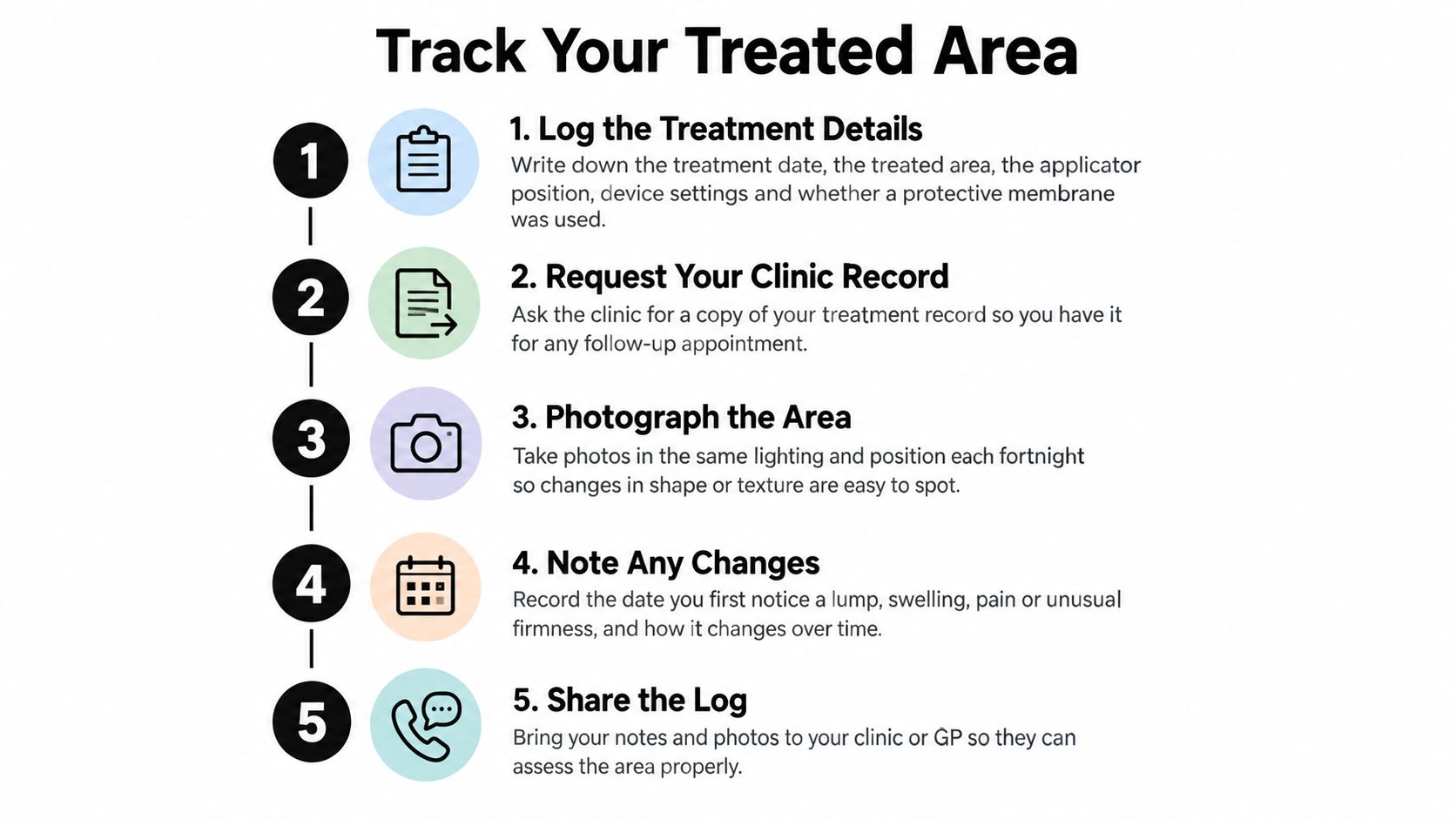
- Write down the treatment details: Record the date, treated site, applicator position, device settings and whether a protective membrane was used. Ask the clinic for these details if you weren't given them, because they help another clinician understand exactly what was done.
- Photograph from front and side: Take weekly photos for three months at the same time of day, in the same lighting and with the same posture. Consistent photos make slow change, swelling or a new rectangular outline much easier to spot.
- Measure at a marked point: Use a soft tape at a fixed mark, such as a freckle or a point measured from your navel. Repeat at that mark each time, because moving the tape even slightly can create a false change.
- Check firmness by hand: Press gently and compare with the untreated side or nearby untreated tissue. Note any hard, lumpy or tender patch and the date you first feel it.
- Log sensation with dates: Write down numbness, burning, electric-shock feelings, oversensitivity or new tenderness as they change. A dated log shows whether sensation is steadily improving or has stalled.
- Compare with your baseline: Put new photos beside your consultation photos, measurements or 3D body scan. Baseline records stop you guessing from memory and show asymmetry more clearly.
- Bring everything to review: Take the log, photos and measurements to the clinic or your GP. Good records shorten the conversation and make referral easier if needed.
Why weight alone misleads
Fat freezing can leave uneven contour if fat cells weren't exposed evenly, and the scales won't show that. You could weigh the same and still have a ridge, dip or firmer patch that needs checking. Palpation, photos and circumference at a fixed point give a fuller picture.
The video below is useful background before you compare your own photos, and our page on fat freezing results sets out the timescale we discuss in clinic.
Fat freezing results build gradually, and results vary from person to person. Keep tracking even when the area looks settled, because delayed firmness or enlargement can appear around 2 to 4 months after treatment. If your log shows that pattern, book a review rather than waiting for a routine appointment.
What should I do straight away if something feels wrong after fat freezing?
Fat freezing should be paused on the treated area straight away if something feels wrong, with no repeat cycle until a clinician has reviewed it. Don't try to correct a worrying area with more cooling. A single concerning sign is a reason to get checked, not a reason to panic.
The checklist below is the sequence we'd want you to follow.
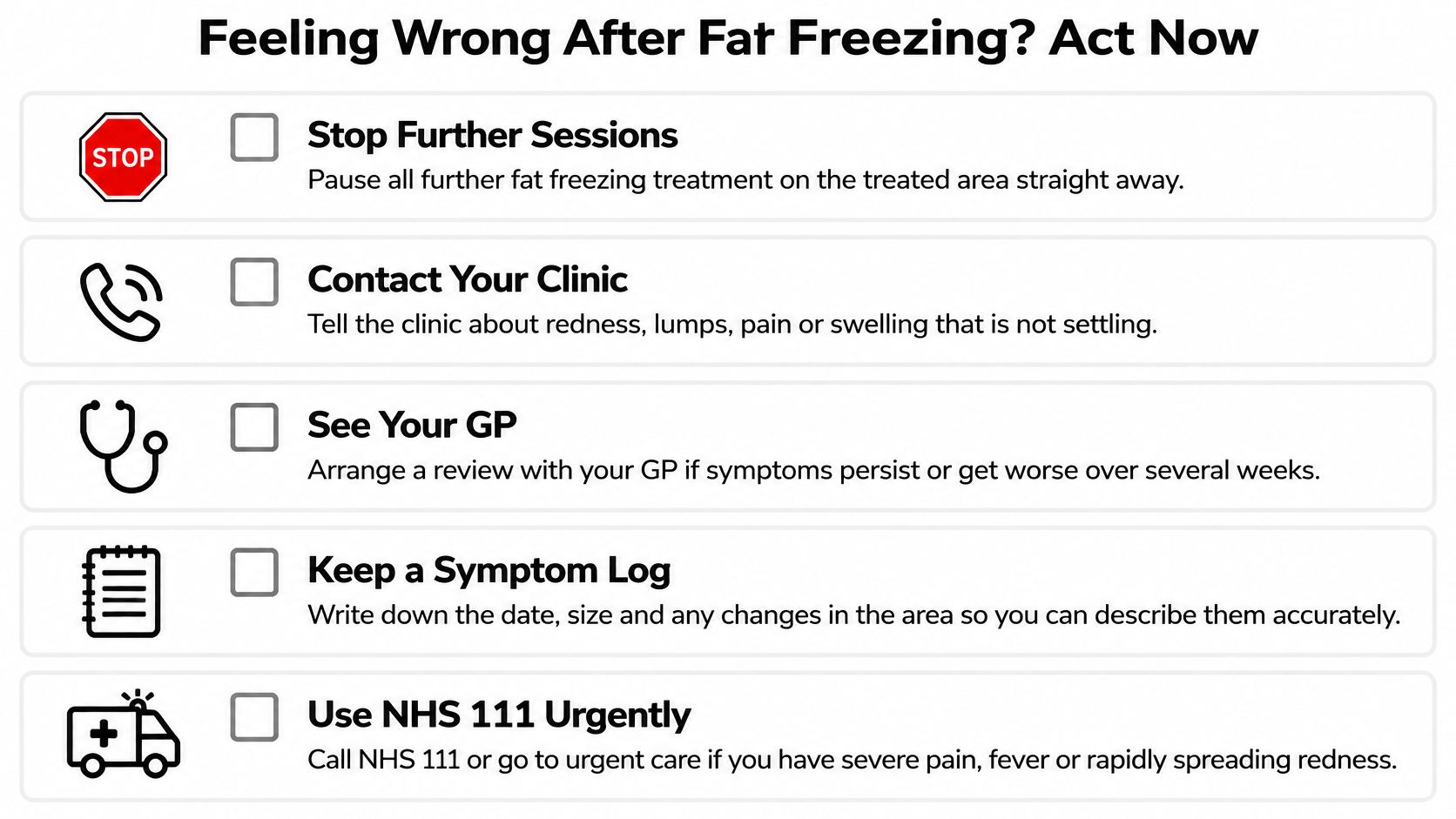
- Don't book another cycle: Pause treatment on that area until it's been examined. Repeat sessions over unresolved injury can make assessment harder.
- Contact the treating clinic: Send your dated log and photos, and say when each symptom started. That gives the practitioner something concrete to assess.
- Write symptoms down now: Note what you feel, where it is and whether it's spreading while details are fresh. Memory blurs quickly once you start worrying.
- Escalate urgent signs immediately: Use the contacts in the next part of this page for blistering, skin breakdown, severe pain, fever or spreading redness. Don't wait for a clinic reply if you're deteriorating.
- Report a suspected device reaction: Suspected device-related adverse events should be documented and reported through the UK MHRA Yellow Card system. Reporting helps build a clearer safety picture.
- Ask for clinical review first: Request an assessment before any further treatment, even if the area looks normal on the surface. Our fat freezing aftercare guidance covers the routine care we'd expect you to have been given.
Who should I contact after fat freezing, and how quickly?
Fat freezing problems that are urgent go to NHS 111, A&E or 999, while persistent but stable problems go to your GP first and to the clinic that treated you. Use the table to match the situation to the contact. If you're unsure, choose the faster route.
| Situation | Contact | Timing |
|---|---|---|
| Blistering, open sore or skin breakdown | GP or NHS 111 | Same day |
| Severe pain, fever, spreading redness or collapse | NHS 111, A&E or 999 if you feel very unwell | Immediately |
| Firm, persistent lump or new asymmetry | GP, then referral to a dermatologist or plastic surgeon if needed | Within one to two weeks |
| Numbness or burning not improving after about six weeks | GP and treating clinic | Within two weeks |
| Unsure what you are seeing | Treating clinic for review, or GP if you can't be seen promptly | Review within the week |
Fat freezing follow-up sometimes needs referral beyond the clinic, and that's normal practice, not failure. We don't offer surgical removal of a PAH area, so if surgery is needed we'll review you and refer you on. Clients from Warwick and Kenilworth use the same NHS routes as anyone else in Warwickshire.
The NHS explains how to use NHS 111, and the British Association of Dermatologists and the Primary Care Dermatology Society publish skin information you can take to a GP appointment. If you'd like us to look at an area we treated, start by arranging a review through our free consultation booking page or by calling us. Bring your photos and symptom log so we can compare the area with your baseline scan.
How can I lower the risk of problems before and after fat freezing?
Fat freezing risk is lowered mainly at consultation, through honest screening, correct applicator choice and a clear follow-up plan. These steps can't prevent every problem. They make problems less likely and easier to spot early.
Before treatment
- Tell us your full history: Mention any hernia, abdominal-wall weakness, pregnancy, Raynaud's phenomenon (a circulation condition where fingers or toes react strongly to cold) or other cold-related condition. Abdominal treatment needs particular care where there's known weakness.
- Ask about the applicator: Ask which size will be used and how much tissue it'll grip. Incorrect handpiece placement, unsuitable settings or insufficient tissue for the applicator can increase bruising risk, a warning made by the UK Association of Cosmetic Practitioners.
- Ask about the protective membrane: Confirm that a membrane is used between applicator and skin and why. It's a basic safety detail you should understand before treatment starts.
- Agree the review point: Book who'll review you and when, including around the three-month point. Delayed changes are missed when no follow-up is planned.
After treatment
Fat freezing aftercare works best when you keep the photo and measurement log going, even after the early soreness settles. Report new symptoms early rather than saving them for the next session. Don't have repeat treatment on the same area until a clinician has reviewed it and agreed it's settled.
A clinic that pushes you to rebook before reviewing a changed area is putting the calendar ahead of your skin.
Fat freezing also needs realistic planning about sessions and cost before you start, so you're not pressured into extra cycles to chase a result. We'd rather pause, photograph and reassess. In our clinic we usually see calmer clients when the timeline, review date and warning signs are written down from day one.
Who should not have fat freezing, and what is the next step?
Fat freezing is not suitable for everyone. Do not treat an area with a hernia or known abdominal-wall weakness, broken or infected skin, or an unexplained skin change. Pregnancy, cold-reactive conditions such as Raynaud's phenomenon, and an unresolved complication from earlier treatment are also reasons not to proceed. Have the underlying concern reviewed before booking.
Fat freezing is for targeted fat reduction, not weight loss, and may not suit someone seeking an overall smaller waist. For example, if you have a hernia near your navel and want lower-abdominal treatment, that area should not be treated until it has been medically reviewed, even if the fat pocket otherwise appears suitable. A consultation should include the possibility of being advised against treatment.
Your next step in Leamington Spa
At 3D Aesthetics Leamington Spa, the next step is a complimentary consultation with a full 3D body scan. The scan helps assess the area and create a baseline for measuring results over time. Your practitioner can also review your skin and medical history to decide whether treatment is appropriate. Check the prices page before you decide, and use the clinic's free consultation booking page to arrange an assessment.
Proceed only when you understand the expected effects, the delayed signs to watch for, and who will review the treated area. Results vary from person to person, so a particular outcome cannot be promised. If you are concerned about an area already treated, contact the treating clinic or your GP first and have dated photos ready. If you are still considering treatment, bring your questions to the consultation and expect clear guidance on whether to proceed, wait, or seek medical review.
If you are worried by Fat Freezing Gone Wrong stories, start with an assessment rather than booking a session. 3D Aesthetics Leamington Spa offers fat freezing and a complimentary consultation with baseline 3D body scanning. Book the free consultation and bring any photos or symptom notes you already have, so the next step can be based on your concerns and suitability.
← Back to Home