
You've lost weight, changed your routine, or noticed a stubborn pocket that doesn't respond to either. The question is usually phrased as fat freezing vs fat melting, but that wording hides the most important issue. “Fat melting” can describe several different ultrasound or heat-based approaches, while cryolipolysis is a specific cooling treatment.
At our clinic, we don't choose between labels. We assess the pocket of fat, the device, your health history, your expectations and how change will be measured. Some clients are suitable for localised body contouring. Others expect weight loss, immediate inch loss or a treatment that we can't responsibly recommend, and we'll say so.
Table of Contents
- Fat Freezing vs Fat Melting in Simple Terms
- How Each Pathway Works and Who Responds
- Effectiveness and the UK Evidence Base
- What Clients Actually Notice During and After Treatment
- Safety, Risk Communication and Regulatory Context
- How to Choose a Pathway Based on Your Goals
- Quick Decision Map for Each Typical Client Profile
- Next Steps and Common Questions After Reading
Fat Freezing vs Fat Melting in Simple Terms
Fat freezing, or cryolipolysis, uses controlled cooling to target a localised pocket of pinchable subcutaneous fat. Fat cells are more vulnerable to cold than many surrounding tissues, so affected cells are damaged and gradually cleared by the body over several weeks, as described in the UK government consultation on non-surgical cosmetic procedures.
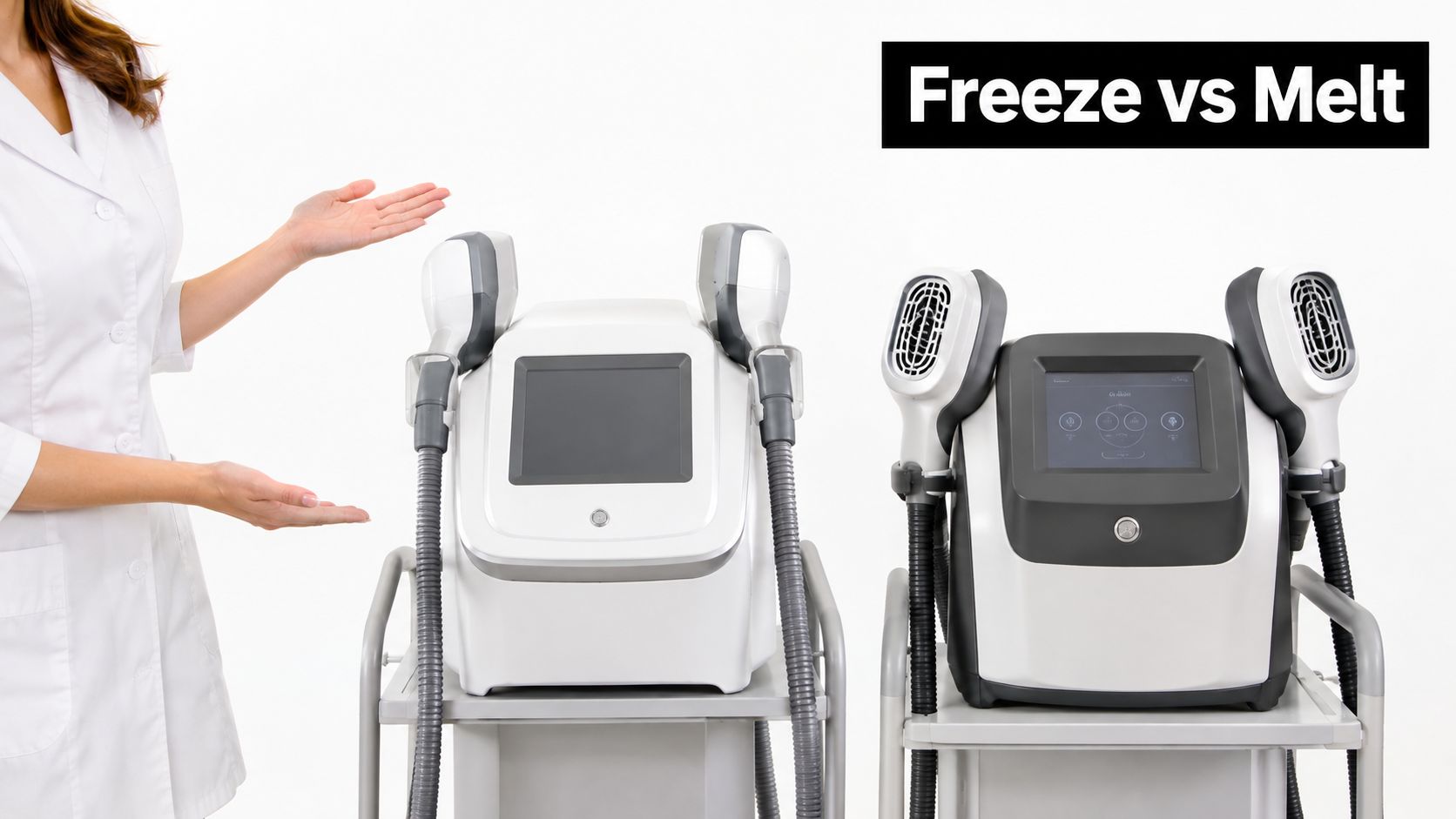
Fat melting is a marketing term rather than one standard treatment. It can refer to ultrasound cavitation, focused ultrasound, heat-based energy or another body-contouring protocol. Those devices can differ in frequency, intensity, focality and thermal output, so one machine's results shouldn't be transferred automatically to another.
Both pathways are intended for localised contouring, not general weight loss. Neither addresses visceral fat in the same way as weight reduction, and neither should be sold as a method for losing kilograms across the whole body. Ultrasound-assisted liposuction, including VASER, is also a separate invasive surgical technique. The UK government describes VASER as using ultrasound energy to liquefy fat so it can be surgically removed. That mustn't be confused with non-invasive cavitation or other treatments promoted as fat melting.
What we compare in consultation
A useful comparison looks beyond the cold-versus-heat story. We consider:
- The actual device: The model, applicator and settings matter more than the word “melting”.
- The treatment area: A discrete, pinchable pocket is different from a broad request to reduce body weight.
- The evidence: Cryolipolysis has a more established body of local fat-reduction evidence than many commercial cavitation protocols, but results still vary from person to person.
- The follow-up: Delayed biological change needs repeatable measurements, not a mirror check immediately after the appointment.
- The consent: You should understand expected sensations, limitations, possible complications and what happens if your outcome is disappointing.
Our explanation of non-surgical body contouring covers the wider purpose of these treatments. For clients in Leamington Spa, and those travelling from Warwick or Kenilworth, the practical decision is not which word sounds more impressive. It's which pathway matches the anatomy in front of us.
How Each Pathway Works and Who Responds
Cryolipolysis suits a client with a discrete, pinchable pocket of subcutaneous fat who accepts gradual change and realistic limits. Ultrasound or heat-based contouring can also suit a localised concern, but the clinic must identify the exact device and protocol before discussing likely response.
Cooling follows a more defined mechanism
Cryolipolysis uses controlled cold because fat cells are relatively vulnerable to cooling compared with many surrounding tissues. The treated cells are then broken down and cleared by the body. UK patient guidance describes cryolipolysis as selectively damaging approximately 20–40% of fat cells in a treated area, with visible change developing over several weeks as clearance takes place. This figure refers to the treated area, not total body fat or body weight, and ACE patient guidance on cryolipolysis stresses the importance of realistic expectations and informed consent.
Ultrasound-based “melting” has no single biological pathway. Devices may be focused or non-focused, thermal or non-thermal, and may use different frequencies, intensities and applicators. A client should be able to ask exactly what technology is being used and how the clinic will record change. Our information about ultrasonic cavitation explains why the treatment name alone isn't enough.
Who we may turn away
We're cautious about treating anyone whose main goal is broad weight loss, visceral-fat reduction or a dramatic change within days. These pathways aren't substitutes for medical weight management, and a body-contouring appointment isn't appropriate when the requested outcome doesn't match what localised treatment can do.
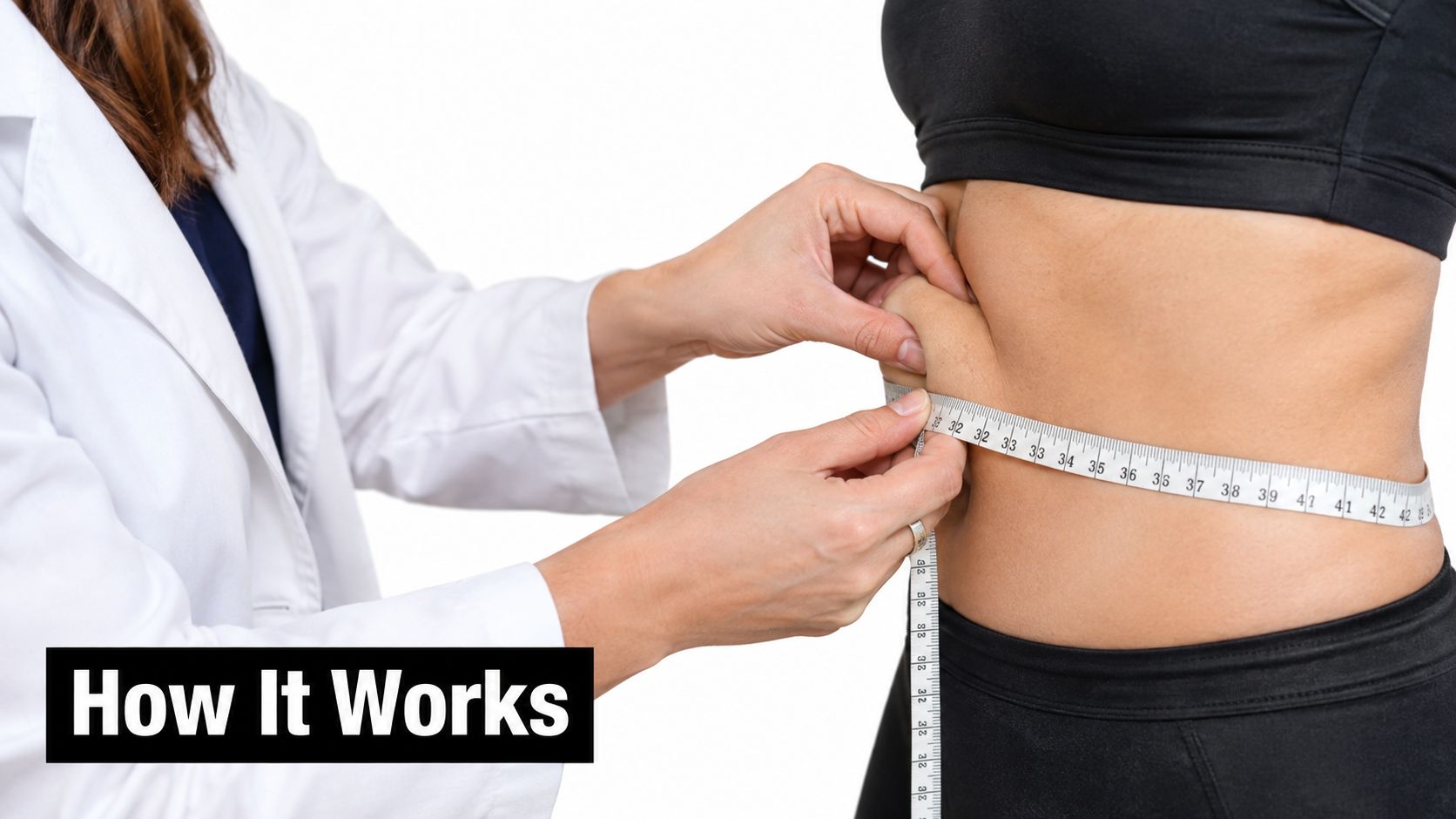
We also need to assess the fat pocket itself. If there isn't enough pinchable subcutaneous fat for the applicator or treatment approach, the area may not be suitable. Significant skin laxity, unclear expectations, relevant health considerations or an inability to follow aftercare and review arrangements can also change the recommendation.
Measurement matters because swelling, posture and lighting can create a misleading short-term impression. We use a repeatable approach involving photographs, circumference measurements and, where appropriate, 3D body scanning. Results vary from person to person, so the useful benchmark is change in the assessed area after the appropriate biological interval, not the number on the scales the next morning.
Effectiveness and the UK Evidence Base
Cryolipolysis has a larger and more consistent evidence base for localised fat reduction than many ultrasound or heat-based “melting” treatments, but no modality label guarantees a particular outcome. Device model, applicator, treatment area, settings, operator technique and follow-up timing all affect how useful a comparison is.
A UK study summarised in a 2023 peer-reviewed review reported a 40% reduction in skinfold thickness, equivalent to 13.7 mm, after cryolipolysis. The study involved 28 participants, assessed outcomes at a minimum of 12 weeks, and reported patient satisfaction of 88%. The review classified the study as level III evidence, so we treat it as a clinical data point rather than a promise. The reported reduction concerned skinfold thickness in the treated area, not total body fat or body weight. The figures are available in the peer-reviewed review of non-invasive lipolysis.
Why a percentage can mislead
A headline percentage can sound precise while leaving out the measurement method. Skinfold thickness, circumference, photographs and 3D scans don't measure exactly the same thing. A percentage relating to one device and treatment protocol shouldn't be presented as a universal result for every clinic or area.
The same academic review summarised a comparative study that found no statistically significant difference between ultrasound and cryolipolysis for waist circumference or suprailiac skinfold. That doesn't establish that all ultrasound treatments perform the same as cryolipolysis. It shows why the question “which works better?” needs a device-specific answer.
UK evidence for salon-style cavitation is particularly varied. An independent UK review of ultrasound cavitation notes that commercial systems differ substantially and that treatment-specific, sham-controlled and long-term evidence remains limited. One focused-ultrasound benchmark cited in the academic review described approximately 2–3 cm of abdominal-circumference reduction after one treatment over an 8–12-week period, while a course of three treatments every two weeks was associated with a reported 3–5 cm range. Those figures relate to a specific device protocol. They aren't a universal cavitation benchmark.
For anyone comparing options in Warwickshire, our non-surgical fat removal information should be read alongside a consultation that identifies the actual machine and measurement plan.
What Clients Actually Notice During and After Treatment
Clients usually notice a treatment sensation first, then a period in which visible change develops gradually rather than immediately. The experience depends on the device, area, settings and individual sensitivity, so we explain the likely sensation without pretending every appointment feels identical.
Fat freezing can involve cooling, pressure and temporary altered sensation in the treated area. Ultrasound or heat-based treatments may feel warm, vibratory or otherwise active on the skin, depending on the technology. Neither experience should be used as proof that a treatment will produce a better contour.
Plan around the recovery window
Many clients want to know whether they can return to work, exercise or social plans. That answer depends on the area and treatment response, but localised non-surgical contouring is generally planned around the possibility of temporary tenderness, swelling, redness or sensitivity. We won't describe a treatment as having no impact merely because it doesn't involve surgery.
The more important practical difference is the review timeline. Cryolipolysis relies on the body clearing affected cells over several weeks. Ultrasound and heat-based treatments may be marketed as faster, but a quick visual impression isn't a substitute for documented follow-up. Our fat freezing results guidance explains why measurements should be repeated under similar conditions.
Practical rule: Don't judge a contouring treatment from a single photograph taken at a different angle, in different lighting or before swelling has settled.
For clients arranging appointments in Leamington Spa, Warwick or Kenilworth, we recommend leaving enough flexibility around the appointment to observe how the area responds. Keep photographs consistent, use the same landmarks for circumference measurements and record when each image was taken. Results vary from person to person, so the review should focus on your own baseline and agreed objective, not someone else's before-and-after image.
Safety, Risk Communication and Regulatory Context
A treatment with more published evidence still needs careful risk communication, and a treatment with less evidence shouldn't be described as safer just because it sounds gentler. We discuss the device, operator competence, consent, insurance and follow-up before recommending either pathway.
Cryolipolysis has an uncommon delayed complication called paradoxical adipose hyperplasia, or PAH. A 2025 systematic review estimated PAH at approximately 0.22%, around 1 in 455 patients, but rated the evidence as low certainty and highlighted incomplete follow-up, so the true rate remains uncertain. The estimate and its limitations are discussed in UK cryolipolysis patient information. A client should know what delayed change might look like and who will assess it if it occurs.
Ultrasound needs equal honesty
Cavitation and other ultrasound approaches have a more variable evidence base across commercial devices. UK regulatory reviews have listed cavitation among treatments requiring attention, while inappropriate therapeutic-ultrasound settings or equipment can carry risks such as pain, burns, blisters or nerve injury. The treatment name doesn't tell you whether the machine, settings or operator are appropriate for your area.
We also explain the wider UK context. The Chartered Institute of Environmental Health review of cosmetic-treatment regulation states that there's no complete official national dataset recording how many non-surgical cosmetic treatments take place or how often complications occur. That absence of national data is one reason we don't turn a marketing percentage into a guarantee.
The Medicines and Healthcare products Regulatory Agency, or MHRA, regulates the UK medical-devices market under the UK Medical Devices Regulations 2002, as amended. Its guidance on medical-device boundaries explains that classification depends partly on intended purpose and mode of action. A device using controlled physical energy shouldn't automatically be presented as changing metabolism or producing a drug-like weight-loss effect.
England's 2023 government consultation considered licensing non-surgical cosmetic procedures, and the Government announced in August 2025 that practitioners would be expected to meet stronger standards for safety, training and insurance while the proposed licensing framework was still being developed. For us, practical accountability means written consent, device identification, practitioner training, appropriate insurance and a clear escalation route if a delayed problem appears. Our fat freezing safety information sets out why those questions should be answered before treatment.
How to Choose a Pathway Based on Your Goals
Choose cryolipolysis when your priority is gradual localised contouring and you value a more established evidence base; consider ultrasound or heat only after you've identified the exact device and accepted greater variability in the available data. Neither is a general weight-loss treatment.
Start with the outcome you can measure. “I want to lose weight” is a different goal from “I have a pinchable pocket at my lower abdomen that I'd like assessed.” The second can be discussed as a contouring concern. The first needs a wider health conversation, and we may not recommend either treatment.
Questions worth asking before booking
- Which machine is being used? Ask for the device name, applicator and treatment settings relevant to your area.
- What exactly will be measured? A clinic should explain whether it will use circumference, photographs, skinfold assessment or a 3D body scan.
- When will the review happen? Delayed outcomes shouldn't be judged immediately after treatment.
- What are the contraindications? Your health history and the condition of the treatment area matter.
- Who handles a concern later? Confirm the practitioner's qualifications, insurance, consent process and escalation pathway.
- What happens if I'm not suitable? A responsible consultation should include the possibility of declining treatment.
The strongest plan isn't necessarily the one with the most attractive headline. It's the one that matches your anatomy, gives you enough time to assess change and records the baseline clearly. A full consultation and repeatable measurements are more useful than choosing based on “freezing” or “melting” as standalone terms.
Quick Decision Map for Each Typical Client Profile
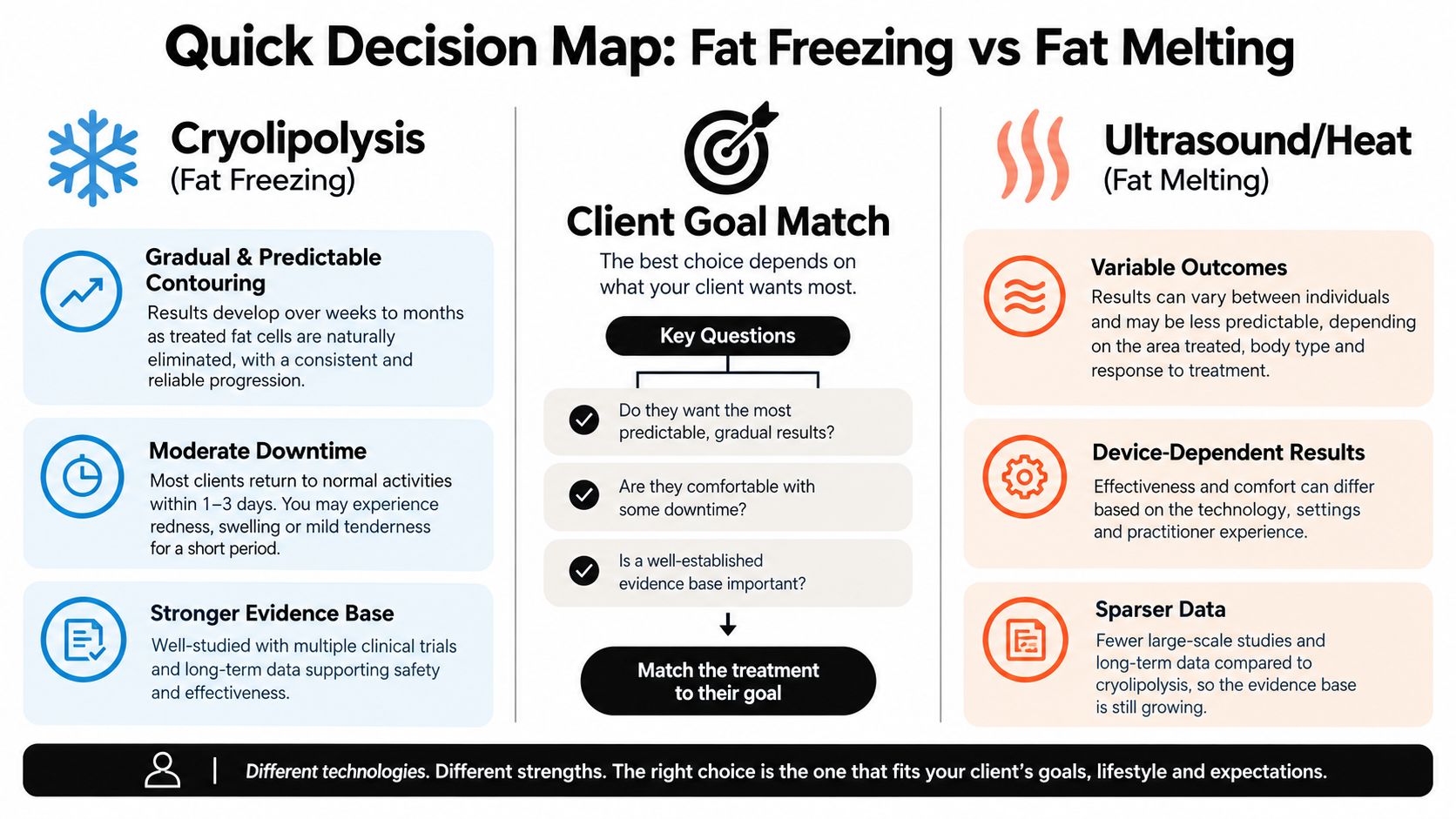
A client wanting a discrete pocket assessed with a defined follow-up plan is usually a better candidate for cryolipolysis, while a client considering ultrasound or heat needs to accept device-dependent outcomes and more limited generalisable evidence. A full assessment remains necessary before committing.
| Client goal or constraint | Pathway usually more appropriate | Key consideration |
|---|---|---|
| Gradual contouring of a pinchable local fat pocket | Cryolipolysis | Discuss delayed clearance, consent and follow-up measurements |
| Preference for an ultrasound or heat-based approach | Ultrasound or heat-based contouring | Identify the exact device, settings, applicator and evidence |
| Expectation of broad weight loss | Neither pathway | Local contouring doesn't replace weight management |
| Desire for immediate visible inch loss | Neither pathway | Early appearance can reflect swelling, posture or measurement variation |
| Limited time for follow-up | Neither until timing is addressed | Results vary from person to person and need appropriate review |
| Concern about a pocket without enough pinchable fat | Neither may be appropriate | The tissue and applicator must match the treatment |
| Willingness to compare objective measurements over time | Either may be considered | Agree the measurement method before treatment |
When we say no
We may turn someone away if the desired result is unrealistic, if the area isn't suitable, or if a health concern needs assessment outside our service. We also won't use a comparison table to push someone towards a treatment just because they've arrived expecting to book.
3D Aesthetics Leamington Spa can assess body-contouring concerns using consultation, treatment-area evaluation and 3D body scanning. That doesn't mean every client will be offered fat freezing or cavitation. A safe recommendation can be no treatment, a different body-sculpting discussion or a request to seek appropriate medical advice.
Next Steps and Common Questions After Reading
The next step is a free consultation with a full 3D body scan, followed by a treatment recommendation based on your area, health history, expectations and measurement plan. You can book your free consultation at our clinic at 11 Guys Place East, Leamington Spa, Warwickshire CV32 4RG, or call 01926 315764.
Bring details of your relevant health history, previous body-contouring treatments and the result you're hoping to assess. Wear clothing that allows the treatment area to be considered comfortably, and be prepared to discuss whether you can attend a later review. We'll identify the proposed device and explain consent, sensations, limitations and follow-up before you decide.
Common questions
Are results immediate? No. Cryolipolysis depends on gradual clearance over several weeks, and ultrasound or heat-based outcomes also need proper follow-up. Results vary from person to person.
How many sessions will I need? There isn't one responsible number for everyone. The treatment area, tissue volume, device, treatment goal and response determine whether one appointment or a planned course should be discussed.
Is either treatment suitable for everyone? No. We assess the area, your expectations and relevant health information. We may decline treatment when localised contouring isn't appropriate.
What if the result is poorer than expected? We compare follow-up measurements with the baseline, review the treatment record and discuss the available next step. A consent process should explain who to contact and how concerns are escalated.
Where can I read more about choosing a clinic? For broader context on evaluating aesthetic services and patient-facing clinic information, Leaping Lemur Media med spa marketing offers a useful resource, although your treatment decision should still be based on an individual consultation and appropriate clinical information.
At 3D Aesthetics Leamington Spa, we offer fat freezing, cavitation, body sculpting, 3D Powersculpt, cellulite reduction, skin tightening and 3D body scanning for clients seeking localised body-contouring guidance. Visit 3D Aesthetics Leamington Spa or call 01926 315764 to arrange a consultation and discuss whether either pathway matches your goals.
← Back to Home