
A HIFU facelift typically lasts 12 to 18 months, with some clients seeing results for up to 2 years. The full tightening usually develops over 2 to 3 months as new collagen forms, so the best result is gradual rather than instant.
That timeline surprises people who expect HIFU to behave like surgery. In practice, it works more like a collagen-remodelling programme with a maintenance cycle, and that changes how you should judge value, timing, and whether it suits your skin.
Table of Contents
- Why HIFU Is Not a Permanent Facelift
- The Biological Timeline of HIFU Results
- Factors That Determine How Long Your Results Last
- Your HIFU Maintenance and Aftercare Plan
- How HIFU Durability Compares to Alternative Treatments
- Getting the Best HIFU Results at 3D Aesthetics Leamington Spa
Why HIFU Is Not a Permanent Facelift
The biggest mistake people make is assuming HIFU behaves like a surgical facelift. It doesn't. HIFU, or High-Intensity Focused Ultrasound, creates controlled heat points in the skin and deeper support layers, which encourages the body to build new collagen rather than physically reposition tissue in the way surgery does. That means the result can look lifted and firmer, but it's still governed by natural ageing and collagen turnover. A useful overview of facial rejuvenation treatments can be found in this facial rejuvenation guide.
Most UK-facing guidance places visible results in the 12 to 18 month range, with some people seeing benefits for up to 2 years or, in selected cases, around 3 years. That spread tells you something important, the treatment isn't “one and done”. It's better understood as a repeatable intervention for mild to moderate laxity, especially when the goal is to tighten and support rather than overhaul advanced sagging.
Practical rule: If a treatment depends on collagen stimulation, treat it as a cycle, not a permanent fix.
That distinction matters when you're comparing HIFU with stronger interventions. Younger skin with mild laxity often responds more predictably, because there's more structural reserve for collagen remodelling to work with. Older skin, or skin with more obvious jowling and laxity, usually doesn't hold the result as long, and sometimes doesn't reach the level of change people hoped for in the first place. The treatment can still be useful, but the expectation has to be honest.
The value of HIFU is that it can create a meaningful tightening effect without surgery, stitches, or incision-based downtime. The trade-off is durability. If someone wants a permanent structural change, HIFU isn't the right mental model. If they want a measured improvement that can be maintained, it often fits very well.
The Biological Timeline of HIFU Results
HIFU doesn't give the dramatic “before and after” reveal people expect from a mirror check the next day. The reason is biological, not technical. The treatment creates thermal coagulation points in the dermis and SMAS-adjacent tissue, and the body responds by laying down new collagen. That remodelling process is what gradually improves firmness and contour, not immediate tissue displacement.
When the change becomes visible
UK-facing clinical guidance describes the main tightening as appearing after 8 to 12 weeks, or about 2 to 3 months, with improvement sometimes continuing for up to 6 months as collagen matures. That delayed curve is not a warning sign, it's the mechanism doing its job. If the skin looked dramatically different on day one, that would raise more questions about what was treated.
The common sequence is simple. There may be a slight early tightening sensation, then a more obvious change in firmness over the following weeks, then a plateau as the new collagen network settles. After that, natural ageing starts to take over again, and the result gradually softens rather than disappearing overnight.
The best HIFU outcomes feel calm and incremental. They don't shout.
Why the result fades
Collagen is not static tissue. Once the remodelling phase is complete, the body keeps ageing in the background, and the newly improved support structure slowly weakens over time. That's why UK guidance repeatedly frames HIFU as a treatment with a maintenance window, not a permanent correction. The result can hold well for a time, then starts to taper as the skin continues its natural decline.
That timeline is why many practitioners plan HIFU around a yearly review, rather than waiting until laxity has fully returned. It also explains why the treatment is often more satisfying for clients who want subtle, cumulative improvement rather than a dramatic one-off transformation.
Factors That Determine How Long Your Results Last
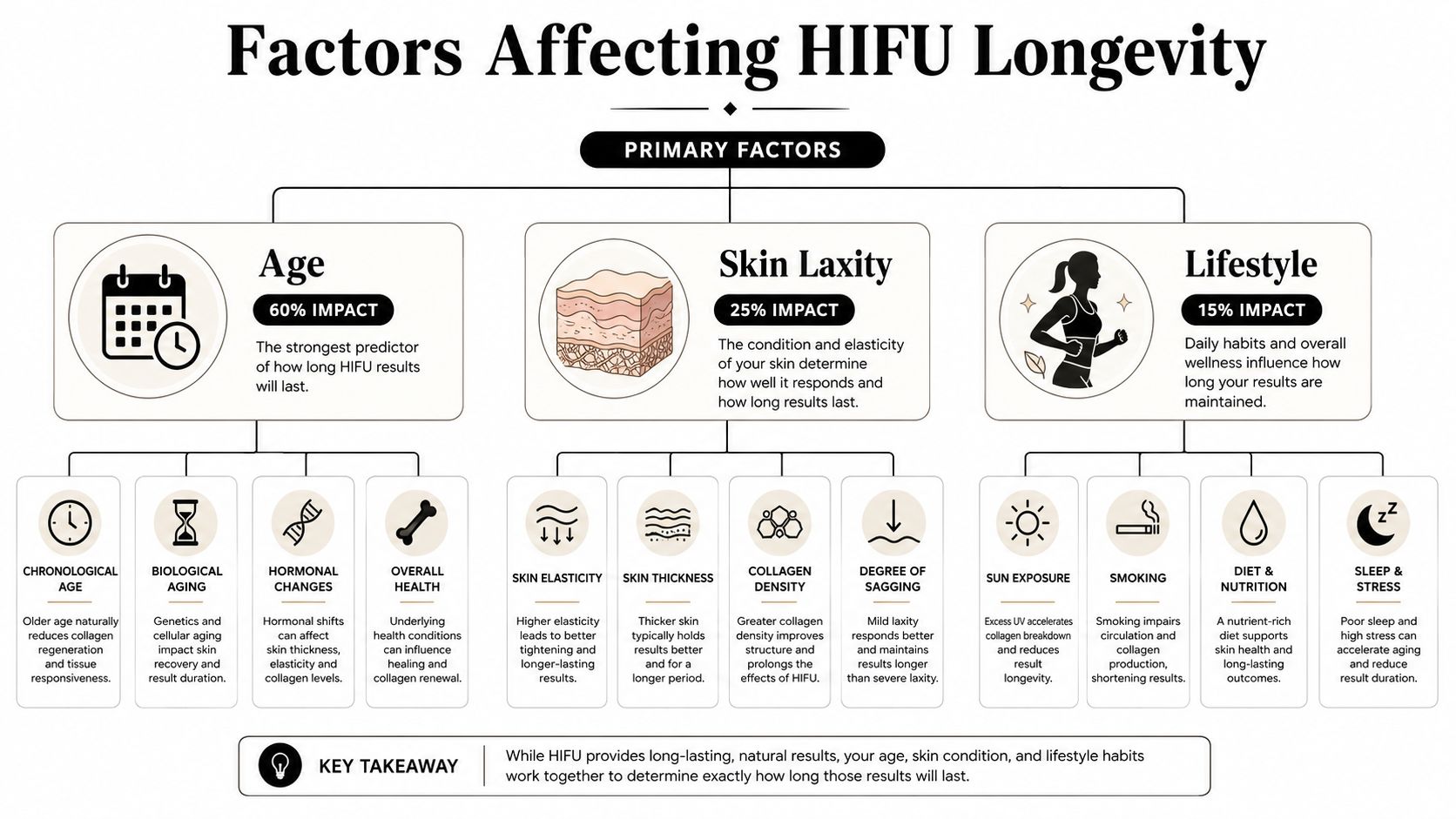
Two people can have the same HIFU session and get very different outcomes. That's not marketing spin, it's biology, skin quality, and technique. Age and baseline laxity are major variables, but they're not the only ones. Sun exposure history, smoking, and general collagen reserves all influence how long the skin holds onto the result.
Who tends to keep results longer
Younger clients with mild laxity generally have the best longevity. Their skin still has more repair capacity, so the collagen response tends to look cleaner and hold longer. By contrast, older clients, or people with more advanced laxity, often see a shorter-lived result because there's less structural support to rebuild from. Existing UK-relevant commentary suggests some younger clients may see results lasting 18 to 24 months, while older clients or those with moderate to severe laxity may be closer to 12 to 18 months.
That difference matters when someone asks whether HIFU can replace a facelift. For mild sagging, it can be a strong non-surgical option. For more advanced descent, the response may not be durable enough to meet the goal.
What weakens longevity in day-to-day life
Lifestyle choices matter because collagen doesn't rebuild in a vacuum. Smoking, heavy sun exposure, poor skin care, and inconsistent protection all work against the remodelling process. A good routine won't stop ageing, but it can help the result look smoother for longer.
A few practical variables deserve attention:
- Sun exposure: UV damage accelerates collagen breakdown and shortens the visible lift.
- Smoking: Nicotine and related effects impair skin quality and recovery.
- Skin condition at baseline: Better elasticity usually means a better response.
- Technique and device quality: Energy depth and cartridge selection influence whether the right tissue is treated.
- Aftercare habits: Gentle skincare and consistent protection help maintain the look.
Device quality deserves real weight here. A well-trained practitioner using the wrong cartridge or delivering energy at the wrong depth can blunt the result. That's why longevity isn't just about the client, it's also about who performs the treatment and how carefully they assess the face before starting.
Your HIFU Maintenance and Aftercare Plan
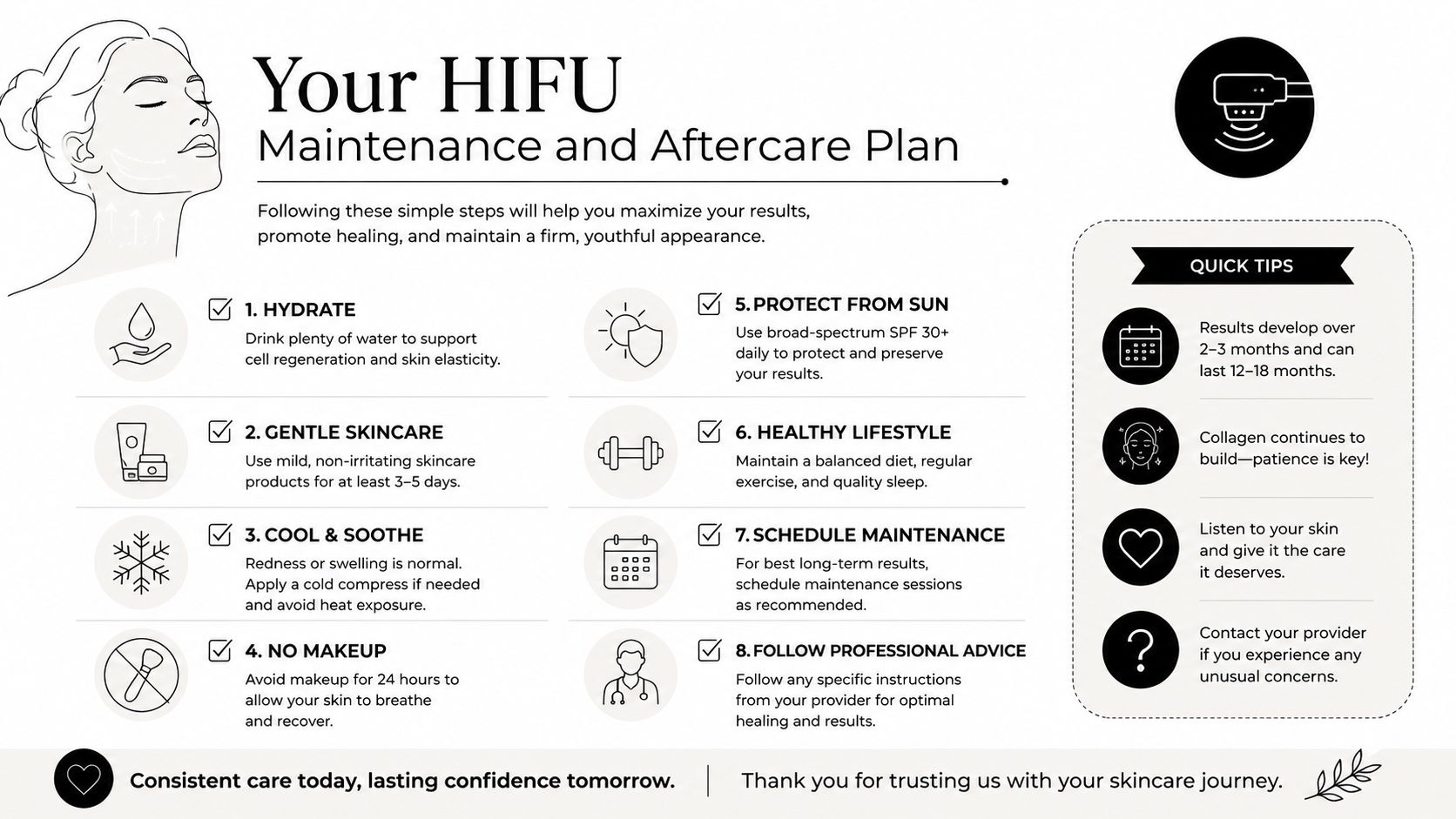
The most useful way to think about HIFU is as a planned maintenance treatment. Many UK-facing clinics advise a repeat session at around 12 months, with some recommending top-ups every 12 to 18 months depending on age, skin quality, and lifestyle. That approach fits the biology of collagen remodelling far better than waiting for everything to slide back before acting.
What to do after treatment
The first few weeks matter because the skin is recovering and the collagen response is getting underway. Keep the routine plain and predictable.
- Use SPF daily. UV protection helps preserve the work you've just invested in.
- Keep cleansing gentle. A mild cleanser and moisturiser are suitable for everyone.
- Avoid aggressive treatments early on. Strong peels, intense scrubs, and overhandling can irritate skin that's still settling.
- Limit smoking and heavy sun exposure. Both undermine the repair environment.
- Stay hydrated. Hydration won't create results on its own, but dehydrated skin rarely looks at its best.
A supportive home routine can also include a collagen-focused cream if your skin tolerates retinol well. One example is this collagen and retinol cream, which some people use as part of a broader skin maintenance plan rather than as a stand-alone fix.
How to think about the next session
Don't wait for all of the lift to vanish. If the result is beginning to soften around the one-year mark, that's often the right time to review. Some clinics also combine HIFU with other collagen-supporting treatments between sessions, such as LED light therapy, microneedling, or radio frequency, to help maintain skin quality overall.
The point is consistency. HIFU works best when it sits inside a skin programme, not as a rescue treatment after prolonged neglect.
How HIFU Durability Compares to Alternative Treatments
HIFU sits in a useful middle ground. It lasts longer than many quick-fix non-surgical treatments, but it doesn't compete with surgery on duration. That's not a weakness, it's just the trade-off you're making for minimal downtime and no incisions. If you want a deeper look at treatment categories, this skin tightening treatments guide gives useful context.
| Treatment | Typical Duration | Downtime | Best For |
|---|---|---|---|
| HIFU | 12 to 18 months | Low | Mild to moderate laxity, collagen support |
| Dermal fillers | Varies by product and area, often shorter than surgical options | Low to moderate | Volume loss and contour refinement |
| Radio frequency skin tightening | Often shorter and usually needs multiple sessions | Low | Gradual tightening and skin quality support |
| Thread lifts | 12 to 18 months | Moderate | Temporary lift for selected patients |
| Surgical facelift | Much longer lasting than non-surgical options | Higher | Advanced sagging and structural repositioning |
The table makes the main point clear. HIFU is attractive because it delivers a meaningful result without the recovery burden of surgery, but it's not the longest-lasting route overall. Fillers address volume, RF supports skin quality over repeated sessions, and thread lifts create a temporary lift through a different mechanism. Surgery remains the longest-lasting option for deeper structural change.
The right choice depends on the face in front of you. For someone with early laxity and a preference for non-invasive care, HIFU can be a strong fit. For someone with more advanced sagging, it may be only part of the answer, not the whole one.
Getting the Best HIFU Results at 3D Aesthetics Leamington Spa
At 3D Aesthetics Leamington Spa, the useful part starts before treatment. The clinic offers a complimentary consultation with a full 3D body scan, which helps assess skin concerns and personalise the plan rather than guessing at cartridge depth or session approach. That matters because HIFU longevity depends heavily on selecting the right settings for the right face.
The clinic's non-surgical face lift service is built around the same maintenance logic discussed above, with repeat treatment planned around the result window rather than after the effect has completely faded. Its broader facial portfolio, including 3D Dermaforce microneedling, 3D Face & Eye RF, Dermalux LED light therapy, and the 3D-HydrO2 facial, also gives clients other ways to support skin quality between HIFU sessions. For more details, the clinic's dedicated 3D HIFU face lift page is the most direct place to start.
A good HIFU outcome comes from matching the treatment to the skin in front of you. That's where trained therapists, correct energy delivery, and realistic expectations make the difference between a decent result and a disappointing one.
If you're considering HIFU and want a measured view of what it can achieve for your skin, book a consultation with 3D Aesthetics Leamington Spa. Their team can assess whether your skin is better suited to HIFU alone or to a broader maintenance plan that keeps collagen support on track over time.