
You catch yourself doing it in bright bathroom light or on your phone's front camera. You smile, then notice the skin at the sides of your eyes sits a little differently. Your jawline looks softer. Makeup doesn't glide on the way it used to, or your skin looks tired even when you aren't.
That's usually when people start asking a simple question that turns out to have a bigger answer than expected. What is facial rejuvenation? It isn't one treatment, one machine, or one dramatic change. It's a way of restoring a fresher, healthier, more balanced appearance by treating the specific layers that have changed over time.
The easiest way to understand it is to stop thinking of the face as a flat surface. Think of it more like a house. Some concerns come from the structure beneath. Some come from the support within the walls. Others sit right at the surface where you can see dullness, pigmentation, lines, rough texture, or enlarged pores. When you know which layer is responsible, the treatment choice starts to make sense.
Table of Contents
- An Introduction to Modern Facial Rejuvenation
- How Facial Rejuvenation Works The Science of Skin Ageing
- A Guide to Non-Surgical Rejuvenation Treatments
- Comparing Results Risks and Downtime of Treatments
- Beyond Skin Tightening The Role of Facial Contouring
- Your Rejuvenation Journey What to Expect at Our Clinic
- Is Facial Rejuvenation Right for You
An Introduction to Modern Facial Rejuvenation
Facial rejuvenation is the umbrella term for treatments that improve how the face looks and feels as skin ages. That can mean softening fine lines, improving texture, tightening lax skin, refining pores, brightening uneven tone, or restoring a cleaner facial contour. Today, it often doesn't begin with surgery. It begins with a personalised plan.
That shift is already well established in the UK. Non-surgical facial rejuvenation represents a £3.6 billion annual market in the UK and accounts for over 75% of total cosmetic market revenue, while facial injectables adoption surged by 7,000% between 1997 and 2016 according to The PMFA Journal's review of non-surgical rejuvenation trends. Those numbers matter because they show this isn't a fringe choice. It's a mainstream route for people who want visible change without the disruption of an operation.
People often assume rejuvenation means “looking younger” in a vague sense. In practice, it's more precise than that. A good plan asks what specifically has changed. Is your skin thinner-looking and crepey? Has your lower face started to sit lower? Are pores and roughness making the skin look tired? Those are different problems, so they need different tools.
What most people are really asking
When someone asks about facial rejuvenation, they're usually asking one of these:
- Can I look fresher without looking done: Individuals often seek natural-looking change, not a different face.
- What will improve first: Some treatments brighten the skin quickly, while others work more gradually as tissue remodels.
- How much downtime will I need: This is often the deciding factor for busy professionals and parents.
- Do I need one treatment or a plan: Usually it's a plan, because ageing doesn't happen in only one layer.
Good facial rejuvenation should make people think you look well rested, not treated.
Supportive treatments can play a role too. For example, light-based therapies such as Dermalux LED therapy are often used to calm the skin and support recovery as part of a broader strategy.
How Facial Rejuvenation Works The Science of Skin Ageing
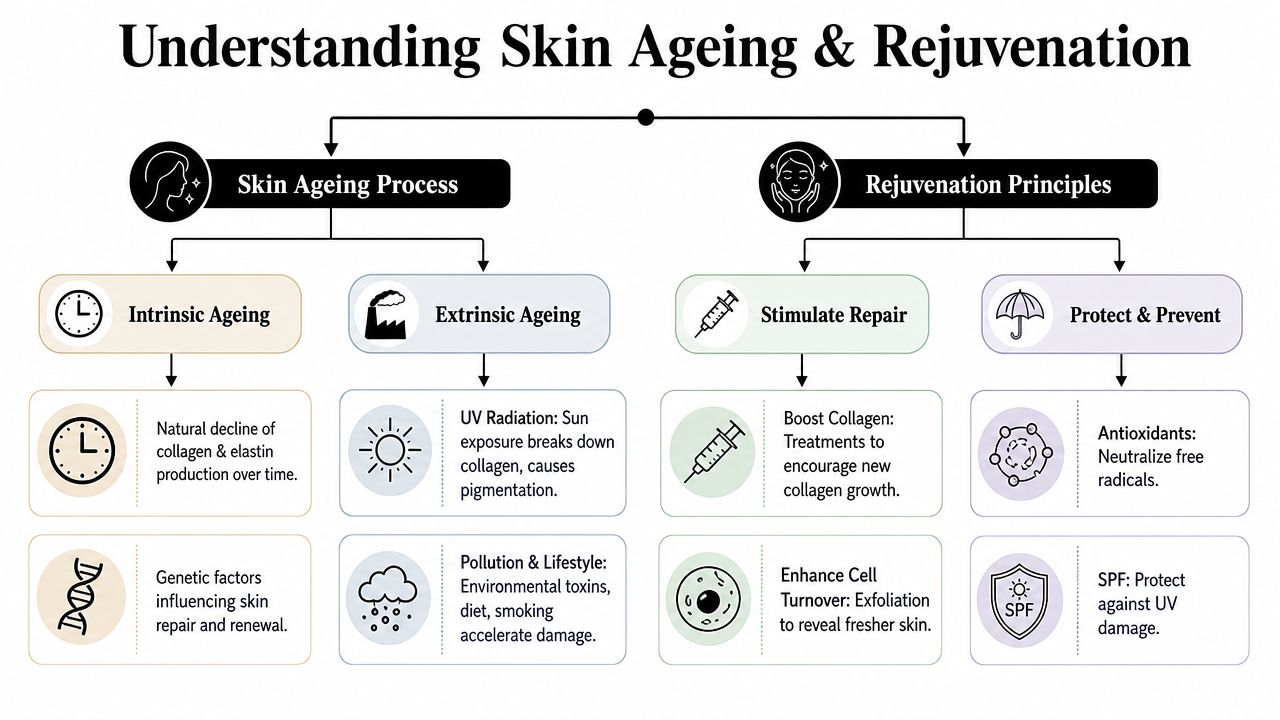
Ageing becomes much less confusing once you picture the face like a house that's been standing through years of weather, gravity, and daily use. If the foundations shift, the building sits differently. If the walls lose strength, the structure feels less solid. If the paint gets worn, the whole house looks older even if the frame is still sound.
The house renovation way to understand ageing
The foundation is the deeper support system of the face, often discussed in relation to the SMAS and underlying tissue support. Over time, gravity, repeated facial movement, and tissue descent can make the cheeks sit lower, soften the jawline, and deepen folds. This is why someone can have smooth skin but still feel they look tired or less defined.
The walls are your dermis, where collagen, elastin, and hydration help skin stay springy and resilient. When these supports decline, skin doesn't bounce back the same way. It starts to look thinner, looser, and less firm.
The paintwork is the surface. Here, you notice rough texture, enlarged pores, pigmentation, uneven tone, and fine lines. Sun exposure and daily environmental stress often show up here first. If you're interested in broader lifestyle support alongside clinical care, this guide to supplements for healthy aging gives a helpful overview of habits and nutrients people commonly explore as part of a skin-health routine.
Why one treatment rarely fixes everything
Many people often become frustrated. They choose a treatment designed for the surface, then feel disappointed because the underlying issue is lower-face laxity. Or they choose a tightening treatment, but what bothers them most is rough texture and visible pores.
A better way to think about it is layer by layer:
- If the foundation has shifted, lifting or tightening technologies may be more relevant.
- If the walls have weakened, collagen-stimulating treatments may help more.
- If the paint is weathered, resurfacing or skin-renewal treatments often make the biggest visible difference.
Practical rule: Match the treatment to the layer that changed, not just the feature you notice in the mirror.
Once you understand that, the logic behind facial rejuvenation becomes much simpler. It isn't about chasing every sign of ageing separately. It's about restoring the structure, support, and finish of the face in the right order.
A Guide to Non-Surgical Rejuvenation Treatments
Different technologies do different jobs. Some lift. Some stimulate repair. Some resurface. Some support skin health between bigger procedures. When patients understand that, treatment names stop sounding like jargon and start sounding like tools.
Foundation treatments for lift and support
If your main concern is sagging around the cheeks, jawline, or lower face, the target is deeper. HIFU is commonly used here because it delivers focused ultrasound energy beneath the skin to encourage tightening in deeper support layers. In the house analogy, this is the closest thing to working on the foundation without opening the walls.
Radio frequency can also support firmness, particularly where skin laxity is mild to moderate. Facial RF tends to suit people who want a gradual tightening effect and a gentler entry point than more intensive procedures.
Wall treatments for firmness and repair
If your skin feels thinner, less elastic, or more lined, the goal shifts to rebuilding support within the dermis. Microneedling, including 3D Dermaforce microneedling, creates controlled micro-injury that encourages skin repair and collagen renewal. It's often chosen for fine lines, post-acne texture, and general firmness.
RF microneedling goes one step further by combining needling with heat energy. That means it can address both textural concerns and deeper dermal remodelling in one plan. This category is often where patients begin to see why combination therapy can be useful. You're not just polishing the surface. You're trying to improve the quality of the skin itself.
Surface treatments for tone texture and glow
When the issue is dullness, roughness, superficial lines, pigmentation, or enlarged pores, resurfacing becomes important. Fractional CO2 resurfacing works at the surface and just below it to refresh damaged skin and improve overall texture. It's often one of the more rejuvenating options for people whose skin quality has changed noticeably.
For gentler maintenance and hydration-focused care, treatments such as HydrO2 facials, LED therapy, and carbon facials can help support brightness and skin comfort. These won't replace deeper lifting or collagen work when those are needed, but they can be excellent additions.
If uneven tone is one of your main worries, this guide to Neutralyze's skin tone solutions offers a useful plain-English look at why pigmentation and post-blemish marks can linger.
You can also explore a broader category of skin resurfacing treatment options when texture, pores, and visible sun damage are high on your list.
Non-Surgical Facial Treatments at a Glance
| Treatment | Primary Target | Best For | Typical Downtime | Results Timeline |
|---|---|---|---|---|
| HIFU | Deeper support layers | Mild to moderate laxity, softer jawline, lifting support | Little to minimal | Gradual |
| Facial RF | Dermal tightening | Early looseness, maintenance, skin firmness | Little to none | Gradual |
| Microneedling | Collagen support in the dermis | Fine lines, texture, acne scarring, pores | Short social downtime | Progressive |
| RF Microneedling | Dermis plus thermal remodelling | Texture and firmness together | Short downtime | Progressive |
| Fractional CO2 resurfacing | Surface renewal and skin remodelling | Rough texture, lines, pores, visible sun damage | More noticeable downtime | Stronger change after recovery |
| Dermalux LED | Skin support and calming | Recovery support, redness-prone skin, maintenance | None | Subtle and supportive |
| HydrO2 facial | Surface hydration and brightness | Dull skin, event prep, regular upkeep | None | Quick glow, ongoing upkeep |
Think of this toolkit as renovation equipment. You wouldn't repaint a wall that needs structural repair first. The same logic applies to the face.
One clinic option that brings several of these non-surgical approaches together is 3D Aesthetics Leamington Spa, where treatments such as HIFU, RF, microneedling, CO2 resurfacing, Dermalux LED, and HydrO2 are used according to the concern being treated.
Comparing Results Risks and Downtime of Treatments
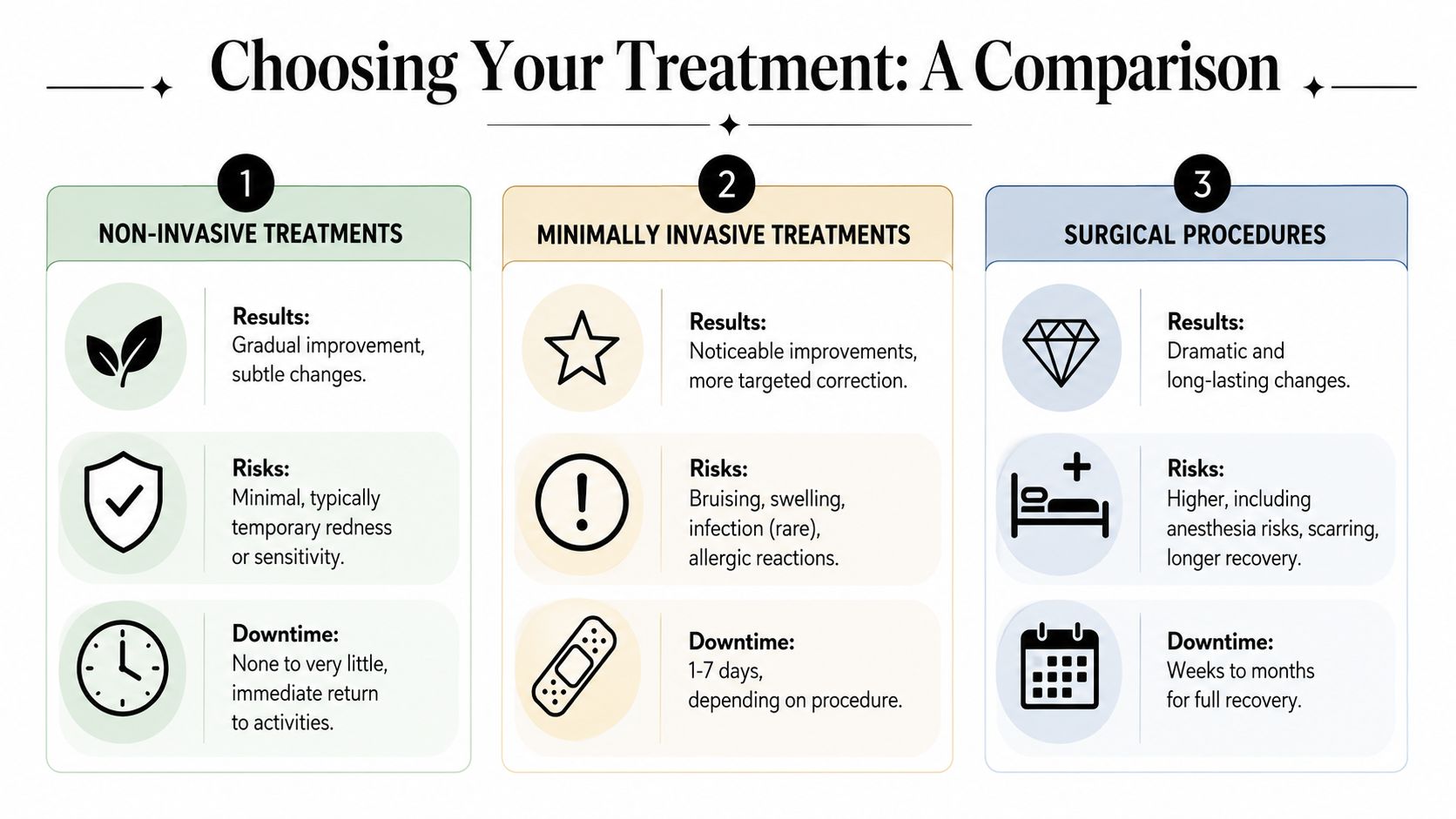
The right treatment isn't always the strongest one. It's the one that fits your concern, your timetable, and your tolerance for recovery. Some people want a subtle refresh with no interruption to work. Others are happy to take a few days of visible healing if the skin-quality change is more dramatic.
How to think about treatment trade-offs
A simple way to compare options is to place them on a spectrum.
- Low-intervention treatments such as LED or hydrating facials usually involve no downtime and can help the skin look fresher, calmer, or more radiant.
- Mid-level treatments such as microneedling, RF, or HIFU tend to ask more of the skin but can address firmness, texture, and early laxity more meaningfully.
- Higher-intensity resurfacing such as fractional CO2 often brings the most visible surface change, but recovery is more noticeable.
Surgical procedures sit in another category entirely. They can create stronger structural change, but that comes with a different level of commitment, risk, and downtime. That's why many people begin with non-surgical plans and assess from there.
Why combination plans often work better
One of the most important ideas in modern facial rejuvenation is that combining technologies can produce a more complete result than relying on one method alone. That isn't just a marketing idea. In a study on a single-session multimodal protocol combining HIFES+RF, TUS+RF, and RF microneedling, histological analysis showed a 230.02% increase in hyaluronic acid density, a 39.53% rise in collagen density, and a 130.04% boost in elastin density, along with 47.31% pore reduction, 43.36% wrinkle reduction, and 31.20% improved skin evenness, with 100% of subjects showing overall appearance improvement at three months in GAIS evaluation, according to the ESMED report on multimodal facial rejuvenation.
That matters because ageing is layered. A treatment that tightens won't necessarily resurface. A treatment that resurfaces won't necessarily contour. When a plan combines technologies intelligently, it can target several pathways at once.
The best question isn't “Which treatment is best?” It's “Which combination matches what has changed in my face?”
This is also why consultation matters so much. Two patients can both say “I want to look less tired” and need completely different plans.
Beyond Skin Tightening The Role of Facial Contouring
A common mistake in facial rejuvenation is assuming every heavy or sagging lower face is caused by loose skin. Sometimes that's true. Sometimes it isn't. In many faces, especially around the jowls and under the chin, stubborn fat can blur the jawline and add weight that tightening alone won't fully solve.
When looseness is not the whole story
This is an overlooked part of the conversation. The underserved angle of fat reduction within facial rejuvenation is rarely addressed, yet minimally invasive techniques can specifically target stubborn fat in the jowls and under-chin area to refine contour, helping patients with heavier lower faces who need more than skin tightening, as described in this overview of Endolift and facial fat-focused contouring.
That idea is easy to understand if you return to the house analogy. If the outline of the building looks bulky because something is pressing outward, tightening the exterior won't always create a cleaner shape. You may also need to reduce what's creating that heaviness.
For the face, that often means asking better questions at consultation:
- Is this true laxity: Loose skin and descended tissue usually need lifting or tightening support.
- Is this excess volume in the wrong place: Lower-face heaviness may need contouring.
- Is it both: Many people need a blend of tightening and reduction for the most balanced result.
If your concern centres on fullness beneath the chin, options such as double chin fat freezing are part of that contouring conversation.
A sharper jawline doesn't always come from tighter skin. Sometimes it comes from removing the weight that's hiding the shape.
Your Rejuvenation Journey What to Expect at Our Clinic
Individuals feel more comfortable once they know what happens from the first appointment onwards. The process should feel measured, calm, and clear, not rushed or sales-led.
Your consultation and skin assessment
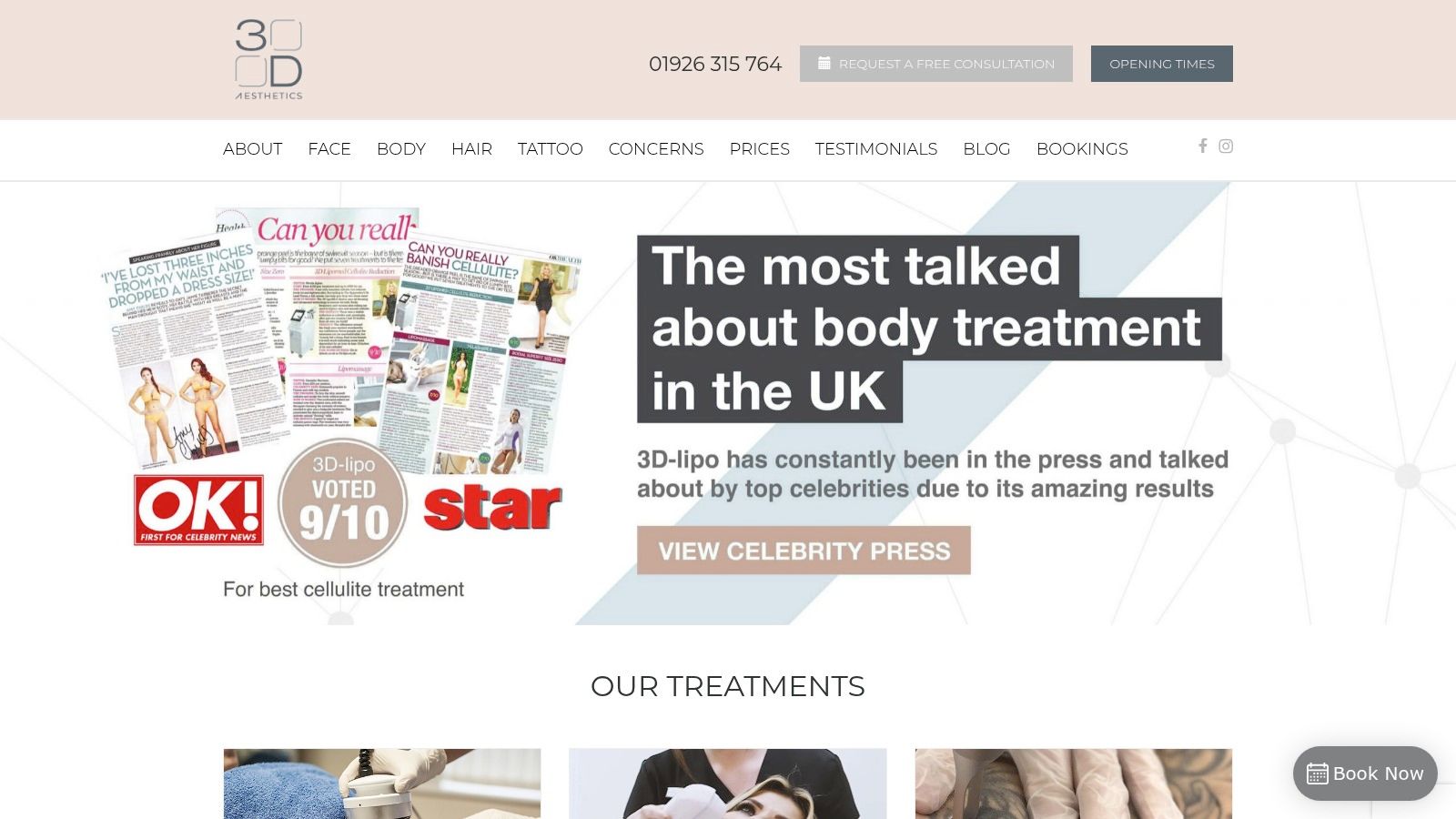
The starting point is a complimentary consultation with an in-depth assessment, including a full 3D scan. That scan helps map areas of concern, create a personalized treatment plan, and track changes over time. For patients, this is often the moment everything clicks. Instead of saying “I just look older”, you begin to see whether the issue is more about laxity, texture, pigmentation, contour, or a combination.
A thoughtful consultation also rules things out. If a concern is mostly contour-related, a surface treatment alone may not be the right use of your time or budget. If skin is reactive or depleted, the plan may begin with repair and preparation before anything more intensive.
Ask your practitioner what layer they're treating and why. If they can't answer that clearly, the plan probably isn't specific enough.
Treatment day and aftercare
On treatment day, the experience depends on the technology used. LED and hydrating facials tend to feel relaxing. Microneedling and RF-based treatments feel more active but are usually manageable. CO2 resurfacing is a bigger event and needs more preparation because recovery is more visible.
Aftercare is where good results are protected. That usually means keeping the skin clean, following product guidance, avoiding unnecessary irritation, and being patient while the skin settles. Regenerative treatments often improve gradually rather than all at once, because your body is doing the remodelling work in the weeks that follow.
Changes in facial fullness can also be part of the discussion, especially if weight loss has affected the face. For readers trying to understand that side of the picture, this article on how to prevent Ozempic face is a useful background read on why volume loss can alter facial balance.
Here's a short look at the clinic environment and treatment approach:
Results timing varies by treatment. Some skin-brightening procedures give a quicker visible lift. Collagen-focused treatments usually reward patience. The key is having realistic expectations from the start so you know whether you're choosing a quick refresh, a gradual rebuild, or a layered plan that unfolds over time.
Is Facial Rejuvenation Right for You
Facial rejuvenation is usually a strong fit if you've started to notice mild to moderate changes in firmness, texture, tone, pores, or lower-face definition and you want a natural-looking result without the commitment of surgery. It also suits people who prefer a personalised plan over a one-size-fits-all treatment menu.
It may be especially suitable if you want to look fresher rather than dramatically different. The aim is often restoration, not reinvention. For many patients, that means combining a few well-chosen treatments over time instead of searching for one miracle procedure.
This field is also continuing to grow globally. The global facial rejuvenation market is valued at US$ 22.6 billion in 2025 and is projected to reach US$ 34.9 billion by 2032, growing at a CAGR of 6.4%, according to the BBC's summary of facial rejuvenation market growth. That long-term growth reflects something simple. More people now see facial rejuvenation as a normal, trusted option for maintaining confidence and skin quality.
If you're still unsure, that's normal. The right next step isn't guessing. It's getting your face assessed properly so you can understand which layer has changed, which treatments match it, and what kind of result is realistic for your lifestyle.
If you'd like clear guidance on your options, book a complimentary consultation with 3D Aesthetics Leamington Spa. You'll get a personalised assessment, a 3D scan, and a treatment plan built around your skin, facial structure, and goals.