

You catch it in ordinary moments. Foundation sits a little differently along the jawline. The skin under your chin looks softer on video calls. Your cheeks still look healthy, but the definition you used to take for granted isn't as crisp. Individuals who start looking into skin tightening treatments for face aren't trying to look different. They want to look more like themselves, just fresher and firmer.
That's where non-surgical treatment can make sense. You don't have to jump straight to surgery to address early jowling, mild skin laxity, fine lines, or loss of facial firmness. The key is understanding which treatment works at which depth, and why one person may be better suited to HIFU while another gets more from radiofrequency, RF microneedling, resurfacing, or a supportive skin-health treatment. If you've been comparing options and feeling that everything sounds the same, that confusion is normal.
A clear explanation matters before you book anything. If you're also weighing broader rejuvenation options, this guide to facial rejuvenation treatments gives helpful background. Below, I'll break down what tightens skin, who each option suits, where the trade-offs sit, and how a personalised plan is built.
Table of Contents
- Is a Non-Surgical Facelift Right for You
- How Skin Ages and Why Tightening Treatments Work
- An Overview of Top Skin Tightening Treatments
- A Deep Dive into Energy-Based Devices
- A Deep Dive into Resurfacing and Rejuvenation
- The 3D Aesthetics Difference Your Personalised Plan
- Frequently Asked Questions About Facial Skin Tightening
Is a Non-Surgical Facelift Right for You
A common client story starts like this. They haven't had a sudden change. They've just noticed a gradual softening around the lower face, a heavier look through the jowls, or makeup collecting more around smile lines. They don't want a dramatic result, and they don't want the recovery of surgery. They want a treatment that nudges the skin back towards firmer, tighter support.
That's the right mindset for a non-surgical facelift approach. These treatments are usually most useful when the concern is mild to moderate laxity, not very heavy excess skin. If your issue is early sagging, soft jawline definition, crepey skin, or a tired-looking lower face, non-surgical technology can often improve firmness and contour in a natural-looking way.
Signs you may be a good candidate
- Your face looks less defined, not drastically changed. Early jowls and mild neck laxity often respond better than severe heaviness.
- You want progressive improvement. These treatments stimulate your own collagen and elastin rather than creating an instant surgical lift.
- You can commit to a plan. Some options work best as a course rather than a one-off session.
- Your expectations are realistic. Non-surgical treatment can tighten and refine. It won't replace surgery where skin excess is advanced.
Practical rule: The best non-surgical result usually comes when treatment starts at the stage where you've noticed change, but before laxity becomes severe.
When it may not be the right fit
If skin is very loose, if there's substantial heaviness through the lower face, or if you want a dramatic repositioning effect, a surgical consultation may be more appropriate. That isn't a failure of non-surgical treatment. It's choosing the right tool for the right anatomy.
Many individuals sit somewhere in the middle. They don't need the operating theatre, but they do need more than a basic facial. That's the space where specific skin tightening treatments for face can be very effective.
How Skin Ages and Why Tightening Treatments Work
Skin doesn't suddenly become lax. It changes because its support network changes. Collagen gives skin structure. Elastin helps it spring back. As those fibres become less firm, skin doesn't hold itself as tightly against the face in the same way. That's when you start seeing softness around the jawline, fine lines that stay put, and a looser texture through the cheeks or neck.
The important part is this. Different treatments work because they trigger the skin to repair and rebuild in different ways. Once you understand the mechanism, the options stop sounding interchangeable.
Thermal stimulation
Treatments such as HIFU and radiofrequency deliver controlled heat into specific layers of tissue. That heat creates a repair response. Over time, the skin builds fresh collagen and elastin, which is why tightening develops gradually rather than all at once. This approach is most relevant when the goal is lifting, firming, or improving laxity.
Controlled micro-injury
Microneedling works differently. Tiny channels are created in the skin to kick-start repair. When microneedling is paired with radiofrequency, you get two mechanisms working together. Surface renewal from the needles, and deeper thermal tightening from RF. That combination is often useful when texture and laxity sit side by side.
Skin quality affects how “tight” the face looks. Two people can have similar laxity, but the one with stronger texture and better epidermal renewal usually looks firmer overall.
Supportive skin-health treatments
Not every useful treatment is a primary lifting treatment. LED and HydrO2-style facials support the skin in a different way. They improve recovery, calm inflammation, boost hydration, and help skin function better overall. That doesn't mean they replace HIFU or RF. It means they often improve the outcome around them.
A lot of people also underestimate the role of normal skin renewal. If you want a simple explanation of how cell turnover benefits your skin, that background helps make sense of why resurfacing and recovery-focused treatments can change how firm skin appears.
An Overview of Top Skin Tightening Treatments
A client often sits down and says, “I want tighter skin,” but the underlying concern is usually more specific. It might be a softer jawline, crepey cheeks, post-acne texture, or skin that looks tired even when it is well cared for. The right treatment depends on which layer is driving the change.
That is why I do not group every facial tightening treatment together. Some technologies work deeper and suit structural laxity. Others improve the skin surface, which can make the face look fresher and firmer without creating much lift. Some are best used as support around a main treatment plan.
Skin Tightening Treatment Comparison
| Treatment | Best For | Typical Downtime | Sessions Required |
|---|---|---|---|
| HIFU | Deeper lifting, jawline and neck laxity | Minimal to none | Often planned as a course or review-based treatment plan |
| Radiofrequency | General firming, mild laxity, fine lines | Minimal | Usually delivered as a course, based on skin response |
| Microneedling with RF | Texture plus tightening | Usually some short recovery depending on intensity | Usually a course, tailored to skin condition |
| Fractional CO2 | More intensive resurfacing and textural correction | More downtime than gentler options | Usually planned as a structured treatment course |
| Lasers | Surface rejuvenation and mild tightening | Varies by device and intensity | Depends on concern and laser type |
| Dermalux LED | Recovery support, inflammation control, skin health | None | Usually repeated sessions |
| 3D-HydrO2 facial | Hydration, circulation, glow, skin support | None | Maintenance-based |
HIFU
HIFU is suited to clients whose main complaint is loss of definition rather than rough texture. I consider it most useful for early jowling, lower-face heaviness, and laxity through the chin and neck, because the energy is delivered deeper than a surface-led treatment. If the goal is a fresher finish, HIFU on its own may not be enough. If the goal is support and lift, it is often a stronger fit.
Clients considering 3D HIFU face treatment for deeper facial lifting need to be comfortable with gradual results. Collagen remodelling takes time, so this is not the treatment for someone who wants a dramatic change by next week.
Radiofrequency
Radiofrequency is often the better choice when laxity is mild to moderate and spread more evenly across the face. It heats the dermis more broadly, so it can improve general softness, fine lines, and skin that has started to feel less springy.
It also suits clients who prefer a progressive course with very little disruption to normal routine. The trade-off is depth. RF can be excellent for firming, but if the problem is a heavier lower face or more obvious tissue descent, deeper-focused options may be more appropriate.
Microneedling with RF
Microneedling with RF works well when skin quality and laxity are both part of the picture. This is a common combination in real clinic work. The face does not only look looser. It may also show enlarged pores, uneven texture, old acne marks, or early crepey change.
In that situation, combining controlled needling with radiofrequency gives a more rounded result than using a lifting treatment alone. You get tightening support, but also visible improvement in the skin surface. There is usually some recovery, so timing matters.
Fractional CO2
Fractional CO2 is generally chosen for stronger resurfacing rather than simple maintenance. I would consider it for clients with more established lines, significant sun damage, acne scarring, or rough texture that softer treatments will not shift very far.
The trade-off is clear. Results can be impressive for the right candidate, but downtime is greater and aftercare matters more. It is not the first treatment I would point to for someone who only wants a subtle tightening effect with no interruption to daily life.
Lasers
Laser is a broad category, and that matters. Some laser treatments are aimed mainly at pigment and tone. Others contribute modestly to tightening by stimulating renewal and collagen activity in the upper layers.
For that reason, “laser” is not really a treatment plan by itself. The device, settings, skin tone, and primary concern all affect whether it is being used for rejuvenation, resurfacing, or a small degree of firming.
Dermalux LED
Dermalux LED supports skin recovery and skin function. It does not lift sagging tissue, but it can reduce visible redness, calm reactive skin, and help recovery after stronger treatments.
That makes it useful in a personalised plan. Healthier, less inflamed skin often responds better overall.
3D-HydrO2 facial
3D-HydrO2 facials are best used for skin health, hydration, and maintenance. They can improve how the skin looks and feels quite quickly, which is helpful for dullness, congestion, and dehydration.
They do not replace a true tightening treatment where laxity is the main issue. In clinic, they are often most valuable as part of a wider programme, especially when we want to improve skin condition alongside collagen-focused work.
A Deep Dive into Energy-Based Devices
A common consultation starts like this. Someone looks in the mirror and notices two different changes at once. The jawline is less defined, but the skin across the cheeks also feels looser and less springy. Both concerns fall under “skin tightening,” yet they do not respond best to the same technology.
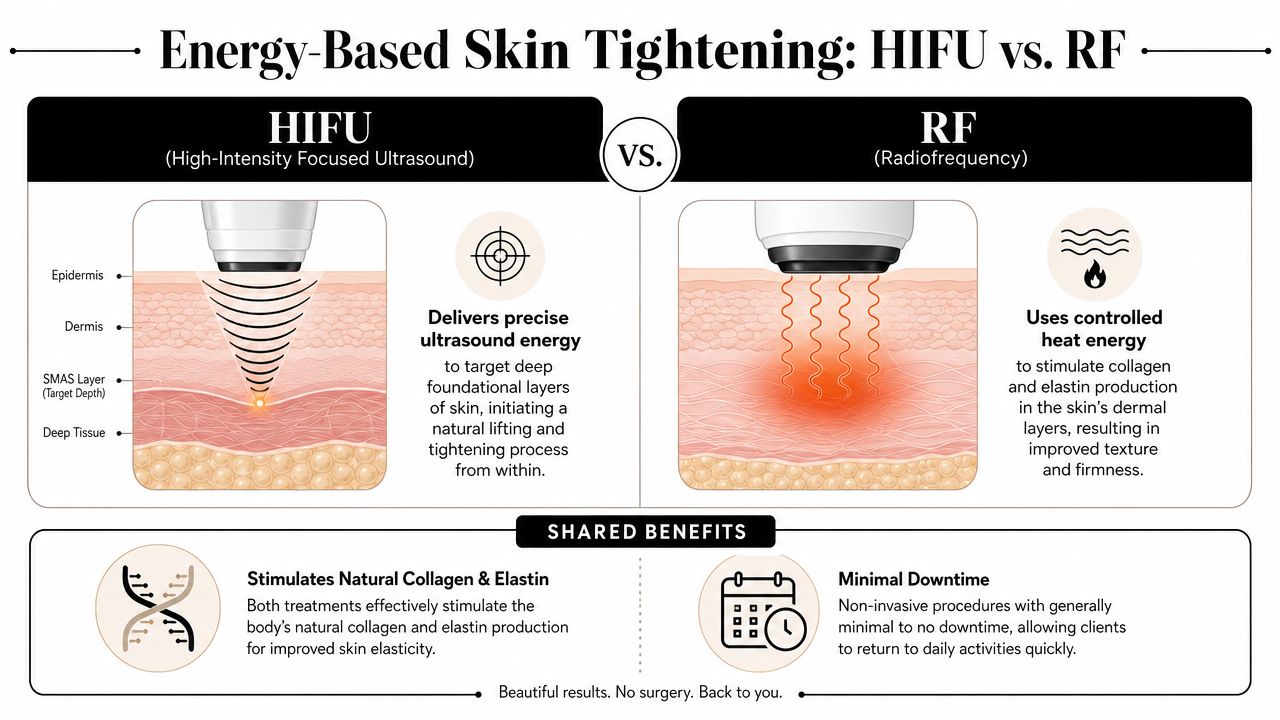
HIFU and radiofrequency both use heat to trigger collagen remodelling. The difference is where that heat is delivered, how focused it is, and what kind of laxity that pattern suits. That is the part that matters most in clinic, because matching the device to the problem is what gives a result that makes sense on the face in front of us.
Why HIFU suits structural laxity
HIFU delivers focused ultrasound energy at specific depths beneath the surface of the skin. It is usually the better fit when the concern is contour rather than texture. I consider it for clients who are starting to see early jowling, softening along the jawline, heaviness under the chin, or a mild drop through the lower face and neck.
Those clients are usually not asking for brighter skin. They are asking for shape back.
That distinction helps avoid the wrong treatment choice. If tissue support is the main issue, a treatment aimed mainly at the upper skin layers can improve glow while leaving the face looking much the same in profile. For the right candidate, 3D HIFU face treatment for lifting and tightening is used to target that deeper structural change.
HIFU also has limits. It does not replace surgery where skin excess is advanced, and it is not my first choice for someone whose main complaint is crepey texture or fine surface lines. In those cases, the client may need a different technology or a combination plan.
Why RF suits diffuse laxity and skin quality changes
Radiofrequency creates dermal heating in a broader, less point-specific way. That makes it useful for clients whose face looks generally softer rather than visibly descended in one area. Cheeks that have lost some firmness, fine lines that are becoming more noticeable, and skin that feels thinner or less elastic often respond well to RF-based treatment planning.
The trade-off is practical. RF usually works best as a course rather than a one-off appointment. Improvement tends to build gradually as collagen remodelling develops, so it suits clients who are happy with steady change and prepared to commit to a series.
This is also why expectations need to be set properly. One isolated RF session can leave an established laxity case underwhelmed. A well-planned course, with the right spacing and review points, is much more realistic.
How I separate HIFU from RF in treatment planning
The mechanism guides the recommendation.
| Question | HIFU may suit better | RF may suit better |
|---|---|---|
| Where is the concern? | Lower face, jawline, under chin, neck | Cheeks, overall facial softness, fine lines |
| What bothers you most? | Structural descent | General loss of firmness |
| What result are you chasing? | Lift and contour | Firming and skin-quality improvement |
| How does it feel in planning terms? | More targeted | More course-based |
In practice, the decision often comes down to whether the face needs depth, spread, or both. HIFU is more targeted for support and contour. RF is often better for a broader firming effect through the skin.
Neither option is universal. Skin thickness, age-related change, comfort level, downtime tolerance, and the pace of result a client is happy with all affect the choice. The best treatment is the one that matches the actual pattern of laxity, not the treatment with the strongest headline.
A Deep Dive into Resurfacing and Rejuvenation
Not every face needs a lifting-first strategy. Some people look older mainly because the skin itself has changed. It's rougher, duller, more creased, more marked, or less even. In those cases, resurfacing and rejuvenation treatments can make a bigger visible difference than a deeper lift alone.
RF microneedling for texture and tightening together
RF microneedling earns its place because it combines two useful effects. The needling creates controlled micro-injury that encourages repair, while radiofrequency delivers heat into the deeper skin layers. That pairing often suits clients who have mild laxity plus uneven texture, enlarged pores, superficial scarring, or crepey areas.
A UK clinical study on fractional radiofrequency found that 88.24% of patients noticed improvement in facial wrinkles and skin laxity after three treatments, with no serious side effects reported, according to this paper on fractional radiofrequency for facial laxity and wrinkles. That's one reason RF microneedling is often chosen when someone wants more than simple tightening.
If you're comparing resurfacing-led options, this page on skin resurfacing treatments gives a useful overview of where these therapies fit.
Fractional CO2 when surface damage is a major concern
Fractional CO2 sits further towards active resurfacing. It's usually a stronger option when the skin has obvious textural issues that won't be changed enough by hydration facials or gentle maintenance treatments. Think roughness, acne scarring, sun damage, or deeper etched lines.
The trade-off is straightforward. You usually accept more visible recovery in exchange for a more intensive reset of the skin surface. That makes it less attractive for people who want no downtime, but more attractive for those whose main frustration is skin quality rather than mild lifting.
Clinical reality: If the surface is the part that looks aged, treating only deep tissue can underdeliver visually.
Where LED and HydrO2 fit
These treatments are often misunderstood because they don't sound dramatic. They're still useful.
- Dermalux LED supports recovery and helps settle the skin. It can be a sensible add-on around more active procedures.
- 3D-HydrO2 facial supports hydration, cleansing, circulation, and overall skin condition. It's a good maintenance treatment and can help the skin look fresher.
- Combination planning often works better than chasing one hero treatment. A person with laxity, dullness, and texture rarely has a single-layer problem.
A polished, healthy skin surface reflects light better and looks firmer. That doesn't replace structural tightening, but it does change how the whole face presents.
The 3D Aesthetics Difference Your Personalised Plan
Choosing between HIFU, RF, microneedling, resurfacing, or supportive facials isn't something a person should do from a trend list alone. Treatment works best when it's based on your anatomy, your skin quality, the pattern of laxity, and how much recovery time you can realistically manage.
What happens in consultation
At 3D Aesthetics Leamington Spa, consultation is where the useful decisions happen. The therapist looks at more than the area you point to in the mirror. They assess whether the issue is deeper laxity, surface creasing, dehydration, volume loss, poor texture, or a mix of several factors.
That matters because the same complaint can have different causes. “My face looks tired” might mean early jowling in one client, crepey texture in another, and inflammation or dehydration in someone else. If you treat the wrong cause, even a technically good treatment won't feel right.
A bespoke plan is then built around:
- Your primary concern, such as jawline softening or creased cheeks
- Your skin behaviour, including sensitivity and healing pattern
- Your tolerance for downtime, which rules some options in or out
- Your preference for gradual or more intensive change
How progress is tracked properly
One of the strongest parts of a structured clinic process is objective tracking. A full 3D scan helps create a baseline before treatment starts, and it gives a visual way to assess change over time rather than relying on memory alone.
That's useful because collagen-led results can be gradual. Clients often see themselves every day and miss the shift until side-by-side comparison makes it obvious.
A short look at the clinic can help put that process into context:
When treatment is personalised and progress is measured properly, decisions become calmer and clearer. You're not guessing which technology sounds most impressive. You're choosing what fits your face.
Frequently Asked Questions About Facial Skin Tightening
A common consultation question sounds like this: “I want firmer skin, but I do not want to look overdone or book the wrong treatment.” That concern is reasonable. Facial skin tightening works best when the treatment matches the type of laxity, the depth of the issue, and your tolerance for downtime.
Are skin tightening treatments painful
Most clients describe these treatments as tolerable, not relaxing. The feeling depends on the technology and the area being treated. HIFU can feel sharp in bony areas. Radiofrequency usually feels hot and active. RF microneedling is often more noticeable than a standard facial because it combines needling with heat.
Comfort also depends on settings, treatment depth, and your own sensitivity. In clinic, we manage that by adjusting intensity properly rather than pushing everyone through the same protocol.
How long do results actually last
Results are not permanent, because skin keeps ageing. What clients usually notice is a gradual improvement over several weeks or months, followed by a period where the skin feels firmer and better supported. How long that lasts depends on the treatment used, your age, baseline collagen levels, sun exposure, and whether you have maintenance sessions.
For milder laxity, results often hold well with sensible upkeep. For more established sagging, one course can help, but it rarely stops the need for future maintenance.
Can treatments be combined
Yes, and in many cases combination treatment gives a better result than relying on one device alone.
A client with early jowling may need deeper tissue stimulation. A client with crepey cheeks, rough texture, and pigment may need resurfacing support as well. Combining treatments works well when each one has a clear job and the timing is planned properly. Doing everything at once is not the goal. Choosing the right sequence is.
What tends to work less well than people expect
Single sessions for moderate laxity often disappoint. So do treatments chosen from social media trends rather than skin assessment.
Home devices can have a place for maintenance, but they do not usually create the same level of tissue response as professional treatment. Surface-focused options also have limits if the underlying issue sits deeper, such as structural skin laxity along the jawline or lower face.
What is the typical price range
Pricing varies widely by device, area, and whether you need a single treatment or a course. Consumer articles often quote broad ranges, including this overview of non-surgical skin tightening treatment costs, but UK clinic pricing can differ quite a bit in real practice.
The more useful question is what the plan includes. A lower starting price may cover only one session, while a higher quote may include a structured course, review appointments, and progress tracking.
If you're weighing up skin tightening treatments for face and want a plan based on your actual skin rather than guesswork, book a consultation with 3D Aesthetics Leamington Spa. A customized assessment can show whether your concern is best treated with lifting, firming, resurfacing, or a combination of approaches.