
In the UK, 6 to 8 laser hair removal sessions are typically required for most body areas, while facial or hormone-sensitive zones often need 8 to 10 sessions. These sessions are usually spaced 4 to 6 weeks apart, so the initial full course typically takes about 6 to 9 months to complete.
If you're reading this, there's a good chance you're tired of planning your life around shaving, dealing with stubble after a day or two, or booking waxes just to repeat the whole cycle again. The question most clients ask at consultation is simple: how many laser hair removal sessions are needed before it feels worth it?
The honest answer is that 6 to 8 sessions is the standard UK starting point, not a universal promise. Your hair colour, skin tone, treatment area, hormones, and how well you stick to the timing all affect the number. In clinic, that difference matters more than the headline figure.
A realistic plan should tell you two things clearly. First, what the average course looks like. Second, why your own treatment may sit at the lower end, the upper end, or beyond it. That's where people usually get frustrated, because many articles stop at the simple answer and never explain the reasons behind it.
Table of Contents
- Your Journey to Smooth Skin Starts Here
- The 6 to 8 Session Standard Explained
- Key Factors That Change Your Session Count
- Understanding Your Treatment Timeline and Hair Growth Cycles
- After Your Course Realistic Expectations and Maintenance
- Your Consultation What to Ask Our Leamington Spa Team
Your Journey to Smooth Skin Starts Here
Shaving feels quick until you add it up over months. Waxing can give you a longer gap, but it also means letting the hair grow out, managing ingrowns, and fitting appointments around work and weekends. Most clients who ask about laser aren't looking for a miracle. They want a plan that finally feels more sensible than constant upkeep.
In a UK clinic setting, the practical baseline is 6 to 8 sessions for areas such as underarms, bikini, and legs, with some facial or hormonal areas needing more, as outlined by Cambridge Clear Beauty's breakdown of standard UK treatment courses. That figure is useful, but only if you know what sits behind it.
What clients usually want to know
Some people want the shortest possible route. Others want to know whether they will still need to shave between sessions, whether facial hair takes longer, or whether their hair type makes them a difficult candidate. Those are the right questions.
Practical rule: If a clinic gives you one flat answer for every body area and every person, it isn't giving you a clinical answer. It's giving you a sales answer.
A proper treatment plan should account for:
- The area treated because facial hair behaves differently from leg or underarm hair
- Your hair characteristics because coarse dark hair usually responds differently from fine pale hair
- Hormonal influence because chin, upper lip, chest, back, and bikini can be more stubborn
- Your schedule because missed or poorly timed sessions slow the whole process
That doesn't make laser complicated. It just means the process works best when expectations are realistic from the start.
The 6 to 8 Session Standard Explained
A client in Leamington Spa might start underarm laser in January, see patchier regrowth by spring, and still need several appointments before the area looks consistently quiet. That pattern is normal. The standard course is built around timing, not just treatment strength.

Why the standard exists
Clinics across the UK often quote 6 to 8 sessions for body areas because that is usually the point where enough active follicles have been treated across multiple growth cycles to make a visible difference. In clinic, that tends to fit areas such as underarms, lower legs, bikini, and Hollywood, where hair is often darker and more predictable than facial hair.
Facial areas usually sit outside that basic range. Upper lip, chin, jawline, and neck hair often needs 8 to 10 sessions or more because those areas can be influenced by hormones and can cycle back more stubbornly. The same applies to some male areas, especially chest, shoulders, and back.
LaserDocs' UK guidance on laser hair removal session numbers states that a standard course of 6 sessions can produce an average 80 to 90% reduction in hair growth across body parts excluding the scalp. In practice, that usually means less frequent shaving, softer regrowth, and more gaps between hairs rather than every follicle disappearing.
The number also has a calendar behind it. Body appointments are often spaced around 4 to 6 weeks apart at the start, then sometimes longer as growth slows. A straightforward underarm course may take around 6 to 9 months. Lower legs can take longer because the intervals are often wider. If a client asks me how many sessions they need, I answer with both a session range and a likely timeframe, because those are not the same thing.
What significant reduction looks like
For many clients, session six is the point where the routine starts to change. Shaving is usually less frequent. Regrowth often looks finer and more scattered. Ingrown hairs may settle if they were linked to frequent waxing or shaving.
That is different from complete permanence.
A realistic course usually delivers a strong long-term reduction, then a few resistant hairs remain, especially in hormone-sensitive zones. That is why some clients move on to occasional top-up sessions, while others with light, fine, or hormonally driven hair consider laser hair removal vs electrolysis for stubborn remaining facial hair.
Here's a visual explanation of how a course is built over repeated treatments.
A six-session course is the first major benchmark for many body areas. It is not a universal finish point.
That distinction matters in clinic. Clients do better when they expect steady reduction over a course, not instant clearance after two appointments or a one-size-fits-all answer for every body part.
Key Factors That Change Your Session Count
Two clients can start laser in the same week and finish on very different schedules. That's normal. The machine matters, but the bigger issue is how well the treatment matches the biology in front of the therapist.
Hair and skin contrast
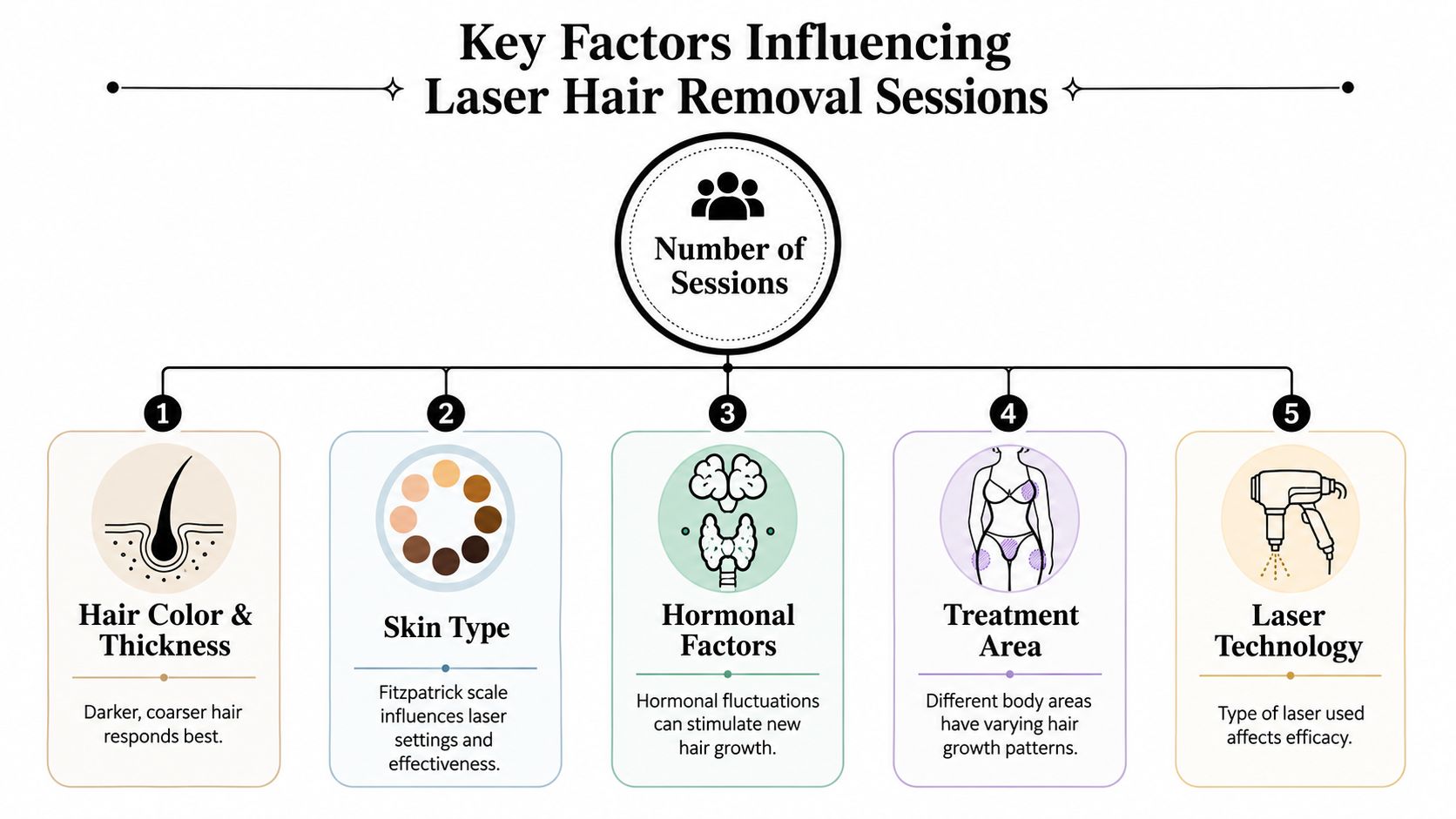
Laser is easiest to calibrate when there is a strong contrast between the hair and the skin. Dark, coarse hair is usually more straightforward to target than very light, grey, or fine hair. When that contrast is lower, results can still be pursued, but expectations have to be more careful.
Colaz's discussion of session planning notes that low skin-hair contrast may mean 2 to 4 extra sessions for some profiles. This is one of the least explained parts of laser consultations, yet it's one of the most important if your hair is lighter, finer, or more mixed in colour.
This process is akin to tuning a radio. A clear signal provides a clean station quickly, while a weak or messy signal demands more adjustment and passes for proper reception.
Body area and hormones
Not all hair behaves the same way. Underarms often behave very differently from chin hair. Legs can improve steadily but may need longer spacing. Facial hair can be more reactive to hormonal change and may need more persistence.
A straightforward way to think about it is this:
| Area type | Typical pattern |
|---|---|
| Standard body areas | Often sit within the usual treatment range |
| Facial zones | Commonly need a longer course |
| Hormonal areas | May be more resistant and more likely to need top-ups |
| Large male areas | Can take longer because of density and hormonal influence |
Some people also compare laser with electrolysis when the hair is very light or scattered. If you're weighing those options, our page on laser hair removal vs electrolysis explains where each method tends to fit.
Technique and treatment planning
Good results don't come from merely showing up and zapping the area. Settings, timing, shaving advice, sun exposure, and consistency all affect the total number of sessions.
A few things often push the session count up:
- Irregular attendance because missed timing means fewer follicles are treated at the ideal stage
- Waxing or plucking between sessions because the follicle needs to be present for laser to target it
- Treating resistant zones such as upper lip, chin, chest, back, or bikini where progress may be slower
- Expecting pale hair to respond like dark hair when the treatment reality is different
The most accurate answer to how many laser hair removal sessions are needed is never based on the area alone. It's based on the area, the hair, the skin, and the pattern of regrowth together.
Understanding Your Treatment Timeline and Hair Growth Cycles
A lot of confusion disappears when clients understand one simple point. Laser does not target all visible hair equally on the day of treatment. It works best when the follicle is in the right phase.
The gardening cycle analogy
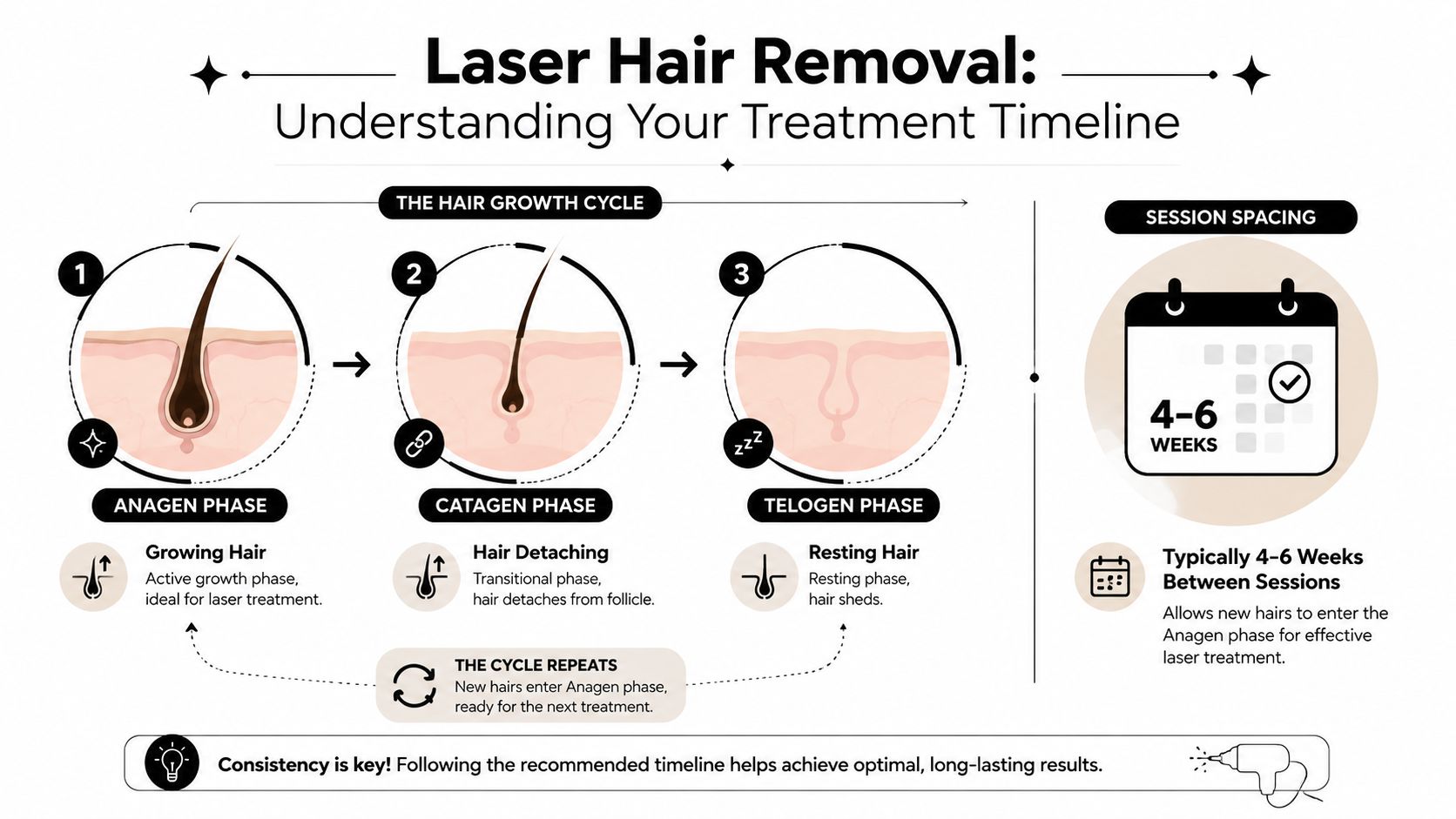
Hair grows in cycles. The active growing stage is anagen, then comes catagen, then telogen, the resting phase. The easiest way to explain this in clinic is with a garden analogy. You can only remove what has sprouted and connected strongly enough for the treatment to reach it properly.
If a hair is resting or transitioning, the laser session may not affect it in the same way. That is why clients often see shedding in some hairs after treatment while other follicles seem untouched until a later appointment.
Treat laser like gardening, not painting. You're not coating the whole area once. You're returning at the right times to catch new growth as it appears.
Typical timing by area
The timing between sessions isn't guesswork. This UK technical explanation of laser timing sets out 4 weeks for facial hair and 6 weeks for body hair, with facial cycles averaging 28 days and leg and body cycles extending to 8 to 12 weeks.
That leads to a practical timetable many clients recognise:
- Face needs closer spacing because growth cycles move faster
- Body is often booked further apart
- Legs can require patience because the growth cycle is longer
- Poor timing can reduce efficiency and drag out the course
When sessions are done too close together, some follicles haven't moved into the right stage yet. When they're left too long, you lose momentum and may need more overall sessions than expected.
This is why the initial course typically stretches over months rather than weeks. It isn't delay for the sake of delay. It's the treatment schedule doing what it's supposed to do.
After Your Course Realistic Expectations and Maintenance
A common moment in clinic is this. A client finishes her course, sees a big drop in regrowth, then spots a few new hairs months later and worries the treatment has stopped working. In practice, that usually means the area has moved from active treatment into maintenance.
Permanent reduction versus perfection
Laser hair removal is best judged by how much it reduces coarse, visible regrowth and how much easier the area becomes to manage day to day. For many clients in Leamington Spa, that means less shaving, fewer ingrown hairs, slower regrowth, and softer remaining hair. It does not mean every follicle stays inactive for life.
Some follicles recover. Some finer hairs remain. Hormonal shifts can also trigger new growth later, especially on the face, chin, neck, abdomen, and around the areola. Pregnancy, perimenopause, PCOS, and changes in medication can all affect what happens after a course ends.
What maintenance usually looks like
After your initial course, maintenance is often light. Many clients come back once or twice a year for a top-up, while others leave it longer and only book when they notice enough regrowth to justify treatment. The pattern depends on the area treated, your hormones, your hair type, and how complete your reduction was by the end of the course.
Body areas often stay settled for longer.
Facial areas tend to need more watching because hormonal influence is stronger and the hair cycle is more active. That is one reason I set different expectations for underarms and lower legs than I do for chin or jawline hair.
A realistic guide looks like this:
- Underarms and bikini often respond well, then need occasional top-ups
- Lower legs can stay low-maintenance for long stretches, but patience is still needed if finer hairs remain
- Face, chin, and neck are more likely to need periodic review
- Hormonal areas may need a few extra sessions after the main course before they settle into maintenance
When extra sessions are normal
Some clients are effectively in maintenance after their first course. Others need a short second phase on a stubborn patch. That is not unusual, and it is not a sign that the whole plan has failed.
In clinic, the areas that most often need extra attention are the ones affected by hormones or mixed hair growth. Coarse dark hairs may clear well, while finer or newly stimulated hairs appear later. The result can still be very good, but the endpoint is usually improvement you can maintain, not absolute finality.
If discomfort has been putting you off booking top-ups, our guide on what laser hair removal tends to feel like in different areas explains why some zones are easier than others and what clients usually cope well with.
Small amounts of upkeep are normal. For many clients, one brief maintenance visit is still far easier than returning to regular shaving, waxing, or dealing with repeated ingrown hairs.
Your Consultation What to Ask Our Leamington Spa Team
A good consultation answers the question clients usually arrive with. "How many sessions will I need for me?" Generic advice is easy to find online. A useful clinic conversation explains why your course may sit at one end of the range rather than the other, and what that means for your calendar, budget, and expectations in a UK clinic setting.

In clinic, I want a client to leave knowing three things clearly. Whether laser is suitable. How we would space the appointments for their area. What level of reduction is realistic after the first course.
Questions worth asking before you commit
Ask the therapist to be specific. If the answers stay vague, you do not have enough to decide well.
- How many sessions do you expect for my area, skin tone, and hair pattern? Ask for a realistic range and the reason behind it.
- What interval would you use between appointments for this body part? Underarms, legs, face, and bikini are not usually booked on the same rhythm.
- What change should I expect after session two, session four, and the end of the first course? This helps you judge progress properly.
- Are there signs that I may need extra sessions later? Hormonal facial hair, mixed textures, and very fine regrowth should be discussed early.
- What preparation matters before each visit? Shaving, sun exposure, active skincare, and medication checks all affect safety and response.
- How do you review settings if my response is slower or faster than expected? Good treatment plans are adjusted by clinical response, not left on autopilot.
If you are comparing local options, our page on laser hair removal in Leamington Spa explains how consultations are used to assess suitability, patch test where needed, and map out likely session spacing for each area.
Why cost needs a fuller conversation
Price matters, but price per session is only one part of the decision. A cheaper single session can work out poorly if the course is underplanned, poorly spaced, or likely to need more review than you were told at the start.
Ask for the expected total course cost, not just the headline figure. Then ask what happens if your area responds slowly, whether maintenance is charged separately, and how the clinic records progress. Those points tell you far more than a simple package price.
A useful consultation should cover:
- Your likely session range for each area
- The timetable for those appointments
- Factors that may lengthen the course
- How progress is reviewed and documented
- What upkeep may look like after the initial plan
That kind of conversation restores confidence with specific, evidence-led solutions. You can then decide calmly, with a clear view of the trade-offs, rather than buying into a standard "6 to 8 sessions" answer that may not fit your hair, your skin, or your goals.
If you are ready for a direct answer based on your own hair growth pattern rather than a generic estimate, book a consultation with 3D Aesthetics Leamington Spa. We will assess the area you want treated, explain what may affect your session count, and tell you whether laser is a good fit.