

You catch your reflection in a shop window, tilt your chin slightly, and notice your neck before you notice anything else. For many people, that's the moment the question starts. Is this loose skin? Is it a double chin? Will a neck tightening treatment help, or am I looking at the wrong solution entirely?
That confusion is common. The neck ages differently from the face, and it often changes for more than one reason. Some people are dealing with skin laxity, where the skin looks crepey or slack. Others are mainly seeing excess fat under the chin, which changes the profile even if the skin quality is still fairly good.
The most useful place to start isn't with a device name. It's with diagnosis. Once you know what's causing the concern, the treatment path becomes much clearer. If you're also trying to improve your skincare at home, this guide to neck skin tightening cream can help you understand where topical support may fit alongside professional options.
Table of Contents
- Your Guide to a Firmer Younger-Looking Neck
- Diagnosing Your Concern Skin Laxity vs Excess Fat
- Exploring Non-Surgical Treatments HIFU and Radio Frequency
- Which Treatment Is Right for You A Detailed Comparison
- What to Expect During and After Your Treatment
- Measuring Success with 3D Body Scan Technology
- Begin Your Transformation in Leamington Spa
Your Guide to a Firmer Younger-Looking Neck
The neck often gives people away before the face does. You may still feel happy with your skin overall, yet the area under the jaw starts to soften, fold, or lose its crisp definition. That can make makeup, skincare, and even a healthy lifestyle feel less effective than they once did.
A good neck tightening treatment starts with a simple truth. Different neck concerns need different solutions. If someone has loose skin, the goal is to encourage firmer support within the tissue. If someone has fullness caused by fat, tightening alone may leave them disappointed because it doesn't remove that volume.
Why the cause matters more than the trend
Device names can sound impressive, but they aren't interchangeable. HIFU, radio frequency, cryolipolysis, and other options each do a different job. When people choose treatment based only on what sounds popular, they often end up treating the wrong issue.
Practical rule: If you don't know whether your neck concern is mostly laxity or fullness, you're not ready to choose a treatment yet.
That's why the first step is always to look at the neck properly. Not just the front view, but the side profile, the jawline transition, the texture of the skin, and whether the concern changes when you lift the chin slightly.
What this means in real life
A person with fine, crepey skin under the chin may benefit from collagen-stimulating technology. A person with a fuller pocket beneath the jaw may need an approach aimed at fat reduction first. Someone else may have both issues and need a staged plan rather than a single treatment.
That's the reassuring part. Confusion at the start doesn't mean you're a difficult case. It usually just means the neck needs a more thoughtful assessment than a quick online comparison can give.
Diagnosing Your Concern Skin Laxity vs Excess Fat
Most neck concerns fall into one of two main categories. They can overlap, but one usually drives the appearance more than the other. If you identify that first, the treatment path becomes far more logical.
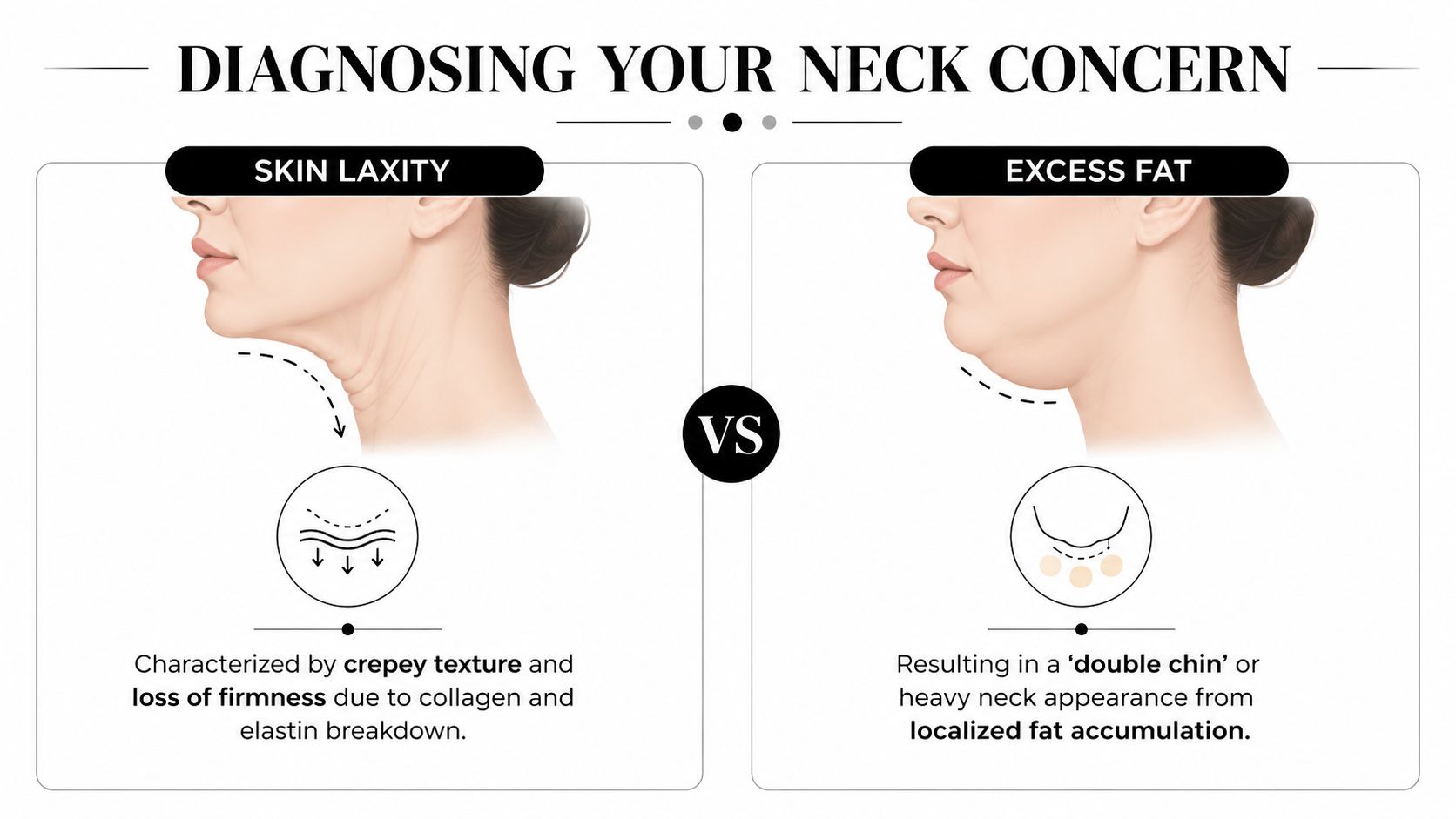
Two concerns that look similar but behave differently
Skin laxity is what many people describe as a “turkey neck”. The skin can look loose, soft, crepey, or less springy than it used to. This is similar to a balloon that has lost some of its tension. The structure is still there, but it no longer sits as tightly as before.
Excess fat creates more of a heavy or full appearance under the chin. That's closer to an overstuffed cushion. The issue isn't mainly the skin itself. It's the volume beneath it, which changes the neck angle and blunts the jawline.
This distinction matters because treatment efficacy changes depending on the root cause. One published discussion notes that the critical distinction between fat-driven double chin concerns and skin-laxity-driven turkey neck dictates treatment efficacy, and that RF, Morpheus8, and Ultherapy can provide only minimal tightening lasting 6 to 18 months when laxity is the issue, while fat-specific concerns need a different approach for longer-term resolution, as explained in this review of neck liposuction, neck lift and non-surgical treatment.
Simple signs to look for in the mirror
A quick self-check can help you notice which concern is more dominant.
- If the skin looks crinkled or folds easily: laxity may be leading the problem.
- If the area looks fuller even when the skin seems smooth: excess fat may be the main issue.
- If you see both looseness and heaviness: you may need a combined plan.
- If the jawline disappears from the side profile: volume under the chin may be playing a bigger role than skin quality alone.
You can also notice what happens when you gently extend your neck. If the area smooths significantly, loose skin is often involved. If fullness remains obvious, volume is usually a factor.
A tightening treatment can improve laxity, but it won't behave like a fat-removal treatment.
That's where many generic guides fall short. They treat every neck concern as though one machine can solve all of it. In reality, if the concern is primarily under-chin fullness, a fat-focused option may need to come first. For readers exploring that route, this page on fat freezing for the chin shows how a targeted approach differs from skin tightening.
Exploring Non-Surgical Treatments HIFU and Radio Frequency
Once you've identified that the main issue is skin laxity, two technologies come up repeatedly in neck tightening treatment plans. These are HIFU and radio frequency. They both aim to improve firmness, but they don't work in exactly the same way.
How HIFU works
HIFU stands for high-intensity focused ultrasound. The easiest way to understand it is to think of a magnifying glass focusing sunlight onto one precise point. HIFU concentrates energy deeper within the tissue rather than spreading heat broadly across the whole surface.
That targeted energy creates controlled thermal points below the skin. The body then responds by rebuilding support in that area over time. The reason many people like HIFU is that it's designed to reach deeper structures linked to lift and firmness without injuring the surface of the skin.
For facial and neck rejuvenation more broadly, this overview of skin tightening treatments for face gives a helpful sense of how these collagen-focused technologies fit into a treatment plan.
How radio frequency works
Radio frequency, often shortened to RF, works more like a gentle blanket of warmth. Instead of focused ultrasound points, RF heats the dermal layers in a broader way. That heat encourages tissue contraction and supports new collagen formation.
Patients usually understand RF best when it's described as a gradual conditioning treatment for the skin. It's often chosen when the goal is to improve firmness, texture, and overall tone rather than create the strongest possible lift in one go.
A verified UK summary reports that RF skin tightening for neck laxity typically requires 6 to 8 sessions, with visible improvements emerging over 3 to 6 months and durability of about 1 to 2 years when maintenance is performed, while also being considered safe for all skin types with minimal downtime, according to this guide to the best neck tightening treatment.
Why people mix them up
Both treatments are described as “collagen stimulating”, so they can sound nearly identical online. They aren't. HIFU is usually discussed when more depth is needed. RF is often chosen for a gentler, progressive tightening approach.
That doesn't make one universally better. It means the better choice depends on how loose the skin is, how quickly someone wants to work through a treatment course, and whether the neck concern is isolated or part of a wider facial ageing pattern.
Which Treatment Is Right for You A Detailed Comparison
A useful comparison starts with the skin itself. Mild crepiness behaves differently from heavier, more visible laxity. That's why treatment matching matters more than brand recognition.

When HIFU tends to suit best
If someone has moderate to more pronounced neck laxity, HIFU is often the stronger non-surgical option. Verified comparative commentary notes that HIFU demonstrates superior efficacy over RF microneedling for moderate-to-severe neck skin laxity, and that a 2019 study in a laser journal confirmed its advantage in stimulating deep collagen production for significant laxity correction, as discussed in this HIFU comparison review.
In plain terms, HIFU usually makes the most sense when the skin needs a deeper structural push. This is often the person who says, “My neck doesn't just look crepey. It looks like it's dropping.”
Typical signs HIFU may fit better:
- More visible looseness under the chin: especially when the profile has softened.
- A stronger lifting goal: where subtle textural improvement alone won't feel like enough.
- Moderate to severe laxity: where depth of treatment matters.
When radio frequency may be the better fit
RF often suits people with mild to moderate laxity who want a steadier, more progressive improvement in firmness. It can be a very sensible choice if the skin feels thinner, less toned, or slightly slack, but not heavily descended.
This option also appeals to people who like the idea of a course-based treatment. The skin is encouraged gradually, and the outcome often looks refreshed rather than dramatically altered.
For early laxity, the best treatment isn't always the most aggressive one. It's the one that matches the tissue realistically.
A practical way to think about it is this:
| Concern | HIFU | Radio frequency |
|---|---|---|
| Depth of action | Tends to target deeper support layers | Tends to heat the dermal layers more broadly |
| Best fit | Moderate to severe laxity | Mild to moderate laxity |
| Main aim | Lift and deeper firming | Gradual tightening and skin conditioning |
| Treatment style | Often chosen when fewer, deeper sessions are preferred | Often chosen as a course of sessions |
A short video can help if you prefer to see treatment principles visually before comparing options in clinic.
What if your concern is not mainly loose skin
This is where honest advice matters. If the neck looks heavy because of fullness rather than laxity, neither HIFU nor RF should be presented as the perfect answer. They may improve the skin envelope, but they won't remove the underlying bulk in the way a fat-focused approach can.
That's why some people are disappointed after “tightening” elsewhere. The machine may have done what it's designed to do, but the original concern was never mainly skin in the first place.
What to Expect During and After Your Treatment
Even when someone is confident they've chosen the right neck tightening treatment, they still want to know what the experience feels like. The process is usually much less dramatic than people imagine. The bigger challenge is often patience, because collagen takes time.
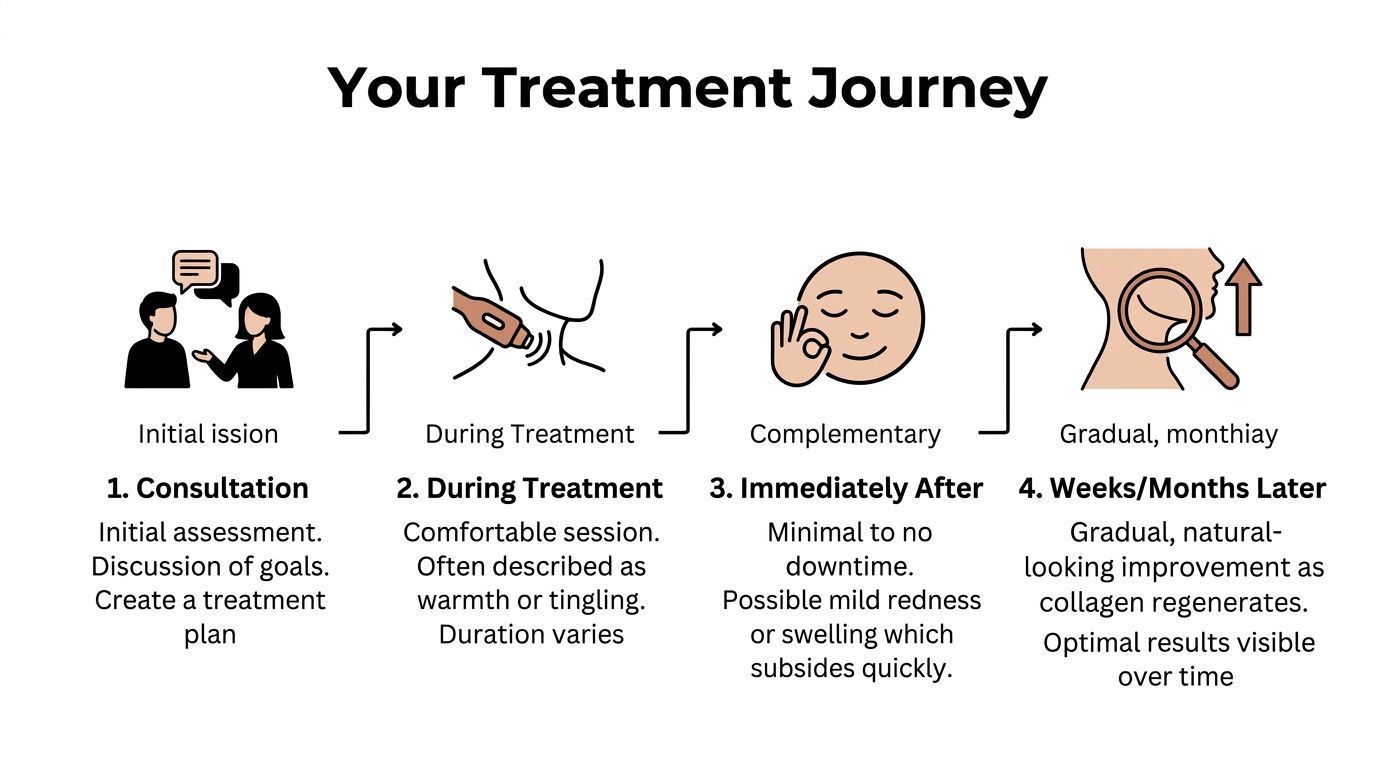
From consultation to treatment day
The first appointment should focus on assessment, not rushing into a device. A trained practitioner looks at the skin quality, the amount of laxity present, the jawline shape, and whether the concern is made worse by under-chin volume.
During treatment, the sensation is often described as warmth, energy pulses, or brief prickly moments depending on the technology used. These procedures are generally chosen by people who want minimal disruption to daily life, so the session itself is usually straightforward and manageable.
Afterwards, the skin may look a little flushed or feel slightly tender, but downtime is typically limited. Patients generally resume their normal routine quickly.
Results timeline and recovery
This part matters most because expectations often go wrong here. In UK-accredited aesthetic practice for non-surgical neck tightening, patients typically require 2 to 3 treatment sessions spaced 4 to 6 weeks apart, with significant improvement in neck laxity observable within 30 days and peak tightening effects achieved between 3 to 6 months after treatment, as outlined in this review of non-surgical neck tightening.
That timeline makes sense biologically. These treatments don't “pull” the skin tight in the way surgery does. They stimulate the body's own repair and remodelling response, and that happens gradually.
The best non-surgical neck results often appear so slowly that patients only notice them properly when they compare photos or scans side by side.
Here's a simple guide to the usual pattern of change:
| Timeframe | What to Expect |
|---|---|
| Shortly after treatment | Mild warmth, temporary redness, or a slightly treated feeling in the area |
| Within 30 days | Early visible improvement may begin to show in skin tone and tightness |
| After spaced sessions | Changes build progressively as the treatment course continues |
| At 3 to 6 months | Peak tightening effects are commonly seen as collagen remodelling develops |
A few practical aftercare habits can support the process:
- Protect the skin: daily sun protection helps preserve the quality of treated skin.
- Be consistent with review appointments: this makes it easier to judge whether the plan needs adjusting.
- Avoid judging too soon: day-to-day changes are subtle, and that's normal.
- Support the skin generally: hydration and gentle skincare help the skin look its best while remodelling continues.
Measuring Success with 3D Body Scan Technology
One of the biggest frustrations with non-surgical tightening is that the result rarely arrives all at once. People look in the mirror every day, from the same angle, in the same bathroom light, and start wondering whether anything is changing at all.
Why gradual results can feel hard to judge
This worry has become more visible in patient questions. Verified UK commentary points to a 12-month trend in patient FAQs around post-treatment collagen latency, with people asking how to objectively measure tightening because gradual changes can be hard to verify by eye alone, as described in this discussion of effective treatments to eliminate turkey neck fast.
That concern is understandable. If improvement is subtle and progressive, memory becomes unreliable. Individuals often do not remember their starting profile accurately enough to judge small contour changes with confidence.
What a 3D scan adds
Objective measurement changes the experience. A 3D scan records shape and contour in a way a casual phone photo can't. It gives structure to the whole process. Instead of asking, “I think it looks a bit better?”, you can compare changes more clearly over time.
A scan is especially useful for neck treatments because the improvements are often natural-looking rather than dramatic. That's a positive outcome aesthetically, but it can make personal tracking difficult. Objective visual comparison reduces second-guessing.
For anyone interested in how measurement supports treatment planning more broadly, this page on body composition analysis gives a useful overview of data-led assessment.
When results are gradual, evidence matters. A good scan doesn't replace clinical judgement, but it gives patients something concrete to follow.
The emotional benefit is important too. People are much more likely to stay realistic and patient when they can see that change is happening in a measured way.
Begin Your Transformation in Leamington Spa
If you take one thing from this guide, let it be this. The right neck tightening treatment depends on the reason your neck looks the way it does. Loose skin and excess fat may appear similar at first glance, but they don't respond to the same treatment in the same way.
For people with mild to moderate laxity, radio frequency remains a well-established option. Verified UK guidance notes that RF skin tightening induces gradual tissue contraction, with visible improvements emerging over 3 to 6 months, durability of about 1 to 2 years with maintenance, and a typical protocol of 6 to 8 sessions, while being considered safe for all skin types with minimal downtime.
If you're unsure where your concern sits, that uncertainty is exactly why a proper consultation matters. A clear assessment can save time, money, and disappointment. It helps you understand whether your best route is tightening, fat reduction, or a combination planned in the right order.
The most reassuring next step is a no-pressure one. Get the neck assessed properly, look at the profile objectively, and choose a plan that matches your anatomy rather than a trend.
If you'd like personalized advice, book a complimentary consultation with 3D Aesthetics Leamington Spa. You'll get a no-obligation assessment, honest guidance on whether your concern is skin laxity or excess fat, and a full 3D scan to help track gradual changes with confidence.