You've noticed it in a changing room, in a photograph, or when you lift your arm and the skin beneath it moves more than you'd like. “Bingo wings” can feel frustrating, particularly when your weight is stable and exercise hasn't changed the appearance as much as you hoped. The important first step is identifying whether you're seeing loose skin, localised fat, crepey texture, or a combination of all three.
At 3D Aesthetics Leamington Spa, we assess that difference before recommending skin tightening treatments for arms. Radiofrequency and body HIFU can support firmer-looking skin where laxity is mild to moderate, but energy-based treatment can't remove substantial hanging tissue. That distinction matters, especially after significant weight loss.
Table of Contents
- Why do my arms look loose and what can non-surgical treatments actually do
- How do radiofrequency and ultrasound tighten arm skin
- Which specific arm tightening treatments do we offer at our clinic
- Who is not a suitable candidate for non-surgical arm tightening
- Can I combine fat reduction with skin tightening for better arm results
- What happens during a 3D body scan and arm consultation in Leamington Spa
- How much do arm skin tightening treatments cost and what are the next steps
Why do my arms look loose and what can non-surgical treatments actually do
Upper-arm laxity usually develops through a mixture of age-related changes, genetics, skin stretching and weight fluctuation. As skin loses some of its structural support, it may look thinner, crepey or less resilient. A person can also have good muscle tone underneath and still see loose skin above it.
The first consultation question should therefore be, “What is creating the appearance?” If the main issue is a small amount of localised fat, skin tightening alone may not create the contour you want. If the concern is mild crepiness and reduced firmness, controlled energy may encourage collagen remodelling. If there's a fold of redundant skin that hangs significantly when the arm is raised, non-surgical treatment has a clear ceiling.
Our practical rule: we'd rather tell you that a treatment won't meet your goal than sell you a course that can't address the tissue causing the concern.
UK demand for surgical correction of upper-arm laxity increased in 2024. The BBC's report on the BAAPS audit states that brachioplasty, an upper-arm lift, rose by 13% year on year among reporting British Association of Aesthetic Plastic Surgeons members. The audit recorded 27,462 cosmetic-surgery procedures overall, a 5% increase from 2023, but it covered reporting members rather than the whole UK population. These figures relate to surgery, not non-surgical radiofrequency or HIFU, but they show how commonly people seek help for excess arm tissue.
What non-surgical tightening can and cannot change
Non-surgical skin tightening treatments arms options are most realistic when the skin still has some elasticity and the laxity is mild to moderate. They may improve the appearance of:
- Crepey texture: skin that looks finely wrinkled or thin.
- Early laxity: reduced firmness without a large hanging fold.
- Diffuse looseness: a general loss of smoothness across the upper arm.
- Combined concerns: mild laxity over a small area of excess fat.
They won't excise surplus skin. An upper-arm lift, or brachioplasty, is the surgical route used when the central problem is substantial redundant tissue. We don't provide surgery, and we won't describe a non-surgical treatment as an equivalent substitute.
People researching post-weight-loss options may also find this practical guide to how to tighten loose skin in the UK useful for understanding the wider choices. For our non-surgical approach in Warwickshire, you can read about body skin tightening treatments before arranging an assessment.
Results vary from person to person. Your skin quality, age, weight stability, tissue thickness and amount of excess skin all affect what's reasonable. We see clients at our Leamington Spa clinic who want a subtle improvement rather than a surgical change, and that can be a sensible goal when the anatomy matches the treatment.
How do radiofrequency and ultrasound tighten arm skin
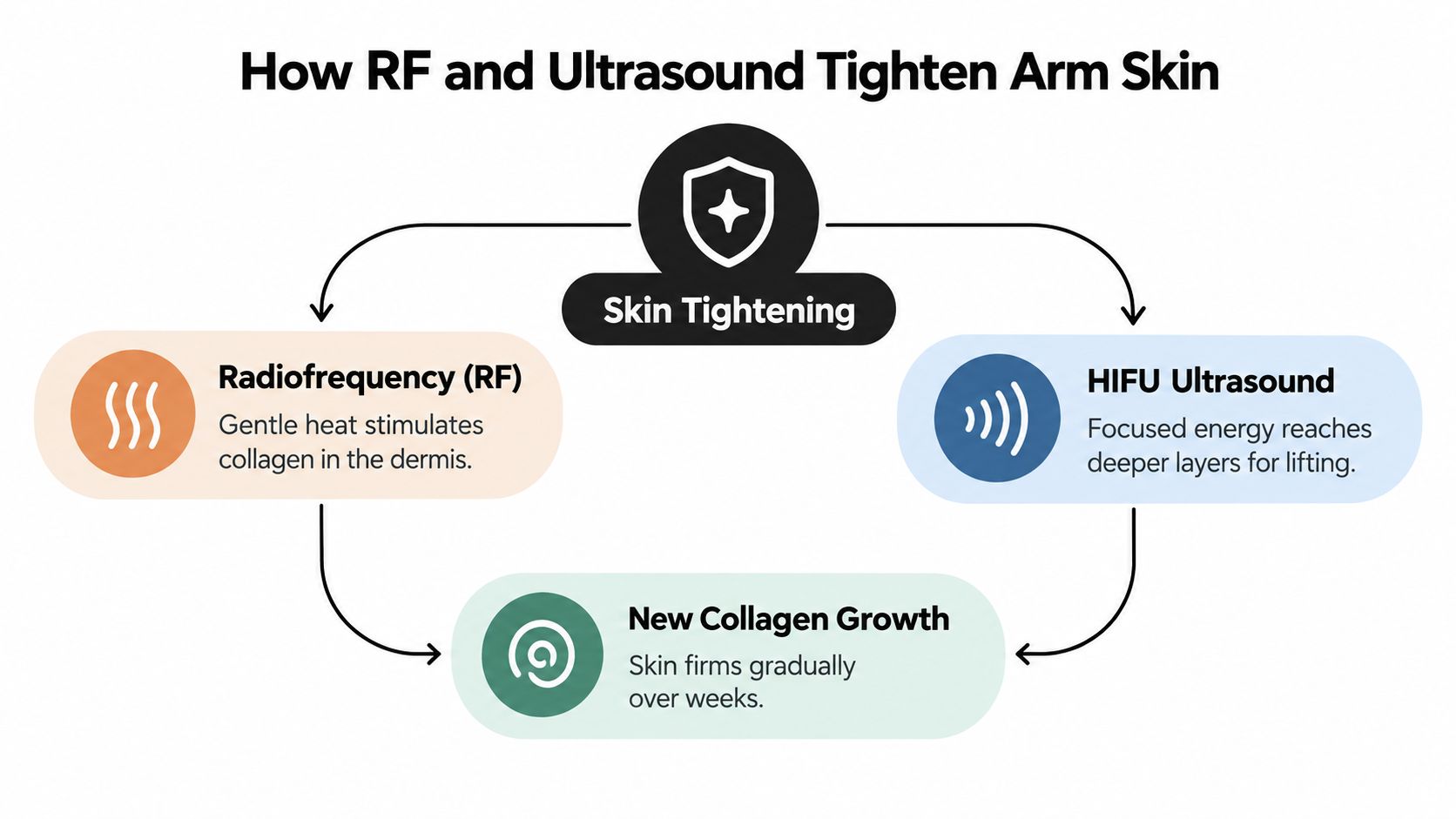
Radiofrequency, or RF, uses controlled heating in the dermis, the deeper skin layer where collagen fibres are organised. HIFU, meaning high-intensity focused ultrasound, delivers focused ultrasound energy to create localised thermal coagulation zones at selected depths. Both approaches use heat, but they don't deliver it in exactly the same way.
The process has two broad stages:
- Controlled contraction: heating can make existing collagen fibres contract, producing an early tightening response.
- Remodelling: fibroblasts, the cells that produce connective tissue, respond over time by supporting new collagen formation and elastin remodelling.
A simple analogy is a controlled shrink-wrap effect followed by a rebuilding phase. The first response doesn't represent the final appearance, because biological remodelling takes time.
How RF uses dermal heat
RF devices transfer electromagnetic energy into tissue and generate heat within the dermal layer. The available UK Government consultation material describes dermal temperatures of approximately 41–43°C as capable of producing immediate collagen-fibre contraction while also triggering delayed collagen synthesis and elastin remodelling. In a clinical evaluation referenced in that material, 49 subjects received two RF sessions one month apart, and three-dimensional photographic assessment recorded overall improvement in 74% of participants. Those figures aren't UK population estimates or a promise of arm-specific results, and results vary from person to person.
Temperature control matters more than just increasing energy. Excessive heating can increase the chance of pain, burns or pigmentary change, with particular care needed when treating darker skin. We explain the expected warmth, treatment parameters and aftercare rather than treating “more energy” as automatically better.
How HIFU reaches selected depths
HIFU concentrates ultrasound energy at planned points below the surface. The localised thermal zones can contract existing collagen and stimulate longer-term remodelling by fibroblasts. HIFU is generally more appropriate for selected clients with mild to moderate laxity and adequate tissue thickness than for someone with a large amount of hanging skin.
You can read more about our radiofrequency skin tightening treatment and how we assess whether RF or HIFU better matches the tissue we're treating. Neither technology acts like a surgical excision, and neither should be presented as an immediate transformation.
Which specific arm tightening treatments do we offer at our clinic
We offer body HIFU and radiofrequency skin tightening for selected upper-arm concerns, with the choice based on skin quality, tissue thickness, laxity and whether localised fat is also present. The two technologies can overlap in purpose, but they create different treatment experiences and aren't interchangeable for every client.
RF usually suits diffuse early-to-moderate laxity and crepey texture. The handpiece delivers controlled warmth across the treatment area, and clients commonly describe heat or tingling rather than a sharp sensation. We monitor comfort and skin response throughout, because controlled treatment is more useful than just pursuing the highest possible temperature.
Body HIFU uses focused ultrasound energy at selected depths. The sensation can include warmth, pressure or brief, more concentrated discomfort at treatment points. The treatment plan depends on the area and tissue profile, so we discuss the expected number of sessions after assessment rather than assigning the same course to everyone.
What timeline should you expect
HIFU tightening generally develops progressively over approximately three months and may persist for up to one year, according to the 2025 systematic review of upper-arm tightening evidence in the Aesthetic Surgery Journal. The review identified mainly mild adverse effects such as temporary erythema, meaning temporary redness. Results vary from person to person, and the review measures clinical evidence rather than guaranteeing a particular cosmetic outcome.
RF also relies on delayed collagen remodelling, so a session-by-session comparison immediately after treatment can be misleading. We may recommend a course rather than a single appointment when repeated stimulation is more appropriate for the condition of the skin. Maintenance can also be discussed because collagen changes continue as the skin ages.
Patients can return to normal daily activities after these non-surgical treatments. Temporary redness, warmth, tenderness or sensitivity can occur, and the exact response depends on the technology and the individual. A consultation should cover downtime openly, including what might make you postpone work, exercise or a social event.
If you're comparing body contouring choices more broadly, our body contouring treatments page provides additional context. Some clients also compare treatment planning with wider tools that help monitor health information, such as the option to compare health monitoring systems, although health monitoring doesn't replace an in-person skin and tissue assessment.
Who is not a suitable candidate for non-surgical arm tightening
A consultation may end with a recommendation not to treat. That is appropriate when the upper arm has substantial redundant skin, particularly after massive weight loss or bariatric surgery. The main issue in these cases is surplus tissue, not merely reduced collagen. Heating may improve skin quality to some degree, but it cannot remove a hanging fold. A surgical opinion with an appropriately qualified team may be more suitable.
Suitability also depends on health, sensation, circulation, skin condition and the type of energy used. We take a full medical history before planning treatment, because it may lead us to proceed, change the approach, postpone the appointment or recommend medical advice elsewhere.
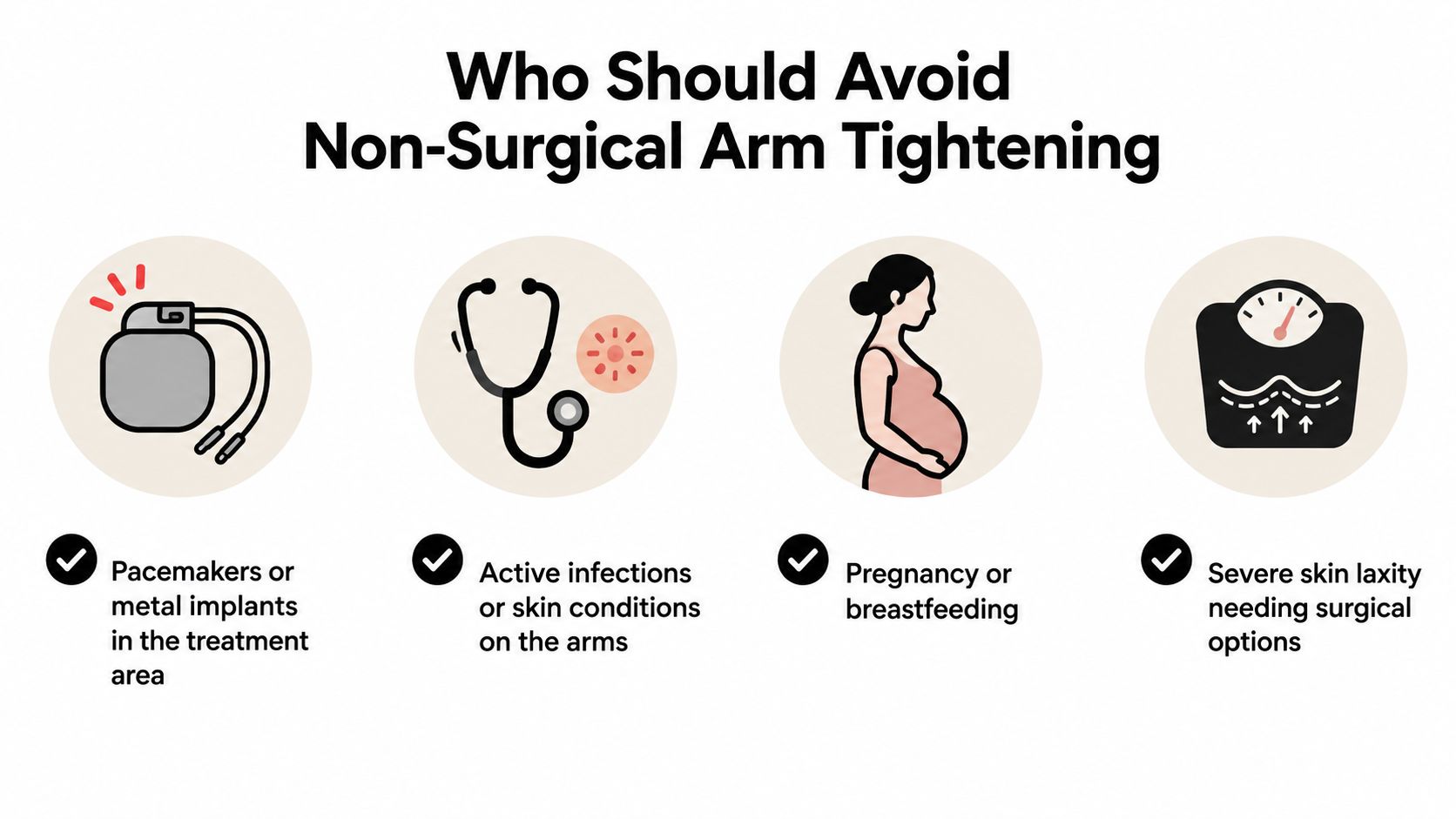
Some situations require extra information or mean we will not treat the arms:
- An implanted electronic device or metal in the treatment area: we must check the device, its position and the proposed energy before proceeding.
- Reduced sensation: you may not recognise excessive heat, tenderness or discomfort reliably.
- Lymphoedema or significant swelling: the tissue may need medical assessment before an aesthetic procedure.
- Varicose veins in the treatment area: local anatomy and circulation need careful review.
- Pregnancy or breastfeeding: we generally postpone elective energy-based treatment.
- An active infection or skin condition: the skin should settle before treatment.
- Rapidly changing weight: continued change can alter the tissue and make the result difficult to assess.
UK professional guidance notes that non-surgical procedures are not uniformly covered by CQC regulation. Provider governance, practitioner competence and suitable premises therefore matter. The Nursing and Midwifery Council response on regulation of non-surgical cosmetic procedures also highlights the importance of suitable practitioners and appropriately regulated premises.
A non-surgical label doesn't mean risk-free. Tell us about your health, sensation, swelling, implants, skin condition and treatment goals before an appointment is considered.
We do not turn away someone with severe laxity casually. We explain what the technology can and cannot change, so you are not left spending money on a treatment that cannot address the amount of skin present.
Can I combine fat reduction with skin tightening for better arm results
An upper arm can look bulky because of localised fat, loose skin, or both. Combining treatments may help when fullness is accompanied by mild laxity, but it will not correct every type of excess tissue. Reducing fat can reveal the remaining skin laxity, while tightening alone cannot remove fat volume.
The first decision is whether fat reduction is appropriate. Depending on the assessment, we may consider fat freezing, ultrasound cavitation, body sculpting or 3D Powersculpt. Fat freezing, or cryolipolysis, uses controlled cooling for selected areas. Cavitation uses ultrasound energy, and body sculpting plans combine techniques according to the tissue profile. These methods shape the contour, but they do not remove substantial surplus skin.
A useful example is an arm that appears heavy mainly because of a localised fat pocket. Reducing that volume may improve its outline, provided the skin still has enough elasticity to contract. If the arm is already thin but hangs because of stretched skin, fat reduction is unlikely to improve the concern and could make looseness more noticeable.
The sequence therefore depends on the tissue:
- Predominantly fat: assess a suitable fat-reduction option, then review how the skin sits.
- Predominantly mild laxity: consider RF or HIFU when the skin remains suitable for non-surgical tightening.
- Mixed tissue: stage the treatments so the residual laxity can be judged before adding another procedure.
- Substantial hanging skin: explain clearly that non-surgical contouring cannot remove the surplus tissue.
Our non-surgical fat removal options explain the body-contouring treatments available for this part of the discussion. A combined plan does not guarantee a stronger or more dramatic result. It is appropriate only when each treatment addresses a genuine contributor to the arm's appearance.
Skin texture still needs separate consideration. Thin, heavily stretched or changing skin may respond differently from thicker skin with some remaining elasticity. The treatment name matters less than the match between the method, the amount of fat, the degree of laxity and the result you consider worthwhile.
What happens during a 3D body scan and arm consultation in Leamington Spa
At 11 Guys Place East, Leamington Spa, Warwickshire CV32 4RG, the appointment begins with your concerns, not a device. We discuss when you noticed the change, whether your weight is stable, and what improvement would be worthwhile to you. An arm with substantial excess skin after major weight loss may be unsuitable for non-surgical treatment, and we will say so rather than recommend a procedure unlikely to meet your goal.
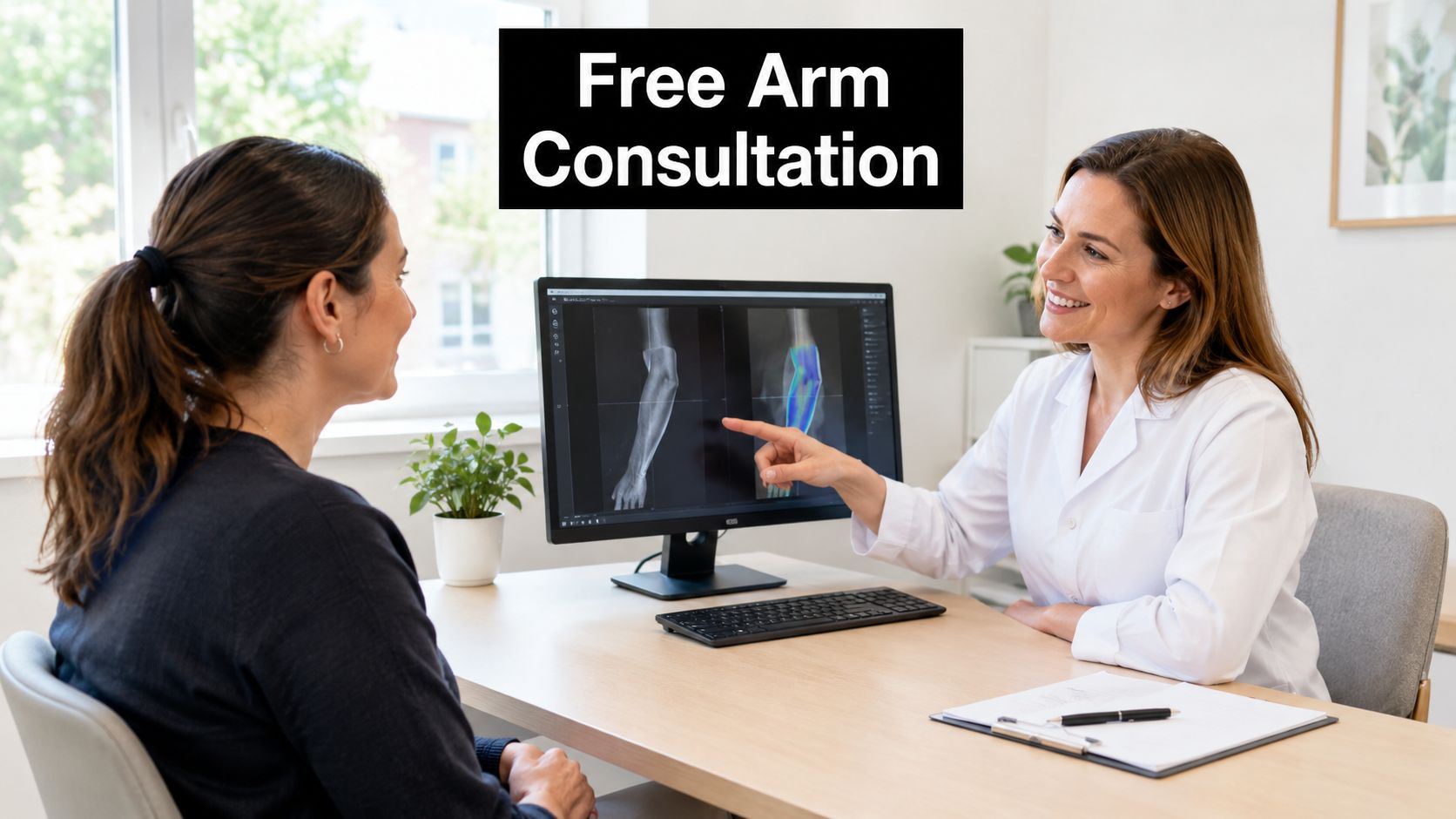
The 3D body scan records body shape, arm symmetry, circumference and tissue distribution before treatment. Those images provide a baseline for planning and later comparison, without relying only on memory, lighting or one photograph. Our guidance on body measurement tracking explains how recorded measurements can support follow-up discussions.
The scan does not make the decision by itself. We examine the skin, pinchable tissue and the position of any looseness, then compare those findings with your expectations. Thin, crepey skin, localised fullness and substantial hanging tissue require different advice. If the arm is already thin and the main issue is stretched skin, fat reduction may be inappropriate. If the skin cannot contract enough, RF or HIFU may offer too little change.
Your medical history also affects suitability. We ask about implants, changes in sensation, swelling, pregnancy and skin conditions, alongside previous procedures and any relevant symptoms. The aim is to identify situations where treatment should be delayed, adjusted or declined.
Ask how the clinic checks its devices and treatment standards. In Great Britain, medical devices must be registered with the Medicines and Healthcare products Regulatory Agency, or MHRA, before being placed on the market. The Joint Council for Cosmetic Practitioners paper on energy-based devices explains why regulatory status belongs in the conversation, although registration does not guarantee a particular cosmetic result.
Clients travel from Leamington Spa, Warwick and Kenilworth. We explain likely appointment planning, treatment sensation, temporary redness and when to contact us about unexpected pain, swelling, altered sensation or skin changes.
You can also watch an overview of the consultation experience here:
A free AI Skin Scanner may provide additional skin information, but it cannot replace the physical assessment required for body HIFU or RF. You remain free to decline treatment if the expected result does not justify it.
How much do arm skin tightening treatments cost and what are the next steps
The cost of arm skin tightening depends on the area assessed, the technology selected and the number of sessions that makes sense for your skin. We don't quote a misleading one-size-fits-all figure because two people with “loose arms” may have entirely different tissue concerns. Our prices page provides general guidance, while the consultation gives you the relevant treatment plan and price.
A sensible next step is:
- Book an assessment: discuss your goals, medical history and whether the concern is fat, laxity or excess skin.
- Review the scan and options: understand why RF, HIFU, fat reduction, combination treatment or no treatment has been recommended.
- Plan the timeline: allow for gradual collagen remodelling rather than judging the result immediately.
- Discuss maintenance: future sessions may be considered as skin changes over time, but results vary from person to person.
- Choose freely: you shouldn't feel pressured to proceed during the consultation.
Non-surgical treatment is most defensible for mild to moderate laxity, realistic expectations and a stable enough starting point for assessment. If you have substantial post-weight-loss skin, we'll explain that an energy-based option may not provide the change you're seeking.
For questions, call 01926 315764. You can also book your free consultation or start with our free AI Skin Scanner before visiting our Leamington Spa team.
At 3D Aesthetics Leamington Spa, we offer body RF, HIFU, fat reduction and 3D body scanning for selected arm concerns, with suitability screening before treatment. Visit 3D Aesthetics Leamington Spa to explore your options and arrange an honest consultation about firmer-looking arms.
← Back to Home