
Collagen induction therapy is microneedling that creates controlled micro-injuries to start the skin's repair response and new collagen production, not an immediate replacement for lost volume. The advice to judge success by how plump your skin looks straight afterwards misses the important part: repair takes time, and results vary from person to person.
At our clinic in Leamington Spa, we want you to understand the procedure before deciding whether to book. The useful questions aren't just whether needling stimulates collagen, but which device is proposed, how extensively it treats, and whether the likely limits match your expectations.
Table of Contents
- What Is Collagen Induction Therapy
- How Does Collagen Induction Therapy Rebuild Skin?
- Which Needle Depths Collagen Induction Therapy Uses
- How Does 3D Dermaforce Differ From Other Microneedling Devices?
- What Results Collagen Induction Therapy Can Give
- How Many Sessions Does Collagen Induction Therapy Take
- How Long Does Collagen Induction Therapy Downtime Last
- Who Should Not Have Collagen Induction Therapy?
- Can I Book Collagen Induction Therapy in Leamington Spa?
What Is Collagen Induction Therapy
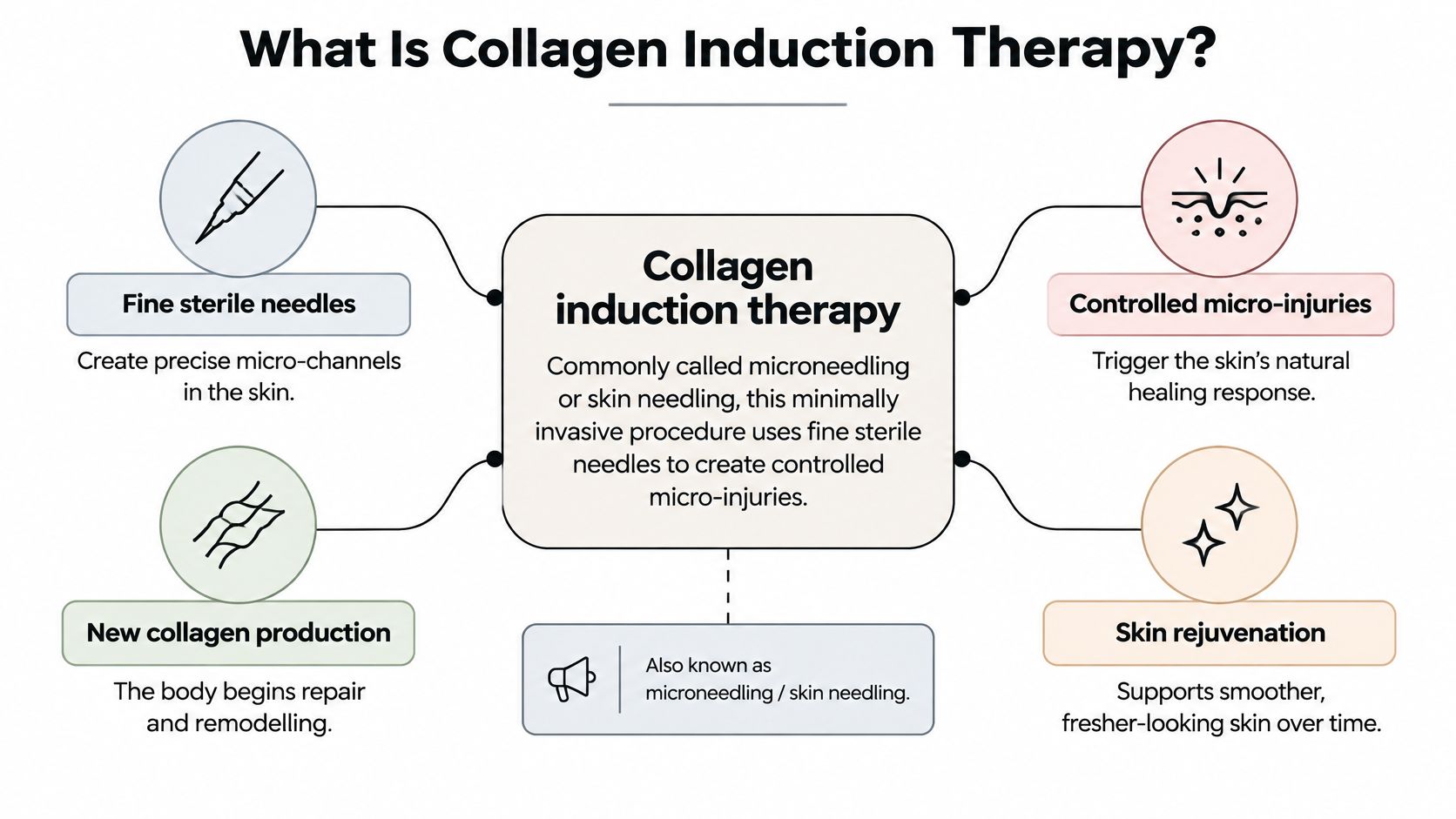
Few names in aesthetics promise more than this one. Collagen induction therapy sounds as though collagen is being delivered into the skin. It describes a response instead: fine needles, on a manual roller or an electronic pen, create small injuries that ask your skin to produce new collagen itself. You may also see it called microneedling or skin needling.
Take the small depressions that can remain after acne has settled. These are atrophic scars, scars that sit below the surrounding skin surface. They are a sensible reason to ask about needling, and your consultation should begin by confirming that scarring is the concern you want treated. A name containing the word collagen is not, on its own, a reason to book.
Expectations deserve the same honesty. The average effect on scarring and texture is modest, and improvement builds gradually across sessions, not in a single appointment. For many clients that is still worthwhile, as long as it is understood from the start.
Why the word controlled matters
The Government's licensing consultation describes microneedling as creating "miniscule micro-injuries" to stimulate collagen and healthy tissue repair. The accompanying British Journal of Dermatology material offers peer-reviewed context for these discussions of cosmetic-procedure standards.
Controlled does not mean trivial. Depth is part of the definition of a treatment: the deeper the needles reach, the higher the demands on training, skin assessment and infection control. A consultation that names the device but never mentions intended depth has skipped the detail that most affects both risk and likely benefit.
Our starting point: A treatment name isn't enough information to consent to a procedure. You should understand what will touch your skin and why.
What regulation means for your appointment
Proposals to licence non-surgical cosmetic procedures in England are still developing, and the Government's consultation describes gaps in a national framework for practitioner training and infection control. Oversight of the device and oversight of the person holding it are separate questions.
The Medicines and Healthcare products Regulatory Agency, usually shortened to MHRA, is the UK regulator for medical devices. A device being available and a practitioner being competent answer different problems, so neither should be treated as proof of the other.
For us, assessment, sterile technique and informed consent come before device selection. Where microneedling is appropriate, we use the 3D Dermaforce, an RF microneedling system, and we explain the reasoning for each client. When we discuss possible changes to scars, texture or fine lines, we are clear that results vary from person to person.
How Does Collagen Induction Therapy Rebuild Skin?
Collagen induction therapy prompts repair by creating tiny needle channels that activate the skin's wound-healing response, as described in the UK Government consultation on non-surgical cosmetic procedures.
That guidance recognises both manual rollers and electronic microneedling pens. The shared principle is controlled injury followed by repair, rather than putting a supply of ready-made collagen beneath the surface.
Fibroblasts, the skin's connective-tissue repair cells, are involved in producing new collagen. The Government's description of tissue repair helps explain why we discuss remodelling as a process rather than an appointment-day transformation; results vary from person to person.
What that means in plain English
Think of the distinction between requesting repair and seeing the finished repair. The appointment provides the stimulus, but the visible appearance immediately afterwards isn't a reliable measurement of new collagen.
Our consultation therefore separates two questions:
- What happens during the procedure? We explain the device, the planned treatment area and the intended settings.
- What are we hoping to assess later? We agree which visible concern matters to you, rather than using the vague aim of better skin.
- What could affect the plan? We ask about your skin history, medicines, previous procedures, active blemishes and healing concerns.
A photograph taken just after treatment records a recently treated face, not a completed course of skin remodelling.
Is this the same as taking collagen?
The word collagen also appears on supplements and skincare, which can make different approaches sound interchangeable. They aren't the same procedure, and a product label doesn't explain how needling works.
If you're trying to untangle supplement terminology, NZ Supps' guide to collagen types for supplement shoppers is separate reading about that product category. We wouldn't use supplement information to predict your response to microneedling.
Which Needle Depths Collagen Induction Therapy Uses
Collagen induction therapy uses different needle-depth bands, with Health Education England's cosmetic-procedure training guidance identifying different hazards for manual, power-assisted and shallower needling.
Collagen induction therapy depths and hazards
| Approach | Depth | Hazards named by HEE |
|---|---|---|
| Manual microneedling | Up to 1.5 mm | Pain, bleeding, infection, blood-borne infection |
| Power-assisted microneedling | Up to 1.0 mm | Pain, bleeding, infection, blood-borne infection |
| Manual microneedling | 0.5–1.0 mm | Pain, bleeding, infection, inadequate response |
| Shallower needling | 0.5 mm or less | Discomfort, lack of effect, or aggravation of an underlying skin condition |
These bands and their listed hazards come from Health Education England's cosmetic training publication, which includes manual needling up to 1.5 mm, power-assisted needling up to 1.0 mm, manual needling at 0.5–1.0 mm, and shallower needling at 0.5 mm or less.
How to read the bands
The broader manual category names hazards associated with needles moved by hand. The power-assisted category refers to mechanically driven needling and still includes blood-borne infection among its hazards.
The intermediate manual category explicitly includes an inadequate response. The shallowest category still includes the possibility of aggravating an underlying skin condition, so shallow doesn't mean consequence-free.
These are training risk bands, not a complete device specification or a recommendation that every face should receive the same setting. Their ranges overlap because they describe procedure categories, not a simple ladder from weak to strong.
What you should take from the numbers
We wouldn't choose depth on the basis that more must be better. Equally, choosing the shallowest setting without a reason doesn't establish that the proposed procedure addresses your concern.
Useful questions for your consultation include:
- Treatment site: Why is that setting proposed for this particular area?
- Clinical purpose: What concern is the selected depth intended to address?
- Hygiene: Which components are single-use, and how are reusable components processed?
- Limits: What would make us decide not to proceed?
The practical lesson is to ask about depth, purpose and hygiene together, rather than comparing devices by needle count alone.
How Does 3D Dermaforce Differ From Other Microneedling Devices?
3D Dermaforce RF microneedling differs from mechanical-only microneedling because it combines needle penetration with radiofrequency, meaning energy used to produce controlled heating through the needles.
Our clinic uses 3D Dermaforce RF microneedling for collagen stimulation and skin tightening. Results vary from person to person.
Collagen induction therapy methods compared
| Method | Depth band | Energy added | Source |
|---|---|---|---|
| Manual roller | HEE manual training band | No radiofrequency added | UK Government guidance; Health Education England training band |
| Electronic pen, power-assisted band | HEE power-assisted training band | Motor drives needles; no radiofrequency in a mechanical-only pen | UK Government guidance; Health Education England training band |
| 3D Dermaforce RF microneedling | Selected according to the treatment site, assessment and device protocol | Radiofrequency through the needles | Our clinic device |
The Government identifies rollers and pens as collagen induction methods, while HEE provides the training categories used in the comparison. Those categories shouldn't be mistaken for the operating limits of every individual machine.
Why the device name isn't the whole answer
With a roller, your questions concern the mechanical needling technique and hygiene. With an electronic pen, they also concern the powered handpiece and cartridge.
With RF microneedling, you're agreeing to needling plus an energy-based procedure. We should explain both parts clearly rather than presenting radiofrequency as an incidental extra.
Before consenting: Make sure you know whether your proposed appointment involves mechanical needling alone or needling combined with radiofrequency.
What we need to explain at consultation
- Settings: The reason for the proposed depth and energy settings.
- Suitability: How your skin history affects the recommendation.
- Components: How needles and the handpiece are managed between appointments.
- Recovery: Which instructions apply to the actual device being used.
A recognisable machine name doesn't replace individual assessment. Nor should evidence about conventional microneedling automatically be treated as a precise prediction for an RF procedure.
What Results Collagen Induction Therapy Can Give
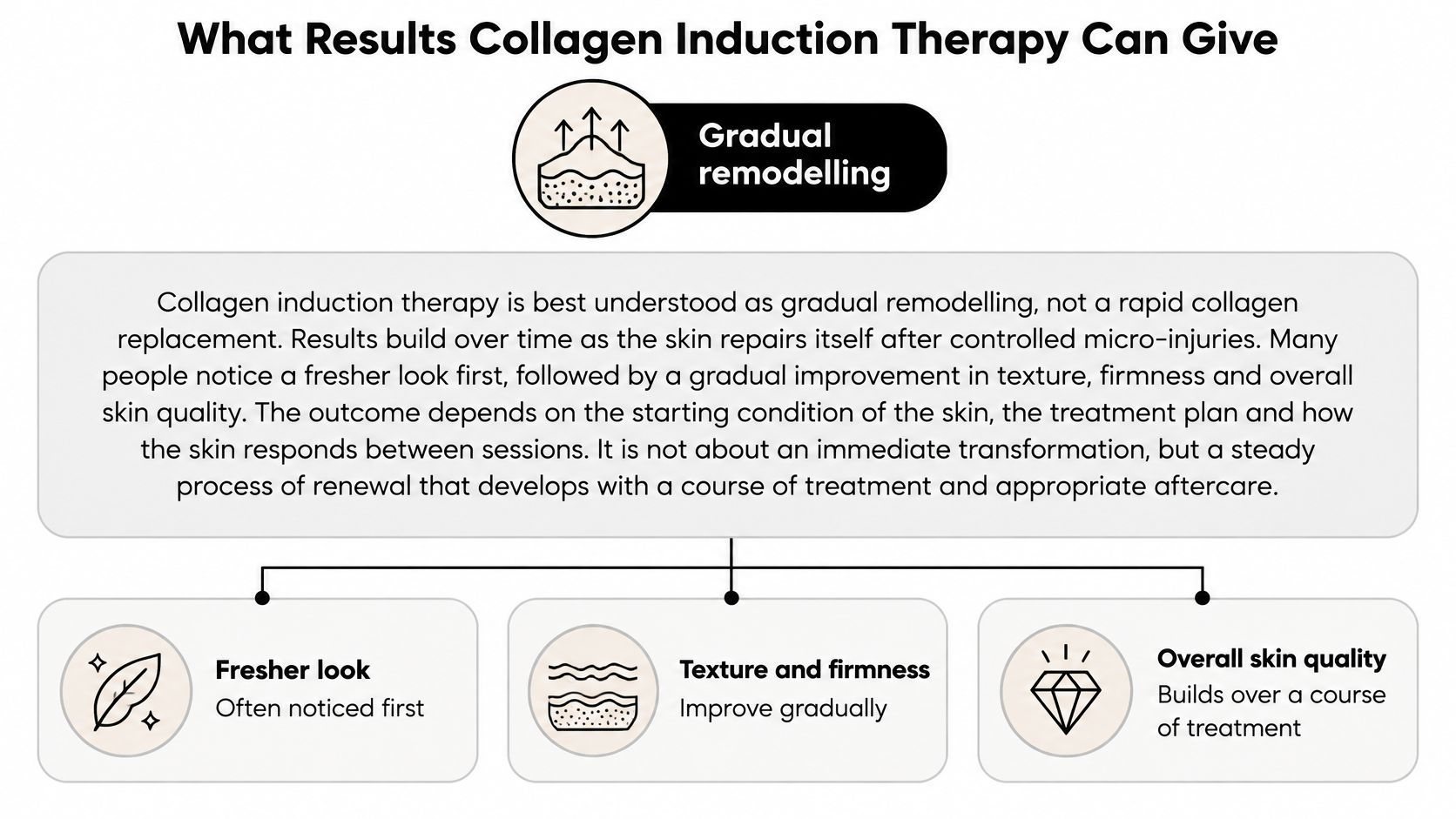
Collagen induction therapy is better understood as gradual remodelling with a modest average effect on atrophic scars, rather than a dramatic clearing of every scar; results vary from person to person.
Collagen induction therapy, also called microneedling, aims to improve scar appearance through controlled repair rather than immediate collagen replacement. The evidence summary associated with the Scottish Government's consultation background paper on non-surgical cosmetic procedures describes a meta-analysis of 12 randomised controlled trials involving 414 people, with a statistically significant but modest benefit for atrophic scars: standardised mean difference 0.42, with a 95% confidence interval of 0.12–0.73. A standardised mean difference lets researchers combine different scar-scoring systems; it isn't a percentage of scars removed. The practical interpretation is average improvement, not a prediction that every depression will disappear. Results vary from person to person, including with scar depth, age, skin type and aftercare. We therefore wouldn't judge success from early redness or temporary plumping, or tell you that a single visit will finish the job.
What does modest mean for your decision?
It means we should agree on a realistic aim before discussing a course. Wanting a little less visible unevenness is a different expectation from wanting deep scars to become indistinguishable from surrounding skin.
The scar finding also isn't a direct measurement of how much collagen your own skin will produce. We won't turn a pooled scar score into a personal collagen percentage.
For a related question about facial shape, our explanation of whether microneedling lifts the face helps distinguish texture goals from lifting expectations. Results vary from person to person.
Don't confuse skincare claims with procedure evidence
You may also encounter collagen wording on products such as REVETIX's NAD pink collagen balm. That product page is useful for checking what a particular skincare product claims, not for establishing what needling will achieve.
We don't recommend adding a cosmetic balm to freshly treated skin because its name mentions collagen. Your written aftercare should identify which products are appropriate for your actual procedure.
Recovery timing and suitability deserve their own consideration. Neither should be brushed aside because a before-and-after photograph looks appealing.
How Many Sessions Does Collagen Induction Therapy Take
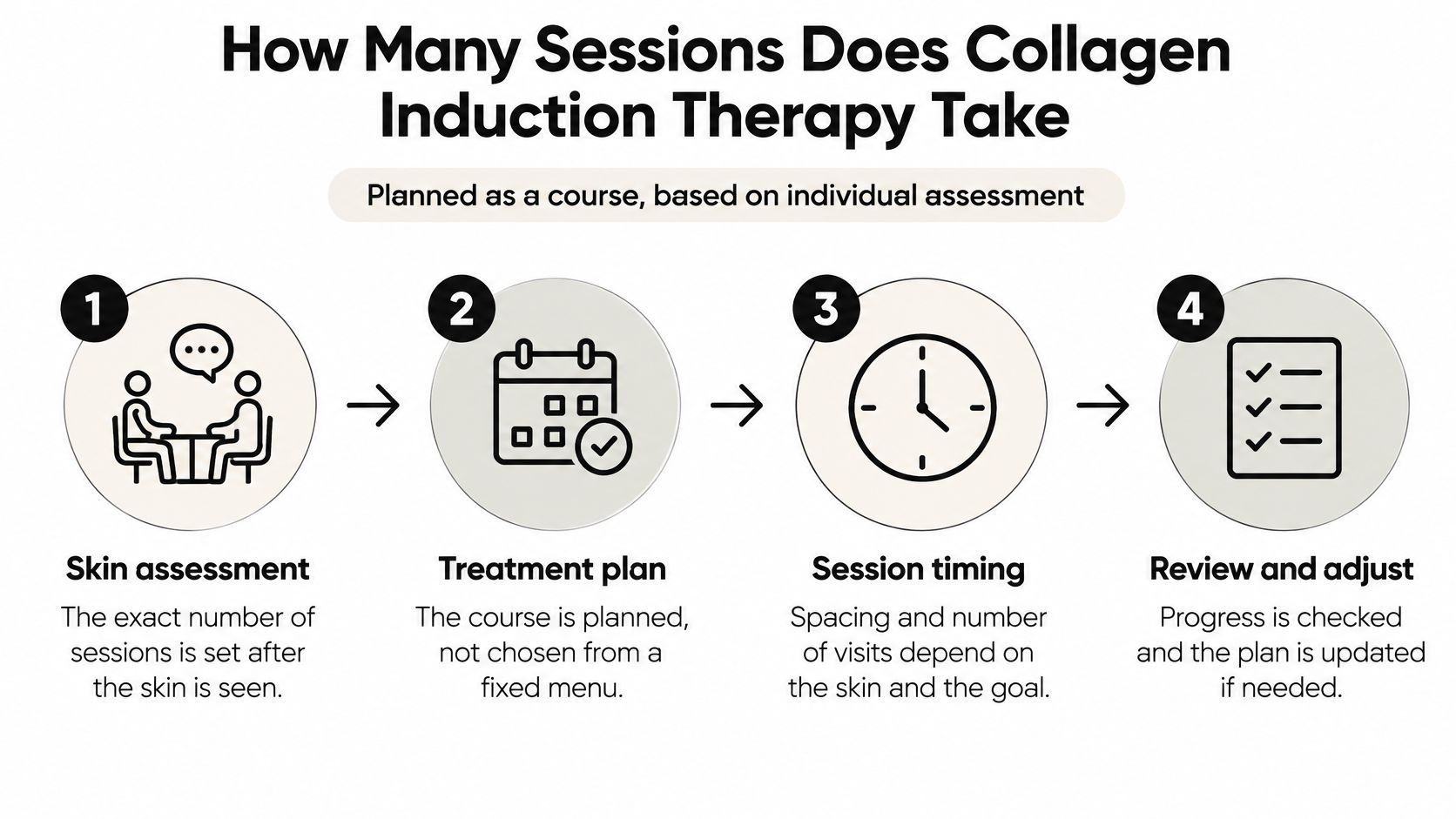
A sensible session count is a decision made after assessment. Collagen induction therapy remodels skin gradually, so we would rather agree a careful course than quote a number that sounds precise and proves wrong on your skin.
A course works like interval training for repair: one session can start a response, while spacing, depth and device choice decide whether repeated sessions build on it usefully. Our guide to how many microneedling sessions you may need can help you prepare questions, but it doesn't replace an individual recommendation.
How we approach the decision
Start with your concern and history. Old acne depressions, visible pores and uneven texture do not behave as one problem, so tell us what bothers you most and what you have already tried. Bring information about medicines, previous procedures and any tendency to develop dark marks after irritation.
Decide whether needling is the right category. A consultation isn't a commitment to needles. We should be able to explain why we recommend proceeding, postponing or choosing a different approach.
Agree the actual procedure. Device choice, treatment area, depth, passes and appointment spacing belong in the plan. Depth changes the likely effect and the caution required, so wanting faster change is not a reason to go deeper.
Understand aftercare before leaving. You need written instructions and a clear way to raise concerns. Don't leave an unanswered question until you're at home.
Agree how progress will be reviewed. Decide which concern you'll compare with your starting point and what would lead to adjusting, spacing differently or stopping treatment. Results vary from person to person.
Your postcode doesn't change the assessment
The same suitability questions matter wherever you're travelling from.
Tell us about upcoming events and how much recovery time you can accommodate. That information helps us place sessions sensibly, but it shouldn't pressure you into an unsuitable schedule.
How Long Does Collagen Induction Therapy Downtime Last
Collagen induction therapy redness commonly improves within 1–2 days, according to the Chelsea and Westminster Hospital NHS Foundation Trust microneedling leaflet, while pain or tightness may last 1–3 days.
Collagen induction therapy recovery timings
| What you may notice | Typical timing | What the leaflet adds |
|---|---|---|
| Redness | Often improves within 1–2 days | Expected early response |
| Pain or tightness | May last 1–3 days | Settles as the skin calms |
| Pinpoint bleeding | During treatment | A dressing is not normally required |
| Peeling | May follow treatment | Part of surface recovery |
| Pigment lighter or darker | Can appear after treatment | May not fully return to the previous shade |
| Infection | Small risk | Lowered by keeping the area clean and following aftercare |
Those timings describe general microneedling expectations rather than a promise about your individual recovery. Because we treat with the 3D Dermaforce, which pairs needling with radiofrequency energy, your recovery plan is written for that specific procedure instead of being copied from a general leaflet. Results vary from person to person.
Plan for recovery, not just the appointment
Visible redness settling is only part of the picture. The same leaflet lists peeling, pigment changes and a small infection risk, and any of these can outlast the initial pinkness.
Keep the treated area clean and follow the instructions given for your procedure. A product your skin normally tolerates can still irritate recently needled skin.
Our microneedling aftercare guidance is useful preparation for that discussion. Your individual written instructions take priority over a generic social-media recovery routine.
When should you seek help?
These symptoms deserve medical review rather than another cosmetic appointment:
- Spreading redness: Don't dismiss worsening redness as routine recovery.
- Persistent swelling: Contact the treating clinic and seek medical advice.
- Unusual marks or worrying pigment change: Arrange assessment rather than trying to correct them with extra products.
- A delayed rash: Report when it started and which products you've applied.
Looking ready to go out and being ready for another procedure are different decisions.
If your skin isn't settling as expected, don't book the next session to keep to a calendar. Have the reaction assessed first.
Who Should Not Have Collagen Induction Therapy?
Collagen induction therapy isn't something we would recommend proceeding with over active infection or active inflammatory acne, or when your expectations depend on a complete transformation of deep scars.
We also need to assess any underlying skin condition that needling could aggravate. Saying no or postponing is a legitimate consultation outcome, not a failure to find the right package.
What about darker skin tones?
Post-inflammatory hyperpigmentation means dark marks that develop after inflammation. Fitzpatrick skin types describe how readily skin burns or tans, ranging from very fair to highly pigmented skin.
Typology's UK discussion of microneedling for scars reports no post-inflammatory hyperpigmentation in reviewed Fitzpatrick III–IV patients, but also describes pooled hyperpigmentation of 6.8% with roller treatments and highlights concern in Fitzpatrick IV–VI skin.
Those findings describe different studied groups and shouldn't be combined into a personal risk estimate. They also don't establish an equivalent risk figure for RF microneedling.
The practical conclusion isn't to exclude someone because their skin is darker. It's to take pigment history seriously and avoid blanket reassurance. Results vary from person to person.
What should you feel comfortable asking us?
- Your skin history: How does previous pigmentation or difficult healing affect the recommendation?
- Training and insurance: Who will treat you, and what relevant competence and cover do they have?
- Products: What will be applied during treatment, and why?
- Follow-up: How will a concern be assessed if your skin reacts unexpectedly?
The Government's licensing consultation also makes clear why treatment availability shouldn't be mistaken for uniform national standards. Regulation is context, not a reason to skip questions.
If you're comparing approaches, our microneedling versus chemical peel explanation can help organise those questions. A comparison page isn't itself a recommendation to book either procedure.
Can I Book Collagen Induction Therapy in Leamington Spa?
Collagen induction therapy can be discussed at a consultation with us at 3D Aesthetics Leamington Spa, where suitability comes before any decision to treat.
We've been providing non-surgical aesthetic treatments for over 10 years, and every client begins with a complimentary consultation. That appointment is where we assess your skin, explain which device and needle depth we would use, and give an honest view of what treatment can realistically achieve.
When booking makes sense
A consultation is a sensible next step if your concern is texture, visible pores or old acne depressions and you're open to a frank discussion about limits. Come prepared to talk through recovery, possible course planning and the possibility that we won't recommend proceeding.
An active infection is a reason to wait rather than book. A single appointment also won't transform deep scars, because collagen induction therapy works through gradual remodelling over a course of sessions. Results vary from person to person.
- Prepare your questions: Tell us which concern matters most and what change you would regard as worthwhile.
- Check costs: Review our treatment prices and ask for the cost of your proposed plan before agreeing.
- Start with assessment: Use your consultation to ask who will treat you, what training they hold and how a concern would be handled if your skin reacted unexpectedly.
Take the next step without committing to treatment
You can book your complimentary consultation to discuss whether needling fits your skin and expectations. Bring your questions, your skincare list and details of any previous reactions.
We'd rather help you make a well-informed decision than have you agree to a procedure you don't fully understand.
We offer 3D Dermaforce RF microneedling for collagen stimulation and skin tightening, from £150, with individual assessment before treatment; results vary from person to person. Book your complimentary consultation through the 3D Aesthetics Leamington Spa website to discuss your skin concern and whether collagen induction therapy is an appropriate next step.
← Back to Home