

Could skin tightening ultrasound lift your skin, or is that promise doing more work than the treatment? At our clinic in Leamington Spa, we explain HIFU plainly: it can improve early-to-moderate skin laxity, but it can't remove substantial excess skin or create a surgical-scale lift. Whether it's worth considering depends on your skin, the area you want treated and what you'd count as a worthwhile change.
We're 3D Aesthetics Leamington Spa, at 11 Guys Place East, Leamington Spa, Warwickshire CV32 4RG. We see clients from Leamington Spa, Warwick and Kenilworth, and would rather tell you HIFU isn't right for you than take payment for a treatment unlikely to meet your expectations.
Table of Contents
- Can Skin Tightening Ultrasound Really Lift Your Skin?
- How Ultrasound Energy Tightens Skin
- Is Ultrasound Skin Tightening Regulated in the UK?
- How Ultrasound Compares With Other Non-Surgical Options
- What Happens During Ultrasound Skin Tightening at Our Clinic
- How Long Until You See Results From Ultrasound Tightening?
- Side Effects and Who Ultrasound Tightening Is Not For
Can Skin Tightening Ultrasound Really Lift Your Skin?
Skin tightening ultrasound can create a modest, gradual tightening effect when laxity is mild to moderate, but it can't remove substantial excess skin. High-intensity focused ultrasound, or HIFU, directs energy below the skin surface to encourage tissue contraction and lifting. That's the mechanism described in the UK Government's guidance on non-surgical cosmetic procedures.
A person with early laxity around the jawline or neck may be seeking a firmer-looking contour. Someone with substantial loose skin, or whose main concern is excess tissue after significant weight change, may not get the change they want from ultrasound. The NHS Scotland evidence summary reports modest measured changes in published microfocused-ultrasound studies, and notes that outcomes declined as laxity and BMI increased. It also identifies excessive laxity and BMI above 30 as proposed relative contraindications. These are reasons for careful assessment, not a promise that a particular person will respond in a particular way. NHS Scotland's evidence summary discusses those findings. Results vary from person to person.
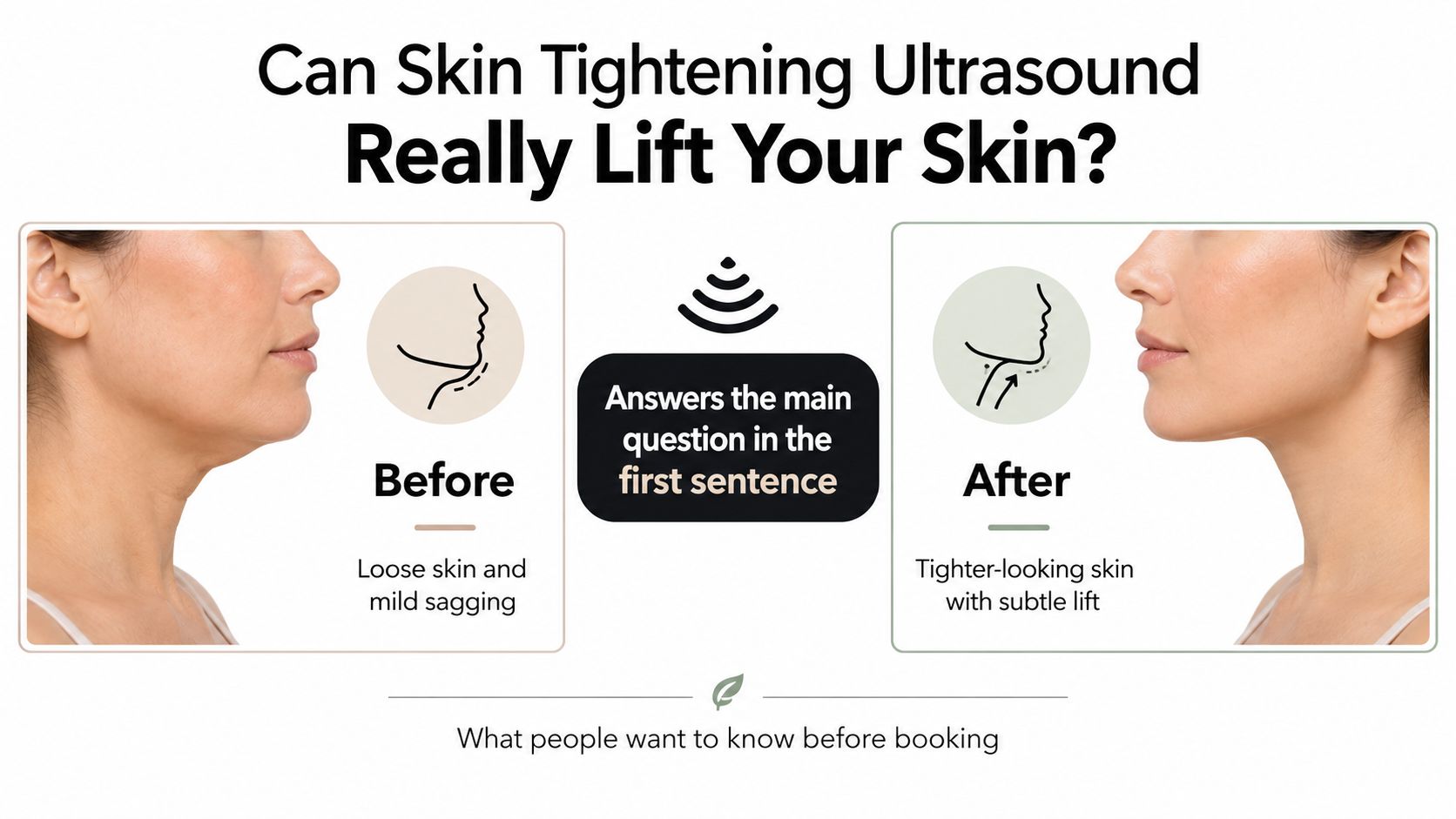
A realistic goal is a subtle improvement in firmness, assessed against your starting point, rather than a dramatic lift. Published measures in the NHS Scotland summary include brow-lift changes of approximately 0.47–1.7 mm and submental-area reductions of 26–45 mm². Those figures describe study findings, not an outcome we can forecast for you. We use a consultation to discuss what you want to change and whether the likely scale of improvement makes sense for that goal.
Our position: if your concern is significant excess skin, we'll say so. HIFU isn't a way to remove it.
We offer HIFU skin tightening at our clinic. For background on the equipment used in aesthetic practice, Omega Lasers explains how HIFU equipment is used in aesthetic settings. If you're considering treatment, you can book a free consultation with us.
How Ultrasound Energy Tightens Skin
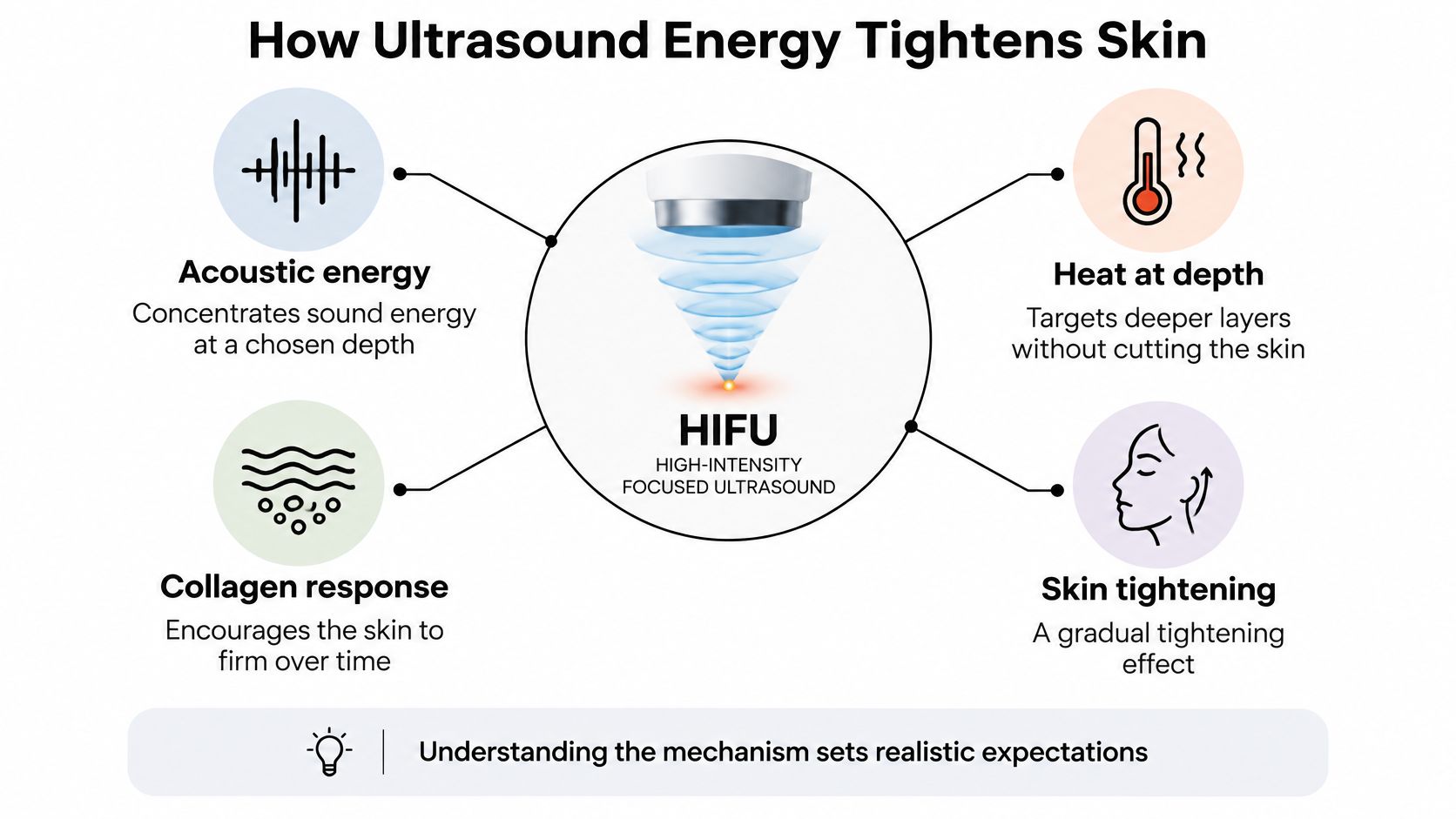
HIFU concentrates acoustic energy, meaning sound-wave energy, at selected depths beneath the skin to create a local heating effect. Instead of heating the whole surface evenly, the device focuses energy at chosen points. The UK Government describes HIFU as directing ultrasound into deeper skin layers to encourage contraction and lifting, while a systematic review discusses its focused-energy mechanism and treatment parameters (review of HIFU facial treatments).
A useful analogy is a magnifying glass focusing sunlight at a point, rather than a warm room heating everything evenly. The aim is to create thermal coagulation points, small zones of controlled heat, while the epidermis, the outer skin layer, is intended to remain comparatively preserved. The body's response includes contraction and longer-term collagen remodelling. “Remodelling” means changes in the structure of collagen over time, not an immediate mechanical lift.
Why depth and placement matter
The review reports commonly used facial treatment depths of approximately 1.5–4.5 mm, frequencies of 2–7 MHz, and around 600–800 thermal coagulation points per session. These are reported ranges from reviewed protocols, not a recipe for every face. Different depths can target different tissues, so a practitioner needs to account for anatomy and skin thickness rather than selecting one setting for everyone.
Treatment planning also matters because the energy has to be delivered accurately. A review by the UK Health Protection Agency notes that protection depends substantially on correct beam placement, and that equipment design does not necessarily prevent excessive heating of tissues above the focal point. That's why consultation, suitable coupling between applicator and skin, conservative energy selection and avoiding vulnerable anatomy are practical safety considerations.
For a different approach to skin firmness, our clinic also offers radio-frequency skin tightening. The two approaches use different energy types, so the choice depends on the concern and treatment plan, not just the device label.
The video below shows an overview of the HIFU process.
Is Ultrasound Skin Tightening Regulated in the UK?
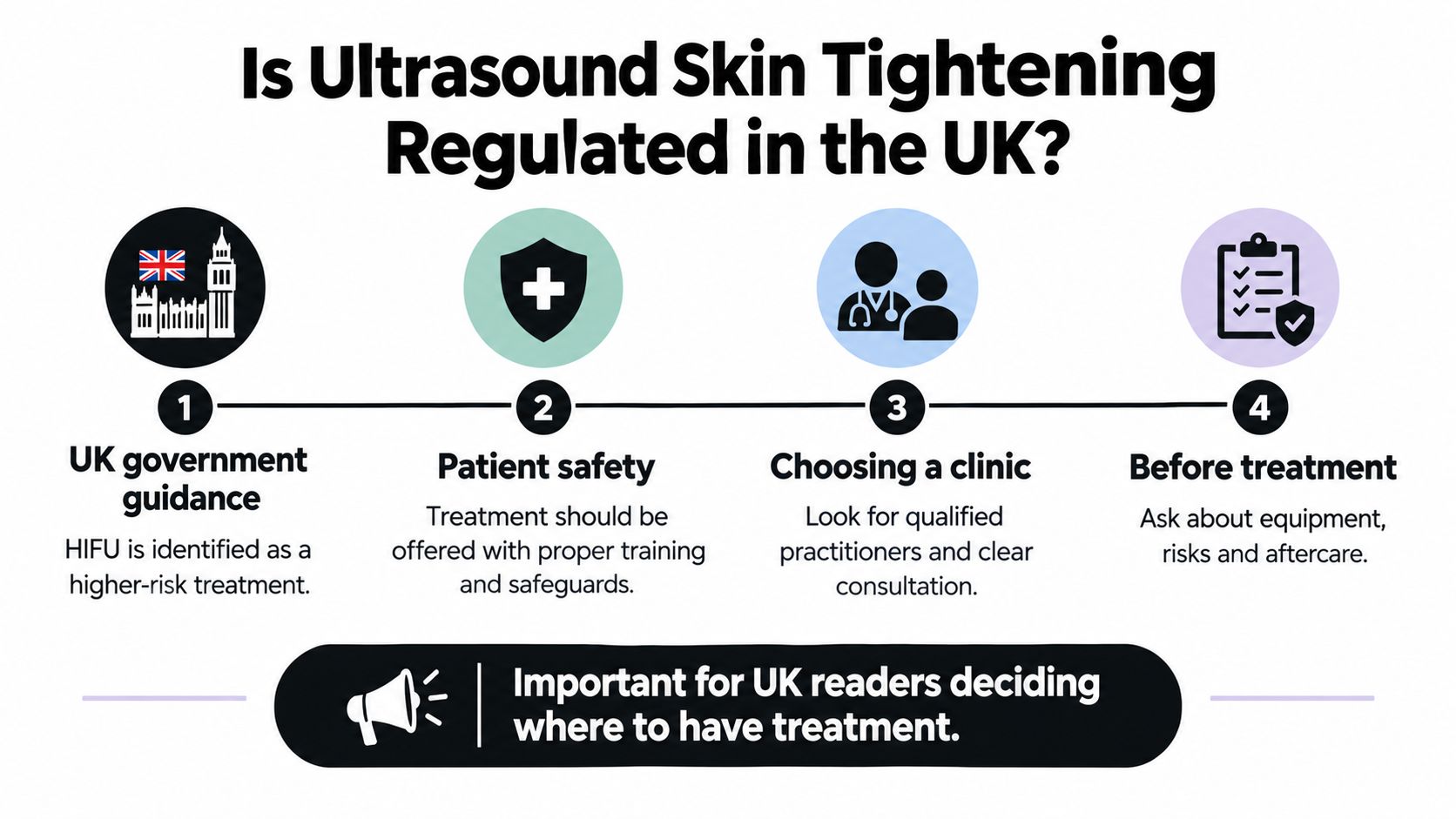
Yes, ultrasound skin tightening sits within an evolving UK safety and regulatory framework, but the rules for procedures and the rules for devices are not the same thing. The UK Government lists HIFU as a non-surgical cosmetic procedure that delivers energy below the skin surface and may carry safety risks if performed incorrectly. It also says the Health and Care Act 2022 gave England's Secretary of State for Health and Social Care the power to introduce licensing for non-surgical cosmetic procedures. That power is a policy milestone, not evidence that every proposed licensing requirement is already in force.
The device framework is another part of the picture. The Medicines and Healthcare products Regulatory Agency's guidance on medical devices in the UK sets out that the Medical Devices Regulations 2002 are the principal legal foundation in Great Britain. The UKCA conformity route opened on 1 January 2021, and medical devices must be registered with the MHRA before being placed on the Great Britain market. The guidance also says that, depending on device type and classification, compliant CE-marked devices may continue to access that market until 30 June 2030. Northern Ireland follows a different arrangement under EU medical-device rules.
What to ask before booking
For a client in Leamington Spa or elsewhere in Warwickshire, the useful questions are practical. Ask what device the clinic uses, who will perform the procedure, how they assess whether you're suitable and what safety steps they follow. Device status is not the same as a guarantee of a good treatment, and an advertised cosmetic outcome doesn't tell you how carefully a clinic plans or delivers the session.
The Government's consultation also points to practitioner competence, suitable premises, hygiene and safety standards as relevant considerations. We encourage you to look for clear answers and a proper consultation, not just a persuasive description of a “lift”.
How Ultrasound Compares With Other Non-Surgical Options
HIFU is one option for early-to-moderate laxity, while other treatments address different concerns such as texture, scarring or stubborn fat. There isn't one device that suits every goal. At our Leamington Spa clinic, we match the option to the concern we're assessing, rather than treating all changes in contour as a skin-tightening problem.
| Treatment | Mechanism | Typical downtime | Best-fit concern |
|---|---|---|---|
| HIFU | Focused ultrasound energy at selected depths | Varies by person and treatment | Mild-to-moderate laxity |
| 3D Dermaforce RF microneedling | Radiofrequency delivered with microneedling | Varies by person and treatment | Skin texture and selected mild concerns |
| CO2 fractional laser resurfacing | Fractional laser treatment of the skin surface | Varies by person and treatment | More significant texture concerns and scarring |
| Fat freezing (cryolipolysis) | Cooling to target fat, not lax skin | Varies by person and treatment | Stubborn fat rather than laxity |
HIFU directs energy beneath the surface and may be considered when mild-to-moderate laxity is the main concern. It won't remove a substantial amount of loose skin. The outcome depends on the device, settings, treatment plan and operator, so claims made about one platform shouldn't automatically be applied to another. Our HIFU and radio-frequency comparison offers more detail on how the approaches differ.
3D Dermaforce RF microneedling is an option we offer for selected skin concerns involving texture and mild laxity. CO2 fractional laser resurfacing is a different treatment focused on surface texture and scarring, while fat freezing targets stubborn fat rather than loose skin. A treatment that addresses fat won't, by itself, tighten excess skin, and a tightening treatment shouldn't be sold as a fat-reduction method.
Choosing by the concern, not the trend
Downtime and the number of sessions depend on the treatment and individual plan, so we don't use unsupported one-size-fits-all promises. Some clients may benefit from a combination of approaches, but combining treatments doesn't mean every option is appropriate or that the effects will add up in a predictable way.
We use a complimentary consultation and 3D body scan to assess the area and discuss what you'd like to change. The scan can support consistent measurement over time; it doesn't decide suitability on its own. We'll explain the trade-offs and recommend a different approach, or no treatment, if that better fits your concern.
What Happens During Ultrasound Skin Tightening at Our Clinic
Ultrasound skin tightening at our clinic begins with a complimentary consultation, not with the applicator. We discuss what's bothering you, what change you're hoping for, your health history and the area you want assessed. We then use a full 3D body scan to document the area and help plan how we'll measure any change over time.
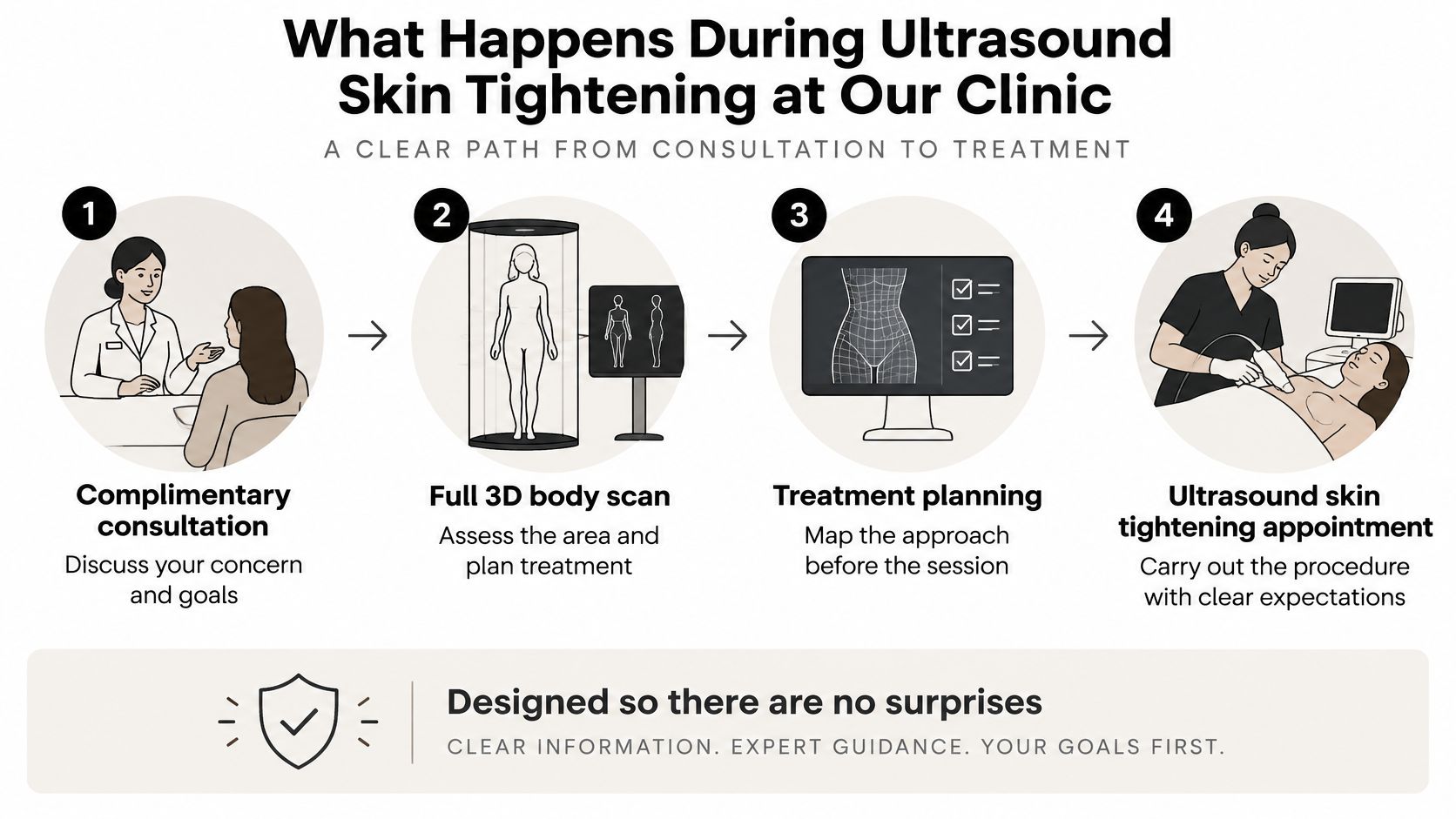
We don't treat on the day just because someone has booked. The consultation gives us time to consider whether HIFU is appropriate and to explain what it can and can't do. We also ask about health factors and examine the skin at the proposed treatment site before deciding whether to proceed.
If we agree to proceed
Before treatment, we prepare the area, apply ultrasound gel as the contact medium and mark out the planned zones. The treatment is then delivered along the mapped lines, using settings selected for the person and area rather than a generic pattern. Correct coupling and placement matter because the energy needs to reach its intended target.
People may describe sensations such as warmth, tingling or prickling, but comfort varies. We'll check how you're feeling and adjust the approach if the sensation becomes uncomfortable. We won't claim that the procedure feels the same for everyone.
Afterwards, we explain what to expect and give aftercare guidance suited to your treatment. The appointment length depends on the area and plan, so we confirm the practical details during consultation rather than quoting a single duration for every client. We're based at 11 Guys Place East, Leamington Spa, Warwickshire CV32 4RG. You can also call us on 01926 315764 if you'd like to discuss what a visit involves before booking.
How Long Until You See Results From Ultrasound Tightening?
Skin tightening ultrasound works gradually, so an immediate mirror check isn't a reliable way to judge the final effect. The treatment's intended response includes collagen remodelling over time, which is why we prefer planned photographs and repeat measurements to a same-day impression. Results vary from person to person, and we won't promise that you'll see a particular change.
A systematic review of HIFU protocols notes that many studies used a single treatment session, but treatment parameters and protocols differed between devices and studies. That doesn't mean one session is right for everyone, or that a particular number of sessions can be prescribed without assessing the individual. We'll discuss whether a session or a planned course makes sense for your area and expectations.
Why we review at eight to twelve weeks
The reviewed literature recommends reassessment at approximately 8–12 weeks, when a delayed tissue response is more meaningful than immediate post-treatment tightening (HIFU protocol review). That's a review point, not a promise that visible change will have occurred by then. We compare standardised photographs and repeat 3D measurements with your starting assessment, then discuss whether what we can observe aligns with your goals.
If your concern is specifically beneath the chin, we can assess whether HIFU is appropriate for that area as part of a consultation about skin tightening under the chin. The measurement approach helps us look at change consistently, but it can't remove the uncertainty that comes with individual responses.
A useful review asks two questions: what can we measure against the baseline, and does that change matter to you?
Long-term results and comparisons between different devices and protocols remain insufficiently studied, and the literature identifies limited standardisation. Maintenance intervals also vary, so we won't invent a timetable or tell you that a repeat session is automatically needed. We'll review your response and discuss next steps, including whether doing nothing further is the sensible choice.
Side Effects and Who Ultrasound Tightening Is Not For
Ultrasound tightening isn't appropriate for everyone, and we screen for health and skin factors before deciding whether to treat. Possible unwanted effects include pain, burns, nerve irritation or unwanted loss of volume if energy is excessive or poorly positioned, concerns described in the reviewed HIFU literature and safety material. How someone responds varies; we'll explain the relevant risks during consultation rather than dismissing them.
The Royal Berkshire NHS ultrasound-therapy patient guide lists situations where ultrasound may not be appropriate. These include:
- Pregnancy or an electronic implant near the proposed treatment area.
- Recent infection, active or expected bleeding, or recent radiotherapy affecting the area.
- Significant vascular conditions, such as deep-vein thrombosis or embolism, or haemophilia without factor replacement.
- Cancer or suspected cancer over the treatment area.
- Poor skin condition or inability to provide consent.
That guide supports proper screening, but it doesn't replace an individual assessment. We may advise against treatment, ask you to seek appropriate medical advice, or recommend waiting if your health history or the treatment site raises a concern.
Skin condition matters too
Ultrasound gel contacts the skin, so the condition of the skin barrier is relevant. UK infection-prevention guidance defines non-intact skin as a break or alteration in skin integrity, including a rash or surgical wound, and says ultrasound gel needs particular consideration when it contacts or comes close to non-intact skin (UK guidance on ultrasound gel and infection prevention). We'll assess the proposed area and follow appropriate infection-control procedures.
If you're unsure whether skin tightening ultrasound fits your needs, book a free consultation rather than trying to decide from a photograph or a sales claim. You can read our overview of HIFU facelift side effects and bring your questions to the appointment. We'll tell you plainly if we don't think treatment is right for you.
At 3D Aesthetics Leamington Spa, we offer HIFU skin tightening with a complimentary consultation and 3D assessment, so you can discuss suitability and realistic expectations before deciding. Visit 3D Aesthetics Leamington Spa or call 01926 315764 to arrange a consultation.
← Back to Home