
Most advice on How to Tighten Jowls Without Surgery starts in the wrong place. It lists a cream, a face exercise and a clinic device as if they all do the same job, just at different prices. They don't. In our clinic we start with a plainer question. What's making your jaw look soft? Is it loose, crepey skin, a fat pad under the chin, weak muscle tone, or a mix of all three? A device that suits one of those won't fix the others, and we won't sell you a course until we've worked out which layer is leading. That means we sometimes say no. A subtle, honest improvement in definition is a fair aim. A surgical lift without surgery isn't.
Table of Contents
- What causes jowls, and what can non-surgical tightening change?
- Which Treatment Matches Your Type of Jowl
- Who should not have non-surgical jowl tightening?
- How is non-surgical jowl tightening planned and combined safely?
- How Long Does Non-Surgical Jowl Tightening Take
- What can I do at home between jowl treatments?
- Book a Jowl Assessment in Leamington Spa
What causes jowls, and what can non-surgical tightening change?
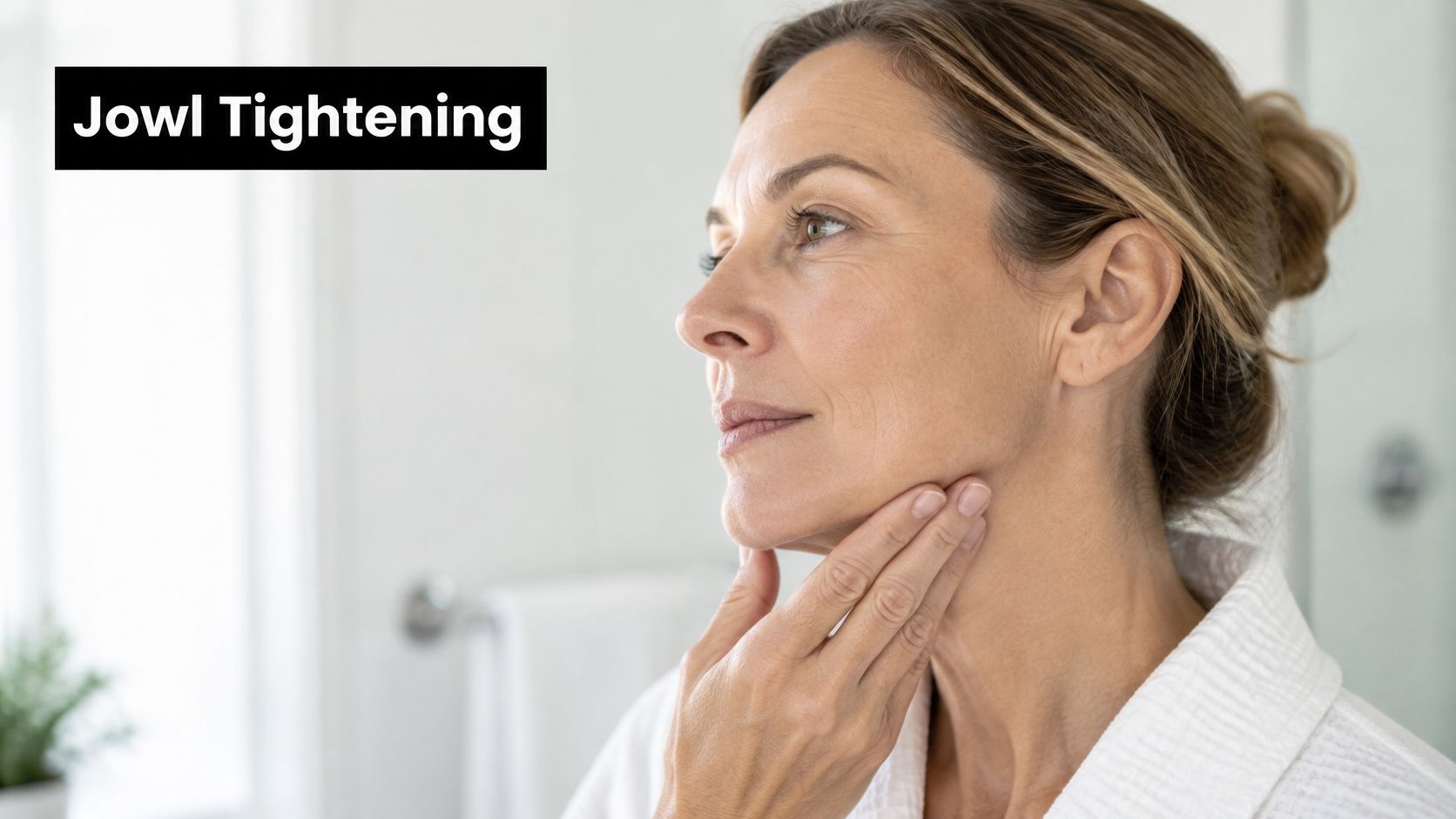
Jowls are the softer fold where the jaw meets the neck, and non-surgical tightening improves mild skin laxity and jawline definition rather than moving bone or descended fat. That's the honest limit, and it's where every plan at our Leamington Spa clinic begins. If we can't explain which layer we're treating on your face, we shouldn't be treating it.
What is changing under the skin
Collagen (the protein that gives skin structural strength) and elastin (the protein that helps skin recoil) both become less effective with age, so skin gets thinner and less resilient. A UK clinical explanation of how jowls form describes how reduced collagen and elastin can make skin thinner and less resilient, facial fat compartments can lose volume and move downward, supporting ligaments can loosen, and gradual changes in the facial skeleton can reduce support around the jaw and chin. In plain terms, the scaffold weakens at the same time as what it held starts to drift down.
That layered change is why two jaws that look similar in a photo can need opposite plans. Energy-based tightening works on skin laxity and collagen remodelling. It doesn't replace lost bone, and it doesn't lift a descended fat compartment back into the cheek.
Two patterns we separate at consultation
Say one client from Warwick has a soft jaw border, thin skin and fine creping along the edge of the jaw. Her problem is mainly skin quality and recoil. Another client from Warwick has firmer skin but a clear pad of fullness under the chin that blurs the neck angle. Her problem is mainly localised fat. We would not treat them the same way, and you'd waste money if we did.
If the fold you can see is mostly fat or mostly lost volume, tightening the skin surface alone won't give you the jawline in the photo you're holding up.
People with substantial excess skin, or a concern that is mostly lost mid-face volume, usually see little from skin tightening alone. We'll say so at consultation rather than book you in and hope. You can read more about the under-chin pattern on our page about skin tightening under the chin, and readers comparing wider approaches sometimes also look at facial rejuvenation options in Easton to see how clinics elsewhere frame the same limits. Whatever route you consider, results vary from person to person, and a softer, better defined border is a realistic aim for the right candidate, not a repositioned face.
Which Treatment Matches Your Type of Jowl
The right device depends on what is softening the jawline: loose skin, changes in muscle tone, texture, or fat beneath the chin. HIFU is a non-surgical lifting and tightening treatment. Cryolipolysis reduces under-chin fat, while radiofrequency and RF microneedling address skin tightening and texture. These approaches do different jobs.
| Option | Best when | What it targets | Usual course shape | Downtime |
|---|---|---|---|---|
| HIFU Non-Surgical Facelift | Skin laxity affects the jaw and jowl line | Lifting and skin tightening | One-off full face and neck treatment from £350 | Little to no recovery time |
| Radiofrequency skin tightening | Skin looks crepey or mildly lax | Skin tightening through radiofrequency | Recommended course of 8 treatments | Little to no recovery time |
| 3D Dermaforce RF microneedling | Texture concerns accompany mild laxity | Collagen stimulation and skin tightening | From £150; course shape depends on the plan | Little to no recovery time |
| EMlift / Muscle Stimulation | Muscle toning and skin tightening are the focus | HIFEM+ muscle stimulation | Non-surgical treatment from £150 | Little to no recovery time |
| Double Chin Removal (Cryolipolysis) | Fat beneath the chin blurs the jawline | Localised fat beneath the chin | One-off treatment of around 30 minutes, £195 | No downtime |
How the options differ
HIFU Non-Surgical Facelift uses the 3D HIFU system for non-surgical lifting and tightening. It targets the brow and jowl line, and can also reduce nasolabial folds and periorbital wrinkles. Improvement in facial contouring and fine lines may be noticeable within 4 weeks, with further improvement in skin tightening and wrinkles up to 6 weeks after treatment.
Radiofrequency skin tightening uses heat to support collagen production. Our skin-tightening appointments cost £100 for 30 minutes, £150 for 60 minutes or £175 for 90 minutes, with a recommended course of 8 treatments. For a closer comparison of the two approaches, read about HIFU and radiofrequency for skin tightening.
3D Dermaforce RF microneedling is another option for collagen stimulation and skin tightening, from £150. It may suit someone with texture concerns alongside mild laxity, but it should not be presented as a way to correct a heavy fold. EMlift uses HIFEM+ for muscle toning and skin tightening. Slight twitching during contractions is normal and should not be uncomfortable.
Double Chin Removal uses cryolipolysis to reduce fat beneath the chin and define the jawline. The treatment takes around 30 minutes. It reduces fat, not loose skin, so it may not be the right match if skin laxity is the main concern.
Home care can support skin quality between treatments, but it does not replace a device. Some readers also compare how clinics describe facial aesthetics at a private dental clinic. A device cannot restore lost cheek volume, and results vary from person to person. Judge change with repeat photos taken in the same light.
Who should not have non-surgical jowl tightening?
A device cannot remove a large amount of loose skin or replace lost facial volume. Non-surgical tightening is more suited to mild laxity. If either excess skin or volume loss is the main reason for a softened jawline, a device may not address the cause.
Heat-based treatments are generally not advised during pregnancy or over active skin infections, open skin or fresh sunburn. Suitability depends on the treatment and individual circumstances, so discuss these factors during a consultation before deciding whether to proceed.
When a device may not meet your expectations
A surgical face and neck lift can make a more substantial change than non-surgical tightening. If you expect that degree of lift, a device is unlikely to deliver it. Be equally cautious about treating a prominent fold of excess skin with heat alone.
Understanding the safety evidence
A UK government review of cosmetic intervention regulation reported that the UK had no central collection of complication data for cosmetic interventions. The review also described complications reported to plastic surgeons after non-surgical treatments, including some that were irreversible. Without complete national data, a precise complication rate cannot be given.
Heat-based devices can cause pain, burns, swelling, bruising or uneven results. Read about possible side effects of a HIFU facelift before considering treatment, and discuss any concerns as part of your assessment. Results vary from person to person.
How is non-surgical jowl tightening planned and combined safely?
A useful plan starts by identifying what is shaping the jowl. HIFU targets lifting and skin tightening; radiofrequency can support skin tightening, while cryolipolysis reduces fat beneath the chin. These treatments address different layers, and none removes substantial excess skin or replaces lost facial volume.
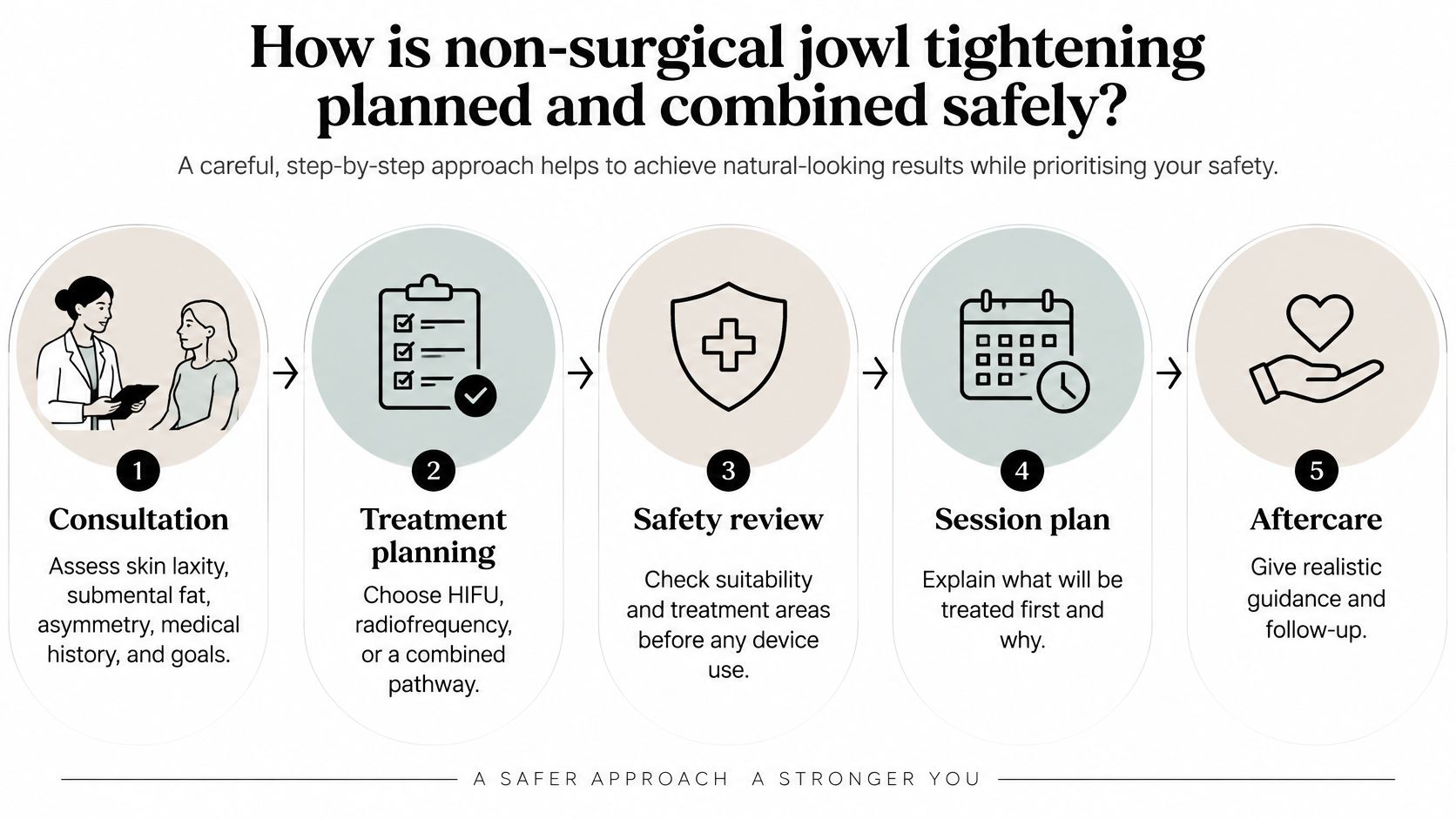
The six steps we work through
- Assess in person: We consider skin laxity, fat beneath the chin, asymmetry, medical history, contraindications and your desired result.
- Record a baseline: Standardised frontal and profile photographs provide a comparison point. Where useful, 3D facial scanning can add measurements. Our free AI Skin Scanner is a starting look, not evidence of a lift.
- Identify the dominant layer: We match the treatment to the main concern. HIFU is a non-surgical lifting and tightening option; cryolipolysis is for fat beneath the chin, not loose skin.
- Choose a conservative plan: Treatment settings should suit the individual rather than follow one setting for everyone. The jaw border and bony areas need careful consideration.
- Discuss aftercare: We explain what to expect and how to contact us if something worries you.
- Set a review point: We assess progress after the treatment's remodelling period, rather than judging the result immediately.
What HIFU can and cannot achieve
HIFU results vary from person to person. It can support lifting and tightening, but it cannot reproduce a surgical lift or remove a large fold of excess skin. If your priority is a modest improvement in definition, it may be worth considering. If your main concern is substantial loose skin or lost volume, a device treatment is unlikely to address it.
Use the baseline as your comparison, not a general percentage or someone else's result. Repeat photographs in the same lighting and from the same angles make changes easier to judge. A 3D measurement may also help track contour, but it does not show that every concern has been corrected.
How to combine treatments carefully
A staged approach makes it easier to assess what each treatment contributes. HIFU may be considered for lifting and tightening; radiofrequency or 3D Dermaforce may be considered for skin tightening, and cryolipolysis only when fat beneath the chin is the main target. Combining heat-based treatments on the same area in one visit is generally best avoided. Allowing time between treatments makes it easier to assess the skin's response before deciding what, if anything, to add.
A practical sequence: Choose one treatment for the dominant concern, allow time to assess the response, then reconsider the plan.
Dermalux LED therapy may be considered as part of a plan when redness needs settling. EMlift uses HIFEM+ for muscle toning and skin tightening, so it addresses a different target from HIFU. The treatments are not interchangeable; the choice depends on the concern being treated.
How Long Does Non-Surgical Jowl Tightening Take
HIFU doesn't show its full tightening on the day, and in our clinic we usually see a change in facial contour and fine lines within 4 weeks, with further skin tightening and wrinkle change up to 6 weeks, while results vary from person to person. Warmth or brief redness on treatment day is a skin response, not a result. Judging your jaw in the clinic mirror before you leave will mislead you in both directions.
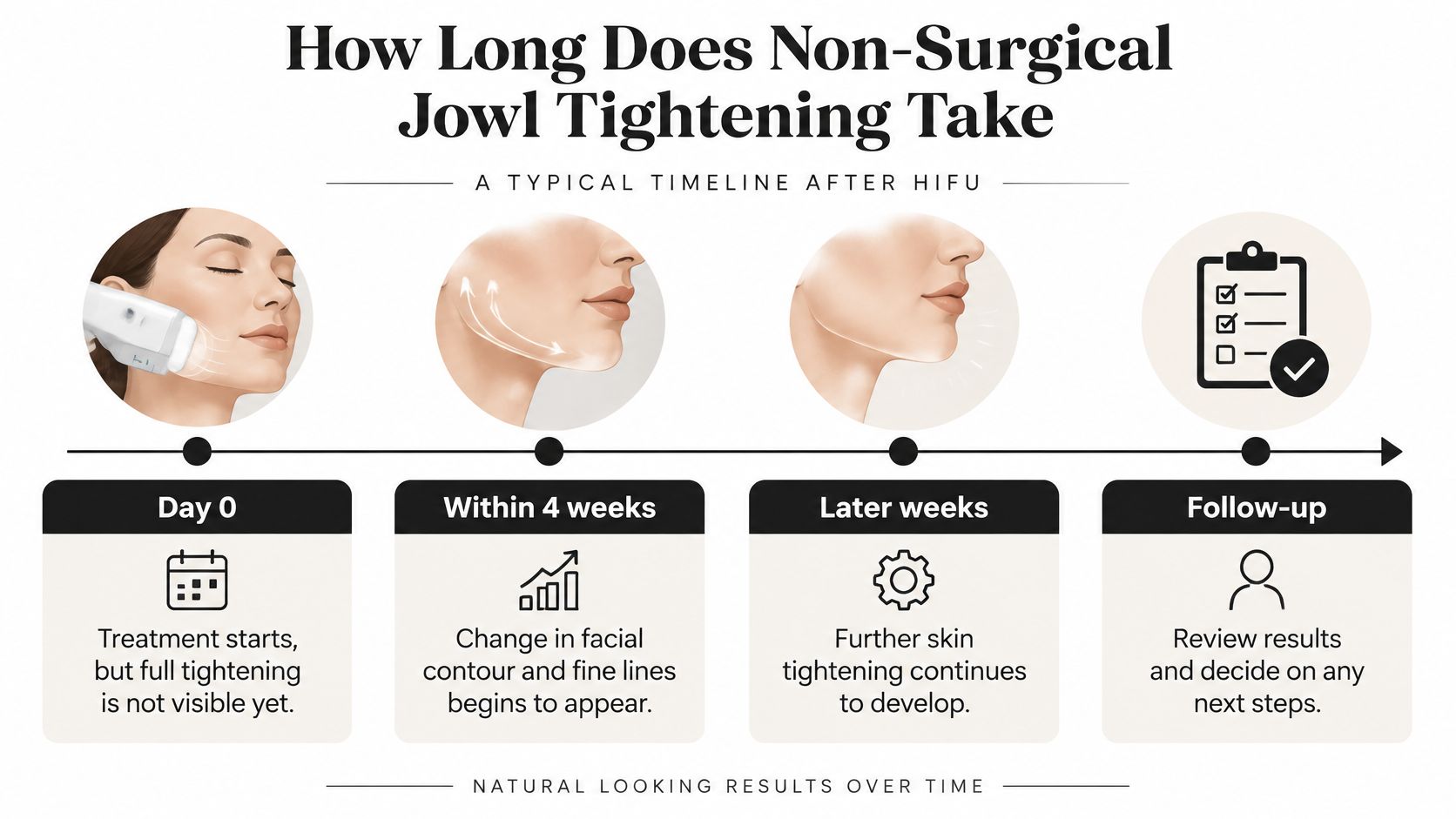
| Checkpoint | When | What we usually look for |
|---|---|---|
| Baseline | Consultation day | Photos and, where used, a 3D measurement, not a result |
| Treatment day | Same day | Warmth or brief redness, little or no downtime |
| Early HIFU change | Within 4 weeks | Contour and fine lines may start to look different |
| Further HIFU change | Up to 6 weeks | Skin tightening and wrinkles, still not a surgical lift |
| Radiofrequency or Dermaforce course | Across the course, then weeks after | Texture and mild laxity, judged after remodelling |
| Double chin cryolipolysis | After the single 30-minute visit, on review | Jawline fat contour, not skin recoil |
| Formal review | After the remodelling window | Same lighting and angles; results vary from person to person |
How to tell a real change from a flattering photo
The useful comparison is a second set of photographs in the same light, same distance and same head position as your baseline, plus the 3D scan where we used one. Treat the scan as a measurement aid, not as evidence that tissue has lifted. It records contour, and contour can shift for dull reasons like posture and fluid.
The trap is a single smiling selfie in brighter light, chin lifted, taken from above. Almost every jaw looks better that way, treated or not. If your before photo was straight on in flat light and your after photo isn't, you're comparing photography, not skin.
The short video below shows the treatment format so you can see what's involved before you book an assessment.
Radiofrequency and 3D Dermaforce build across a course, so judging either after one visit is too early. Cryolipolysis for under-chin fat is judged on the contour of that fat pocket, not on skin recoil. Our page on the ultrasound face lift covers the HIFU format in more detail.
Collagen remodelling continues over several weeks to months, and a softer jaw border can be worthwhile without looking like surgery. Wait before judging if you're still swollen, and be cautious if your main issue was volume loss rather than laxity, because time alone won't change that mismatch. Ageing also continues, so we don't promise a fixed duration for any result. We book a review, look at your matched photographs together and decide then whether anything further is worth doing. Results vary from person to person.
What can I do at home between jowl treatments?
Home care after HIFU or radiofrequency protects the result and skin quality, and it doesn't tighten a jowl on its own. That isn't a dismissal. Poor home care can undo good work, particularly sun exposure while your skin is remodelling.
The habits that protect remodelling skin
- Wear daily broad-spectrum sunscreen: New collagen remodelling is wasted if the skin gets burnt, so sunscreen isn't an optional extra during a course.
- Keep cleansing gentle: Use a mild cleanse and moisturiser while the skin is warm or pink, and skip scrubs in the first days after treatment.
- Avoid extra heat early on: No saunas or hot yoga in the first days after radiofrequency microneedling, while the skin is still settling.
- Sleep slightly raised: If your jaw feels puffy that first night, an extra pillow helps you judge the area more fairly the next morning.
Check your jaw in a straight-on photo at eye level rather than a downward phone camera, which exaggerates every fold under the chin. It's a small habit, but it stops a bad angle convincing you a treatment hasn't worked. It also stops a flattering angle convincing you it has.
Weight, smoking and face exercises
Keep your weight stable if you can. A new fat pad under the chin is a different problem from lax skin, and it's why some people later need cryolipolysis rather than another tightening visit. Repeated crash diets stretch and release the same skin, which doesn't help recoil.
Stopping smoking supports skin quality more reliably than any cream we could sell you.
We don't sell facial exercises as a treatment, and we won't dress them up as one. If you enjoy them and they do your skin no harm, that's your choice, but they aren't part of a plan we'd charge for. Home care supports the clinic treatment you've chosen, it can't replace it, and results vary from person to person.
Book a Jowl Assessment in Leamington Spa
A jowl assessment should identify whether the main concern is lax skin, a heavier jowl line or fat beneath the chin. At 3D Aesthetics Leamington Spa, a complimentary consultation helps us match a suitable option to your concern, rather than recommend a device by default.
HIFU Non-Surgical Facelift is a one-off full face and neck treatment from £350. 3D Dermaforce RF microneedling is from £150, and Double Chin Removal using cryolipolysis costs £195 for a one-off 30-minute treatment. These options address different concerns, so a consultation is the right place to decide whether one fits your goals.
We will say plainly if non-surgical treatment is unlikely to help enough, or if no treatment is the fairer advice. Book your consultation through our booking page and bring the photo that best shows the change you want to address. For a fair comparison later, take repeat photos in the same light and from the same angle. Results vary from person to person.
If you want to discuss whether treatment suits your jowl line, visit 3D Aesthetics Leamington Spa to arrange a consultation.
← Back to Home