
Could treating every visible upper-lip hair be the wrong approach? Before counting sessions, we need to establish whether the hair has enough pigment to respond, whether your skin can be treated safely, and whether new growth needs a GP assessment first.
At our clinic in Leamington Spa, we start with suitability rather than a package. Sometimes a course makes sense. Sometimes fewer sessions, a different approach or no laser at all is the better decision.
Table of Contents
- Does Laser Hair Removal Work on the Upper Lip?
- How Many Sessions Does Upper Lip Laser Hair Removal Take?
- Will Upper Lip Laser Hair Removal Last?
- Does Upper Lip Laser Hair Removal Hurt?
- How to Prepare and Care for Your Upper Lip Between Sessions
- What Are the Side Effects of Upper Lip Laser Hair Removal?
- What Should I Check Before Booking Upper Lip Laser Hair Removal?
Does Laser Hair Removal Work on the Upper Lip?
Can laser reduce upper-lip hair without treating every hair as a suitable target? It can work well on dark, coarse hair, though the aim is long-term reduction rather than complete removal. Laser light is absorbed by pigment in the hair and converted to heat, which can damage the follicle's growth structures. The clinical evidence on facial laser treatment supports assessing hair colour, skin type and hormonal factors before treatment.
Fine facial fuzz needs a different judgement from thicker, pigmented hair. Grey, white and very blond hairs contain little pigment and generally respond poorly. Darker skin is not automatically excluded, but safe treatment depends on suitable settings, practitioner experience and a patch test.
Which hair and skin combinations make sense?
Terminal hair is thicker and pigmented; vellus hair is fine facial fuzz. Visibility alone does not make a hair a useful laser target.
Likely response by hair type and skin type
| Hair type | Skin type | Likely response | What we do |
|---|---|---|---|
| Dark, coarse hair | Lighter skin | Usually a strong response | Assess suitability and carry out a patch test |
| Dark, coarse hair | Darker skin | A good response may be possible with careful settings | Use a patch test and conservative settings; practitioner experience matters |
| Fine, light or vellus hair | Any | Poor or unpredictable response, with a risk of stimulated growth | Discuss at consultation; treatment may not be suitable |
| Grey, white or very blond hair | Any | Little or no response because there is little pigment to absorb the light | Explain that laser is unlikely to help |
| New or rapidly increasing facial hair | Any | Assess the cause before considering laser | GP assessment first |
These are general guides, not individual predictions. For unpigmented hairs, electrolysis may be an alternative, though it is not offered through this article.
When would we say no?
We may advise against treating fine, light facial fuzz if the likely benefit is limited. Rapidly developing facial hair also needs a GP assessment before laser is considered.
For clients visiting us from Leamington Spa, Warwick and Kenilworth, the next step is a consultation and test patch, not a commitment to a full course, because only a patch test can show how your hair and skin respond.
How Many Sessions Does Upper Lip Laser Hair Removal Take?
How many appointments should you plan for? A course of around eight sessions is typical because hair grows in cycles. The exact number depends on how the hair responds as the course progresses.
Upper lip session schedule at a glance
| Stage | Typical timing | What happens |
|---|---|---|
| Test patch | Before treatment begins | A small area is treated and checked for a skin reaction |
| Course | Around eight sessions | Repeated appointments target hairs as they enter a responsive growth phase |
| Spacing | Set individually after assessment | Appointments are timed around hair growth and skin recovery |
| Maintenance | Occasional top-ups, if needed | Considered when suitable pigmented hair returns |
Why isn't one appointment enough?
Hair follicles do not all enter the active growth phase at the same time. Repeating treatment across a course gives the laser opportunities to target different hairs as they become responsive. The clinic uses the 3D Trilogyice, a triple-wavelength diode laser, for long-term hair reduction across all skin tones.
How should your course change as you go?
The course should be reviewed against the pattern of returning hair and your skin's response. Around eight sessions is typical, but fewer may be appropriate if the response is already strong. More appointments are not automatically useful if the remaining hair is unsuitable for laser treatment.
Practical rule: Let suitable regrowth and treatment response guide the course, rather than treating every visible hair on a fixed schedule.
Track changes in how often you need to remove hair and whether suitable pigmented growth becomes less dense or slower to return. Results vary; consistent photographs can help you compare progress over time.
See our guide to assessing laser hair removal results for useful progress measures. For a simple skincare routine, read the Mesoderm RX guide to gentle skincare. Follow your practitioner's specific instructions for treatment care.
Will Upper Lip Laser Hair Removal Last?
Upper-lip laser hair reduction can last for many months for some people, but duration varies widely. It reduces hair growth rather than guaranteeing that facial hair will never return. Hormonal changes can influence regrowth, so maintenance may sometimes be appropriate.
A 2016 NHS-funded study published in Clinical and Experimental Dermatology followed 142 women with facial hirsutism treated between 2010 and 2012. Participants' time spent removing hair returned to baseline between 12 and 30 months after treatment, and emotional improvements also declined, according to the published facial-hirsutism study. This study concerns facial hirsutism, not a prediction for every person seeking cosmetic upper-lip treatment.
Hirsutism means excessive growth of thicker hair in a pattern associated with androgen hormones. If suitable hair returns, a top-up may be reasonable. Repeatedly treating hair that is not responding well is unlikely to be a sensible maintenance approach.
Plan for possible maintenance rather than a promise of permanent hair removal. Read more about how long laser hair reduction can last. Sudden changes in facial hair growth should be discussed with your GP before starting a cosmetic course.
Does Upper Lip Laser Hair Removal Hurt?
Upper-lip laser hair reduction can sting or hurt briefly, so we won't describe it as painless. NHS facial-hair guidance lists temporary pain among the possible reactions, and your assessment should include a clear discussion of comfort as well as safety.
A quick snapping sensation followed by warmth is a useful way to describe what you might feel, not a promise of how your appointment will feel. Tell us if you're anxious about discomfort before we start rather than trying to tolerate more than you're comfortable with.
What happens if a pulse feels too strong?
Say you've arrived for a patch test and the first pulse feels sharper than expected. The sensible response is to pause, tell the practitioner and assess the skin, not to assume a stronger sensation means a better treatment.
Fluence means the energy delivered per square centimetre. We assess energy alongside wavelength, pulse duration and skin response; turning it down without considering whether the hair remains an appropriate target isn't a complete safety strategy.
- Cooling and pauses: Ask which cooling method will be used and agree how to signal that you need a break.
- Comfort products: Don't apply a numbing product yourself before attending. Ask us first whether any product is appropriate for the planned session.
- Eye protection: Protective eyewear stays on during laser use. Don't lift it to look at the treatment.
What should you disclose beforehand?
Tell us about cold sores, including recent symptoms or tingling around the lip. If you have recurrent outbreaks, discuss the proposed appointment with your GP or pharmacist before treatment; we won't make decisions about preventive medicines.
Don't attend expecting us to treat over an active sore or irritated skin. Contact us beforehand so we can decide whether to postpone.
The comparison of laser hair reduction and waxing can help if you're weighing different kinds of discomfort and upkeep. Neither approach should be chosen on the assumption that discomfort is something you have to endure.
How to Prepare and Care for Your Upper Lip Between Sessions
How you prepare matters: arrive with clean, untanned skin, and follow aftercare instructions while the area settles. The NHS laser aftercare guidance covers sun protection and care after treatment.
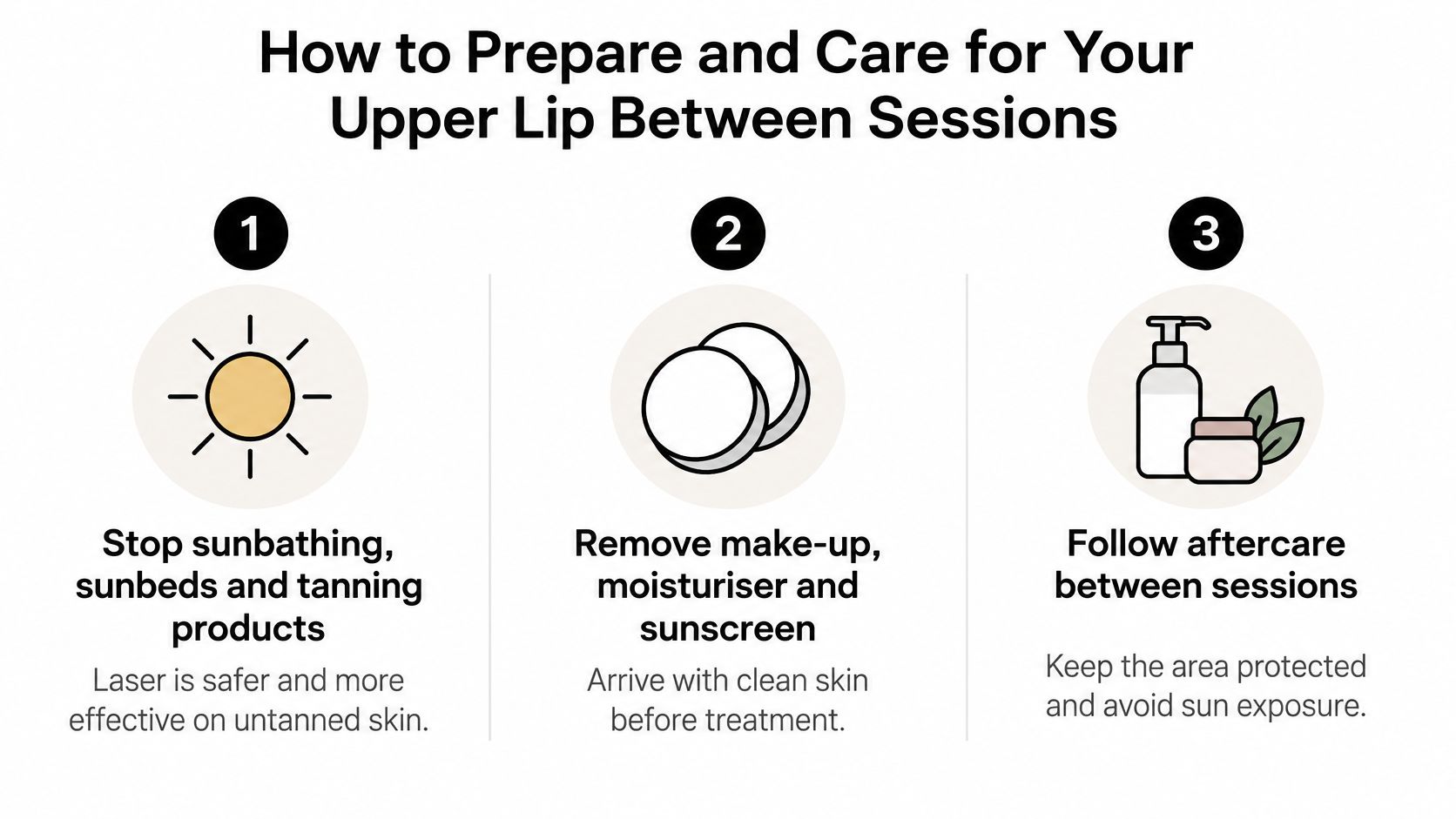
Use this visual as a reminder, alongside your individual instructions.
What should you do before your appointment?
Avoid sunbathing, sunbeds and tanning products. Recent tanning can affect treatment planning, even if it is no longer obvious. Tell the clinic about any intense sun exposure and check whether your appointment should be moved.
Arrive with clean skin. Remove make-up and other products from the treatment area as instructed so the practitioner can assess it. Use sun protection while travelling, then remove it before treatment if asked.
Mention irritation or recent waxing. Treatment may need to wait if the skin is irritated or the hair has been removed from the follicle. Contact the clinic rather than covering redness with make-up.
Shave only as instructed. Ask when to shave, as timing can depend on your appointment instructions. Avoid waxing and plucking between sessions.
What should you do afterwards?
Cool the skin gently if needed. Use a clean, cool compress without rubbing or applying ice directly. Follow your clinic's advice about hot baths, saunas and strenuous exercise.
Protect the area from the sun. Use sunscreen and avoid tanning while the skin settles. If you are unsure which product to use, ask the clinic before applying it.
Shave between appointments rather than plucking. For general product background, see facial aloe tips from ALODERMA. Check with the clinic before applying aloe or any new product to freshly treated skin.
Tell the clinic about intense sun exposure before your next session. Avoiding sunbeds and intense sun before treatment helps the practitioner assess whether it is appropriate to proceed. Don't assume sunscreen alone makes an appointment suitable.
The laser hair removal preparation guide covers what to do before treatment. Contact the clinic if you have concerns about your skin or aftercare.
What Are the Side Effects of Upper Lip Laser Hair Removal?
Could upper-lip laser hair removal affect your skin or make fine hairs more noticeable? Temporary redness, swelling and stinging can occur after treatment. Blistering, burns and changes in skin colour are less common risks that need attention.
A separate concern is paradoxical hypertrichosis: laser-associated stimulation that can make fine vellus hairs grow back darker and coarser. It is one reason to assess the hair carefully before treating the whole upper lip.
Can laser make facial hair worse?
The UK clinical evidence summary on laser hair reduction reports paradoxical hypertrichosis in around 10% of treated patients overall. The summary notes greater concern for people of Mediterranean background or darker skin tones. This is an overall reported figure, not an upper-lip rate or a prediction for an individual.
Fine hair, low fluence or an unsuitable wavelength may affect the risk. Hair and skin characteristics, hormonal status and treatment settings also matter. Choosing an arbitrarily low setting is not a safeguard: the practitioner needs to assess whether the hair is a suitable target and whether treatment is appropriate.
Upper lip laser side effects and what to do
| Effect | When it appears | How common | What to do |
|---|---|---|---|
| Redness and swelling | Often soon after treatment | Expected temporary reactions | Use a cool compress and sun protection; report persistence or worsening |
| Temporary pain or stinging | During or after treatment | Recognised temporary reaction | Tell the practitioner during treatment; report worsening pain |
| Blistering | May appear after treatment | Less common risk | Contact the clinic promptly |
| Pigment change, including lighter skin | May become noticeable later | Less common, but possible, and more likely with darker skin or deeper settings | Report it so the course can be reviewed |
| Burns | During or after treatment | Uncommon but recognised risk | Contact the clinic for assessment |
| Paradoxical hypertrichosis, or darker growth | Becomes apparent as hair grows | Reported overall figure described above | Pause treatment and reassess suitability and settings |
Hypopigmentation means that a patch of skin becomes lighter. It is a possible pigment change, not a reason to assume that lighter patches are more common than short-lived redness.
What would make us stop?
If growth becomes darker or spreads beyond the intended area, pause treatment and reassess. More sessions are not automatically the answer, and results vary.
We may decide not to treat every visible upper-lip hair, even when you're keen to clear the whole area.
Contact the clinic promptly about blistering, unusual pain or unexpected pigment changes. Photographs taken consistently can help you describe how the area has changed.
What Should I Check Before Booking Upper Lip Laser Hair Removal?
Upper-lip laser hair reduction should wait for a GP assessment if facial hair appears suddenly, increases rapidly or comes with irregular periods, acne or scalp hair thinning. The NHS Scotland interventional hair-reduction referral protocol distinguishes cosmetic reduction from medical assessment and describes hirsutism affecting areas including the upper lip and chin.
A private consultation gives you space to explain changes in growth and your medical history.

Laser targets the hair, not the underlying reason it appeared. Cosmetic treatment is generally not routinely NHS-funded, and eligibility differs between pathways, so don't assume a private cosmetic course and NHS medical care are interchangeable.
What should a safe clinic explain?
The medical check and the clinic safety check are separate. Even when your growth has an established explanation, the practitioner still needs to assess your skin, hair and readiness for treatment.
Dudley Council's laser safety guidance warns that faulty or incorrectly used lasers can seriously injure clients, operators and people nearby. It identifies strictly controlled risks around Class 3B and Class 4 laser use, which are equipment hazard classifications, not measures of how effective a course will be.
We recommend checking for:
- Relevant practitioner training: Experience with facial hair and your skin type matters, not just familiarity with a machine.
- Documented safety arrangements: Eye protection, controlled room access and appropriate equipment procedures should be routine.
- A consultation and patch test: These should come before committing to a course, with written consent rather than a rushed signature.
- A clear escalation plan: You should know whom to contact about a skin reaction or unexpected growth.
Government proposals for licensing non-surgical cosmetic procedures in England have emphasised practitioner training, insurance, hygiene, infection control and premises standards. A proposal shouldn't be presented as an established legal requirement, or as evidence that an individual clinic has passed checks it hasn't documented.
Our accompanying video provides another way to become familiar with the appointment discussion.
What should you ask us specifically?
Ask which wavelength is proposed, how your skin type affects the settings, what the patch test involves and what we'll do if growth appears stimulated. Our laser hair reduction process guide helps you prepare for that conversation.
At our clinic, most laser hair reduction clients achieve 80–95% reduction with a full course, with occasional top-ups thereafter; results vary from person to person, and that's a general client figure, not an upper-lip prediction. The first session costs from £20, with 50% off the first session and course discounts applied automatically. We'll confirm the applicable price before you commit.
We are 3D Aesthetics Leamington Spa, previously trading as 3D Lipo Leamington Spa, at 11 Guys Place East, Leamington Spa, Warwickshire CV32 4RG. We welcome clients from Warwick and Kenilworth as well as the surrounding Warwickshire area.
Call 01926 315764 or book your free consultation so we can check hair colour, skin type and hormonal history and discuss a written plan with expected sessions and spacing. We will kindly turn you away if laser isn't appropriate, because an honest no is better than a course with no sensible target.
At 3D Aesthetics Leamington Spa, we offer upper-lip laser hair reduction with a suitability-led consultation before you decide on a course. Visit us to discuss your hair growth, skin history and priorities, and we'll explain whether laser is a reasonable next step or whether you should seek another assessment first.
← Back to Home