You lift your arm to put on a sleeveless top, catch the underside in the mirror, and pinch a patch that feels softer than it used to. Is it loose skin, remaining fat, or just an arm that needs more muscle definition? At our clinic, that distinction comes before any conversation about arm skin tightening. We don't want you paying to treat the wrong problem.
Table of Contents
- Why Arm Skin Starts to Feel Loose
- Skin, Fat, and Muscle, The Three Layers That Decide Your Treatment
- Non-Surgical Arm Skin Tightening Options We Offer
- When Surgery Becomes the Honest Answer
- Your Consultation and 3D Body Scan at Our Leamington Spa Clinic
- Realistic Timelines, Results, and Maintenance for Arms
- Common Misconceptions About Tightening Arms Without Surgery
- Pricing, Suitability, and Booking Your Consultation
Why Arm Skin Starts to Feel Loose
Arm skin tightening starts with identifying what has changed, rather than assuming every softer-looking upper arm needs the same device. The Chelsea and Westminster Hospital NHS guidance on weight loss and loose skin explains that loose skin can follow substantial weight loss or ageing and commonly affects the upper arms.
The practical difficulty is that appearance alone doesn't tell us how much of your concern is skin and how much is underlying volume. A broad upper arm, a fine wrinkled surface and a hanging fold are different things, even when people describe all of them as sagging.
At our Leamington Spa consultation, we ask you to show us the specific change that bothers you. That might be the outline when your arm rests against your body, the texture when you raise it, or excess tissue that catches against clothing.
What are we trying to distinguish?
Our assessment separates your concern into three useful categories.
- Surface quality: Are you mainly concerned about texture, fine folding or a less firm appearance?
- Underlying volume: Is fullness contributing to the outline you want to change?
- Excess tissue: Is there a substantial fold that needs an assessment beyond non-surgical treatment?
We also ask when the change appeared and whether your weight is still changing. The NHS resource makes an important distinction between loose skin after weight loss and the surgical removal of excess skin. We use that distinction to keep the consultation focused on anatomy rather than marketing language.
Practical rule: A treatment plan should explain what it's targeting before it explains what you should buy.
Our guide to body contouring after weight loss is particularly relevant if your arms changed after losing weight. Your priority may be preserving the progress you've made, not pursuing further reduction.
We don't judge suitability by how an arm looks in a photograph. We combine your history, an examination and body-scan measurements, then discuss whether the concern is something our non-surgical clinic should treat at all.
Skin, Fat, and Muscle, The Three Layers That Decide Your Treatment
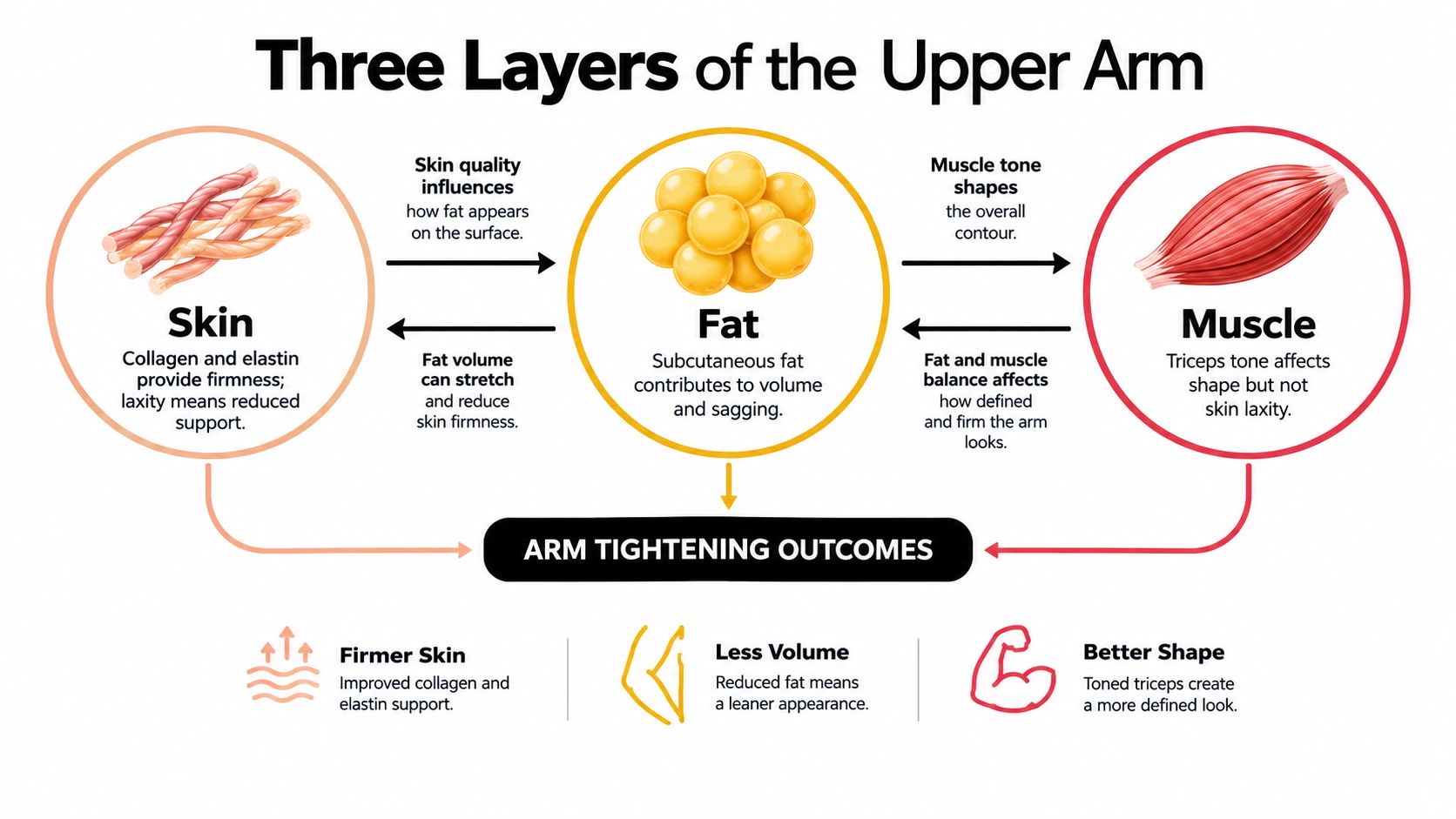
Arm skin tightening needs a clear distinction between the outer skin, underlying fullness and muscle contour before we recommend a treatment plan. We use these layers as an assessment framework, not as a diagnosis generated by a scan.
The diagram below illustrates the distinction, but it can't tell you which layer is responsible for your own concern.
What actually causes upper-arm laxity?
Upper-arm laxity means looseness, but the appearance that prompts someone to seek arm skin tightening can involve excess skin, residual fat, or both. Chelsea and Westminster Hospital's NHS patient guidance identifies substantial weight loss and ageing as causes of loose skin and recognises the upper arms as a commonly affected area. At consultation, we therefore separate the surface concern from the amount and distribution of tissue beneath it. We ask whether you dislike fine folding, overall fullness, or a hanging fold, because those goals aren't interchangeable. We also consider weight history, skin quality and tissue thickness through clinical assessment, rather than treating a body scan as a picture of every internal layer. Muscle definition belongs in that conversation, but it isn't a substitute for assessing excess skin. The useful question isn't whether your arms look loose. It's which tissue needs attention, and whether non-surgical care can reasonably address your specific concern.
How do the layers change our recommendation?
Skin quality is something we assess directly. We look at the texture and how the tissue behaves with your arm in different positions, rather than assigning a treatment from a single posed image.
For subcutaneous fat, meaning fat beneath the skin, we consider fullness and distribution alongside the skin assessment. We don't infer an exact internal fat measurement from an external outline.
Muscle-related goals need their own discussion. Wanting more definition isn't necessarily the same as wanting less skin, and we won't use those goals interchangeably when explaining a plan.
| Your main concern | What we need to clarify |
|---|---|
| Fine folding with little fullness | Whether skin-focused treatment matches your expectations |
| Fullness with relatively little folding | Whether contouring, rather than tightening, is the relevant discussion |
| Fullness and loose tissue together | Whether a staged plan is appropriate |
| A substantial hanging fold | Whether specialist assessment should come first |
These are consultation categories, not promises of change. If we recommend treatment, results vary from person to person.
Non-Surgical Arm Skin Tightening Options We Offer
Arm skin tightening at our clinic may involve radiofrequency or HIFU, while cavitation and 3D Powersculpt require a separate discussion about whether they match your contouring goals. We don't present every body device as an interchangeable way to tighten skin.
Radiofrequency, usually shortened to RF, and HIFU, meaning high-intensity focused ultrasound, use different forms of energy. The UK government consultation on licensing non-surgical cosmetic procedures describes HIFU as directing energy into deeper tissue to encourage contraction, lifting and improved elasticity.
The supplied HIFU evidence supports consideration for mild-to-moderate laxity, rather than substantial excess skin. That's a useful boundary for consultation, not a prediction for an individual client. Results vary from person to person.
How do the options compare?
We won't publish a universal session count or downtime claim without a treatment-specific protocol and your suitability assessment. Your written plan should identify the device, the area being treated, appointment spacing, aftercare and the point at which we review progress.
Non-Surgical Arm Tightening Options at a Glance
| Modality | Typical Sessions | Downtime | Best Suited To |
|---|---|---|---|
| Radiofrequency | Set after assessment and device selection | Explained for the selected protocol | A skin-firmness concern that passes screening |
| HIFU | Set according to the area and protocol | Individual aftercare discussed before booking | Mild-to-moderate laxity, subject to assessment |
| Ultrasound cavitation | A separate contouring plan | Confirmed before treatment | A fullness concern, not an assumed substitute for tightening |
| 3D Powersculpt | A device-specific plan | Confirmed following screening | A sculpting goal assessed separately from excess skin |
Our HIFU versus radiofrequency comparison helps you prepare questions about the two tightening approaches. At consultation, we'll explain why we favour a particular modality, or why neither is appropriate.
When does a combination plan make sense?
A combination isn't automatically better. We only propose one if we can explain what each part contributes, what we'll measure and why the additional treatment is justified.
We also won't assume that reducing fullness will resolve a skin complaint. The upper-arm outline and the quality of the surface need separate assessment.
If you're researching other procedure categories, you can compare Renuvion J Plasma options through Luxe Aesthetic Surgery & Medical Spa. That's an overseas provider's resource, not UK clinical guidance or a service we offer.
For clients travelling from Warwick and Kenilworth elsewhere in Warwickshire, we discuss appointment practicalities before agreeing a course. There's no value in buying a plan you can't realistically attend.
When Surgery Becomes the Honest Answer
Arm skin tightening with non-surgical devices isn't the route we recommend when a substantial hanging fold is the main concern. In that situation, we signpost an appropriate medical or consultant plastic-surgeon assessment rather than sell repeated appointments.
Brachioplasty, the medical term for an arm lift, removes excess tissue between the armpit and elbow. The Cheshire and Merseyside NHS body-contouring policy explains that suitable cases may benefit from reduced rashes, blistering, irritation and mobility problems, but that arm contouring is generally not routinely commissioned because it is usually cosmetic.
What are the surgical trade-offs?
The same NHS policy cites a study of 1,065 patients with an overall complication rate of 28.9%, including hypertrophic scarring, meaning raised or thickened scars, seroma, meaning fluid collection, and haematoma, meaning blood collection; nerve damage affected 16 patients, or 1.5%, and revision rates across cited studies ranged from 0% to 21%.
Those figures shouldn't be treated as a personal risk calculation. The policy also reports a different cohort of 2,294 patients, with major infection complications of 1.7% and major haematoma complications of 1.1%, illustrating why definitions and patient populations matter.
Surgical results vary from person to person. Scar position, time away from work, restrictions on strenuous activity and the appropriate period of weight stability should be discussed with the surgeon who assesses you, not reduced to a generic timetable from our non-surgical clinic.
A referral isn't a failed consultation. Sometimes it's the most useful outcome we can offer.
Why are more people considering an arm lift?
BBC reporting of British Association of Aesthetic Plastic Surgeons figures records 439 brachioplasty procedures in 2024, compared with 389 in 2023, an increase of 50 procedures, approximately 12.9%. These are recorded operations among reporting BAAPS members, not the entire UK market and not a measure of non-surgical tightening.
If folds repeatedly become irritated or affect hygiene or movement, tell your GP. We won't substitute an aesthetic package for assessment of those symptoms.
Our fat freezing versus liposuction guide addresses a separate contouring distinction. For another provider's description of non-surgical skin tightening options, Ideal Face & Body offers an overseas resource, but it shouldn't determine UK suitability or replace individual advice.
Your Consultation and 3D Body Scan at Our Leamington Spa Clinic
Arm skin tightening consultations at our Leamington Spa clinic combine a free discussion, a 3D body scan and an in-person assessment. The scan helps document body shape and track external changes; we don't describe it as an internal scan that independently measures collagen, muscle or every tissue layer.
This screenshot introduces our clinic before you visit.
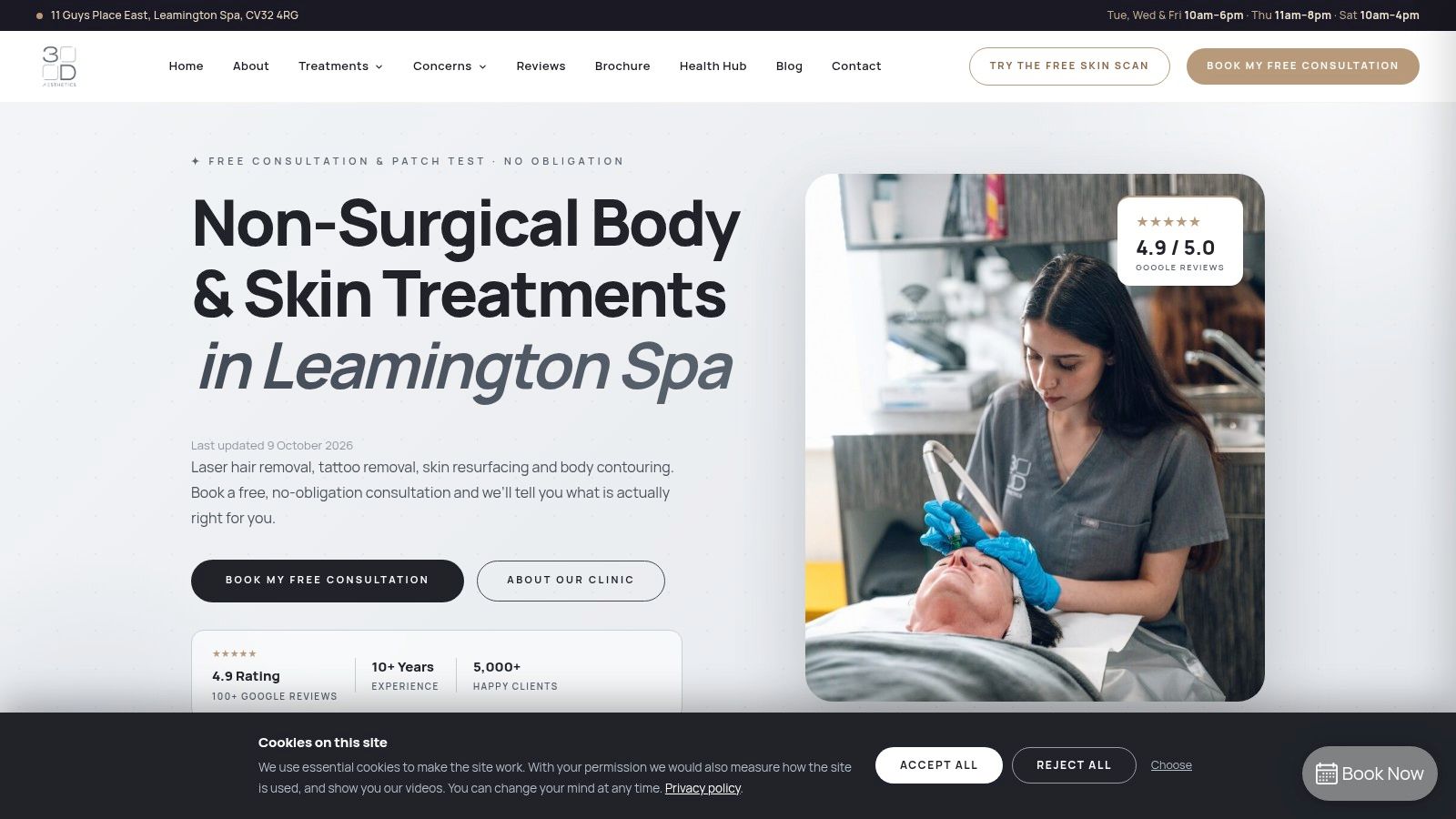
Your scan belongs alongside examination, not in place of it. Tissue thickness and skin quality need assessment, and an external shape measurement shouldn't be mistaken for an ultrasound measurement of internal fat.
Our body measurement and tracking guide explains why a consistent baseline matters. If we later discuss a measured change, results vary from person to person, and we'll keep the measurement's limitations clear.
What will we ask you?
We need enough context to make a responsible recommendation.
- Weight history: Whether your weight is stable, changing or likely to change further.
- Medical history: Relevant conditions, previous procedures, implants and any medical advice you've received.
- Current medicines: Bring an up-to-date list so we can assess suitability.
- Pregnancy and hormonal history: Tell us about relevant changes rather than assuming they don't matter.
- Your priority: Show us the area and explain whether texture, size, folding or comfort concerns you most.
We'll also ask what you would regard as a worthwhile change. If your expectation is complete removal of excess tissue without surgery, we need to resolve that before booking anything.
What else is available at our clinic?
We also offer a free AI Skin Scanner and our Health Hub for blood, microbiome and genetic testing. These are separate services, not requirements for an arm consultation or substitutes for medical diagnosis.
You can also view our clinic video before attending.
We're at 11 Guys Place East, Leamington Spa, Warwickshire CV32 4RG, and welcome clients from Warwick and Kenilworth. If you knew us as 3D Lipo Leamington Spa, we're the same clinic under our current name.
Realistic Timelines, Results, and Maintenance for Arms
Arm skin tightening should be reviewed over time, not judged only by how your arm looks immediately after an appointment. Results vary from person to person, and different measurements may describe different kinds of change.
The review of non-invasive radiofrequency and body-contouring research highlights that some studies use ultrasound measurements of the fat layer rather than photographs or circumference alone. That distinction matters: a narrower outline and improved skin firmness aren't necessarily the same endpoint.
The HIFU research summary describes visible change commonly developing within approximately three months and potentially persisting for up to one year. These are research timescales, not promised deadlines; results vary from person to person.
How should you read a treatment timeline?
The graphic below is an illustrative sequence, not a schedule we promise every client. Its milestones shouldn't be interpreted as fixed dates for early improvement or a final outcome; results vary from person to person.
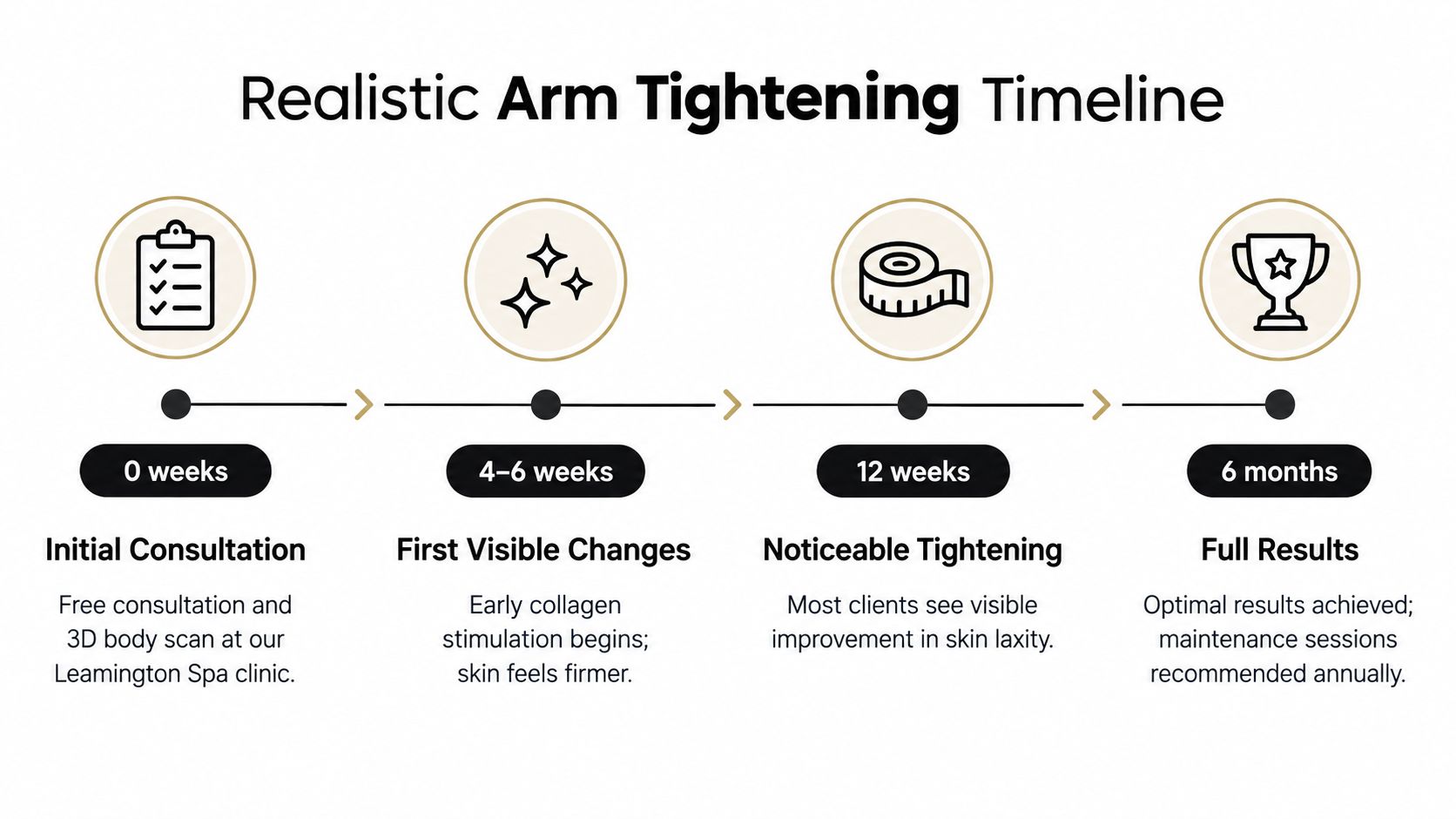
We agree what we're measuring before treatment, then review that same concern consistently. Results vary from person to person.
At follow-up appointments in Leamington Spa, we aim to compare like with like. Position, arm posture, photographic setup and measurement method should remain consistent.
Do you need maintenance appointments?
We don't automatically prescribe an annual package. We review your experience, your current concern and whether further treatment has a clear rationale.
- Review first: Don't purchase a top-up solely because a calendar reminder arrives.
- Separate endpoints: Discuss texture, firmness and circumference individually.
- Keep expectations specific: Agree what would make another appointment worthwhile.
If further treatment isn't justified, we'll say so. Maintenance is a decision made after review, not an obligation built into every consultation.
Common Misconceptions About Tightening Arms Without Surgery
Arm skin tightening shouldn't be sold on the assumptions that exercise resolves every concern, a single visit is always enough, or avoiding surgery removes the need for screening. We address those assumptions before recommending a device.
The image below illustrates a discussion about muscle goals and skin concerns, rather than documenting an individual clinical outcome.
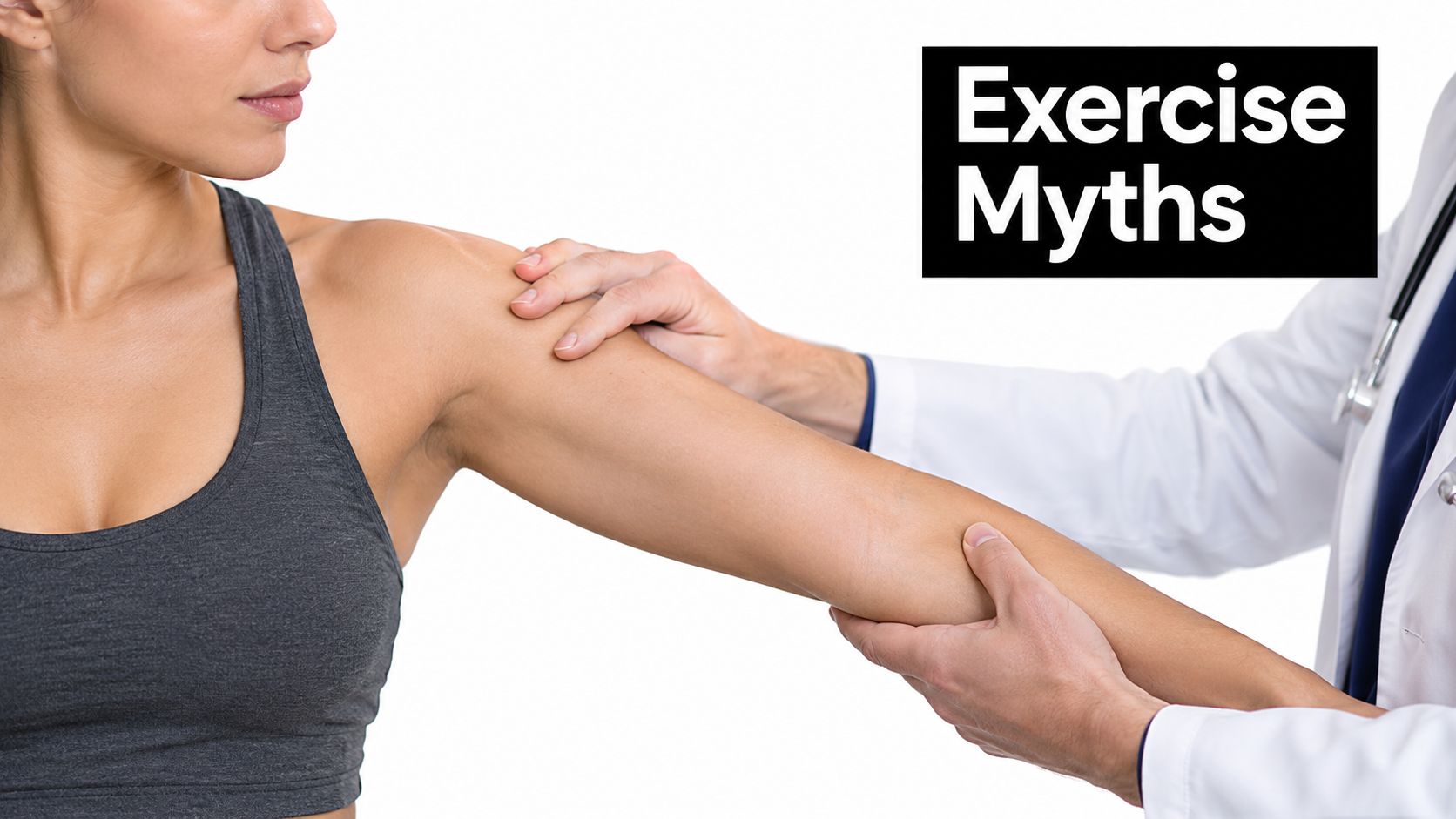
Will exercise answer the same question as tightening?
We don't assess a skin complaint as though it were automatically a training problem. As the NHS loose-skin guidance distinguishes, excess skin after weight loss needs its own consideration.
You may value exercise for your overall goals while still wanting an assessment of a fold or surface texture. We won't tell you that pursuing muscle definition makes clinical assessment unnecessary.
Is a single appointment always enough?
We don't use a universal appointment count as a sales promise. The HIFU timescale discussed earlier concerns the development of change, not a rule about how many sessions every arm needs.
Before you commit, ask what the proposed course contains and when it will be reviewed. Results vary from person to person, regardless of whether a plan involves an initial treatment or a series.
Does non-surgical mean no safety questions?
Non-surgical treatment still requires suitability screening. The UK government's licensing consultation supports appropriate assessment for energy-based procedures, rather than treating them as casual beauty purchases.
We ask about matters that may affect whether, when and how we treat.
- Pregnancy: Tell us before booking so we can apply the relevant treatment policy.
- Implants and medical conditions: These need device-specific consideration.
- Active skin concerns: We may postpone treatment or recommend medical assessment.
- Medicines and previous procedures: We need the details before approving a plan.
We turn people away when the device isn't appropriate, the history requires clarification or the expectation exceeds what we can responsibly offer. That's part of the service, not an obstacle to it.
Pricing, Suitability, and Booking Your Consultation
Arm skin tightening pricing depends on the selected modality, treatment area and agreed course, so we provide a personalised quote after assessment. Our current prices are the starting point, not a substitute for checking suitability.
Our guide to how much body contouring costs explains the wider pricing discussion. We'll distinguish essential elements of your proposed plan from optional services, rather than present a combination package as the default.
Who would we consider treating?
We consider people whose concern fits a non-surgical approach, whose medical screening is satisfactory and whose expectations match the limited endpoint being discussed. Weight stability is part of that assessment, but we don't use an unsupported universal waiting period to approve everyone.
We would decline or defer treatment where there's a substantial fold needing specialist advice, an unresolved medical concern or a request for a change the proposed device can't reasonably address.
- Bring your medicine list: Include relevant supplements and any recent changes.
- Summarise your weight history: Tell us about ongoing weight loss or planned changes.
- Bring relevant letters: Medical information can help us decide whether further clearance is needed.
How many sessions will I need?
Arm skin tightening session counts are agreed after choosing the device and assessing the area. We'll explain the proposed course and review point in writing; results vary from person to person.
Will arm skin tightening hurt?
Arm skin tightening sensations depend on the modality and settings. We discuss expected sensations, comfort measures and aftercare before consent, and you should tell us if you're uncomfortable during treatment.
How long will the change last?
Arm skin tightening outcomes need review rather than a promise of indefinite duration. The research timescales discussed earlier aren't personal forecasts, and results vary from person to person.
You can book your free consultation or call 01926 315764. Come with your questions, including whether doing nothing or seeking another opinion would be more sensible than starting a course.
At 3D Aesthetics Leamington Spa, we offer non-surgical arm skin tightening, body scanning and an honest assessment of whether treatment matches your concern. Visit us at Guys Place East to discuss your arms, review your options and receive a personalised plan only if we believe treatment is appropriate.
← Back to Home