
If fat freezing on the inner thighs is described as painless with minimal downtime, why do some people still feel tenderness, numbness or odd sensations when they walk weeks later?
We ask because that gap between the headline and recovery matters for this area. Your inner thighs rub, they press against clothing, and you use them every time you walk. We're 3D Aesthetics Leamington Spa in Leamington Spa, and we explain fat freezing inner thighs treatment plainly before anyone books. That includes how it works, who we turn away, what recovery can feel like, how long change takes, and the rare reaction where fat enlarges instead of shrinking.
Table of Contents
- How Does Fat Freezing Work on Inner Thighs?
- Who Is Fat Freezing Right For, and Who We Turn Away?
- How to Prepare for and Care for Your Session
- How Long Do Inner-Thigh Results Take to Appear?
- Which Side Effects After Fat Freezing Are Normal?
- How Does Fat Freezing Compare With Other Options?
- Should You Book a Consultation Before Choosing Fat Freezing?
How Does Fat Freezing Work on Inner Thighs?
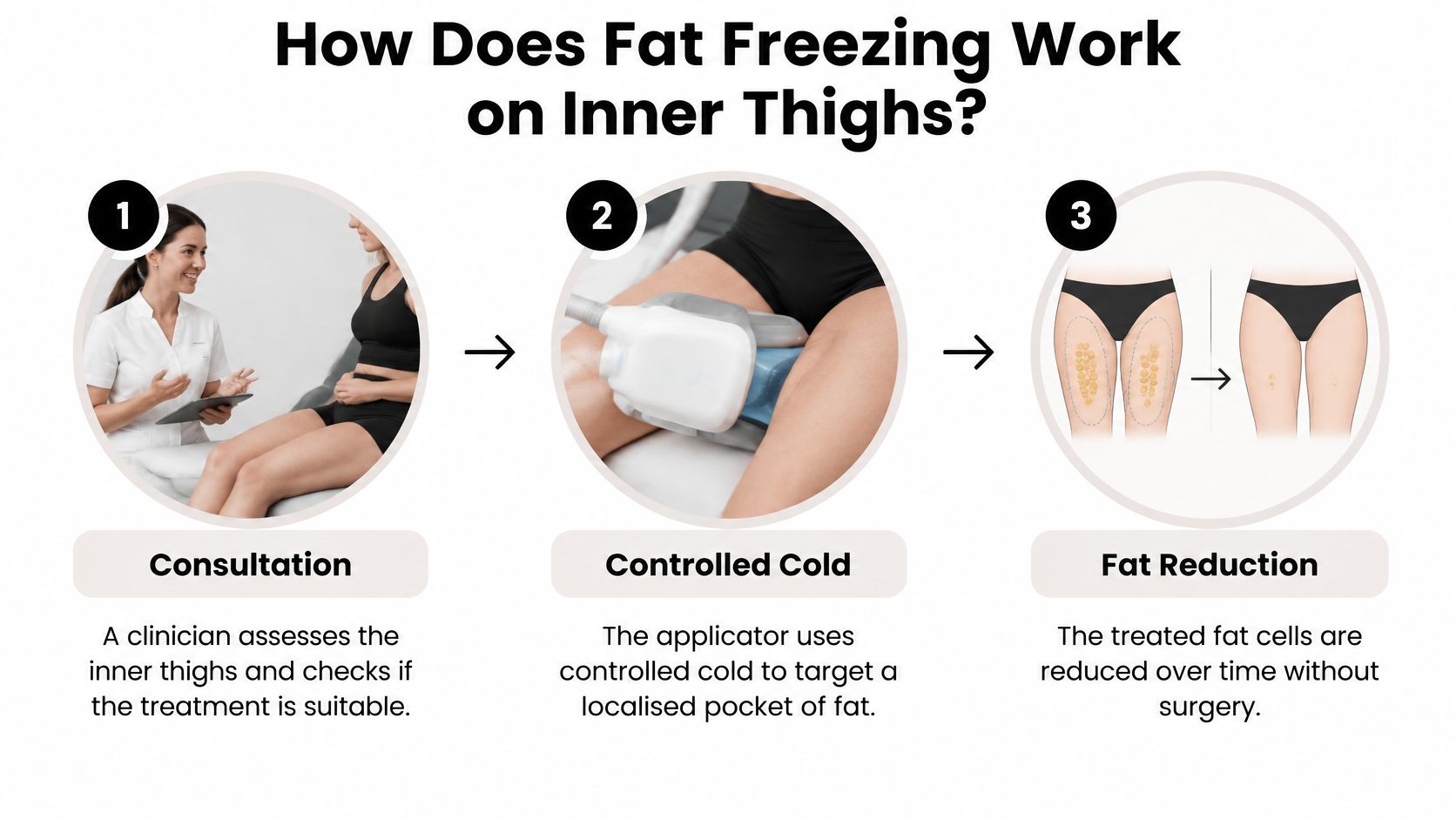
Fat freezing, the common name for cryolipolysis (controlled cooling used to damage fat cells), is a non-surgical treatment that uses controlled cold to reduce a localised pocket of fat on the inner thighs. It doesn't remove fat during the appointment. Your body clears damaged cells over the following weeks, the way it clears other waste, so any contour change is gradual rather than immediate, and results vary from person to person.
The sequence is straightforward:
- Applicator placement: We position the applicator over a measurable pinch of fat on the inner thigh.
- Skin protection: A protective anti-freeze pad or gel sits between the cooling plates and your skin.
- Controlled cooling: The applicator cools the fat layer in a controlled way.
- Fat-cell damage: Fat cells, which are more sensitive to cold, are damaged while surrounding tissue is comparatively unaffected.
- Gradual clearance: Over the following weeks, your body absorbs and clears the damaged cells.
The diagram below sums up that process from assessment to gradual change.
What temperature does fat freezing use?
Fat freezing on the inner thighs uses controlled sub-zero cooling, and the Aesthetic Complications Expert Group cryolipolysis guidance states that treatment temperatures generally range from -4°C to -10°C. That guidance also explains that an anti-freeze pad or gel must be placed between the cooling plates and the skin to reduce the risk of direct cold injury. Controlled suction, temperature and exposure time aim to affect targeted fat cells while avoiding damage to skin and surrounding tissues.
Fat freezing works on the inner thighs when there's a stubborn, pinchable pocket of fat that the applicator can sit over properly. Controlled cold damages fat cells in that pocket, and your body then clears them gradually over weeks, which is why you won't judge the outcome on the day. It can reduce that local pocket for suitable people, but it isn't a weight-loss method, it won't change your bone structure, pelvic width or muscle shape, and it doesn't tighten loose skin or treat dimpled cellulite texture. We assess tissue thickness, applicator fit and your medical history first because treating too little fat, or treating the wrong concern, gives a poor match. Results vary from person to person.
Fat freezing changes only the treated pocket. It doesn't lower overall body weight, and it's not the same as surgical fat removal. You can read more about our approach to non-surgical fat removal at our clinic before you decide.
Who Is Fat Freezing Right For, and Who We Turn Away?
Fat freezing usually suits adults with a stable, pinchable pocket of fat on the inner thighs. It is not right for everyone. We say that plainly at consultation, even when it costs us a booking.
The distinction that matters is contouring versus weight loss. The UK Government guidance on non-surgical cosmetic procedures describes cryolipolysis as targeting fat cells because they are particularly susceptible to cold, with damaged cells subsequently absorbed and excreted by the body. The effect is local to the treated pocket. It is not a percentage of body weight or a guaranteed change in thigh circumference, and results vary from person to person.
Who fat freezing suits and what we check
Fat freezing suitability depends on the tissue we can treat, not just how your thighs look in the mirror. Use this table as a first filter, then let us check properly.
| Situation | Suitability | What we check |
|---|---|---|
| Stable pocket of pinchable fat on the inner thighs | Usually a suitable starting point | Baseline measurements, photographs and 3D body scan |
| Weight still changing | Usually not the right time | Timing discussed at consultation |
| Loose skin or cellulite dimpling as the main concern | Usually better matched to other treatments | Skin tightening or cellulite reduction assessment |
| Too little pinchable fat | Not suitable | Inadequate fat thickness is linked to bruising risk, so alternatives are discussed |
| Open wounds, dermatitis or other skin conditions on the thigh | Not suitable until resolved | Skin check at consultation |
| Cold-related conditions | Raise at consultation | Medical history taken before treatment |
| Pregnancy or breastfeeding | Raise at consultation | Medical history taken before treatment |
We turn people away when there is too little fat for the applicator to grip safely, when the skin on the thigh is broken or inflamed, or when loose skin or dimpling is the main concern. Treating too little fat raises bruising risk, and freezing a pocket under already loose skin can make the looseness more obvious. We also pause if your weight is still changing, because contouring a moving target makes progress hard to judge. The rare enlargement response, where treated fat becomes firmer rather than smaller, is one of the risks we discuss before booking. If that possibility would change your decision, you need that conversation before you pay, not after.
At our Leamington Spa clinic, a free consultation includes baseline photographs, measurements and a 3D body scan (a scan that records body measurements so change can be compared over time) before any decision. We take a detailed medical history and discuss risks before any session. If you are weighing up safety first, read our guide on whether fat freezing is safe.
Practical rule: If you can pinch a fold of fat that has stayed much the same for months, ask us to assess it. If you cannot, expect us to suggest something else.
How to Prepare for and Care for Your Session
Fat freezing has three stages, consultation, the treatment session and the weeks of recovery, and each stage has a clear task. Attention often goes to the session itself. We think the preparation and the sensory recovery deserve equal attention.
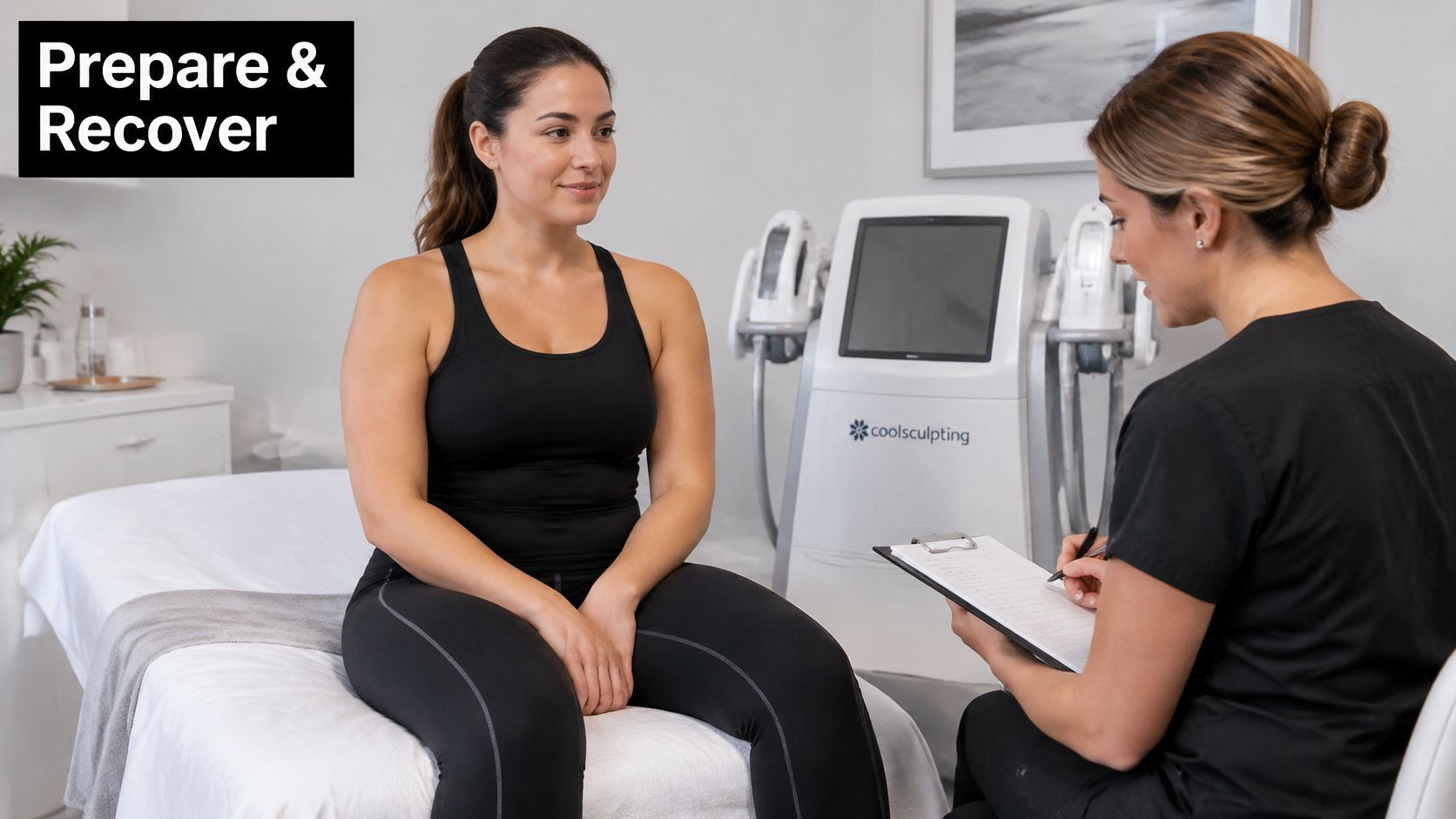
This photo shows the kind of unhurried consultation conversation we have before any treatment is agreed.
What should you do before, during and after fat freezing?
Fat freezing preparation is mainly about giving us accurate information and reducing friction afterwards. Follow this routine:
- Book your free consultation: We take baseline photographs, measurements and a 3D body scan so progress can be judged properly later.
- Share your full medical history: Tell us every medicine you take and any cold-related conditions, skin problems or recent procedures on your thighs. That history shapes whether treatment is suitable at all.
- Wear loose clothing on the day: Choose soft, comfortable clothes and avoid tight waistbands or seams that press on the treated area. Inner thighs already rub together, so extra pressure doesn't help.
- Expect strong cold, then numbness: Many people feel an intense cold sensation at first that quickly fades to numbness for the rest of the session.
- Follow your aftercare sheet: Use pain relief only as advised, keep clothing loose in the first days, and limit friction where you can. Short, gentle walks are usually fine, but stop and tell us if pain is worsening rather than easing.
- Book your progress review: We review at around 12 weeks, using the same measurements and photographs.
Session timing and planning are confirmed at our Leamington Spa clinic in Warwickshire, so you leave knowing what happens next. Our detailed fat freezing aftercare guidance covers the day-to-day points to follow at home.
The short video below gives a visual sense of how a session is set up and what the applicator stage looks like.
What does recovery on the inner thighs actually feel like?
Fat freezing recovery on the inner thighs can feel more noticeable than on a less mobile area because skin rubs skin and clothing presses as you walk. The Aesthetic Complications Expert Group patient leaflet on cryolipolysis describes expected tenderness, aching, stinging, bruising, itching and numbness. It also explains that sensory nerve irritation can produce burning, electric-shock sensations or hypersensitivity that may take several weeks or months to resolve and, rarely, may persist beyond 12 months.
That timeline is why we don't describe treatment as entirely painless. Temporary tenderness and altered sensation can take weeks to settle. Raise symptoms early rather than leaving them, especially if they're getting worse, spreading, or stopping you walking comfortably.
Loose trousers, soft leggings without a harsh inner seam, and avoiding long, friction-heavy walks in the first days usually help. Don't apply strong heat, ice or fragranced products to tender or numb skin unless we've advised it, because altered sensation means you may not feel irritation quickly.
Write down your aftercare questions before your consultation. Ask what sensations we expect, how long they may last for you, and exactly who to contact if something changes.
How Long Do Inner-Thigh Results Take to Appear?
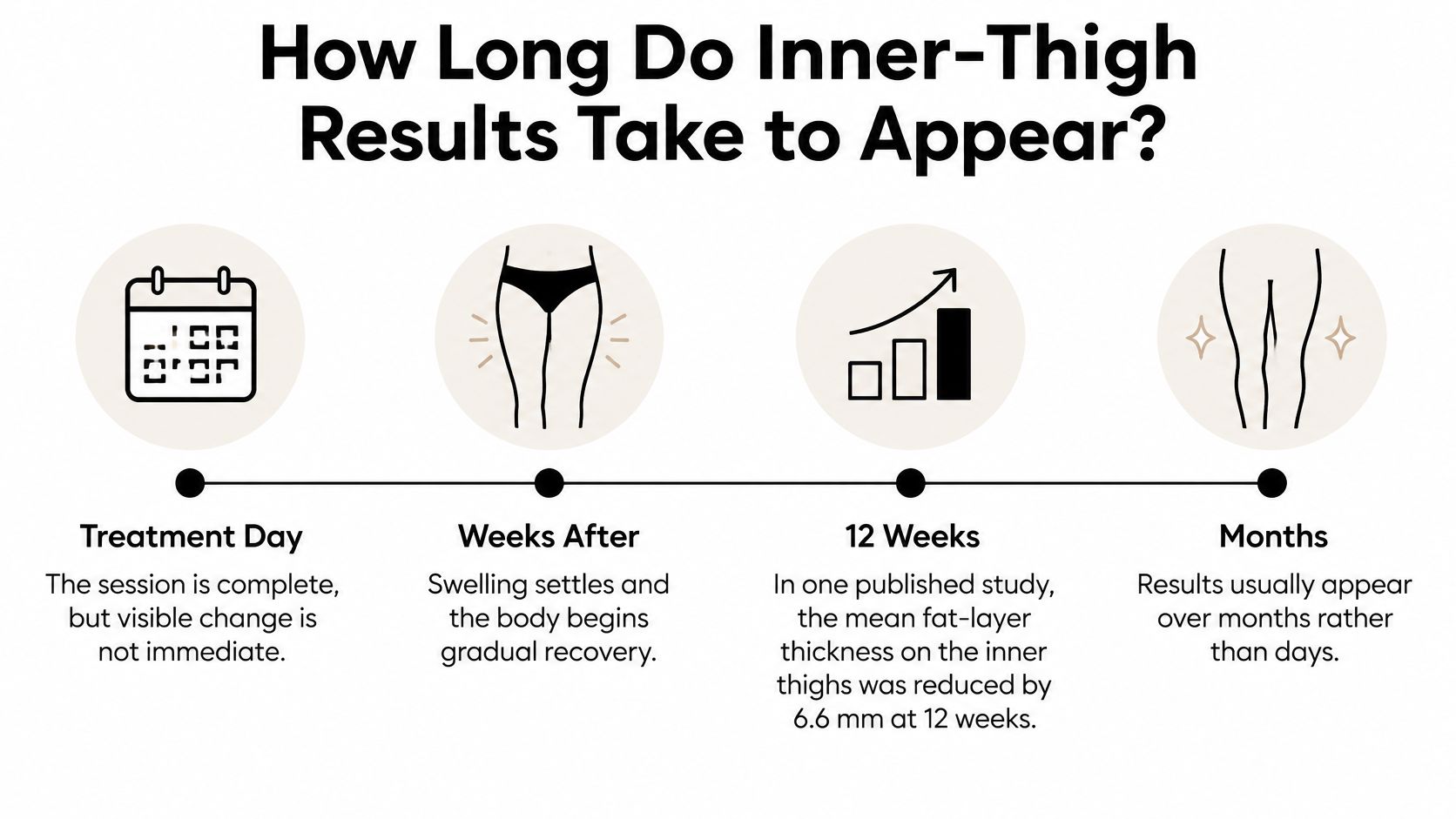
Fat freezing results on the inner thighs usually appear over months rather than days, and in one published study the mean fat-layer thickness on the inner thighs was reduced by 6.6 mm at 12 weeks, compared with 6.5 mm on the arms, though results vary from person to person. That study is reported in Aesthetic Surgery Journal Open Forum research on arms and inner thighs.
The session is like a clear-out where the skip still has to be collected. It damages fat cells, then your body needs time to clear them. Judging in the mirror every morning will frustrate you because daily swelling, lighting and posture change what you see.
The timeline graphic below shows why we set the main review point weeks after treatment, not days.
Inner-thigh results timeline
Fat freezing progress is best judged at fixed points with the same method each time. This table sets out the usual pattern.
| Point after treatment | What is happening | What to expect |
|---|---|---|
| Immediately after the session | Cooling wears off and the area settles | Redness and mild tenderness; see the side effects section |
| First few weeks | The body begins clearing damaged fat cells | Contour change is not yet clear |
| About 12 weeks | Measurement point used in one published inner-thigh study | Mean 6.6 mm fat-layer reduction in that study; results vary from person to person |
| Beyond 12 weeks | Final contour assessed with the same measurements | Compare photographs and measurements taken from the same angle and time of day |
That 6.6 mm figure measures local fat-layer thickness. It doesn't mean total thigh size falls by that amount all round, and it isn't body-weight loss. Individual outcomes differ according to starting fat layer, applicator positioning, treatment settings and number of cycles used.
How should you track fat freezing progress?
Fat freezing progress should be tracked with the same time of day, same lighting, same tape position and photographs from the same angle. A 3D scan at fixed intervals removes much of the guesswork. Weighing yourself tells you very little about one treated pocket.
We usually review around the 12-week mark before discussing whether another session fits. That decision depends on applicator fit, tissue thickness and what the first measurements show, not on a package sold in advance. You can see how we judge fat freezing results over time.
Note your baseline measurements on the day of treatment and keep them with your photographs. Without a baseline, you're relying on memory, and memory is a poor measuring tool.
Which Side Effects After Fat Freezing Are Normal?
Fat freezing side effects on the inner thighs are usually short-term tenderness, aching, bruising, itching and numbness, and they typically settle within days to weeks, though some sensations take longer. Non-surgical doesn't mean nothing can happen, so we explain the usual course and the warning signs before you book.
Many individuals can return to normal routines quickly, but the treated area may feel tender, sting, or itch as it settles. Because your inner thighs touch as you walk, even mild tenderness can feel more obvious there than on your stomach or back.
Can fat grow larger after fat freezing?
Fat freezing can, rarely, be followed by paradoxical adipose hyperplasia (an enlargement of treated fat instead of a reduction), usually shortened to PAH. A review in the Journal of Cosmetic Dermatology on cryolipolysis effectiveness and safety supports explaining that PAH is rare but recognised, that treated fat enlarges instead of shrinking, and that it can create a firm, visible bulge requiring further medical management. The Aesthetic Complications Expert Group is the UK source we point to for PAH needing medical assessment.
If you notice enlargement or a new firm lump where you were treated, contact us and arrange a clinician review. Don't wait for it to settle on its own and don't book another freezing session over it. We need to examine the area, compare it with your baseline photographs and measurements, and agree the next step with you.
Any firm bulge that grows instead of shrinking needs prompt assessment. Photograph it in the same light, note when you first saw it, and contact the clinic that treated you.
Side effects, usual course and when to seek review
Fat freezing symptoms should be judged by their direction. Easing symptoms are usually reassuring, worsening or spreading symptoms need review.
| Symptom | Usual course | Seek a clinician review when |
|---|---|---|
| Tenderness, aching or bruising | Common and usually settles over days to weeks | Bruising spreads, pain worsens or signs of infection appear |
| Itching or redness | Common in the short term | Redness spreads, blistering develops or fever occurs |
| Numbness or altered sensation | Can take several weeks or months to settle | Not improving after several months, or getting worse |
| Burning or electric-shock sensations | Nerve irritation that may take weeks or months to resolve | Still present after several months, or sooner if it worsens |
| Firm, growing bulge instead of reduction | Rare paradoxical adipose hyperplasia | Any enlargement or new firm lump; seek assessment promptly |
Burning, electric-shock sensations or hypersensitivity are signs of nerve irritation. They can take several weeks or months to resolve and, rarely, persist beyond 12 months. Tell us while they're happening rather than waiting for your routine review, so we can record the pattern and advise you properly.
For severe pain, spreading redness, fever or signs of infection, call NHS 111 or attend urgent care, following official NHS guidance on skin infections. For persistent skin changes, the British Association of Dermatologists and the Primary Care Dermatology Society are named UK patient information sources your GP may also use when advising you.
Before booking anywhere, ask the provider one direct question. How would you assess and manage enlargement after treatment? If you don't get a clear answer, don't book.
How Does Fat Freezing Compare With Other Options?
Fat freezing suits a stable pocket of fat, but inner-thigh concerns often have other causes, so the right option depends on what's driving the concern. Our verdict by situation is simple. A stable pocket points to fat freezing assessment, loose skin points to skin tightening, dimpled texture points to cellulite reduction, and overall weight points to your GP or NHS services.
People often use one phrase, thigh fat, for four different problems. Pinchable fat, loose skin, dimpling and muscle shape don't respond to the same treatment. Matching the tool to the tissue is the whole job at consultation.
Inner-thigh options compared by concern
Fat freezing is only one option in this table, and it isn't interchangeable with the others. Use the concern column first, not the treatment name.
| Option | Best suited to | How progress is judged |
|---|---|---|
| Fat freezing (cryolipolysis) | A stable, localised pocket of fat | Measurements and photographs at around 12 weeks |
| Ultrasound cavitation (inch loss) | Measured inch loss across a targeted area | Tape measurement rather than scales |
| Body sculpting | Body contour concern beyond a single stable pocket | Measurements across a plan |
| Skin tightening | Loose skin after weight change | Skin feel and photographs over time |
| Cellulite reduction | Dimpled skin texture | Visual change in skin texture across a course |
| Surgical liposuction | Larger volumes of fat, performed by a surgeon | Surgeon assessment and recovery period |
| NHS weight management | Overall weight change | Weight and health markers reviewed with a GP or NHS service |
Ultrasound cavitation (low-frequency ultrasound used for inch loss) is judged by tape measurement rather than scales, and a course is typical. Body sculpting at our clinic is a plan combining treatments such as cavitation and fat freezing, decided at consultation after a body scan. If you're choosing between the two most confused options, compare ultrasound cavitation and cryolipolysis side by side.
Surgical liposuction is a surgeon's decision involving anaesthesia and a longer recovery. It can remove larger volumes, but it carries surgical risks and downtime that non-surgical contouring doesn't. We don't offer surgery, and we'll say so if your goal needs a surgical opinion instead.
What does fat freezing cost in the UK?
Fat freezing cost should be compared as a total plan, not one headline price. A 2025 UK treatment-cost guide published by ClinicFinder on fat freezing prices reported typical fat-freezing prices of approximately £159 to £1,200 or more per session, depending on treatment area and applicator count. Check our current list at /prices/ and ask what your quoted plan includes, how many applicators it uses, and when review happens.
NHS weight management through a GP or NHS service is the right route when overall weight change is the goal. If you're researching that wider picture first, you can explore obesity treatments in 2026 for context on weight-focused routes that sit outside aesthetic contouring.
Choose by concern, not by offer. Stable pocket, assess for fat freezing. Loose skin, assess skin tightening. Dimpled texture, assess cellulite reduction. Overall weight, start with your GP. Results vary from person to person with every non-surgical option.
Should You Book a Consultation Before Choosing Fat Freezing?
Yes. Book the consultation before you book the treatment. Fat freezing works on a pocket of fat that can be held in an applicator, and only an in-person assessment can confirm whether your inner thigh fat fits that description. Photographs sent online cannot tell us tissue thickness, applicator fit or skin quality.
At the clinic, the appointment follows a set order:
- Medical history: We record your full history, including every medicine you take.
- Baseline records: We take a 3D body scan, photographs and measurements.
- Honest explanation: We explain what fat freezing can and cannot change for your thighs.
- Suitability verdict: We give a clear yes or no. We will recommend against treatment if the pocket is too small, the skin is too loose, or your medical history makes cold treatment unsafe.
At consultation we also cover the parts people rarely ask about by email: the cold-then-numb sensation during treatment, the return of normal sensation afterwards, and the rare enlargement response, where treated fat becomes firmer rather than smaller. You should know those points before you pay.
Fat freezing uses cryolipolysis, a non-surgical, non-invasive treatment that needs no downtime. Where it is not the best fit, we may discuss cavitation or body sculpting instead. Body sculpting combines cavitation, fat freezing, radiofrequency and shockwave therapy, with the mix decided after your body scan.
Our Thigh Gap Treatment costs £350 for a one-off 1-hour duo 3D cryotherapy treatment that sculpts and defines the inner thighs. We will only recommend it if your assessment supports it, and results vary from person to person. A thigh gap depends on pelvic width, leg alignment and muscle anatomy as well as fat, so we talk about contour change, not a promised gap.
You'll find us at 11 Guys Place East, Leamington Spa, Warwickshire CV32 4RG. Call us on 01926 315764. If you are travelling from outside Warwickshire and comparing clinics elsewhere, you can find your nearest Telomyx clinic before making the trip.
Book through /book-your-free-consultation/, bring your medicine list and written questions, and leave with a clear yes or no. That is the decision we are asking you to make, not a commitment to treatment.
← Back to Home