
What if the main question about under-eye laser isn't whether your skin will be red for a week, but whether your eye is properly protected for a few seconds? That's the gap we see in most explanations. Skin recovery matters, and results matter, but neither comes first. We separate those questions here, starting with sight.
Table of Contents
- Is Fractional CO2 Laser Under the Eyes Safe?
- Can fractional CO2 treat under-eye crepiness, bags or dark circles?
- How the Eyes Are Protected During Treatment
- What results can I expect from under-eye CO2 treatment?
- How long is recovery after under-eye CO2 treatment?
- What are the alternatives to under-eye CO2 treatment?
- What should I do before booking under-eye CO2 treatment?
Is Fractional CO2 Laser Under the Eyes Safe?
Fractional CO2 laser under the eyes can be carried out under a strict protocol, but the main hazard is the eye, not the skin. Fractional CO2 is ablative, meaning its energy vaporises water-rich tissue. It emits infrared light at about 10,600 nanometres (nm, the unit of wavelength), which water absorbs strongly, so energy reaching the cornea (the clear front surface of the eye) can cause injury. The UK Government's laser-radiation safety advice states that exposure can cause effects ranging from temporary visual impairment to serious, lasting sight loss, depending on power, exposure time and whether the beam enters the eye directly. A StatPearls clinical reference on laser resurfacing makes the same distinction between treating lower-eyelid skin and exposing the eye itself. Fractional treatment creates microscopic treatment columns and leaves untreated skin between them, so complications are generally less frequent and shorter-lived than with full-surface resurfacing. Redness, pigment change, infection and scarring remain possible. Fractional doesn't remove ocular risk. Safety depends on settings, distance, anatomy and eye protection.
That distinction changes what you should ask at consultation. Don't start with downtime. Start with the documented periocular risk assessment, the trained operator, controlled room access, wavelength-specific protection and the shields used close to the eyelids. Those steps are set out in the next sections.
Who we would not treat
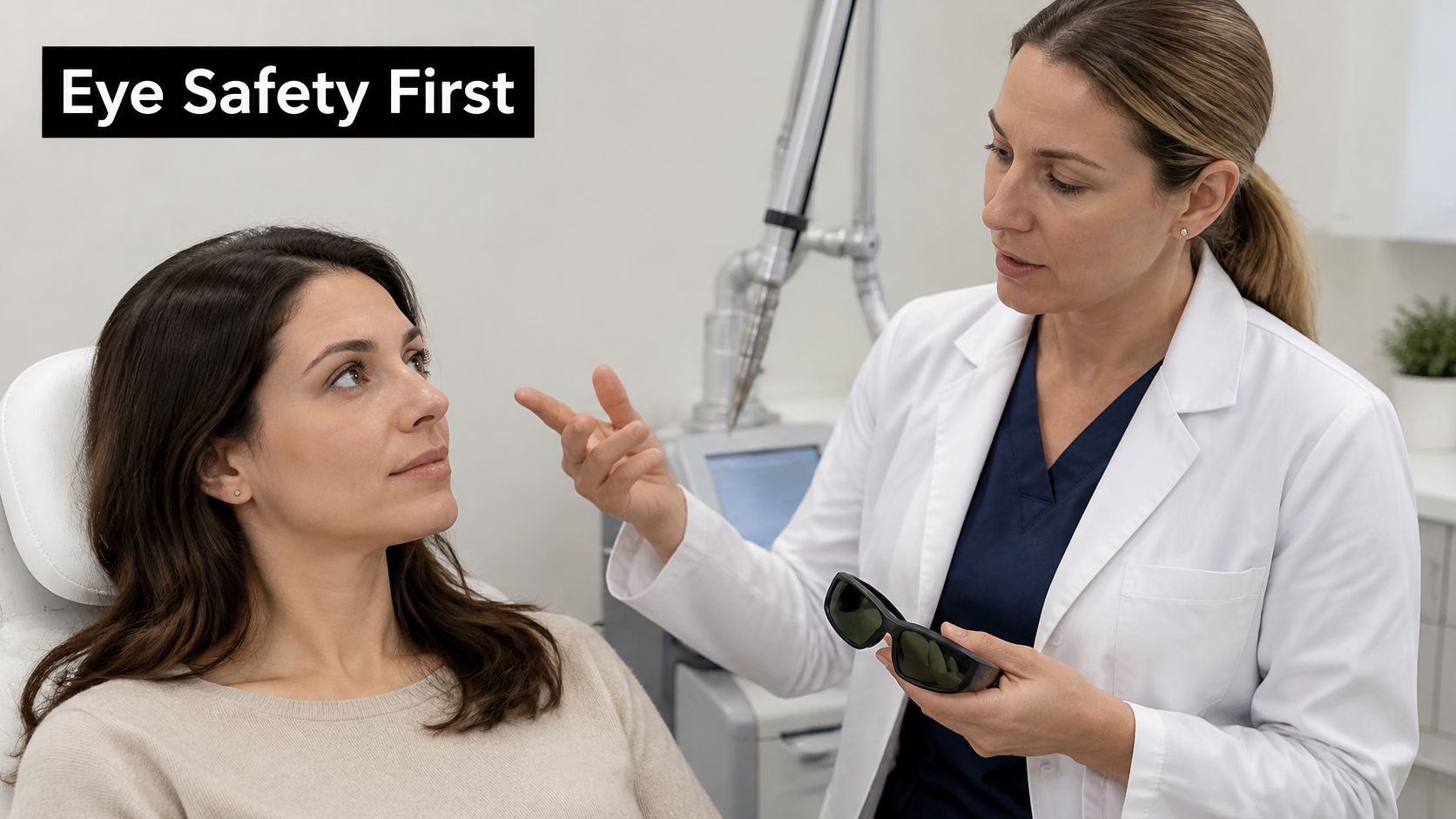
We assess Fitzpatrick skin types (a six-point scale of skin colour and sun response), pigment history, eyelid anatomy and eye history before agreeing to treat. We turn people away when that's the safer choice, and we'd rather do that than sell a session that shouldn't happen yet.
Who Should Not Have Under-Eye CO2 Treatment
| Situation | Main concern | What to do first |
|---|---|---|
| History of cold sores (herpes simplex) | Reactivation after laser treatment | Tell us before treatment and discuss a preventive plan with your GP |
| Recent sun exposure or a fresh tan | Pigmentation changes | Delay treatment until the skin has settled and recovered |
| Darker skin types (Fitzpatrick IV to VI) | Higher post-treatment pigmentation risk | Clinician-led plan with a detailed pigmentation discussion |
| Eye conditions, including dry eye or past eye surgery | Direct or reflected energy reaching the eye | Eye specialist review before any periorbital laser |
| Active skin infection or broken skin near the eyelid | Infection and scarring | Treat the infection first and book again once healed |
| Medicines that increase light sensitivity | Photosensitivity reactions | Ask your GP or pharmacist and declare all medicines at consultation |
| Under-eye darkness with an unclear cause | Pigmentation may worsen if misclassified | Assess the cause before choosing any laser |
Sudden blurred vision, flashes, new floaters, a curtain-like shadow or any significant change in vision after treatment needs urgent NHS 111 or ophthalmic advice, not routine aftercare.
Our Leamington Spa clinic assesses every client before any laser is used, and our fractional CO2 laser treatment page describes the treatment we offer. If your eye history or skin type makes treatment a poor idea, we'll say so at that first visit.
Can fractional CO2 treat under-eye crepiness, bags or dark circles?
Fractional CO2 laser under the eyes mainly targets surface texture and fine lines, and it can help some pigmentation, but it doesn't remove fat bags, fill tear-trough hollows or fix every dark circle. Most online content blends those concerns into one promise of eye rejuvenation. That's the wrong starting point.
In our clinic's view, fractional CO2 works on the skin's surface and doesn't change the volume of fat or bone beneath it. A clinical review of carbon dioxide lasers describes improvement in skin texture, lower-eyelid laxity and periocular wrinkles, which is a narrower claim than fixing the whole under-eye area.
Under-Eye Concerns and What Treats Them
| Concern | Can fractional CO2 help? | What the concern needs instead |
|---|---|---|
| Crêpey lower-lid skin texture | Often a target for fractional CO2 | Assessed at consultation for surface damage |
| Fine lines and periorbital wrinkles | Often a target | Check depth and whether lines are at rest or only in movement |
| Surface pigmentation | Possible, depends on the cause | Cause must be identified first, as some darkness worsens with treatment |
| Fat bags or puffiness | Not treated by CO2 resurfacing | Assessment of fat and eyelid anatomy |
| Tear-trough hollows | Not treated by CO2 resurfacing | A separate plan for volume loss |
| Vascular or structural dark circles | Not treated by CO2 resurfacing | A separate assessment before choosing a treatment |
| Eczema or inflamed eyelids | Not a target | Treat the skin condition first, with GP or dermatologist advice |
What we check before we agree
Fractional CO2 laser under the eyes needs a clear target, so we confirm whether you're treating texture, pigment or volume before we discuss settings. Darkness with a misidentified cause can worsen, and our facial pigmentation treatment options may suit some pigment concerns better than resurfacing. Improvement is gradual, may need several sessions, and swelling, burning and crusting can last longer than the minimal downtime language used online.
Stronger settings raise the chance of redness, infection, scarring and pigment change. In our clinic we usually favour a conservative plan around the eyelids, even when that means slower change. If fat or hollowing is what you notice, treating the surface won't answer it.
How the Eyes Are Protected During Treatment
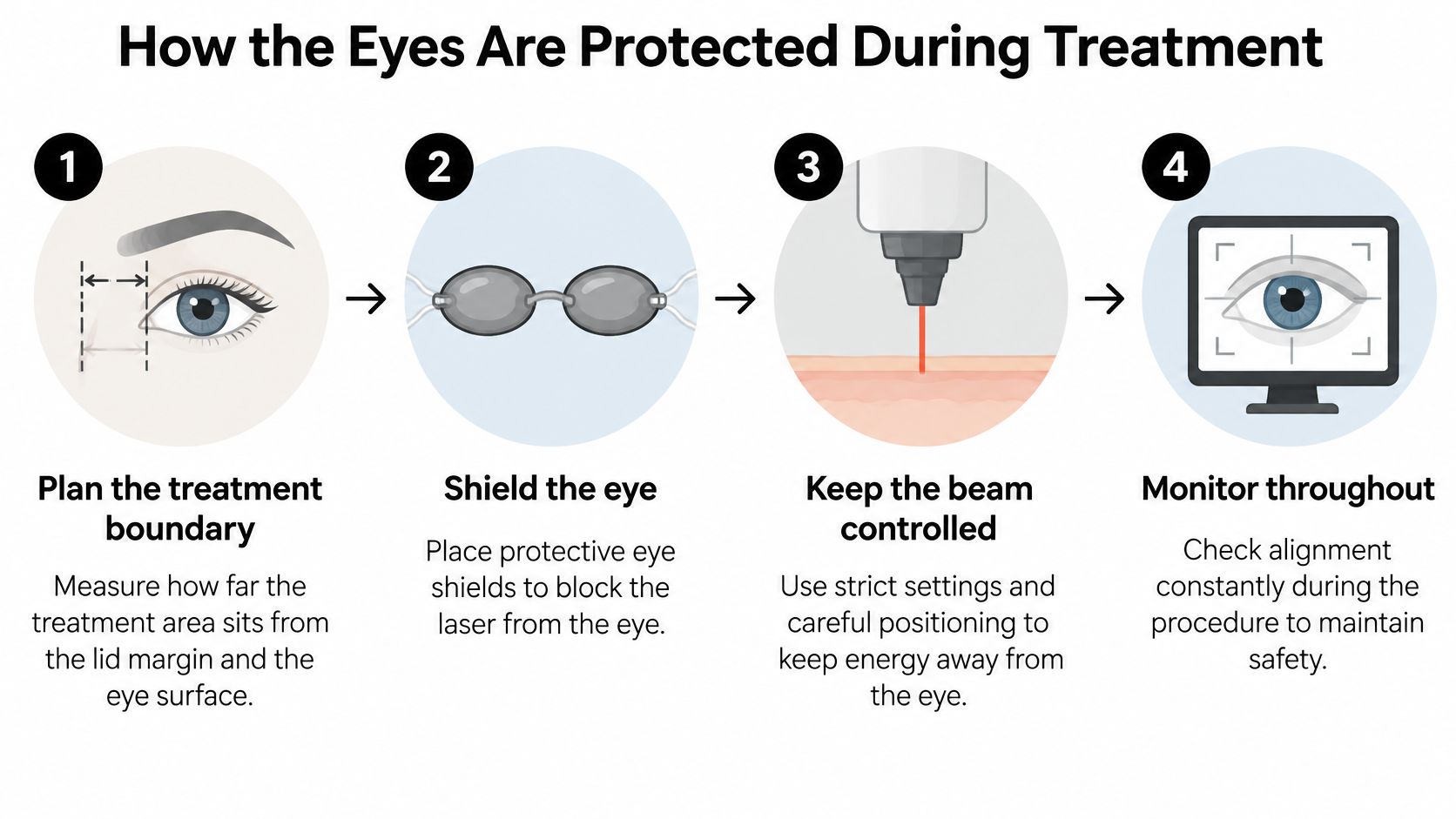
Would you proceed with under-eye CO2 treatment if the eye-protection plan were unclear? The eye is the main safety concern: skin results can be assessed later, but laser exposure to the eye can cause serious harm. Protection should be planned before the first pulse, with clear roles and procedures rather than reassurance alone.
- Plan the treatment boundary. The practitioner should assess the area in relation to the lid margin and eye surface. The lower eyelid offers little room for error, so the treatment boundary needs to be clear before settings are chosen.
- Fit specially designed eye shields. NHS Queen Victoria Hospital guidance on carbon dioxide laser treatment specifies specially designed eye shields, not ordinary glasses, for treatment near the eye. They should remain in place throughout.
- Protect everyone in the room. Anyone present needs eyewear suited to the laser wavelength and protection level while the laser is operating.
- Control room access. Access should be restricted while the laser is firing, with a clear warning signal to prevent someone entering without protection.
- Manage the plume. Extraction should remove the plume, the smoke produced when tissue is vaporised, from the treatment field.
- Adjust treatment near the lash line. Lower density is typically used near the lash line than on the cheek. The practitioner should explain how the treatment plan accounts for the smaller margin around the eye.
- Agree the emergency procedure first. Before treatment starts, agree what to do if you feel pain or notice a change in vision. You should know how to alert the practitioner promptly.
The video illustrates a treatment setting.
Three questions to ask us
Ask who fits your shields, how the treatment boundary is assessed, and what happens if you feel pain or notice a vision change during treatment. Clear answers should come before consent. If the protection plan or emergency procedure is unclear, do not proceed that day.
What results can I expect from under-eye CO2 treatment?
Fractional CO2 laser under the eyes typically gives gradual smoothing of lower-lid texture and softer fine lines, and results vary from person to person. In a published study of 38 patients having laser-assisted treatment of the upper and/or lower eyelids, 32 patients, or 84%, achieved marked aesthetic improvement, 4 patients, or 11%, achieved moderate improvement, and 2 patients, or 5%, achieved slight improvement, with no serious adverse effects reported. The sample included 29 women and 9 men with a mean age of 54 years.
Those figures need their limits stated plainly. The study was small, used one specific method and enrolled Fitzpatrick skin types II to III, so it doesn't establish results for darker skin or for every fractional CO2 protocol. It also gives no evidence on bags, hollows or volume loss.
What gradual actually looks like
Fractional CO2 laser under the eyes is judged after healing, not in the first few days. Smoother texture and softer lines typically build over weeks after each session. In our clinic we usually see change build gradually rather than all at once, which is why we review before repeating treatment.
We don't quote a set number of sessions here because that figure is set at consultation for your skin and concern. Reading what to expect during CO2 laser recovery can help you separate early healing from the later result, and our guide to the best treatment approach for wrinkles explains how line depth affects the choice.
Before your first session: Take a baseline photograph in the same daylight, at the same distance, with no make-up. Weekly photos in identical light show gradual change far better than memory does.
How long is recovery after under-eye CO2 treatment?
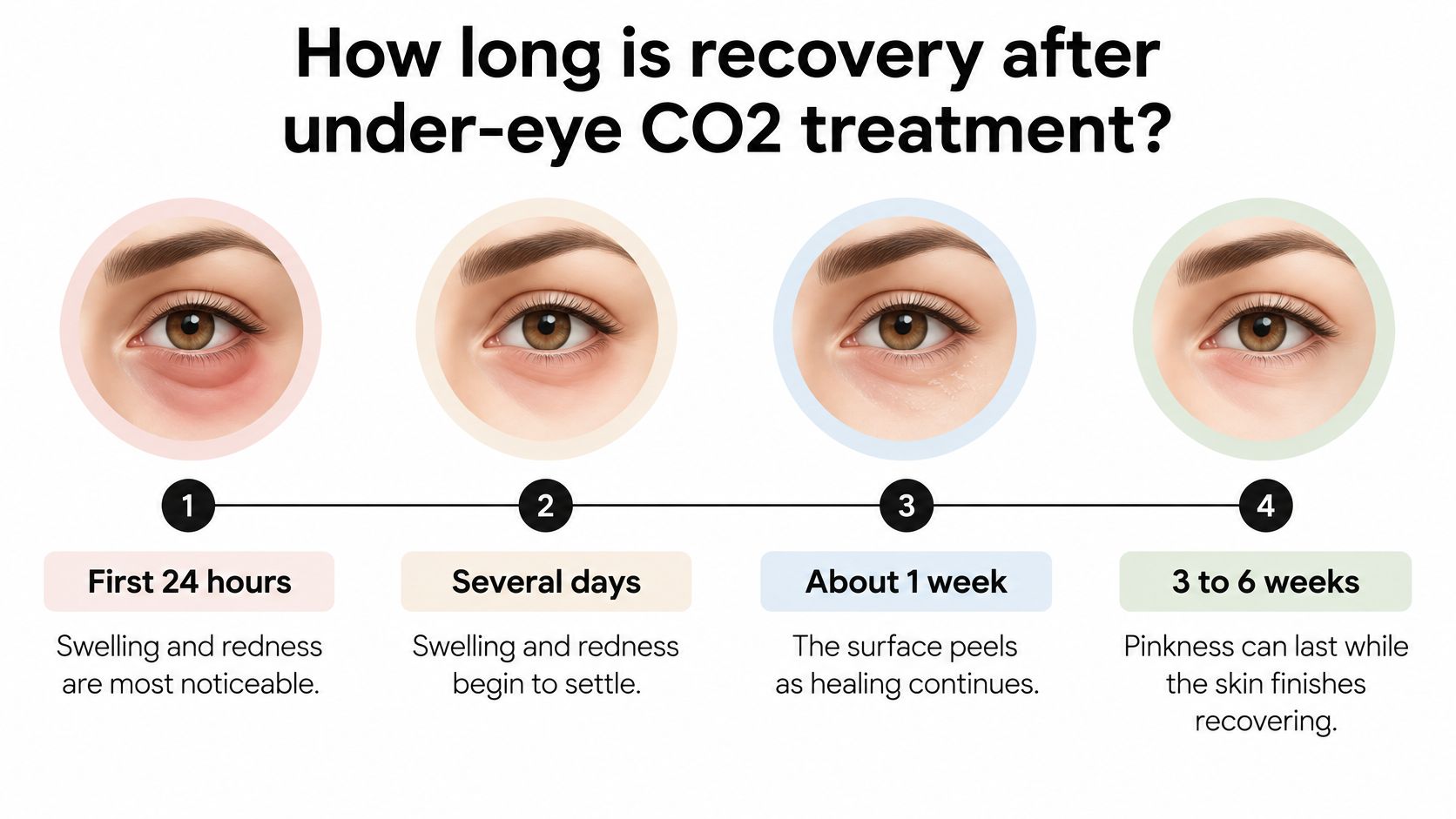
What should you expect while the under-eye skin heals? Fractional CO2 treatment can cause swelling and redness for several days, followed by peeling. Redness may remain for some weeks after the surface has healed, so plan around the visible recovery rather than assuming the skin will look settled as soon as peeling stops.
NHS patient information from North Bristol NHS Trust on laser resurfacing for acne scarring describes skin that feels and looks like moderate sunburn, with swelling and slight oozing in the first 24 hours, peeling over approximately three to seven days, and healing in about seven days. This guidance concerns acne scarring, not the under-eye area, so recovery can differ. Your practitioner should set expectations for your treatment.
Recovery Timeline After Under-Eye CO2 Treatment
| Stage | Typical timing | What you may notice |
|---|---|---|
| First 24 hours | Day 1 | Swelling, a feeling like moderate sunburn and slight oozing |
| Peeling | Days 3 to 7 | The surface lifts and flakes away |
| Healing | About 7 days | New skin forms under the peeling surface |
| Work, contact sports and swimming | Plan around the healing period | Follow your practitioner's advice before returning to activities |
| Driving | Wait until swelling has gone | Swelling can affect vision |
| Make-up | Once the skin has healed | Do not apply before the surface is closed |
| Pinkness | May persist for some weeks | Redness can remain after the surface has healed |
Under-eye swelling is difficult to conceal and may affect vision. Do not drive until it has gone, and arrange transport if you are unsure whether you can see safely. Plan time away from work and activities around how your skin heals, following your practitioner's instructions.
Read about sun protection after laser resurfacing before choosing a treatment date. Once your practitioner says products can be restarted, protect the newly healed skin carefully. Contact your practitioner for review if swelling or pain worsens instead of settling, or if your vision changes.
What are the alternatives to under-eye CO2 treatment?
Which treatment suits you depends on whether the main concern is surface texture, skin laxity or general skin condition. Eye safety and skin results are separate questions: a treatment that avoids resurfacing may still need careful assessment around the eyes, and it will not produce the same surface change as fractional CO2.
Under-Eye Options Compared
| Option | Main target | Typical downtime | Often chosen when |
|---|---|---|---|
| Fractional CO2 laser | Surface texture, fine lines and some pigmentation | Several days to weeks of redness; refer to the recovery timeline | Lower-lid texture is the main concern after assessment |
| 3D Dermaforce RF Microneedling | Collagen stimulation and skin tightening | Downtime varies by treatment and individual | Skin laxity is the main concern and resurfacing is not the goal |
| HIFU | Brow lifting, periorbital wrinkle reduction and skin tightening | Downtime varies by treatment and individual | Tightening is wanted without surface resurfacing |
| Dermalux LED Therapy | Overall skin condition | Usually none | A gentle option or support between other treatments |
3D Dermaforce RF Microneedling
3D Dermaforce RF Microneedling is designed for collagen stimulation and skin tightening. It may suit someone more concerned with laxity than rough texture, particularly when visible peeling is difficult to accommodate. It does not resurface the skin, so it cannot be expected to give the same result as CO2 laser treatment. The clinic offers this treatment from £150.
HIFU
HIFU uses highly focused acoustic energy to create thermal coagulation zones at three selected depths. The resulting wound-healing response forms new collagen and can provide longer-term skin tightening. It targets concerns such as brow lifting, jowl line lifting, nasolabial fold reduction and periorbital wrinkle reduction, rather than resurfacing the skin. See our facial skin tightening options for more on how these approaches differ.
Dermalux LED Therapy
Dermalux LED Therapy is a gentle option for overall skin condition, usually without downtime. It does not resurface the skin or provide the same tightening effect as RF microneedling or HIFU, so consider it supportive care rather than a direct substitute for CO2. Different methods target different tissues, which is why the choice should reflect your anatomy and concern rather than the treatment menu.
Combining treatments involves separate visits, time between treatments for healing, sun protection and a consistent skincare routine. Avoid scheduling resurfacing sessions close together without practitioner review. Combining treatments also adds time and cost, and is not necessary for everyone.
If your main concern is volume or fat, these options do not replace an assessment of that structure. A separate approach, such as facial rejuvenation at Arizona Valley Acupuncture, may address different concerns, but it is not a substitute for choosing a treatment based on the specific tissue involved.
What should I do before booking under-eye CO2 treatment?
Could under-eye CO2 suit your skin and eye history? Start with a complimentary, in-depth consultation. The eye-safety question comes first: the treatment area is close to delicate eye structures, so suitability and protection need careful assessment before considering the skin result. We use the 3D Vjuve, a fractional CO2 skin resurfacing laser. It has genuine downtime, unlike most other treatments at the clinic, so recovery also needs to fit your plans.
What to bring
- Medicines and supplements: Bring a full list, including anything bought over the counter.
- Cold sore history: Tell us about any past herpes simplex, even if it was years ago.
- Eye history: Mention eye conditions, dry eye, past eye surgery and previous eyelid treatments.
- Recent sun exposure: Tell us about tanning, sunburn or a recent holiday.
- Scarring history: Let us know if your skin has healed with raised or slow-healing scars.
- A daylight photograph: Bring a clear photo of your concern taken in natural light.
We'll assess the concern, pigmentation, the distance from your eyelid to the proposed treatment area, and whether CO2 is appropriate. Bring your questions about eye protection and recovery, too. Current costs are listed on our CO2 laser resurfacing pricing page; the treatment plan determines the price.
Under-eye CO2 is not suitable for everyone. If another approach is more appropriate, or an eye specialist should assess you first, we'll say so. Book a complimentary consultation through 3D Aesthetics Leamington Spa, where the team can discuss your concerns and confirm whether CO2 suits you.
← Back to Home