You're standing in front of the mirror, pinching the same area of skin you've been trying to improve for months. Perhaps it's a small pocket around your abdomen, uneven cellulite on your thighs, or skin that looks less smooth after losing weight. Then you see two familiar terms, shockwave therapy vs ultrasound, and wonder whether one is clearly better.
At 3D Aesthetics Leamington Spa, we don't treat these technologies as interchangeable rivals. Ultrasound cavitation is primarily used for localised fat and circumference-focused body contouring, while shockwave is more closely associated with skin texture, tissue pliability and the appearance of cellulite. Results vary from person to person, so the sensible choice starts with the concern we're treating, not the most impressive-sounding machine.
| Factor | Shockwave therapy | Ultrasound cavitation |
|---|---|---|
| Main purpose in our clinic | Cellulite appearance, texture and pliability | Localised inch loss and body contouring |
| Sensation | Noticeable tapping, sometimes uncomfortable | Warmth and mild buzzing |
| Downtime | Usually little or none, with possible short-term redness or soreness | Usually little or none |
| What we measure | Texture, photographs and patient feedback | Circumference and 3D body-scan data |
| Typical course in our clinic | Around six to eight weekly sessions | Around six to eight sessions, usually about a week apart |
| Best starting point | Dimpling or uneven skin appearance | A localised fat pocket with reasonable skin quality |
If you already have a rough idea of your goal, you can book a free consultation and let us assess the area properly.
Table of Contents
- What Most People Get Wrong About These Two Treatments
- How Shockwave and Ultrasound Actually Work
- Side-by-Side Comparison at a Glance
- What Ultrasound Cavitation Is Best Used For
- What Shockwave Therapy Is Best Used For
- Combining the Two for Stubborn Concerns
- Which Option Fits Your Concern and How to Start
What Most People Get Wrong About These Two Treatments
A client may book shockwave for a 4-cm lower-abdominal pocket because a friend used it for thigh dimpling, assuming the stronger-sounding option should work for both. At our Leamington Spa clinic, we separate those concerns before recommending a course. Shockwave therapy and ultrasound cavitation address different body-contouring problems, and the useful result depends on the outcome being measured.
The first question is practical: what would you like to change, and how will we measure that change? Circumference, skin texture, firmness and comfort are separate aims. A device that suits one may be a poor match for another.
Our practical rule: choose the measurable outcome first, then choose the technology.
Why the treatment name can mislead
Both treatments use acoustic energy, meaning sound-based energy delivered into tissue. That shared label does not make their effects identical. A treatment designed for a localised fat pocket should not automatically be presented as an answer to cellulite texture, as explained in our guide to does ultrasonic cavitation work. A treatment intended to influence tissue response should not be sold as a direct substitute for circumference-focused contouring.
The NHS Cheshire and Merseyside policy on Achilles tendinopathy describes shockwave therapy as mechanical pressure waves and therapeutic ultrasound as high-frequency acoustic energy. It also reports that a 2019 meta-analysis found no statistically significant difference between them in the musculoskeletal comparison discussed there.
That finding does not settle every cosmetic question. Pain treatment, tendon treatment and aesthetic body contouring have different targets and endpoints, so evidence from one area should not be transferred casually to another. UK evidence for combining these technologies for cosmetic contouring also remains limited, which is why we assess whether the extra treatment and cost are likely to change the result for the same area.
The assessment matters more than the trend
We assess the amount and position of localised fat, skin quality, cellulite pattern, medical history and the change you want to see afterwards. We may also consider radio-frequency skin tightening, 3D Powersculpt or body HIFU if one of those options better matches the concern.
We will not recommend a course because you request a named technology. If the area or expected result is not a suitable match, we will explain that clearly. This matters for clients travelling from Warwickshire, Warwick or Kenilworth, because a convenient appointment is still poor value when the treatment cannot reasonably address the outcome you want.
How Shockwave and Ultrasound Actually Work
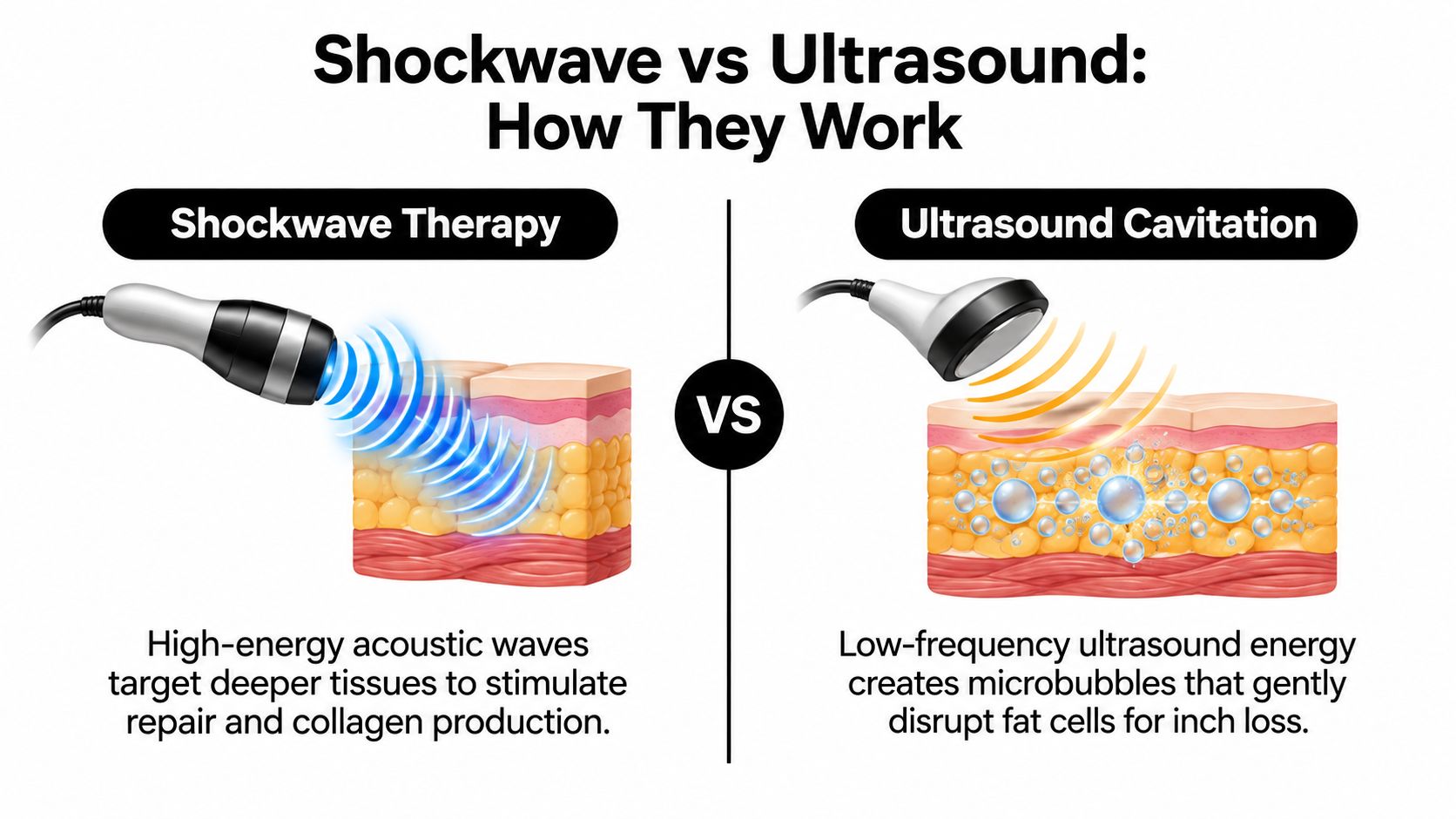
Shockwave therapy delivers short, high-pressure acoustic pulses, while ultrasound cavitation uses low-frequency ultrasound energy for localised body contouring. Both use sound-based energy, but their waveforms, settings and intended tissue responses differ.
An acoustic pulse is a brief pressure wave moving through tissue. Shockwave therapy uses controlled pulses delivered through an applicator against the skin. NICE describes extracorporeal shockwave therapy as a non-invasive procedure that sends short-duration acoustic shockwaves to a targeted area. In calcific shoulder conditions, NICE explains that pressure disturbances may help break up calcium deposits, although that clinical use is different from aesthetic treatment.
What ultrasound cavitation sends into the tissue
Ultrasound cavitation uses low-frequency ultrasound energy directed at a localised area. In our clinic, we use it as part of body-contouring plans focused on a visible or measurable localised fat concern. The treatment isn't the same as diagnostic ultrasound imaging, and it isn't the same as ultrasound-guided injection.
MHz means megahertz, a unit used to describe frequency. Therapeutic ultrasound uses specified frequency and intensity settings, while aesthetic cavitation uses a different treatment purpose and protocol. The fact that both involve sound waves doesn't tell you what result to expect. The important details are the frequency, energy, applicator, treatment area, session plan and outcome being measured.
Ultrasound guidance is not ultrasound cavitation
This distinction causes repeated confusion. Ultrasound guidance is an imaging tool used to help position a device or needle, whereas ultrasound cavitation is an aesthetic treatment intended to affect a localised area of fat. NICE notes that ultrasound may help position an ESWT treatment device, but that doesn't turn shockwave therapy into therapeutic ultrasound.
Similarly, shockwave therapy remains shockwave therapy when imaging is used to help locate the target. A sound-based imaging tool and a sound-based treatment are not automatically the same modality.
Our shockwave therapy for cellulite service is therefore discussed in terms of texture and the appearance of cellulite, not as a promise of general fat removal. The assessment should identify whether the dominant issue is fat volume, skin laxity, dimpling or a mixture of concerns.
Why evidence needs careful reading
NICE's guidance on ESWT for Achilles tendinopathy describes efficacy as inconsistent and limited in quality and quantity, even though no major safety concerns were identified in that guidance. NICE recommends special arrangements around clinical governance, informed consent, audit or research for that indication.
That doesn't mean aesthetic shockwave has no place. It means we should describe it accurately and avoid turning a clinical mechanism into a blanket claim. The device, protocol and endpoint need to match the problem.
Side-by-Side Comparison at a Glance
Ultrasound cavitation is usually the more direct starting point for a localised fat pocket, while shockwave therapy is usually considered when cellulite appearance and skin texture are the main concerns. Results vary from person to person, and our exact recommendation depends on assessment.
Shockwave vs Ultrasound Cavitation Compared
| Factor | Shockwave Therapy | Ultrasound Cavitation |
|---|---|---|
| Primary goal | Improve the appearance of cellulite and support a smoother-looking texture | Target localised fat as part of an inch-loss plan |
| Typical session count | Around six to eight sessions in our clinic | Roughly six to eight sessions in our clinic |
| Session length | Around twenty to thirty minutes per area | Around thirty to forty minutes per area |
| Downtime | Usually minimal, although temporary redness or soreness can occur | Usually minimal |
| Common side effects | Tapping discomfort, tenderness or mild redness | Warmth, buzzing and temporary sensitivity |
| Comfort during treatment | Noticeable and sometimes uncomfortable on bony areas | Usually warm, with a mild buzzing sensation |
| Best-fit concern | Dimpling, uneven texture or tissue that feels less pliable | A localised fat area with reasonable skin quality |
These are clinic planning ranges, not a promise of a fixed course. We may recommend fewer or more appointments, pause a course, or suggest another treatment if the response doesn't match the original aim. Current prices and package details can change, so we discuss personalised costs during consultation and keep our treatment prices available for reference.
The measurement also changes between modalities. With ultrasound cavitation, we can record circumference at defined landmarks and use our in-house 3D body scan. With shockwave, visual records, texture assessment and your own feedback become more important because a smoother-looking surface isn't the same as a smaller measurement.
The useful comparison is not “which machine is strongest?” It's “which result are we trying to record?”
NICE's review of ESWT in calcific rotator-cuff disease shows why caution matters. Across the review, 2,281 patients were analysed, but direct comparisons with ultrasound-based interventions were limited, and the review rated key evidence low quality. That clinical evidence doesn't establish a general advantage for aesthetic treatment, so we won't use it to promise a cosmetic outcome.
What Ultrasound Cavitation Is Best Used For
Ultrasound cavitation is best used in our clinic for localised inch-loss plans involving areas such as the abdomen, flanks, thighs, upper arms and the area beneath the bra line. Results vary from person to person, and we assess whether the visible concern is mainly localised fat rather than loose skin or cellulite texture.
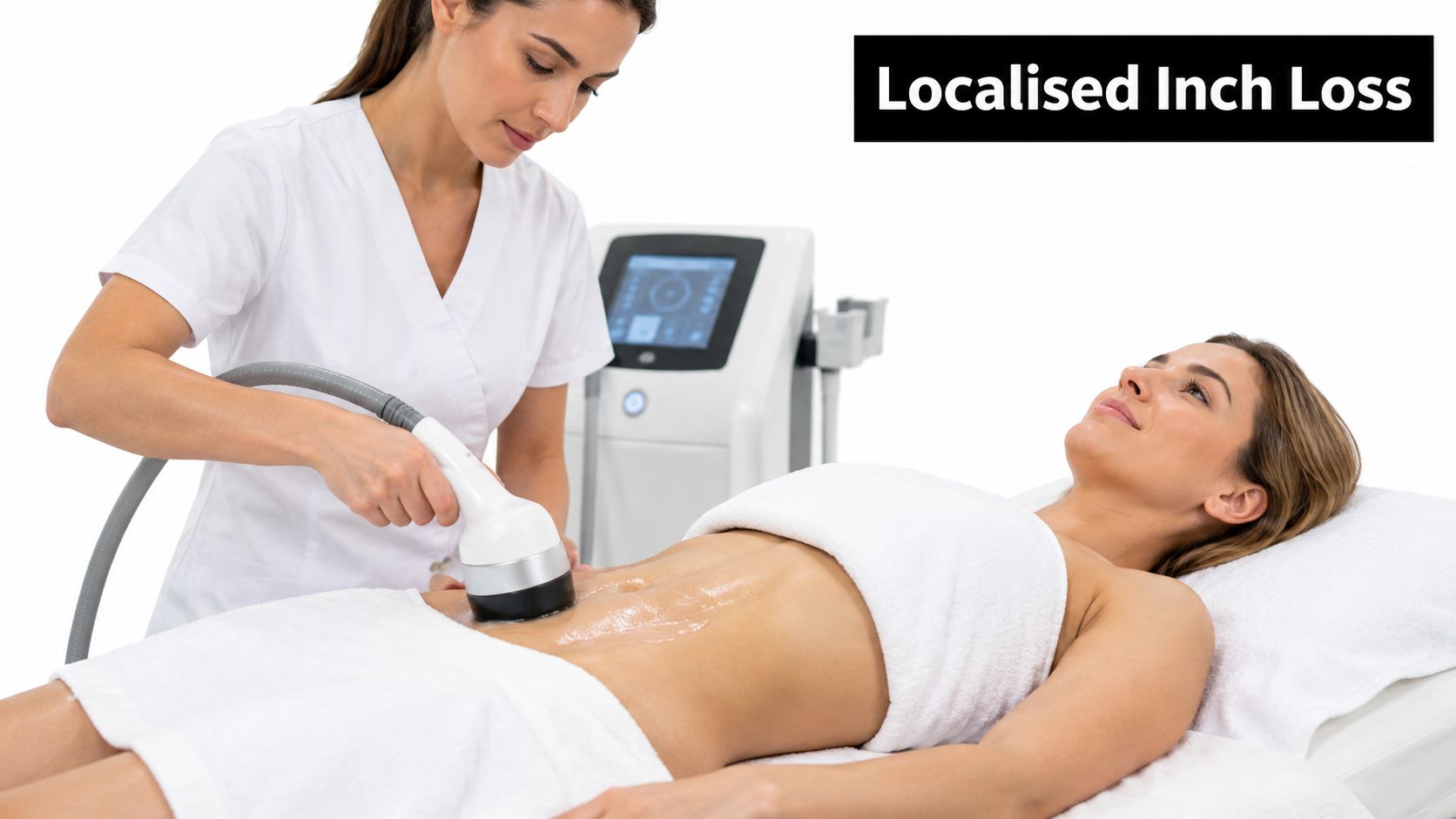
A typical course involves roughly six to eight sessions, usually spaced about a week apart. Each appointment generally lasts around thirty to forty minutes per area. You'll usually feel warmth and a mild buzzing sensation, and an anaesthetic isn't normally needed for this treatment.
What we measure
We don't rely on a mirror photograph alone. At suitable appointments, we can record circumference at consistent landmarks and use our 3D body scan to create a more objective baseline and follow-up comparison. A scan may identify a change that's difficult to judge from day-to-day, while clothing fit and visual appearance may change without a dramatic shift in one measurement.
That's why we avoid promising a particular result. A treatment can be appropriate without producing the same visible change for every client, and results vary from person to person.
Our ultrasound cavitation treatment page explains how we compare cavitation with other body-contouring options. We'll also discuss whether the concern would be better approached with fat freezing, body HIFU, 3D Powersculpt or another option from our body range.
Who we would not treat with cavitation
We'd politely steer you away from ultrasound cavitation if the proposed area or your medical circumstances make it unsuitable. Screening is essential rather than a formality.
- Pregnancy: We don't treat during pregnancy.
- Active metal implants in the treatment area: These require careful review before any appointment.
- Recent surgery: We need appropriate recovery and medical clearance where relevant.
- Certain liver conditions: We may not recommend cavitation when liver health makes the treatment inappropriate.
- A concern caused mainly by loose skin: Cavitation isn't automatically the right tool for laxity.
- A primary cellulite concern with little localised fat: Shockwave or skin-tightening options may be more relevant.
We'll ask about your health, previous procedures, symptoms and expectations before making a recommendation. A localised fat pocket with good skin quality may suit cavitation more naturally than a broad concern involving significant laxity or pronounced textural change.
What Shockwave Therapy Is Best Used For
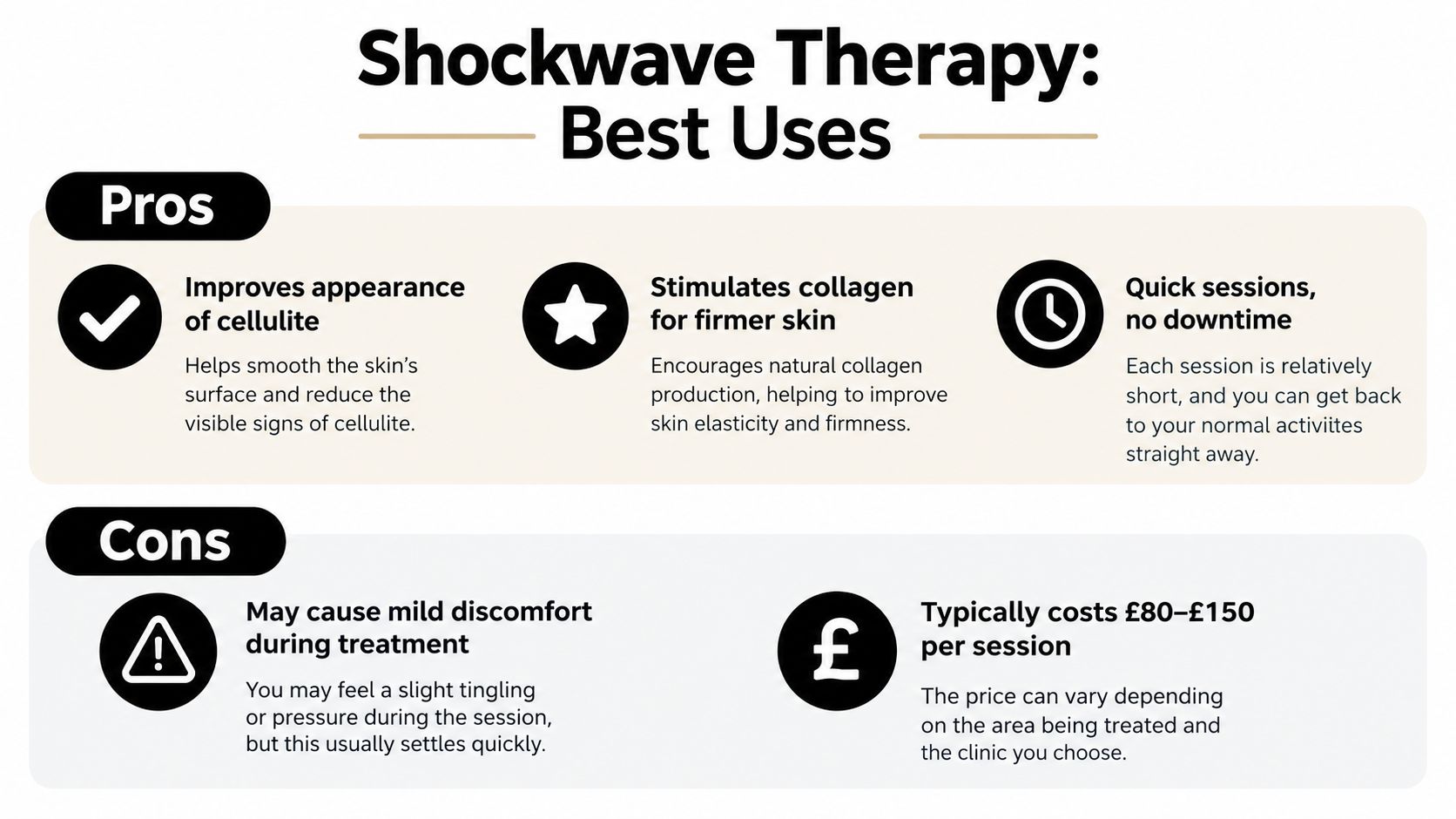
Shockwave therapy is best used in our body-contouring work for the appearance of cellulite, skin texture and tissue pliability, rather than as a direct substitute for ultrasound cavitation's circumference-focused role. We may also consider it after other body work when a client wants to address a less-smooth surface appearance.
A typical course in our clinic is around six to eight sessions, usually weekly, with each session lasting roughly twenty to thirty minutes per area. You'll feel noticeable tapping as the applicator delivers acoustic pulses. The sensation is generally managed without anaesthetic, and bony areas can feel more uncomfortable. Mild redness or short-term tenderness may follow.
What the UK evidence actually says
The evidence for aesthetic shockwave deserves more restraint than many advertisements provide. A plastic-surgery review identified 46 ESWT studies involving 1,496 participants across cellulite, body contouring and skin rejuvenation. The review found substantial heterogeneity and inconsistent technical standards, then concluded that the evidence was insufficient to support any specific intervention. You can read the plastic-surgery review of ESWT in aesthetic applications.
That finding doesn't make the treatment irrelevant. It means that different devices, applicators, energy settings, pulse or frequency settings, treatment areas and endpoints shouldn't be treated as though they were one standard treatment. NICE also describes ESWT efficacy as conflicting or uncertain in several applications, which reinforces the need for condition-specific consent.
Shockwave can be a reasonable option for texture, but texture improvement isn't the same as fat removal.
Comfort, medicines and timing
We'll ask about medicines, bleeding risk, recent procedures, pregnancy status and the area being treated. Scottish NHS guidance advises waiting at least 12 weeks after a steroid injection before shockwave because of potential tendon-rupture risk, and recommends stopping non-steroidal anti-inflammatory drugs, or NSAIDs, before and where possible during treatment because shockwave is thought to stimulate an inflammatory repair response. You can also review practical recovery ideas such as massage and compression gear, although these aren't a substitute for our screening or aftercare advice.
We'll steer you away if the area is unsuitable, if your expectations are centred on a guaranteed fat-loss measurement, or if the discomfort is unlikely to be acceptable. We also won't use pain-treatment evidence to imply that cosmetic cellulite results are established in the same way.
Our shockwave therapy benefits page gives more detail about the treatment's intended role. We'll explain what we can assess, what remains uncertain and whether another option, such as RF skin tightening, is more appropriate for your skin concern.
Combining the Two for Stubborn Concerns
Combining ultrasound cavitation and shockwave therapy can be reasonable when localised fat and uneven texture are separate parts of one concern. In our Leamington Spa clinic, we usually address the circumference-focused goal with ultrasound cavitation first. Once the tissue has settled, we can assess whether shockwave is justified for dimpling or reduced smoothness.
A combined course may follow this sequence:
- Assessment: We establish whether fat volume, cellulite, laxity or a mixture is driving the concern. We record baseline photographs, circumference at set landmarks and, where appropriate, a 3D scan.
- Ultrasound cavitation: We target the localised fat concern and review the area's response.
- Shockwave therapy: We may add treatment for skin texture and pliability, without presenting it as additional fat removal.
- Review: We compare the agreed measurements and photographs, then decide whether further sessions have a clear purpose.
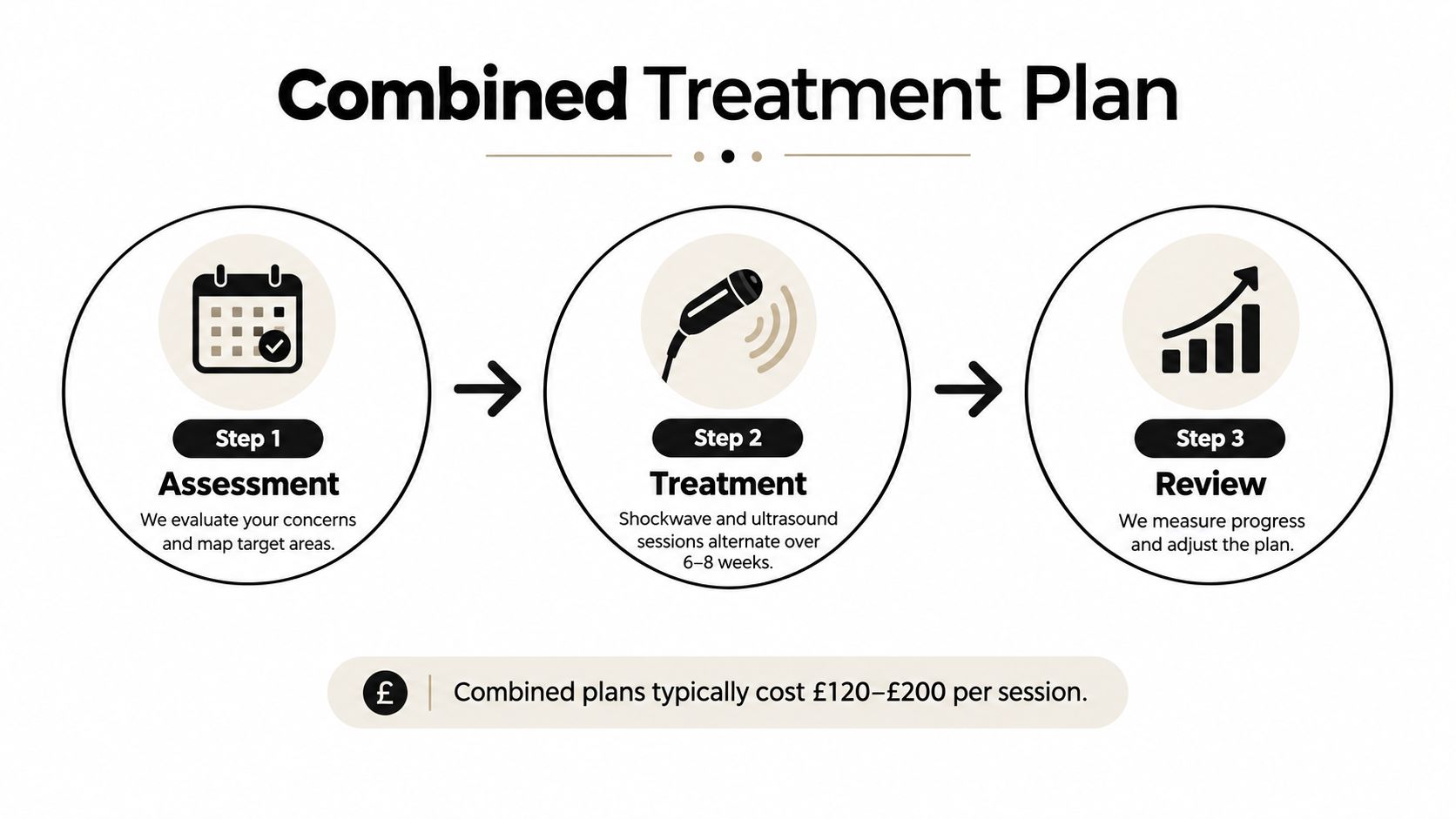
The order matters because each treatment should answer a different need. We won't stack technologies because the combination sounds more advanced. Our non-surgical body-sculpting plans show how we sequence options before asking you to pay for extra appointments.
We only consider adding shockwave after cavitation if circumference has reduced by at least 1-2 cm, while dimpling scores or photographs show no texture change after 4 weeks. Otherwise, we stop and review rather than extend the course automatically. A small fat pocket with good skin quality may need cavitation alone. Limited fat with visible texture change may make shockwave, or RF skin tightening, more logical. We discuss spacing, comfort and whether the added sessions are justified for the same body area before you commit.
Which Option Fits Your Concern and How to Start
Ultrasound cavitation is usually the better starting point for a stubborn localised fat pocket, while shockwave therapy is more appropriate when cellulite appearance and texture are the main concerns. Results vary from person to person.
- Stubborn fat pockets: Start with ultrasound cavitation when the concern is localised fat and you want circumference measured.
- Cellulite appearance: Consider shockwave therapy when dimpling and uneven texture are more important than fat volume.
- Crepey or lax skin after weight change: Ask about skin-tightening options as well as shockwave, because neither technology should be assumed to solve every type of laxity.
- Post-pregnancy changes: Wait until your health, recovery and treatment area have been properly assessed. We won't treat pregnancy, and we may recommend against treatment when recent surgery or another medical factor makes it unsuitable.
We won't treat either option when the area, medical history or expected outcome makes the plan inappropriate. At our Leamington Spa clinic, our free consultation can include the AI Skin Scanner as an objective starting point for skin concerns, alongside body assessment and 3D scanning where relevant.
At 3D Aesthetics Leamington Spa, we offer ultrasound cavitation, shockwave therapy for cellulite, 3D body scanning and other non-surgical body-contouring options. Book a consultation at 11 Guys Place East, Leamington Spa, Warwickshire CV32 4RG, or call 01926 315764, so we can match the technology to the change you want to measure.
← Back to Home