
What do ultrasound cavitation reviews really tell you if nobody explains where the tape measure went, which machine was used or when the follow-up happened? A smaller waist measurement, a comfortable appointment and a lower number on the scales are different things. A useful review shouldn't treat them as interchangeable.
At 3D Aesthetics Leamington Spa, previously trading as 3D Lipo Leamington Spa, we start with your concerns and a baseline measurement, not a promise about centimetres. Our free consultation includes a 3D body scan, and we use tape measurements to help you compare progress. Results vary from person to person.
We also separate personal experiences from clinical evidence. A thoughtful testimonial can explain how someone felt during an appointment, but it can't establish what you'll experience or how your measurements will change.
Our starting point: Look for a clear treatment plan, consistent measurements and an honest discussion of limitations before you look at star ratings.
Table of Contents
- 1. How much inch loss do clients usually notice after ultrasound cavitation?
- 2. How many ultrasound cavitation sessions do most clients have?
- 3. Does ultrasound cavitation hurt, and can I go back to work afterwards?
- 4. Who should not have ultrasound cavitation?
- 5. How long do ultrasound cavitation results last?
- 6. Can ultrasound cavitation be combined with fat freezing?
- 7. How do we measure progress with ultrasound cavitation at 3D Aesthetics Leamington Spa?
- Ultrasound Cavitation Reviews: 7-Point Comparison Guide
- Book Your Free Consultation in Leamington Spa
1. How much inch loss do clients usually notice after ultrasound cavitation?
Ultrasound cavitation may produce modest local measurement changes, but we can't responsibly give every client an expected inch-loss figure. Results vary from person to person.
A Salon Searcher review of ultrasound cavitation evidence describes circumference changes of around 1–2 cm in some studies, while noting small trials, varied devices and inconsistent confirmation of fat reduction. That's a research observation, not a prediction for your waist or thighs.
Cavitation means microscopic bubbles forming, expanding and collapsing under changing acoustic pressure, as described in a clinical ultrasound safety review. The mechanism alone doesn't tell us how much someone's measurements will change.
What should you compare besides the scales?
Our ultrasound cavitation treatment page explains the service we offer. At your consultation, we'll distinguish local contouring goals from weight-loss expectations.
For example, if your concern is how trousers fit around your waist, we'll record that concern alongside your starting measurements rather than judge everything by body weight.
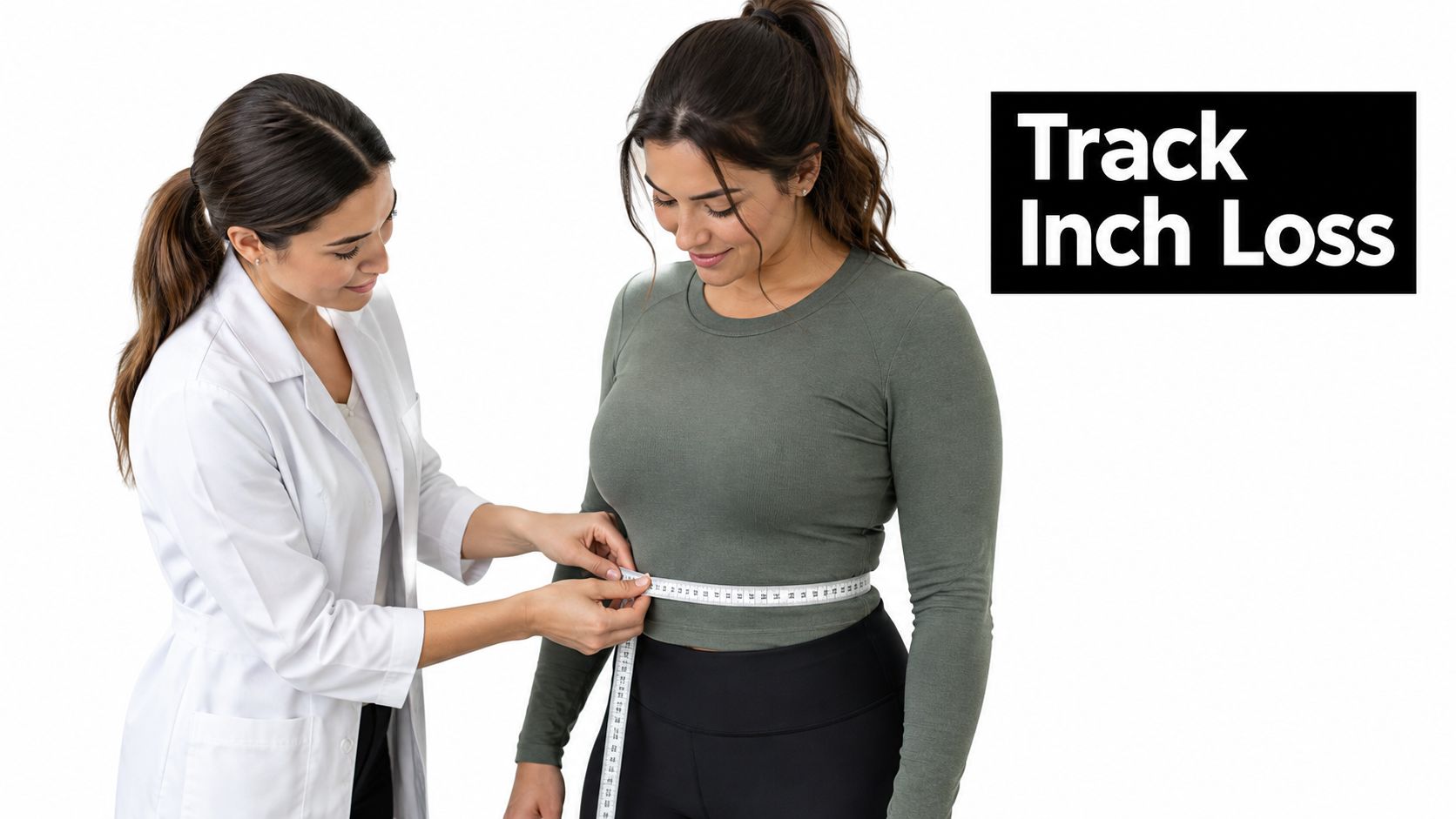
- Use consistent landmarks. Ask us to show you exactly where we're measuring.
- Record the timing. A comparison needs a clear baseline and follow-up date.
- Keep outcomes separate. Circumference, photographs and weight answer different questions.
For a non-clinical discussion of those distinctions, Strive Workout Log's body recomposition guide offers additional reading. It isn't evidence that cavitation will work for you.
2. How many ultrasound cavitation sessions do most clients have?
Ultrasound cavitation session numbers should come from your individual assessment, not a universal course length copied from reviews. We'll discuss the proposed appointments, review points and costs before you decide whether to proceed.
Your plan needs to reflect the area you want assessed, your health history and what you're hoping to change. We won't invent a standard session count when the supplied evidence doesn't establish one.
Results vary from person to person, so buying more appointments shouldn't be treated as a promise of greater change.

What should your written plan include?
Ask for the proposed treatment area, appointment spacing, planned review and overall cost. Our prices page is a starting point, but your consultation should establish which costs apply to your proposed plan.
For example, if you're considering treatment before a holiday, tell us the date before booking. We'd rather explain what can reasonably be assessed than compress a course around an unrealistic deadline.
A review saying someone needed fewer appointments than you doesn't establish that their plan was better. They may have had a different treatment area, device, starting point or definition of success.
Don't commit to a course until you understand when progress will be reviewed and what happens if you're not seeing a worthwhile change.
You should leave knowing what you're paying for, not just how many appointments are available.
3. Does ultrasound cavitation hurt, and can I go back to work afterwards?
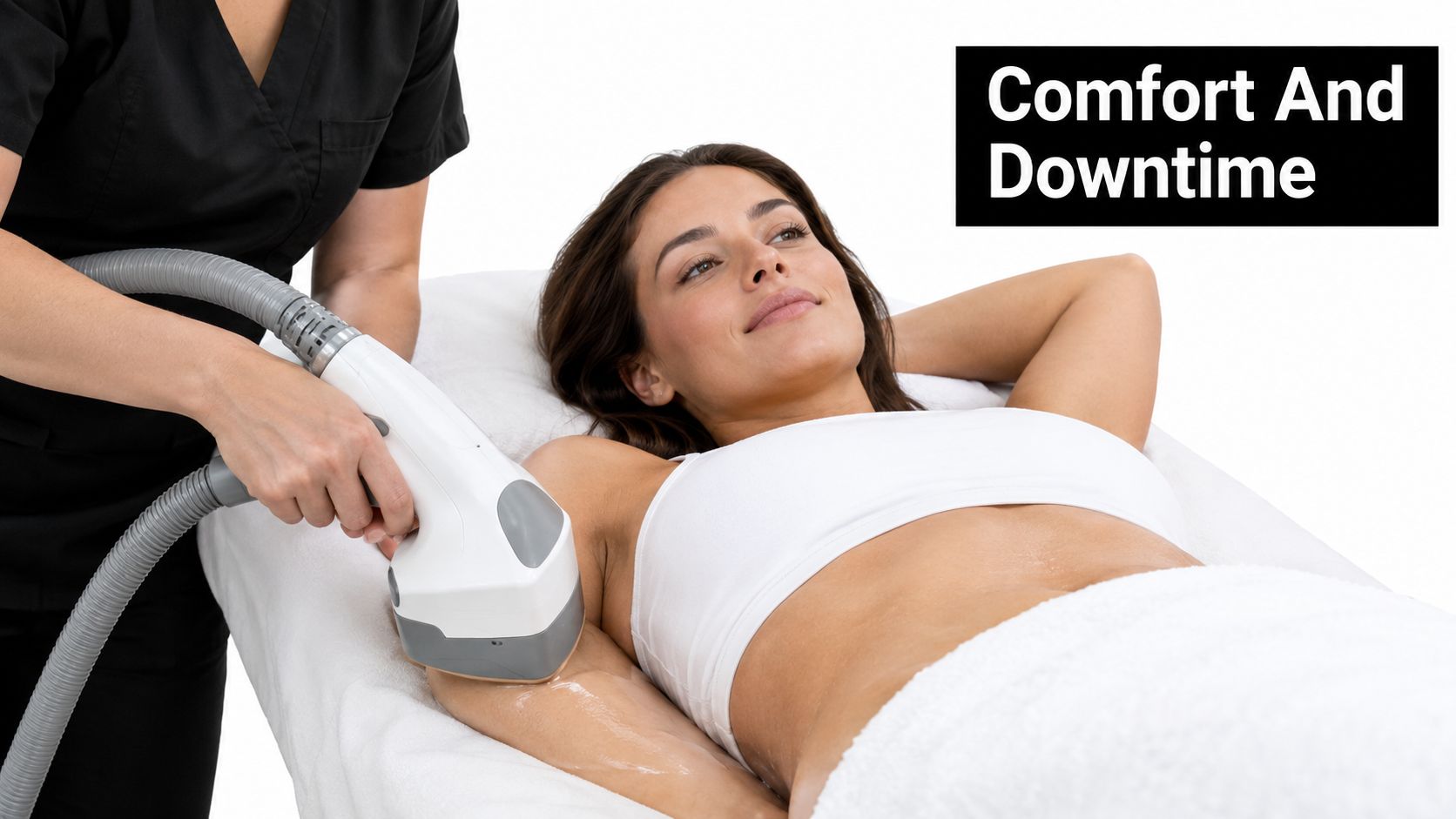
Ultrasound cavitation comfort and return-to-work advice need to be discussed for the actual device and treatment plan, rather than assumed from somebody else's review. We won't promise a painless appointment or tell everyone they can resume every activity immediately.
The UK public-health review of ultrasound safety explains why exposure conditions matter. Evidence about medical ultrasound shouldn't be used as blanket reassurance about cosmetic equipment.
That distinction matters more than a review describing treatment as gentle. Your practitioner should explain what sensations to expect and what would make them pause or stop.
What should you tell us before your appointment?
Tell us if you're returning to desk work, doing a physically demanding shift or planning exercise afterwards. We'll discuss aftercare in relation to your circumstances rather than offer a blanket clearance.
- Speak up during treatment. Tell us promptly if anything feels uncomfortable or wrong.
- Ask about aftercare. You should know whom to contact and what concerns need medical assessment.
- Avoid pushing through discomfort. Completing an appointment isn't more important than reassessing it.
Our ultrasound cavitation side-effects guide gives you questions to raise before booking. For treatment outcomes, results vary from person to person.
For example, someone who can take a quiet afternoon has different practical concerns from someone heading straight into a demanding shift. We want to know that beforehand.
4. Who should not have ultrasound cavitation?
Ultrasound cavitation isn't an appointment we offer automatically to everyone, and our clinic policy is to decline or defer treatment when screening raises concerns.
We don't offer cavitation during pregnancy or breastfeeding, or to clients with an implanted medical device such as a pacemaker. We also defer treatment where there are open wounds, active skin infections or recent surgery in the proposed area pending appropriate assessment.
These are our screening boundaries, not a claim that a general website provides a complete cavitation contraindication list. Tell us about medical conditions and all medicines, including anything affecting blood clotting, so we can identify when advice from your medical team is needed.
What does an honest consultation look like?
Our consultation includes a health-history review, not a medical diagnosis or a substitute for your GP. Our ultrasound cavitation risks guide can help you prepare your questions.
For example, if you've recently had abdominal surgery and want your abdomen treated, we won't rely on the fact that the skin looks healed. We'll defer the decision until the relevant concerns have been addressed.
- Disclose recent procedures. Include the area treated and any ongoing follow-up.
- Bring your medicine list. Don't stop or change medicines to qualify for treatment.
- Accept a pause when needed. A deferred appointment can be the appropriate decision.
The Department of Health and Social Care's England licensing consultation emphasises practitioner competence and consumer protection. That supports asking about assessment and training, not treating a positive review as permission to proceed.
5. How long do ultrasound cavitation results last?
Ultrasound cavitation doesn't have a dependable, evidence-based duration we can quote for everyone; results vary from person to person. The Bolt Pharmacy medical-information review describes uncertain durability and evidence that often relies on short-term circumference measurements rather than direct assessment of fat compartments.
The same review states that NICE hasn't recommended ultrasound-based fat reduction as an obesity treatment. We therefore discuss local appearance goals, not treatment for obesity or fat around internal organs.
What makes a follow-up useful?
Ultrasound cavitation follow-up is most useful when we compare the same area using the same method and record how much time has passed. Results vary from person to person, and a photograph taken shortly after an appointment cannot tell you how an outcome will look later. At our clinic, we discuss what you want to assess before agreeing how progress will be reviewed.
If your waist measurement changes, we'll distinguish that observation from a claim about how much fat has been reduced. If your measurements don't show a meaningful difference, that deserves an honest conversation too. We won't automatically present another course as the answer.
A useful maintenance discussion covers your expectations, any changes in your circumstances and whether further treatment is justified. Keep your original measurements and follow-up dates, and ask to compare like with like. That gives you a clearer basis for deciding whether to stop, wait or reassess.

6. Can ultrasound cavitation be combined with fat freezing?
Ultrasound cavitation and fat freezing can be discussed within a personalised body-contouring plan, but we won't assume that combining treatments is the better choice.
We offer both cavitation and fat freezing, also called cryolipolysis, at our clinic. Whether we recommend either treatment depends on your assessment, proposed area and expectations, not the popularity of a package.
Results vary from person to person. The evidence provided here doesn't establish that a combined course delivers a better outcome than either option alone.
Why might starting with less make sense?
Our comparison of ultrasound cavitation and cryolipolysis can help you prepare for that discussion. Ask us to explain what each proposed treatment is intended to address and why both would be included.
For example, if you're concerned about your waist and thighs, assessing one area first may make the plan easier to understand and budget for. Treating several areas with different methods at once can also make it harder to interpret which part of the plan contributed to any observed change.
- Ask for the rationale. Each treatment needs a clear purpose.
- Request written timing. Understand the proposed sequence and review points.
- Set a budget boundary. Don't add treatments just because they're offered together.
A larger package isn't automatically a more appropriate plan. You're entitled to ask why each appointment is included.
We're comfortable recommending a simpler approach, or no treatment, when that fits your circumstances better.
7. How do we measure progress with ultrasound cavitation at 3D Aesthetics Leamington Spa?
Ultrasound cavitation progress at our clinic is assessed through tape measurements at visits and comparison with the 3D body scan included in your free consultation. Results vary from person to person, and neither method alone establishes how much fat tissue has changed.
Our body measurement tracking guide explains the role of consistent comparisons. We record the treatment area and measurement points so you understand what we're assessing.
The Chartered Institute of Environmental Health review reports that official UK cosmetic-treatment volume data aren't collected. That's an important reason not to mistake a collection of testimonials for a national estimate of effectiveness.
What should you expect in your consultation notes?
We want your record to explain your concern, starting measurements, proposed treatment and follow-up plan. Similar clothing and consistent positioning help make the comparison more useful.
For example, a client travelling from Warwick or Kenilworth might want to understand the appointment commitment before proceeding. We'll discuss that alongside measurement plans, rather than leave practical arrangements until after a course is agreed.
- Name your goal. Tell us whether your concern is fit, contour or a particular measurement.
- Keep the baseline. Ask how your starting scan and measurements will be compared.
- Record the review date. Progress needs a timescale, not just an attractive photograph.
Our free AI Skin Scanner is also available for skin concerns. It's separate from body-contouring assessment and shouldn't be confused with a body scan.
Ultrasound Cavitation Reviews: 7-Point Comparison Guide
| Topic | Process / Complexity 🔄 | Resources / Considerations | Expected Outcomes 📊⭐ | Ideal Use Case 💡 |
|---|---|---|---|---|
| Noticeable inch loss | A course of sessions; progress checked over several weeks | Tape measurements and optional 3D body scan; results vary | Usually gradual, modest changes; not a weight-loss treatment | Tracking changes in targeted areas such as the waist, hips, thighs, or abdomen |
| Number of sessions | Individual course planned at consultation; sessions spaced over time | Multiple appointments; cost depends on sessions and areas treated | Course may be adjusted based on measured progress | People ready to commit to a planned treatment schedule |
| Comfort and returning to work | Non-invasive session with minimal downtime ⚡ | Mild redness or tenderness may occur; comfort varies | Most clients resume daily activities or work straight away | Those seeking a treatment that fits around their usual routine |
| Who should avoid treatment | Health screening at consultation; medical advice may be needed | Pregnancy, breastfeeding, implanted devices, certain conditions, recent surgery, or skin issues may rule it out | Screening helps identify whether treatment is appropriate | Anyone considering treatment should disclose health conditions and medicines first |
| How long results last | Follow-up reviews and measurements can track changes | Ongoing healthy habits support maintenance | Duration varies; weight and lifestyle changes can affect results | People willing to maintain healthy eating and regular activity |
| Combining with fat freezing | Individually planned, often one area or treatment at a time | Adds time and cost; suitability depends on goals and health history | Separate tracking can help assess each treatment | Clients considering treatment for more than one area |
| Measuring progress | Tape measurements at consistent points; 3D scan available at consultation | Similar clothing and measurement conditions improve comparisons | Objective tracking shows changes over time, which may be gradual | Clients who want to monitor progress before or during a course |
Book Your Free Consultation in Leamington Spa
Ultrasound cavitation deserves a personal assessment, not a decision based only on reviews. At our Leamington Spa clinic, we'll discuss what you want to change, review your health history and explain whether we think treatment is appropriate.
We're 3D Aesthetics Leamington Spa, previously 3D Lipo Leamington Spa, at 11 Guys Place East, Leamington Spa, Warwickshire CV32 4RG. We welcome clients from the local area, Warwick and Kenilworth who want a clear discussion before committing to body contouring.
What will we help you decide?
We'll separate questions about local measurements from expectations about weight loss. We'll also explain how we would record your starting point, what a proposed course involves and when we would review whether continuing makes sense.
Bring the reviews that have influenced you, especially if they mention dramatic changes or a particular session count. We can help you identify what information is missing without dismissing another person's experience.
- Bring your health details. Include medicines, implanted devices and recent procedures.
- Explain your priorities. Tell us about your budget, schedule and the area concerning you.
- Ask about limits. You should understand uncertainty as clearly as the proposed benefits.
We won't promise a particular measurement or tell you how long a change will last. Results vary from person to person, and choosing not to proceed is a valid outcome of a consultation.
If you're unsure where to begin, book your free consultation or call 01926 315764. We'll help you decide whether cavitation fits your goals and explain the next steps without pressure to purchase a course.
We offer ultrasound cavitation, personalised body-contouring consultations and 3D body scanning to establish a clear starting point. Visit 3D Aesthetics Leamington Spa to discuss your concerns with us and decide whether a measured, individual treatment plan is right for you.
← Back to Home