

You may be tired of shaving your underarms every few days, fed up with stubble appearing almost immediately, or unsure whether laser hair reduction is a sensible next step for your skin. The right choice depends on what you want from underarm hair removal, how your skin responds, whether you've been in the sun recently, and how you remove hair between treatments.
We're 3D Aesthetics Leamington Spa, and we'd rather assess those details than promise the same outcome to everyone. Here's how common methods compare, what a laser course involves, when we'd ask you to wait, and what underarm aftercare looks like in everyday life.
Table of Contents
- Why This Guide Is Different
- Who Chooses to Remove Underarm Hair and Why
- Every Method Compared Side by Side
- How Laser Hair Reduction Actually Works
- Who Should Pause, Patch Test or Avoid Laser
- Underarm Aftercare That Actually Fits Daily Life
- What It Costs at Our Clinic and How to Start
- Underarm FAQs Most Clients Actually Ask
Why This Guide Is Different
If you've tried shaving, waxing, or cream and disliked the upkeep or irritation, it's natural to wonder whether laser will suit you better. We don't treat that as an automatic yes. We first want to understand your skin tone, recent sun exposure, hair-removal habits, and what you want to change.
Underarm hair removal is a personal grooming choice, not a medical requirement. Some clients want less frequent shaving; others are mainly concerned about ingrown hairs or the effort of keeping up a routine. Laser offers hair reduction, not a promise that all hair will be gone, and the result and treatment experience vary from person to person.
What you'll find here
We compare shaving, waxing, creams, threading, sugaring, at-home IPL, clinic laser and electrolysis using practical trade-offs: how each method works, likely discomfort, how long the effect lasts, typical UK cost information where it's available, and the main drawback. We then focus on laser, including how a course works, who should pause or avoid treatment, and how to care for the underarm afterwards.
We also explain when we'd rather not treat. Recent tanning, active irritation, or skin that needs a more careful laser assessment can change the decision. If your main question is whether deodorant is safe after a session, the aftercare section and FAQs address that directly.
Our starting point: We recommend a method only after we understand your skin and your priorities. A consultation should help you make a decision, not pressure you into one.
Who Chooses to Remove Underarm Hair and Why
Underarm hair removal is common in the UK, but common doesn't mean compulsory. Mintel reported that 78% of UK women had removed underarm hair during the previous 12 months. Separately, a University of Leeds study of 678 women found that 98.67% had removed underarm hair at some point in their lives. Those figures describe behaviour, not a health need or a rule everyone should follow. (Mintel's UK body-hair research)
People choose to remove hair for different reasons: convenience, comfort, personal style, or the feeling that they'd rather not have visible stubble. Others prefer to leave their hair alone. Social expectations can influence either choice, but they don't tell us what will make an individual client feel comfortable.
A preference, not an obligation
The important question at consultation isn't whether you “should” remove underarm hair. It's whether you want to change your routine, and what kind of change would be useful. Shaving may suit someone who wants a quick, flexible option. Laser may make sense for someone seeking a longer-term reduction and willing to attend a course, but it isn't right for every skin or hair combination.
We don't assume that a client wants completely hair-free skin, either. A conversation about how much reduction you're hoping for helps us discuss realistic expectations and whether treatment is worth pursuing. If your reason for booking is mainly pressure from somebody else, it's reasonable to take time before deciding.
Every Method Compared Side by Side
No method is best for everybody. The practical choice is often between a quick fix that needs repeating, a longer-lasting temporary method that can be uncomfortable, and a course of treatment intended to reduce future growth.
| Method | Typical results | Pain | Typical UK cost per session or per cycle | Main drawback |
|---|---|---|---|---|
| Shaving | Hair cut at skin level, with regrowth soon after | Usually mild, but razor burn or nicks can hurt | Cost varies by razor and products | Frequent upkeep and possible irritation or ingrown hairs |
| Waxing | Hair pulled from the root, with a longer hair-free interval than shaving | Can be sharp and uncomfortable, especially in the underarm | Varies by provider and location | Hair must grow back enough for waxing; irritation is possible |
| Depilatory cream | Hair dissolves at or just below the skin surface | Often painless, but stinging can occur if the skin reacts | Varies by product | Chemicals can irritate sensitive underarm skin |
| Threading | Hair is pulled out from the root | Can pinch; technique and sensitivity matter | Varies by provider | Time-consuming over a larger area and needs regrowth |
| Sugaring | A sugar paste pulls hair from the root | Uncomfortable for some people | Varies by provider | Hair must be long enough to grip; irritation can occur |
| At-home IPL | Repeated light pulses aim to reduce regrowth | Often feels warm or like a small snap | Device cost varies; no reliable per-session figure listed here | Device settings and suitability vary, and results aren't assured |
| Clinic laser | A course aims for longer-term hair reduction | A quick snapping or warming sensation is possible | Our underarm prices are listed on the treatment prices page | Requires assessment, repeated sessions and suitable skin-hair conditions |
| Electrolysis | A fine probe treats individual follicles | Can be uncomfortable | Varies by provider and treatment time | Treats hairs individually, so a larger area can take substantial time |
Shaving is easy to fit into a routine, but it cuts hair at the surface, so it won't reduce the follicle's ability to grow hair. Waxing and sugaring pull hair from the root and can leave a longer gap before regrowth, but that trade-off may not suit someone who finds underarm waxing too painful or develops irritation afterwards. Cream can be convenient, though a product that irritates your skin isn't a bargain.
At-home IPL can seem appealing because you can use a device privately, but it isn't interchangeable with clinic laser. The device, your skin tone, your hair colour and your willingness to follow the instructions all matter. For readers weighing waxing against laser, this laser hair removal vs waxing comparison offers another overview of the differences.
What tends to suit which routine
Choose a temporary method if flexibility matters more than avoiding regular upkeep. Consider professional laser if you want reduction over time, your hair and skin can be assessed safely, and you're comfortable following preparation and aftercare instructions. Our underarm laser hair reduction treatment is one option for people considering a clinic course.
No price is included for other methods because costs depend on product choice, provider and location. For our clinic's current underarm pricing, check the linked price list rather than relying on a generic UK estimate.
How Laser Hair Reduction Actually Works
Laser hair reduction targets pigment in actively growing hair, which is why a course is needed rather than one appointment. Hair follicles cycle through anagen, the active growth phase; catagen, when growth slows and the hair detaches; and telogen, a resting phase. The laser works best when a follicle contains pigmented hair in the active phase, but follicles don't all reach that stage together.
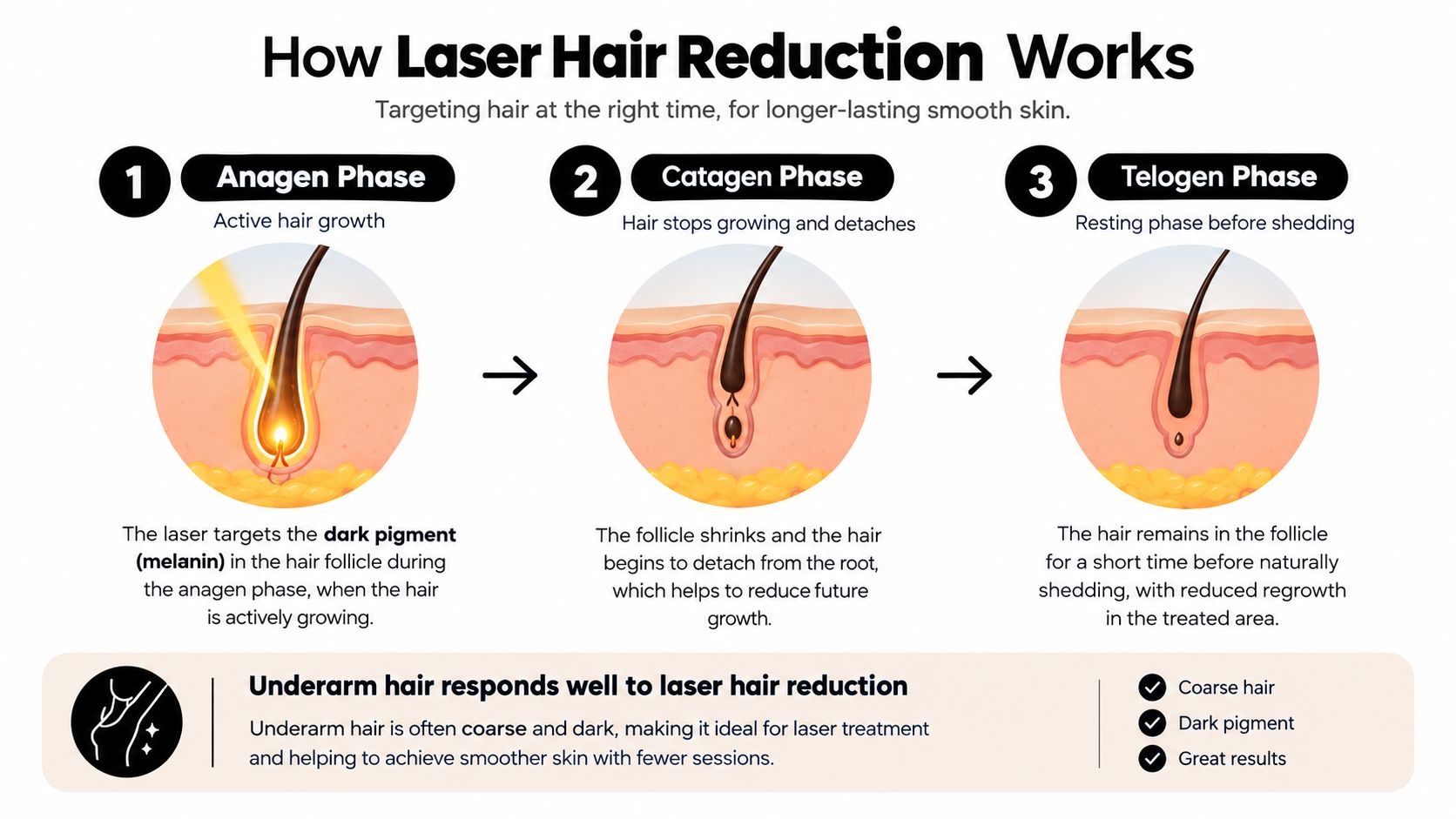
The British Journal of Dermatology's systematic review identified axillary hair as having the greatest reported long-term reduction among the body sites assessed, while noting that the evidence doesn't establish one laser type as universally superior. That's encouraging for underarm treatment, but it doesn't guarantee an individual outcome. Results vary from person to person.
What happens in a session
At our Leamington Spa clinic, we assess your skin and hair before selecting settings. We carry out a patch test as part of the suitability process, and we use a cooling tip to help manage heat during treatment. For a first session, conservative settings allow us to observe how your skin responds rather than pushing treatment intensity without a reason.
Alexandrite and diode lasers use different wavelengths to target pigment in the hair. Nd:YAG is a longer wavelength that can be a safer choice for darker skin when selected and operated appropriately. The right choice depends on your skin tone, recent tanning and hair characteristics, so a wavelength name alone isn't a safety guarantee.
UK NHS evidence summaries report laser hair reduction of about 30%–70% for up to six months after the final treatment, while longer-term studies report around 50% reduction at 6–20 months. Outcomes differ between studies and individuals, so we discuss these figures as context rather than a promise. For a closer look at what a session involves, read our laser hair removal process.
Who Should Pause, Patch Test or Avoid Laser
Laser hair reduction isn't suitable to begin immediately for everyone. We may delay treatment, request further assessment, or decide not to proceed if your skin or circumstances make treatment inappropriate.
Skin tone, tanning and irritation matter
Darker skin needs careful assessment because the laser's target, melanin, is present in both hair and skin. NHS guidance says darker skin and treatment on a suntan increase the chance of pigment changes; it also notes that long-pulsed Nd:YAG lasers are considered safer for darker skin. (NHS guidance on laser hair removal) We won't treat darker skin without considering the appropriate wavelength, settings and patch-test response.
Recent sun exposure or fake tan can also affect our decision. We may ask you to wait until your skin has returned to its natural tone before assessing or treating the area. Active eczema, dermatitis, broken skin or shaving bumps should settle first, since treating irritated skin can make the experience less predictable.
Some medicines can increase sensitivity to light. Tell us what you take, including prescribed and non-prescribed products, so we can decide whether treatment should pause pending appropriate medical advice. Don't stop prescribed medication on your own to try to qualify for laser.
Ask us directly: What wavelength and settings are appropriate for my skin tone, and do you recommend a patch test before treating both underarms?
NHS guidance also flags paradoxical hypertrichosis, meaning laser-stimulated hair growth, and reports it in roughly 10% of patients overall. That figure isn't an individual prediction, but it's a reason to discuss your hair pattern and treatment area openly. The difference between laser hair removal and IPL may help you prepare questions about the equipment and approach.
Underarm Aftercare That Actually Fits Daily Life
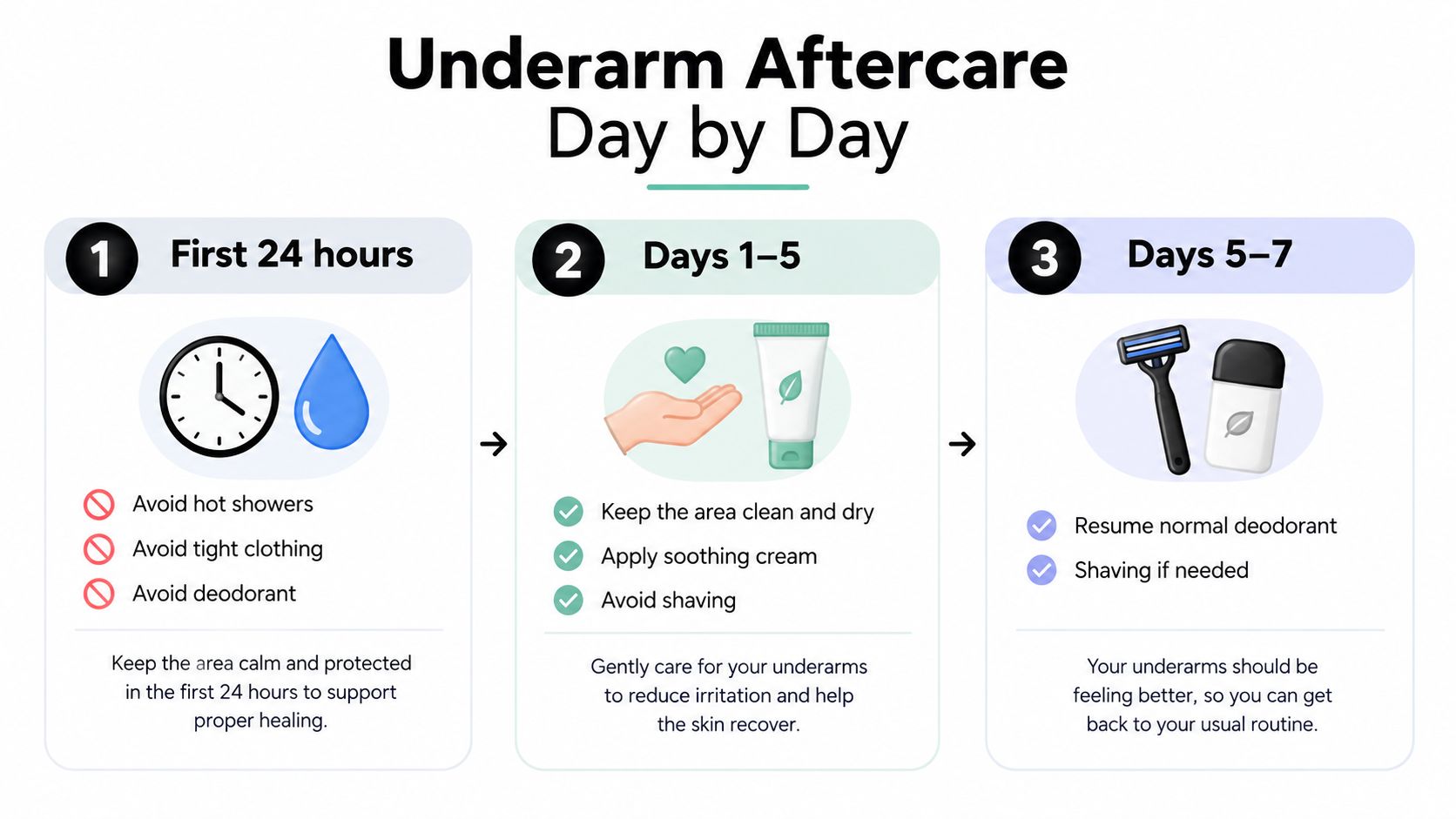
After underarm laser treatment, follow your practitioner's specific instructions and give the skin time to settle before adding heat, friction, fragranced products or shaving. The NHS dermatology laser service at Leeds advises avoiding strenuous exercise, swimming, saunas, steam rooms, hot baths or showers, and fragranced products for seven days, and avoiding shaving for five days. (Leeds NHS guidance on laser treatment)
A practical timetable
- First 24 hours: Keep the area clean and avoid hot showers, tight clothing and deodorant if the skin feels warm or sensitive. A cool compress can help with temporary discomfort.
- Days 1–5: Avoid shaving. Wear loose clothing where possible and keep the area clean and dry. Avoid products that sting or feel fragranced.
- Days 5–7: Shaving may be reasonable after the five-day pause if the skin has settled, but keep avoiding strenuous exercise, swimming, heat and fragranced products for the full seven days.
- After day 7: Resume your usual routine gradually if the skin looks and feels settled. If deodorant causes stinging, stop using it and ask us for advice.
Redness, warmth or nettle-rash-like swelling can occur after treatment; NHS service guidance says these reactions commonly last for several hours. Blistering, burns, crusting, infection or pigment changes are less common but possible. Contact us if the reaction concerns you or isn't settling, and seek advice from your GP if symptoms suggest infection or worsen. For recurring bumps between appointments, our page on ingrown hair prevention covers practical ways to reduce irritation.
What It Costs at Our Clinic and How to Start
At 3D Aesthetics Leamington Spa, our listed underarm price is £40 for a first session, £320 for six sessions and £395 for eight sessions. Check the current treatment prices before booking, as clinic pricing can change. Results vary from person to person, and we'll discuss whether a course makes sense after assessing your skin and hair.

We usually discuss multiple appointments spaced several weeks apart, with the schedule adapted to your hair growth and skin response. A clinical axillary study treated 12 women with six alexandrite-laser sessions at four-week intervals and reported no adverse events; that study supports the practical idea of a course, but it doesn't predict what any one client will experience. (Clinical study of alexandrite laser treatment for axillary hair)
At your free consultation, we'll ask about your goals, hair-removal habits, recent sun exposure, skin sensitivity and relevant medicines. We'll explain the patch-test process and whether we recommend proceeding, waiting or choosing another approach. Our free AI Skin Scanner can support skin assessment, but it doesn't replace a practitioner's judgement. You can learn about laser hair reduction versus waxing before discussing which routine suits you.
The clinic is at 11 Guys Place East, Leamington Spa, Warwickshire CV32 4RG. We also welcome clients from Warwick and Kenilworth. To arrange a free consultation, use our consultation booking page, or call 01926 315764.
Here's an overview of the treatment:
Underarm FAQs Most Clients Actually Ask
When can I use deodorant after underarm laser?
Avoid fragranced products for seven days, following the Leeds NHS service guidance linked above. If your skin has settled but your usual deodorant stings, stop using it and contact us for personalised advice rather than applying more to push through the irritation.
Can underarm regrowth feel thicker if I stop a course early?
It can feel blunt or stubbly as hair grows back after shaving, but that sensation doesn't show that the follicles have become thicker. Laser reduction requires a course, and stopping early may leave more untreated follicles. NHS guidance also reports paradoxical hair growth as a possible complication, so raise a change in your hair pattern with your practitioner rather than assuming it's ordinary regrowth.
Do hormones affect underarm laser results?
Hormonal changes can affect hair growth, so puberty, pregnancy, PCOS or perimenopause may alter the pattern over time. Tell us about relevant changes at consultation. We'll discuss what you're noticing and whether it's sensible to proceed, adjust expectations or seek medical advice about a new or changing pattern.
Does contraception change the result?
Don't stop or change contraception because you're considering laser. Tell us what you use and whether your hair growth has changed, so we can consider your individual circumstances. We'll assess suitability and explain that results vary from person to person rather than promising that a particular method of contraception will or won't affect your outcome.
We offer underarm laser hair reduction at 3D Aesthetics Leamington Spa, with a free consultation to assess your skin tone, recent sun exposure and hair-removal routine before you decide. To talk through whether treatment is appropriate for you, visit 3D Aesthetics Leamington Spa.
← Back to Home